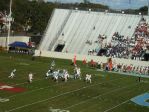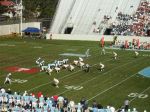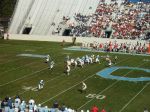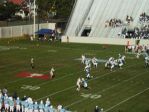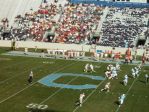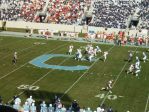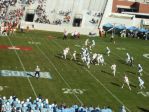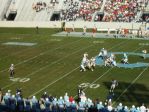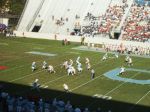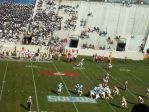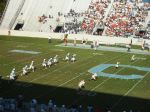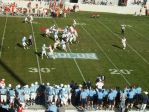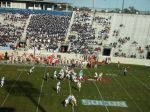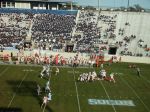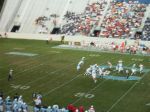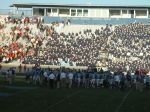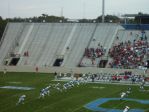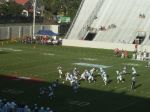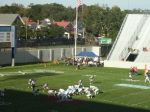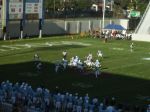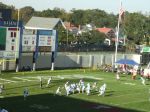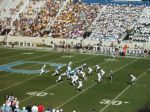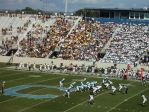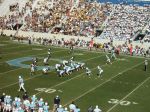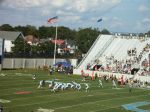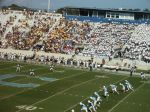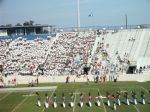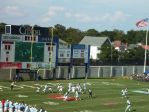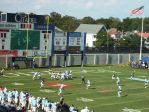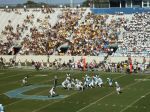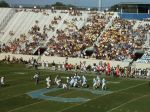
2013 Football, Game 12: The Citadel vs. Clemson

The Citadel at Clemson, to be played in Clemson, South Carolina, at Memorial Stadium/Frank Howard Field, with kickoff at noon ET on Saturday, November 23. The game will be streamed on ESPN3.com, with play-by-play from Jim Barbar, analysis by John Bunting, and reporting from the sidelines by Angela Mallen.

The game can be heard on radio via the thirteen affiliates of The Citadel Sports Network. Danny Reed (the “Voice of the Bulldogs”) will call the action alongside analyst Josh Baker, with Lee Glaze roaming the sidelines.

WQNT-1450 AM [audio link], originating in Charleston, will be the flagship station for the network; the station will have a two-hour pregame show. It is also possible to listen to the game via a smartphone, using a TuneIn Radio application.

Links of interest:

The Citadel game notes

Clemson game notes

SoCon weekly release

ACC weekly release

The Kevin Higgins Show

Kevin Higgins on the SoCon media teleconference

ACC teleconference (Dabo Swinney is the first coach on the line); here is the transcript

Dabo Swinney press conference — Part 1, Part 2, Part 3

Brent Venables talks defense  — Part 1, Part 2

Clemson’s players are not believed to be aliens

Apparently really fast 6’5″, 200 lb. receivers are uncommon

It’s a big game for the Tigers, so despite injury Tajh Boyd will play

Gerald Dixon talks about Dabo Swinney

An in-depth review of Clemson’s game against Georgia Tech, play-by-play

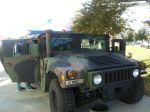
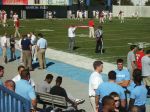
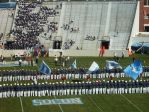
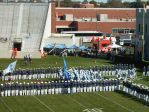
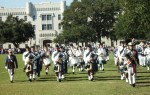
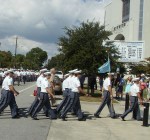
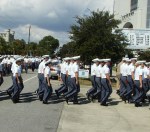
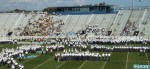
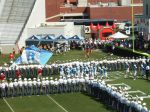
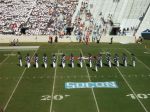
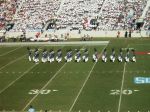
Saturday will be Military Appreciation Day at Clemson, and the school (as usual) is going to put on quite a show. The festivities will feature a halftime performance by the Summerall Guards.

It will also be a “Purple Out”, with fans encouraged to wear purple for the game. From above, the stadium is going to look like a giant bruise.

One note on the “Purple Out”: students will be wearing purple t-shirts (and trying to stay warm). However, the original t-shirt design won’t be used:

All full-time Clemson students attending the game will receive a free Purple Out T-shirt, but it won’t include a Purple Heart symbol as originally planned. That design, chosen from more than 30 student submissions in a campuswide contest, didn’t meet licensing guidelines of the U.S. Army. Proceeds from sales of the redesigned shirt will still benefit campus ROTC units and the Student Veterans Association.

I’m not sure which team Clemson is playing next week, but Dabo Swinney was asked during his on-campus press conference if the Tigers had time to “peek ahead” to that game. Swinney was fairly emphatic:

We don’t have time to peek ahead…regardless of who we play…the objective is the win the football game…I can remember in 1992 I was a senior at Alabama and The Citadel beat Arkansas.

The reason I remember that is because [Alabama] played Arkansas the next week…it was chaos in Arkansas, and we went to Little Rock to play them…I will never forget that.

I didn’t even know who The Citadel was in 1992. Probably, literally the first time I had heard of The Citadel was because they beat Arkansas…

You better be ready each and every week…’cause if you’re not…you get beat. I don’t care who you play, what sport it is, what level it is, how much of a discrepancy it is, you get beat.

Incidentally, Swinney’s memory wasn’t perfect. Alabama actually played Arkansas two weeks after the Razorbacks lost to The Citadel. It was the first time Arkansas had returned to play a game in The Natural State after the dismissal of Jack Crowe, however.

Arkansas actually played at South Carolina the week after losing to the Bulldogs. Joe Kines led the Hogs to a 45-7 shellacking of the Gamecocks. (Dabo and his Crimson Tide beat Arkansas 38-11 the following Saturday.)

The Citadel has defeated Clemson on the gridiron in no fewer than five South Carolina towns. It’s possible no other opponent has lost to the Bulldogs at so many different locations.

The military college has wins over Clemson in Clemson (when the town was called “Calhoun”), Charleston (at the original Johnson Hagood Stadium), Anderson, Orangeburg, and Florence.

This Saturday, look for the Bulldogs to use a similar strategy to that employed in The Citadel’s 1931 victory over the Tigers in Florence:

The Citadel Bulldogs arose here today, whipped out a finely-timed, incisive and unanticipated running attack, to win their annual game with Clemson at the Pee Dee Fair, 6-0. In no previous game this season had the Cadets shown such power, speed, and brilliant elusiveness in advancing the ball…

A good, big bunch of men these Tigers were, too, but they were so much putty in the hands of a Citadel team that had a great day…

Local hero Edwin McIntosh scored the game-winning TD for the Bulldogs that afternoon. Another offensive star was “‘Leaping Larkin’ Jennings, the Columbia Comet”.

The defensive player most responsible for keeping the Tigers out of the end zone was “man-mountain, gargantuan” Delmar Rivers, also known as “Big Boy”.

Other tidbits about that game:

– The Citadel kicked off to start both halves.

– Despite that, Clemson only ran 46 offensive plays during the game, a statistic which would undoubtedly horrify Chad Morris. The lack of offensive snaps was partly due to the Tigers’ tendency to “quick kick” whenever possible. Clemson punted on third down six times, punted on second down three times, and punted on first down (?!) once.

– Clemson only picked up three first downs during the game (well, sure, with all that punting), not getting its initial first down until the fourth quarter.

– At one point during the contest, the Tigers threw incomplete passes on consecutive plays. By rule, that resulted in a five-yard penalty.

The News and Courier reported that both team captains were redheads.

– Attendance: 4000.

***Brief subject change before going back to football***

Clemson last played a football game at The Citadel in 1953, which shouldn’t be a shock to anybody. What may come as a surprise, though, is that the Tiger baseball team has not played The Citadel in Charleston during this century either.

In fact, Clemson and The Citadel have not met on a Low Country diamond since 1990, when the teams were coached by Bill Wilhelm and Chal Port. That game was played at College Park.

Now, you wouldn’t necessarily expect the two schools to play each other every year, as they are basically at opposite ends of the state.  That’s not true for the University of South Carolina, of course, and thus the Gamecocks and Bulldogs naturally meet more often.

However, South Carolina doesn’t just play The Citadel once in a while; the two schools play each other home-and-home every year. Meanwhile, Clemson…doesn’t. The last regular-season meeting of any kind between the Tigers and Bulldogs came back in 2004, at Clemson.

I think this is something that needs to be addressed, particularly because Clemson isn’t averse to playing in Charleston. The Tigers played at College of Charleston in 2008, for example.

It is facing the Bulldogs on The Citadel’s home turf that seems to have become an issue for the Tigers in recent years.

Speaking of that home turf, Clemson has actually played at Riley Park. In 2012, South Carolina and Clemson met in a game that was relentlessly hyped by sports columnist Gene Sapakoff of The Post and Courier, who apparently believed the matchup was the most important development in the history of western civilization and would be attended by hundreds of thousands of dignitaries from around the globe.

Sapakoff was highly upset at the game’s actual attendance (5,851), and was unable to accept the fact that despite the nonstop promotion (much of it by himself), the game drew about the same number of people who would attend a typical game between The Citadel and South Carolina at Riley Park. Indeed, last year’s game in Charleston between the Gamecocks and Bulldogs, played on a Tuesday night with no hype whatsoever, had an attendance of 5,838.

That said, having a crowd of 5,000+ for a regular-season college baseball game is very impressive, and not surprisingly the folks who run the Charleston Riverdogs wouldn’t mind seeing the Gamecocks and Tigers get together again at Riley Park in the near future. In a newspaper article from two years ago, the year 2015 was suggested.

However, I don’t think that game should be played. Not in 2015, anyway.

That’s because I believe the next game Clemson plays at Riley Park needs to be against the local college team that calls the stadium home. The Tigers should play The Citadel there first.

I am aware of a few reasons why Clemson and The Citadel have not met in recent years. I don’t care. People can put aside their differences, if only for one night.

Imagine how many people might attend a game at Riley Park between Clemson and The Citadel if the local media promoted it as heavily as Clemson-South Carolina 2012. That’s part of what this is about, at least to me.

I want The Citadel to receive that kind of positive attention, instead of being ignored while various entities start panting heavily at the mere sight of schools from other parts of the state.

Bringing this back to football, but in a similar vein, I find it a bit tiresome that a writer for a local newspaper (Aaron Brenner, the Clemson beat writer for The Post and Courier) has written multiple times that a local team is a “tune-up” for an opponent. It is particularly annoying that he first characterized the game as such before the season even started.

Look, I’m a realist here, but it wouldn’t hurt to show a touch more respect for a school located in your paper’s immediate area. When I first broached the subject with Brenner, back in August, I was immediately informed that Clemson had beaten The Citadel 15 straight times, and mostly by significant margins. (Tell me something I don’t know.)

Of course, I’m guessing Clemson fans wouldn’t think the 1931 loss to The Citadel is going to have any impact on Saturday’s game, and they would be correct. However, I would suggest that those 15 losses he mentioned won’t have any impact either. Do you think the 1976 game matters to the players of 2013? What about 1954? Or 1986? No, no, and no.

The real issue, I think, is that he isn’t covering Clemson from the Charleston perspective. Rather, he’s writing about the Tigers for the Charleston newspaper. There is a difference.

That’s not really the fault of Brenner, to be fair. He is doing what his employer wants him to do. You may not think there is any fault to be found at all, and I can understand that point of view.

Generally during one of my previews I start discussing a team’s statistics in relation to a comparison with those of The Citadel, but it’s pointless to do that this week since Clemson is an FBS squad. Instead, I’m just going to mention some of Clemson’s numbers. A few of them are scary.

– Clemson is averaging 41.3 points per game, 11th best nationally. The Tigers actually have a higher scoring average on the road, “only” scoring 39.8 points per game at Memorial Stadium.

– CU is ninth nationally in total offense, passing offense, and turnover margin.

– Clemson isn’t quite as dominant in a few offensive categories, ranking 50th in the nation in offensive 3rd-down conversion rate and 43rd nationally in offensive red zone TD%.

– The Tigers have had seven plays from scrimmage this season of 60+ yards, tied for third-most in FBS.

– Of course, Clemson’s raw offensive numbers are skewed by the hurry-up-no-I-mean-really-hurry-up style of offensive coordinator Chad Morris. The Tigers are averaging 82.9 plays per game on offense, fifth-most nationally. In terms of yards per play, Clemson is 32nd in FBS with a 6.18 average (Baylor leads the nation, averaging a staggering 8.5 yards per play).

– Clemson’s defensive third down conversion rate of 30.25% is 6th-best nationally. This may be the statistic that best demonstrates the influence of second-year defensive coordinator Brent Venables. In his first year at Clemson, the Tigers were 24th in FBS in this category, a substantial improvement over the 2011 season (when they were 72nd).

– Clemson’s defensive numbers are affected by its offensive style, and look better in context than in raw totals. Tiger opponents are averaging 5.25 yards per play, 42nd nationally. Getting off the field by stopping teams on third down has helped Clemson in that department (The Tigers were slightly above 5.6 y/p in both 2012 and 2011).

– On defense, the Tigers are allowing a red zone TD rate of 62.5%, which is only 69th in FBS. Venables is probably disappointed with that particular statistic.

– Clemson’s punting and kick coverage/return statistics are, in general, indifferent.

As for Clemson’s players, it’s simple: the Tigers have playmakers all over the field, particularly on offense.

Tajh Boyd has been a wonderful quarterback for Clemson. He has occasionally been labeled as a “doesn’t play well in big games” type, but anyone who believes that did not see his magnificent bowl-game performance against LSU last year.

Sammy Watkins is ridiculously good. Dabo Swinney said during his press conference this week that he thinks Watkins is the best wide receiver in the country, and you could certainly make that argument. I have no idea how the Bulldogs are going to cover him, but then almost every other team in the country would have the same problem.

It says something about Clemson’s talent level that Watkins may not even be the most difficult matchup for The Citadel on Saturday. Another wideout, Martavis Bryant, could pose even more problems.

The Tigers’ running game is keyed by the excellent Rod McDowell (who overcame a clubfoot as a child). McDowell runs behind a starting offensive line that averages 6’4″, 298 lbs.

Clemson defensive end Vic Beasley has 17 tackles for loss, fourth nationally. Ten of those TFLs are sacks. The other three starters on the Tigers’ d-line weigh more on average than The Citadel’s offensive linemen.

The Tigers have intercepted at least one pass in 13 straight games, the longest such streak in the country. Eight different players have at least one pick.

Linebackers Stephone Anthony and Spencer Shuey are 1-2 on the team in tackles.

Saturday’s game is officially a sellout, and that crowd will include a fair number of fans wearing blue and white. There will be multiple tailgating events on site for Bulldog fans, who usually know how to have a good time.

I trust the same can be said for the players. The game against Clemson should be fun.

It will be very challenging, to be sure. However, there is no pressure on the Bulldogs, and I think that will be reflected in their play.

One game is left this season. I hope it’s a memorable one for The Citadel, and in a good way.

Game review, 2013: VMI

Links of interest:

Game story, The Post and Courier

School release

Box score

WCSC-TV report (video)

Postgame comments from Kevin Higgins, Ben Dupree, and Sadath Jean-Pierre (YouTube video)

Kevin Higgins’ locker room speech (YouTube video)

Radio highlights

Also worth a link: Danny Reed’s pregame interview of Brian Ruff. I thought Ruff’s comments about Bobby Ross were particularly noteworthy, but the entire interview is quite interesting. I highly recommend it.

Well, the first half wasn’t exactly the finest Bulldog performance in the history of Johnson Hagood Stadium. I couldn’t believe that VMI’s iron-deficient offense was consistently moving the ball on The Citadel’s D. Indeed, the Keydets did not punt in the entire half.

The offense wasn’t as bad, with the notable exception of the final series of the half. The playcalling on that drive was suspect at best.

However, adjustments were clearly made. Whether or not some of those adjustments were suggested with raised voices, the bottom line is that the Bulldogs played very well in the second half and took care of business, retaining the coveted Silver Shako in style.

The Citadel’s defense finished with seven sacks, some of which were quite impressive.

Derek Douglas pulling down VMI starting quarterback A.J. Augustine on a fourth-down play was memorable, though it wouldn’t have happened in the days of the tearaway jerseys. I can distinctly recall Stump Mitchell running for a long TD in a game against VMI, leaving multiple Keydet defenders in his wake, with several left holding a piece of Mitchell’s jersey…

Later in Saturday’s game, Douglas had another sack (this time of backup VMI quarterback Hayden Alford) in which he did not appear to actually put his hands on the QB; rather, he basically ran over him. From my vantage point in the stands, it was an explosive play, and also a very funny one.

VMI offensive lineman Emmanuel Cooper injured his knee late in the game, and then apparently started having heat-related issues. Best wishes to Cooper, and to his teammates, some of whom may have also struggled in the more-tropical-than-expected conditions.

From a fan’s perspective, the weather for the game was outstanding. The Citadel played six home games in 2013, and a jacket was not really necessary for any of them.

In a way, however, that makes the disappointing season attendance seem even worse. Saturday’s matchup with VMI was the least-attended contest at Johnson Hagood Stadium this year, though there wasn’t much difference in the attendance for any of the home games.

You can’t blame rain or cold for that, not this season.

I’m going to write about some of my thoughts on the attendance issues after the season, possibly in December. I want to think about it a little bit longer. There are a lot of “talking points”, if you will.

At that time, I’m also going to discuss in more detail the recent news that The Citadel is actually going to play a football game in Ladson next season, at Charleston Southern. I’ll be honest: I think it’s a terrible decision, one that provides no benefit to The Citadel at all.

After the football game, I wandered over to McAlister Field House to watch the hoopsters in person for the first time this season. The team played well against an overmatched opponent (North Greenville, a Division II school), winning 83-53.

The best thing about the Bulldogs’ play was the lack of turnovers. The Citadel’s turnover rate in the past two seasons has been horrendous, and a major reason why the program has struggled so much.

I am worried about the serious lack of depth in the squad (currently, only nine players are available).

At the end of my photo review of the football activities, I threw in a few photos of the basketball game. They won’t win any awards.

Coming up later in the week, I’ll preview the football team’s game against Clemson. Do the Tigers have a chance of winning their home finale? Maybe.

2013 Football, Game 11: The Citadel vs. VMI

The Citadel vs. VMI, the Military Classic of the South, to be played at historic Johnson Hagood Stadium, with kickoff at 1:00 pm ET on Saturday, November 16. The game will not be televised, although it will be streamed on Bulldog Insider (subscription service) and can be heard on radio via the thirteen affiliates of The Citadel Sports Network. Danny Reed (the “Voice of the Bulldogs”) will call the action alongside analyst Josh Baker, with Lee Glaze roaming the sidelines and Walt Nadzak providing pre-game, halftime, and post-game commentary.

WQNT-1450 AM [audio link], originating in Charleston, will be the flagship station for the network; the station will have a two-hour pregame show prior to each home football game. It is also possible to listen to the game via a smartphone, using a TuneIn Radio application.

Note that 1:00 pm ET start time, an hour earlier than for the past two home games. Don’t be late!

Also: The Citadel’s basketball team will be playing North Greenville at McAlister Field House on Saturday, with tipoff scheduled for 7:05 pm ET. If you have your ticket from the football game, you can watch the basketball game for free.

The hoopsters won their first game of the season on Tuesday, beating Presbyterian 82-68 in the home opener. The team shot well against PC, and held off the Blue Hose down the stretch despite a fair amount of foul trouble.

I hope a lot of Bulldog fans make Saturday a personal football/basketball doubleheader.

Links of interest:

The Citadel game notes

VMI game notes

SoCon weekly release

Big South weekly release

Kevin Higgins on the SoCon media teleconference

Sparky Woods on the Big South media teleconference (beginning at the 18:20 mark)

The Kevin Higgins Show

Advertisement for VMI-The Citadel (video)

Ben Dupree is the reigning SoCon offensive player of the week

Dupree once found out that wearing flip-flops can be problematic

Game story from The Post and Courier on The Citadel’s win over Elon

Game story from the Burlington Times-News on The Citadel’s win over Elon

This preview is going to be a little lighter on the usual historical/statistical minutiae (possibly a blessing in disguise), as I’m on the road much of this week.

Just a lot of “odds and ends” observations…

The game story from the Burlington (NC) newspaper included two quotes that I want to highlight:

Obviously, it’s a low point right now for Elon football

The above comment is from Elon head coach Jason Swepson. He is in his third season, but it may be his last if he keeps having to make pronouncements like that one. It’s not the way the school wanted to exit the SoCon before starting gridiron action in the CAA next season.

Yeah, since I’ve been on the team, it’s probably the lowest we’ve come as a Phoenix, or the Phoenixes, or whatever you want to call us

That was said by Elon’s starting quarterback, Mike Quinn. “Phoenix, or the Phoenixes, or whatever you want to call us” is so…expressive.

I missed this article that ran last week in the Chattanooga Times Free Press, but better late than never. Both Appalachian State and Georgia Southern currently have losing records against league teams, and I get the impression that doesn’t hurt the feelings of SoCon commissioner John Iamarino one bit.

VMI played its final Big South conference game last week against Gardner-Webb, and a funny thing happened. VMI won.

It wasn’t even close, as the Keydets prevailed 27-9. Gardner-Webb owns victories this season over Wofford and Furman, so yes, this was an upset.

How did it happen? Well, mostly it happened because A) VMI’s defense has been improving over the course of the season, and B) Gardner-Webb couldn’t get out of its own way.

Gardner-Webb opened the game by fumbling a snap into its own end zone, where VMI senior linebacker Weston Reber fell on the ball for a touchdown. G-W fumbled again on its next drive, setting up a Keydet field goal.

Those were two of Gardner-Webb’s five turnovers. The Runnin’ Bulldogs also committed thirteen penalties, and shanked a punt that went for just six yards. It just wasn’t G-W’s day.

Choice comments from Weston Reber:

“I just saw the ball on the ground,” said Reber, referring to G-W quarterback Lucas Beatty, who had lost the ball after having trouble fielding a low snap.

“I was on a lineman and I said, ‘I’m getting this damn ball, this thing is mine!’ It was a foot away and it kept rolling and kept rolling, and when it rolled over the [goal line] I just took off and dove on it.”

Reber laughed and jokingly added: “Hopefully, they will take away some demerits from me for the touchdown!”

I wouldn’t count on it…

Sparky Woods, discussing matters during his media teleconference:

We would like to defeat Citadel [sic] so we could continue this reign the Big South has over the Southern Conference.

He did mention that a year from now, he might feel differently about the conference dynamics, given VMI will be in the SoCon next season. Of course, it’s not a given that Woods will be in charge of the Keydets when the school returns to the league.

VMI’s victory over Gardner-Webb was only its second win of the season, and first over a Division I opponent. Woods is in his sixth season in Lexington, and has won only 15 games during that time.

A new AD, Dave Diles, has taken over at VMI, and Diles will have a decision to make about Woods’ future after the season.

VMI is last in the Big South in the following categories: scoring offense, total offense, rushing offense, offensive third down conversion rate, scoring defense, pass defense, defensive third down conversion rate, kickoff return average, kickoff coverage average, and net punting.

Keydet opponents average 6.2 yards per play. VMI is allowing an average of 35.0 points per contest.

The Keydets can point to some positives. VMI leads the Big South in passing offense (though it is next-to-last in pass efficiency), and its red zone defense is actually quite respectable (allowing 4.6 points per opponent possession inside the 20).

The negative to that red zone defense statistic is that opponents have had 47 such possessions.

VMI also has a knack for inducing penalties. I’m not sure how that happens, but VMI leads the Big South in the category, and it’s the second year in a row VMI opponents have been prone to committing infractions when facing the Keydets.

Last year, by far The Citadel’s worst game of the season in terms of penalties came at VMI. Those mistakes almost cost the Bulldogs the victory. That is something to watch on Saturday.

Redshirt senior A.J. Augustine will start at quarterback for VMI against The Citadel, the third straight start for the native of St. Petersburg. It’s too bad he’s not a native of St. Augustine.

Augustine replaced Eric Kordenbrock, who had started most of VMI’s games at the position since midway through his freshman year. He is the alltime leader in passing yardage for the Keydets.

Kordenbrock suffered a serious concussion against Presbyterian, during a play that resulted in an ejection for a Blue Hose player. As a result, Kordenbrock’s college career is over.

Running back Derrick Ziglar rushed for 94 yards and a TD against Gardner-Webb. He had rushed for 100+ yards in the previous two games, becoming the first Keydet with back-to-back 100-yard rushing games in four years.

VMI’s top receiver is Sam Patterson, who is averaging 17 yards per catch. Patterson has seven touchdown receptions and has caught at least one TD pass in four of his last five games.

Earlier in the year, Patterson had back-to-back 100-yard receiving games, the first VMI player to do that since 2005.

VMI’s starting offensive line averages 6’4″, 289 lbs. The biggest of the group is 6’8″, 325 lb. Andy Marcotte.

The starting center for the Keydets, Will Lucas, is a native of Hartsville. He was the only VMI player named to the Big South’s preseason all-conference team.

Another Keydet who turned up on a couple of preseason “watch lists” was tight end Mario Thompson. Unfortunately, three weeks ago Thompson suffered a season-ending knee injury.

Weston Reber, the player with the potentially demerit-erasing fumble recovery against Gardner-Webb, is VMI’s leading tackler. He has one more stop than free safety Alex James.

Outside linebackers Logan Staib and Chris Harper lead the team in tackles for loss and sacks, respectively. Cornerback James Fruehan has two interceptions; seven of his teammates have one each.

VMI’s defense will line up against The Citadel in a 3-4, or a “three down look”, or a five-man front…pick your terminology.

As mentioned earlier, the Keydets have shown some improvement on D in recent weeks and won’t lack confidence from last year’s game against the Bulldogs. In that contest, The Citadel did not score an offensive touchdown in the second half.

VMI placekicker Dillon Christopher was named the Big South special teams player of the week for his performance against Gardner-Webb, which included a 52-yard field goal. Earlier this season, Christopher made a 45-yarder, so he’s got a strong leg. He has been a bit inconsistent, though, and is 7-12 on field goal attempts for the season.

He is also the kickoff specialist for the Keydets. Christopher has six touchbacks in 38 kickoffs this year.

David Eberhardt is averaging 39.0 yards per punt for VMI. So far this season, only one of the Keydets’ 65 punts has been blocked, which is better than VMI’s recent history in that department.

Ripped from the pages of The Citadel’s game notes…

The Citadel is 0-5 against VMI on November 16. Saturday’s date? November 16. Uh-oh.

The Bulldogs did beat Clemson on November 16, 1918. Perhaps the department of athletics should have tried to flip the dates for the VMI and Clemson games this season.

Saturday is the “Hall of Fame Game” at Johnson Hagood Stadium. This year’s honorees: Chip Cannon, Lance Hansen, Jim McMillan, Dan McDonnell, Richard Moore, and Joe Turbeville. Congratulations to all.

Richard Moore may be the least-known of the six. He probably needs to get a little more attention. Moore (class of 1953) was the rifle coach at The Citadel from 1959-62. To quote the press release:

The Bulldogs were undefeated in shoulder-to-shoulder competition during those four seasons and regularly defeated teams from Army, Navy and Air Force.  The Bulldogs finished first in the Hearst National Rifle Match, which equated to national championships, in 1959, ’60 and ’61.

Arguably the most successful coach in Citadel history, Moore’s four teams captured Southern Conference and state championships each year and along the way, three shooters – Robert Metsker ’60, David Edgerly ’62 and Keels Dickson ’62 – all earned All-America citations, becoming the first Citadel program to showcase three All-Americans.

State, conference, and national championships. That works for me.

Moore’s tenure as the rifle coach ended when he was transferred for a tour of duty in Vietnam, which serves as a reminder that the game against VMI is also Military Appreciation Day.

A few weeks ago, I wrote that my preview of the VMI game might be just one sentence: “The Dogs better not lose to VMI.”

I decided a few more sentences wouldn’t hurt, but the bottom line is that this is a must-not-lose game for The Citadel.

That was true last year, too, and the Bulldogs hung on for a victory in a game that was a little too close for comfort. The Citadel can’t afford to let VMI hang around on Saturday, as the Keydets may have a little more confidence this time around that they can pull off the upset.

In a season that has been more of a struggle for The Citadel than was anticipated, it is now even more critical that the coveted Silver Shako is retained.

Of course, it’s always important to keep the greatest trophy in all of sports in Charleston, where it belongs.

2013 Football, Game 10: The Citadel vs. Elon

The Citadel at Elon, to be played in Elon, North Carolina, at Rhodes Stadium, with kickoff at 1:30 pm ET on Saturday, November 9. The game can be heard on radio via the thirteen affiliates of The Citadel Sports Network. Danny Reed (the “Voice of the Bulldogs”) will call the action alongside analyst Josh Baker, with Lee Glaze roaming the sidelines.

WQNT-1450 AM [audio link], originating in Charleston, will be the flagship station for the network; the station will have a two-hour pregame show prior to each football game. It is also possible to listen to the game via a smartphone, using a TuneIn Radio application.

Links of interest:

The Citadel game notes

Elon game notes

SoCon weekly release

Kevin Higgins on the SoCon media teleconference

Jason Swepson on the SoCon media teleconference

The Kevin Higgins Show

“Sunday Lifts” — The Citadel Strength and Conditioning

Vinny Miller had a good game against Samford

Elon video highlights against Chattanooga

Elon video highlights against Appalachian State

No major changes for Elon during its bye week

Elon football wasn’t supposed to struggle like this. Under Pete Lembo, the Phoenix enjoyed a solid five-year run, contending for the Southern Conference title several times. While Elon never could quite finish first, the school did make an appearance in the FCS playoffs in 2009.

It wasn’t all seashells and balloons for Lembo, possibly the only SoCon coach to have had one of his own players attempt to fight him on the sidelines during a game. However, Lembo parlayed his fine work at Elon into a gig at Ball State, where he has continued to win games (fashioning a 24-11 record in Muncie through Wednesday’s action).

His successor, Jason Swepson, hasn’t been so lucky. Swepson is now 10-21 in his career as the Elon head man.

Maybe, though, it’s less about Swepson and more about the program. In the five seasons prior to Lembo’s arrival, Elon’s cumulative record on the gridiron was 14-42.

It could be that with the way the football program is currently constituted, Elon cannot win consistently at the D-1 level. That isn’t what its upwardly mobile administration wants to hear, of course.

“This is going to be a sixty-minute football game….probably go into overtime.” — Elon head coach Jason Swepson, referring to his squad’s upcoming game against The Citadel.

Playing a sixty-minute game has been a problem for the Phoenix, at least in terms of offense. In six of Elon’s eight games against D-1 opposition, it has failed to score a touchdown in the second half.

Elon was shut out by Georgia Tech, 70-0, a game which featured a running clock. The Phoenix managed a third-quarter TD versus North Carolina A&T but lost, 23-10.

After scoring two touchdowns in the fourth quarter against Appalachian State, no Phoenix player since then has entered the end zone in the second half. That’s a four-game stretch which includes an OT loss to Western Carolina, breaking a 33-game Catamount losing streak versus Division I opponents.

The WCU setback dropped Elon to 2-7 on the season. After being off last week, the Phoenix is finishing the 2013 season with home matchups versus The Citadel and Georgia Southern before travelling to Birmingham to face Samford.

Of the 122 schools listed in the FCS statistical database, Elon is 89th in scoring offense — and also 89th in scoring defense.

The run/pass ratio for the Phoenix from last year to this season is essentially unchanged. In 2012, 53% of Elon’s plays from scrimmage were passes; this year, 52%.

Elon’s yards per rush has increased from 2.58 (in 2012) to 3.90 (this season), a step forward. However, its yards per pass has declined from 7.99 to 6.22. Thus, its yards per play has been reduced from 5.4 to 5.1.

The Phoenix’s offense has not been particularly good in the red zone, averaging 4.65 points per trip. In the SoCon, only Furman and The Citadel have fared worse inside the 20. (The Bulldogs are last in the league in red zone points efficiency, at just 4.55 points per trip.)

Elon is next-to-last in the league in offensive third down conversion rate, at just 33.6%.

The Phoenix ranks next-to-last in the SoCon in total defense, ahead of only Western Carolina. It is dead last in the league in pass defense (though its defensive pass efficiency ranking is more respectable).

Elon is seventh in the league in rushing defense. In general, the Phoenix D has struggled to get off the field. While its defensive third down conversion rate is middle-of-the-pack, Elon has allowed more first downs than every league team save WCU.

Elon has been okay when it comes to turnover margin (+1 for the season).

Also, for whatever reason, opponents are more likely to commit penalties when playing Elon than most other teams. This reminds me a little bit of last year’s VMI team.

That worries me because the game in Lexington was the one time last season The Citadel committed an unusual number of infractions. The lack of discipline almost cost the Bulldogs the contest.

Elon quarterback Mike Quinn is a junior in his first year as the starter. He has completed 64% of his passes, with 14 TDs and only 5 interceptions. Quinn is currently on a streak of 207 consecutive pass attempts without an interception, which is a single-season SoCon record.

He is averaging 6.2 yards per attempt, though, which actually isn’t much higher than what The Citadel’s passers have averaged (5.9).

The Phoenix has three running backs who each have between 300 and 400 yards rushing. Tracy Coppedge has the best yards per carry average of the trio, but he also has lost four fumbles.

Rasaun Rorie has been Elon’s leading receiver. He has 51 catches, with four of those going for touchdowns. Kierre Brown, a preseason second-team All-SoCon pick, has 38 receptions out of the slot. Tight end Doug Warrick has three TD catches.

Elon’s offensive line averages about 6’4″, 282 lbs. None of the five starters weighs 300+ lbs. Center Clay Johnson was a preseason second-team all-conference selection.

The Phoenix will be seeing a triple option team for the third time this season, having already faced Georgia Tech and Wofford. During the SoCon teleconference, Jason Swepson said Elon would use two different defensive fronts against The Citadel.

He also mentioned that Elon is “banged up on defense.” On Saturday, the Phoenix will be without the services of defensive end Jordan Jones and defensive back Akeem Langham.

Jones, suffering from a high ankle sprain, has 34 career starts, including the first eight games of 2013. Langham has started five games this season, four at cornerback and one at strong safety. His football career may be in jeopardy after sustaining two concussions in a four-week span (and at least his third while in college).

Middle linebacker Jonathan Spain is probably Elon’s best defensive player. A preseason first-team All-SoCon selection, Spain is the second-leading tackler for the Phoenix.

Fellow linebacker Alexander Dawson leads the team in stops, with 61. Free safety Chandler Wrightenberry has been credited with 47 tackles.

John Silas hasn’t started a game yet for Elon, but the backup linebacker has 48 tackles. Also of note: Elon has had three different players start at nosetackle this season.

Elon’s placekicker is freshman John Gallagher. He is 7-16 on field goal attempts this season, with a long of 48.

Gallagher also kicks off for the Phoenix; 19 of his 41 kickoffs have gone for touchbacks. The Phoenix leads the SoCon in kickoff coverage.

David Petroni was the SoCon special teams player of the week in Elon’s loss to Appalachian State, and may have had an even better game in the Phoenix’s win over Furman.

In that contest, FU’s average starting field position was its own 19-yard line, and Petroni’s performance was a big part of the reason why the Paladins faced a “long field” much of the afternoon. For the season, he has placed 28 punts inside the 20-yard line (out of 53 kicks).

Kierre Brown is Elon’s primary kick returner, while cornerback David Wood has been the first choice for returning punts.

Odds and ends:

– Prior to last year’s victory over Elon, The Citadel had lost three straight Homecoming games. After beating Samford on Saturday, the program is on a two-game Homecoming winning streak, which is definitely preferable.

– That win over the Phoenix broke a four-game slide in the series, which The Citadel currently leads 7-5. After Saturday’s game, it may be a long time before the schools meet again on the gridiron, with Elon moving to the CAA after this school year.

– Speaking of the CAA, Elon released its 2014 league schedule this week. It appears the school was given a break in terms of travel for next season. However, 2015 is likely to be a different story, with the Phoenix probably making trips to New Hampshire, Maine, Stony Brook, and (in non-conference play) Boston College.

Logan Airport could be Elon football’s home-away-from-home in 2015.

– Elon is averaging 8,430 fans per home game. Against Chattanooga in the most recent contest at Rhodes Stadium, the attendance was 6,547.

Last year, Elon only drew 6,158 for a game versus Furman, leading to Jason Swepson’s immortal comment that “it felt like a coffin out there.” It will be interesting to see if the atmosphere on Saturday is equally as funereal.

– I’ve written about Elon’s move to the CAA before, as part of a discussion about the overall restructuring of the Southern Conference. Maybe this move will work out for the school, but things could get difficult in a hurry for Elon.

That would be especially true if the CAA goes through even more membership changes. I wouldn’t be surprised if at least three schools currently competing in football in the CAA leave the conference in the next two years.

– Darien Robinson caught eight passes last week, most of them of the shovel-pass variety. As per The Citadel’s game notes, that’s the most receptions for a Bulldog since Kevin Higgins switched to the triple option in 2010.

Robinson entered the game with 17 career receptions.

– One of Robinson’s catches on Saturday came from a pass thrown by Jake Stenson. With that completed pass, Stenson now has a passer efficiency rating of 234.40.

– Ryan Bednar, injured in the game against Samford, is listed on the two-deep and is expected to play.

Saturday will be the final conference game of the year for The Citadel, and while the season has not lived up to expectations, the Bulldogs will have a chance to even their SoCon record at 4-4. Finishing .500 in the league wouldn’t be the worst thing in the world.

It is also a chance to win a game at a place where The Citadel has struggled in recent years, having not won at Rhodes Stadium since 2006. In 2011, the Bulldogs lost in overtime, but the 2009 game was a debacle. (Among other things, Elon had 29 first downs to The Citadel’s 5.)

Elon has had two weeks to prepare for the triple option, but has also had two weeks to think about its loss to Western Carolina. That might not be ideal.

I really enjoyed what I saw from the Bulldogs against Samford — not just the win, but the resolve. Now the team needs to continue that push on the road.

That’s not always easy, but I like The Citadel’s chances on Saturday.

Game review, 2013: Samford

Links of interest:

Game story in The Post and Courier

Three points on the game (from The Post and Courier)

School release

Box score

WCIV-TV report (video)

WCSC-TV report (video)

Postgame comments from Kevin Higgins and Ben Dupree (YouTube video)

Kevin Higgins’ locker room speech (YouTube video)

Radio highlights

I’ll write a little bit more about this game later in the week when I preview the game at Elon. Just a few quick thoughts:

– The Citadel did a lot of things right in this game, and it’s a good thing, because Samford was a solid opponent. Before the game began, I thought the Bulldogs would have to play very, very well to win. They did just that.

– The use of sweeps to get outside against Samford’s “bear” front was well conceived, as was the commitment to continue testing the middle throughout the game, which paid off. The fake punt was timely and perfectly executed.

– My only real quibble with the playcalling/game management on Saturday was the sequence that led to The Citadel punting from the Samford 33-yard line late in the game. You never want to put yourself in position to punt from inside the opposing 35.

– Given the opponent, that may have been the best defensive performance of the season.

– SoCon officials need remedial work in ball-spotting. That hurt both teams on Saturday.

– Samford’s football video game coordinator was not happy with no penalty flag being thrown on the two-point conversion attempt, as can be seen in the comments to the ESPN3.com video highlights review. Those grapes are mighty sour.

Also, he’s wrong. Sadath Jean-Pierre’s coverage on the play was legal and excellent. The throw wound up closer to the end rifleman for the Touchdown Cannon Crew than the receiver (who did not run a particularly good pattern, in my opinion).

– While the effectiveness of the team’s play has been questioned at times this season, the effort certainly has not been. There is no quit in this group.

I was very impressed with the Bulldogs’ collective resolve while trailing 17-0. They didn’t give up, they didn’t go through the motions, they kept trying. On Saturday, that paid off with a victory.

To be honest, as I watched the fourth quarter, I knew that win or lose I was already satisfied with the performance. I had seen what I wanted to see.

Winning the game was nice, though.

Let’s talk about off the field — specifically, the tailgating/homecoming scene. Three quick notes, and then a story…

– Tailgating can be educational. For example, I learned that in Chester, South Carolina, Bi-Lo’s is the default option for quality fried chicken. If you’re ever in Chester, keep that in mind.

– I didn’t meet the gentleman, but I understand a member of the Class of 1943 was in attendance on Saturday, for what would have been the 70th reunion year for his class. Kudos to him.

– There were many, many outstanding tailgates in evidence. However, the biggest bash I saw was definitely the one for the Class of 1968.

The spread for the ’68 party was so large, I wouldn’t be surprised to find out next week that Sus scrofa domesticus was being placed on the endangered species list.

– Okay, story time.

About ninety minutes or so before kickoff, I was with a few friends of mine in the tailgating area adjacent to the Altman Center. As the filling for fish tacos was being carefully prepared, we were discussing important matters of state, such as The Citadel’s urgent need for varsity lacrosse.

At that point, Nancy Mace walked into the area. As you may or may not know, Mace is the first woman to graduate from The Citadel as a member of the corps of cadets, and she is also campaigning for the U.S. Senate seat currently occupied by Lindsey Graham. Both Mace and Graham are seeking the Republican nomination.

It wasn’t a surprise to see her at Johnson Hagood Stadium; after all, she’s an alum. She had attended at least one other game earlier in the season. On Saturday, she was with her campaign manager and (I think) one other person.

Mace was introducing herself to folks, chatting tailgaters up, doing the kinds of things associated with retail politics, when a small group of about ten people entered the same space. From among them appeared none other than…Lindsey Graham.

The scene was riveting. The tension in the air was thicker than a tortilla shell. Some people were noticeably uncomfortable.

(Others may have been amused.)

Graham began greeting the same people who had been talking to Mace, shaking hands, talking, hugging at least one person. At least one observer thought Graham purposely avoided acknowledging Mace for as long as possible, which made the whole situation even more fantastically awkward.

Eventually, however, the two did talk. A détente of sorts was reached. Pictures were taken. One of them leads off my photo review of Saturday.

2013 Football, Game 9: The Citadel vs. Samford

The Citadel vs. Samford, to be played at historic Johnson Hagood Stadium, with kickoff at 2:00 pm ET on Saturday, November 2. The game will streamed on ESPN3.com, with play-by-play from Darren Goldwater and analysis by Paul Maguire.

It can also be heard on radio via the thirteen affiliates of The Citadel Sports Network. Danny Reed (the “Voice of the Bulldogs”) will call the action alongside analyst Josh Baker, with Lee Glaze roaming the sidelines and Walt Nadzak providing pre-game, halftime, and post-game commentary.

WQNT-1450 AM [audio link], originating in Charleston, will be the flagship station for the network; the station will have a two-hour pregame show prior to each home football game. It is also possible to listen to the game via a smartphone, using a TuneIn Radio application.

Links of interest:

The Citadel game notes

Samford game notes

SoCon weekly release

The Kevin Higgins Show

Kevin Higgins on the SoCon media teleconference

Pat Sullivan on the SoCon media teleconference

The Dogs are “down, but not out”

Jeff Hartsell’s three points about the Chattanooga game

Game story from the Chattanooga contest

Non-football link: my preview of the upcoming season for The Citadel’s basketball team

Hey, it’s Homecoming! Things you ought to know:

Ye olde Homecoming press release, with schedule of events

The Citadel’s freshman and sophomore wrestlers compete in The Citadel Open, beginning at 9 am on Saturday

The rifle and volleyball squads are both on the road on Saturday

Soccer’s season ended on Wednesday

Oh, and there is also a football game…

First, let me be honest here: I didn’t really follow the Chattanooga game as it was going on last week. This is the time of year when I usually take a break from my regular autumn routine, which is normally A) work and B) obsessing over sports.

Taking a respite from the fall sports season can be helpful, at least for me. As it happens [mondo nerd alert], I saw Mussel-Fishers at Berneval in person instead of watching/listening to The Citadel lose a game it led almost the whole way. I feel good about that decision.

Because I am still catching up with last week’s action in the sports world (including The Citadel’s trip to Finley Stadium), and because of other factors beyond my control, this preview may be a bit more random than usual. I apologize in advance for that.

The rest of the season is going to be tough in terms of game previews, not as much because the Bulldogs are struggling, but because I’m going to be short of time. We live in a busy world.

I have no idea how I’m going to write the VMI game preview; I might just write a one-sentence post: “The Dogs better not lose to VMI.” (It’s not like anything else needs to be said for that game.)

Anyway, below are a few comments on Saturday’s opponent, followed by some friendly advice to alums heading down to Charleston for Homecoming.

Note: “Bulldogs” refers to The Citadel, while “Birmingham Bulldogs”, “SU”, or “Baptist Tigers” will have to do for Samford.

Samford is quite formidable this year. The Birmingham Bulldogs appear to be the best team in the SoCon and would be a major challenge for The Citadel even if the Cadets were having a good season.

Last year, I wrote of Samford:

This is a team with a lot of talented players. The question, I suppose, is whether Samford has enough depth across the board to be a contender for the league title.

Samford finished 7-4 last season, not quite good enough to win the SoCon, but still a very solid campaign. SU could not get past Georgia Southern or Appalachian State last year, and also lost a tough defensive battle at Chattanooga.

In 2013, Samford still has a lot of talented players, but it has made the jump to the top of the conference. SU has already taken care of business against App and GSU, and last week won at Wofford. Only UTC seems to stand in the way of a league title for the folks from Birmingham.

Offensively, Samford has been excellent. Taking Georgia Southern and Appalachian State out of the equation (because the NCAA doesn’t count those two schools in its FCS database), the Birmingham Bulldogs lead the SoCon in total offense, passing offense, and scoring offense, and are in the top 30 nationally in all three of those categories.

Samford’s numbers are skewed slightly by its pace of play, though this season SU is only averaging 67.1 plays per game, down slightly from 71.4 in 2012 and 75.6 in 2011. However, Samford has been much more efficient this year, averaging 6.6 yards per play, a significant increase from the 4.9 yards per play it averaged in 2012.

By contrast, The Citadel is averaging 63.8 plays per game on offense, and 5.7 yards per play. Last week, Wofford ran 82 plays against Samford (with 69 rushing attempts), but only averaged 4.1 yards per play.

Oddly, Samford has had issues in the second quarter this season, being outscored 71-42 in that frame. In the other three periods, Samford has a decisive edge in points.

The Citadel has lost two straight to Samford, and that streak could easily be three; the Bulldogs’ 13-12 win in 2010 was achieved thanks mostly to special teams and inspired D inside the red zone. Samford’s defense has had all the answers for The Citadel’s triple option attack in the three years Kevin Higgins has employed the offense.

In three games against Samford’s “Bear” defensive front, The Citadel has mustered a combined total of 34 points. In those three games, the Bulldogs faced third down on 39 occasions. The Citadel only converted six of them for first downs.

Samford’s D has basically forced The Citadel to beat it by going outside or over the top, and the Bulldogs have been unable to do so with any consistency in any of those games.

In terms of yards per play, Samford defensively has not been quite as good this season (5.3 this year, after holding opponents to 4.8 y/p in 2012). One thing that will probably help Samford’s defense is that The Citadel will be the third triple option team the Birmingham Bulldogs have faced in their last four contests.

Andy Summerlin is Samford’s starting quarterback, and is enjoying his sixth (and presumably final) season of college eligibility. Yes, I said sixth.

Summerlin is 25 years old. He started his career at Memphis, although even his stint there was delayed by a semester:

He’s seven years out of high school, and is listed as a sixth-year senior after being granted an additional year of eligibility by the NCAA because of injuries. He delayed college enrollment by a semester because of a high school injury.

Though he’s been at three different schools…

To tell the truth, I’m okay with Summerlin still getting a chance to play, but then I tend to lean to the “when in doubt, give the athlete a break” side of the ledger on these matters. It does seem a bit unfair, though, that Summerlin is good to go while The Citadel’s All-American wrestler, Khishignyam Undrakhbayar (better known as “Ugi”), is out of NCAA options after just one year as a competitor. Such are the vagaries of the NCAA.

At any rate, he’s having a fine season, completing passes at a 63.8% clip for an average of over 285 yards per game, with 17 TDs (to eight different receivers) against 7 interceptions. Summerlin has made his share of big plays this year, completing 15 passes for 30+ yards.

Summerlin is joined in the backfield by the outstanding Fabian Truss, one of the elite backs in the SoCon. Truss is averaging 5.2 yards per carry this season (the same as he did last year), and he is also a threat to catch the ball, with 27 receptions, good for 9.7 yards per catch.

Truss is also a great kick returner. He already has two 100-yard TD returns this season. Truss currently leads the nation in all-purpose yardage.

The top receiver for Samford is Kelsey Pope, who has 36 receptions this year, averaging a shade over 15 yards per catch. Against Georgia Southern, Pope had receptions of 58 and 83 yards (the latter for a TD).

Samford’s offensive line is big, averaging 6’3″, 288 lbs. Left guard Kasey Morrison, a preseason second-team All-SoCon selection, has started 30 games in his career.

On defense, expect Samford to stack the middle of the line and deny the give to the B-back. Two key players to watch along the d-line in this respect are DT Jeremy Towns (like Summerlin, a sixth-year player) and noseguard Jeremy Mathis, another experienced lineman (18 starts). Both Towns and Mathis are listed at 290+ lbs.

Middle linebacker Justin Shade is a tackling machine, and he’ll put you down before or after you get to the line of scrimmage. Shade has 90 tackles so far this season; he made 19 stops against Southeastern Louisiana and 15 versus Wofford. Shade has 12.5 tackles for loss, including seven sacks.

His father, Sam Shade, is Samford’s DBs coach. If you have a good memory, you may recall the elder Shade starring at Alabama before playing eight years in the NFL.

One of Sam Shade’s pupils, Jaquiski Tartt, is Samford’s best defensive player, and one of the best defenders in the league (if not the best). So far this season he only has one interception, but Bulldog fans will remember his pick-6 against The Citadel in last year’s contest.

Samford has a solid punter in Greg Peranich, now in his third year of handling the punting duties. Peranich is averaging 43.1 yards per punt, with 16 of those landing inside the 20. Seven of his punts have gone for 50+ yards.

The placekicker for the Birmingham Bulldogs is redshirt freshman Warren Handrahan, who is 11-13 on field goal tries with a long of 48. He has only missed one PAT.

Handrahan chose to wear a bow tie for his personal team picture, however, which automatically makes him a suspicious character.

So you’re an alum about to travel to Charleston for Homecoming weekend. Maybe you’re a season-ticket holder, maybe you go to a game or two each season, or maybe you haven’t seen a game since Johnson Hagood Stadium was renovated.

You probably know that The Citadel’s football team was supposed to be good this year, but instead has a record of 2-6, and is looking at a 3-9 or 4-8 type of season. Perhaps you would like to ask some questions about this, or some other things that are related to athletics.

I’m here to help!

First, however, there is one thing you should not do. It’s hard not to do, because it’s kind of traditional, but don’t do it…

Don’t complain about or blame the corps of cadets for any shortcomings.

Is the corps perfect? No. Was it perfect when you were in school? No, it wasn’t.

There will always be a bum (or two or three) in the crowd — and as a group, they may not show a great deal of enthusiasm about the gridiron festivities. Expect this.

Also expect, though, to find almost all of the cadets to be polite, respectful, smart, and driven. Today’s corps of cadets isn’t as good as it was in your day — it is better.

When you see problems within the corps, keep in mind that those problems are usually symptoms of a larger issue with the school itself. It’s not necessarily a reflection on the student body.

I think I’m lucky in that I am around campus just enough to get a general idea of things, but not enough to become disillusioned. You can get very cynical about The Citadel in a hurry if you’re there too long, as anyone who was ever a senior at the military college can attest.

If you’re not around at all, though, then it’s possible to assume the worst.

This isn’t to say the cadets should be completely immune from criticism; it’s just that some other things need to be fixed first before worrying too much about the corps. Let Leo Mercado worry about the corps.

It also doesn’t do the school any good when it is trying to recruit the best and the brightest, and at the same time some of its alums are whining about the current crop of students. That’s just counter-productive.

The bottom line: don’t go bananas about any slacker cadets. There have always been slackers. Maybe the notion of being a slacker cadet cuts a little close to the bone…

If you’re still with me following that harangue, here are some topics that are worth discussing. I’m assuming that the average alum reading this is the biggest of big shots, someone who knows all the major players at the school in the department of athletics and within the administration in general, and who can get a personal one-on-one with any school official at any time.

Here are some questions you might consider asking:

– With last week’s loss to Chattanooga, the Bulldogs are guaranteed to finish with a non-winning record. The Citadel has not had consecutive winning seasons in football since the 1990-92 campaigns.

That stretch of futility, now at 21 years and counting, is the longest such period in the history of the school, going back to the first football season (1905).

Your question(s): is it acceptable for The Citadel to not have any stretch of consistent success on the gridiron? What are the school’s goals on that front?

– You may have noticed that The Citadel isn’t doing a lot of winning in almost any sport as of late. Even the baseball team has had losing seasons in two of the last three years (though that program appears to have rebounded). The basketball team has averaged eight wins per season over the last three years, and has a winning percentage of 26% in SoCon play during that time.

There are several varsity sports (including tennis and golf) that have been particularly non-competitive in recent years.

Your question: given that the school seems to be doing very well overall, why hasn’t that institutional success crossed over into varsity athletics?

– The Citadel’s new (as of this year) long-term strategic plan is called the LEAD Plan 2018, which I wrote about in January. I would urge anyone with an interest in The Citadel to read the plan itself.

Included in the LEAD plan are goals such as increasing membership in the Brigadier Foundation by 25%, funding full scholarships in all sports, and endowing athletic scholarship funds by an additional $5 million.

Your question: is significant progress being made towards accomplishing any of those (or other) goals?

– There is soon going to be a changing of the guard, at least of the canine variety. General and Boo IX are retiring, and will be officially replaced as the school mascots on November 15 by the relentlessly cute G2 and BX.

Donations for care and upkeep of the dogs are always appreciated. The Citadel does not provide any funding for the dogs, which strikes more than a few people as ridiculous, given the popularity of the mascots.

To be fair, I can understand why the school doesn’t allocate funds for the mascot program. What puzzles me is why the powers that be don’t publicize the need for donations more often. I’m sure it’s just an oversight.

It was suggested to me a while back that at least one administrator is afraid that people will contribute to the mascots in lieu of something else. I choose not to believe that; if it were really true, then I would happily wait in line to dump that administrator into a vat of hydrochloric acid.

Your question (if you have some spare cash): would the school be interested in starting an endowment for the mascot program?

– While you were travelling to Charleston on your private jet, you noticed while perusing your favorite college football TV listings page that all six Big South teams will either be on TV and/or ESPN3.com this Saturday. Two of those games will be on regional nets or affiliates.

Meanwhile, Samford-The Citadel will be on ESPN3.com, an online platform. This is the second ESPN3.com appearance for The Citadel this season; the football team will probably get a PPV-only TV appearance at Clemson, but other than that the Bulldogs will not appear on television in 2013.

You probably remember the days when The Citadel appeared on regional TV once or twice per season. You may wonder why the SoCon can’t do a better job of getting its teams exposure, especially when you see what similarly-sized (or even smaller) conferences are able to do in that respect.

Your question: what can The Citadel do to increase its television exposure?

The last few questions should only be asked after you enter the stadium to watch the game.

– Why don’t we have any cheerleaders?

Note: this is a trick question. No matter what answer you get to that question, it will be wrong. There is no correct answer, as The Citadel obviously should have cheerleaders.

– How come the band only plays a few times during the game?

– Is there any reason why the loudspeaker system should play the (truly horrific) pop song “Come on Eileen” instead of having the band play during that time period?

– If the band isn’t going to play, could the school make more money by renting it out for weddings and bar mitzvahs during the game?

– Is it true that prior to the Furman game, the freshmen lined up in the ‘Block C’ formation and started to chant “C-I-T-A-D-E-L”, only to be drowned out by the loudspeaker system as it played a selection from ’80s glam-rock band Poison?

– Is it possible the atmosphere at the stadium is so dominated by the ad-intensive videoboard and the ridiculously loud (and ill-used) loudspeaker system that fewer fans go to the games as a result?

– Is there anyone in the department of athletics brave enough to inform adidas that the name of the school is “The Citadel”?

Okay, I think that’s enough…for now.

Last week, The Citadel started well and Samford started poorly. The Citadel led by 10 points at halftime; meanwhile, Samford’s first offensive possession resulted in a pick-6 for Wofford, one of four turnovers SU had in that game. Ultimately, though, one group of Bulldogs could not hang on for a victory, while the other overcame an early shock to win a critical road game.

The effort in Chattanooga was very good. The team has obviously not quit, which is a credit to the players (and the coaches). Still, effort in itself is not enough, and everyone knows it.

I don’t know how the team will play on Saturday. Samford is a very difficult matchup. I cringe just thinking about the Birmingham Bulldogs’ big-play capabilities, particularly through the air (as The Citadel has been susceptible to those types of passes).

I’ll be there on Saturday, meeting a few old friends and settling in to watch some pigskin. I’m hoping for the best. I’m not counting on it.

2013 Football, Game 8: The Citadel vs. Chattanooga

The Citadel at Chattanooga, to be played in Chattanooga, Tennessee, at Finley Stadium Davenport Field, with kickoff at 2:00 pm ET on Saturday, October 26. The game can be heard on radio via the thirteen affiliates of The Citadel Sports Network. Danny Reed (the “Voice of the Bulldogs”) will call the action alongside analyst Josh Baker, with Lee Glaze roaming the sidelines.

WQNT-1450 AM [audio link], originating in Charleston, will be the flagship station for the network; the station will have a two-hour pregame show prior to each football game. It is also possible to listen to the game via a smartphone, using a TuneIn Radio application.

Links of interest:

The Citadel game notes

Chattanooga game notes

SoCon weekly release

Kevin Higgins on the SoCon media teleconference

Russ Huesman on the SoCon media teleconference

Devin Bice says it isn’t time to give up on the season

Jeff Hartsell “crunches the numbers”

Chattanooga’s red zone defense is better than superficial numbers suggest

Non-football link: my preview of the upcoming season for The Citadel’s basketball team

There are two schools of thought about how The Citadel should approach the rest of the season, in terms of on-field activity. One is that, with no real chance at the playoffs or a winning campaign, a youth movement should be accelerated.

The coaches, in that scenario, would give lots of playing time to reserves and experiment with some aspects of the offense and/or defense (like moving Ben Dupree to slotback, etc.).

Devin Bice has other ideas, however:

If we look at the rest of the season like it’s spring practice, or whatever people are saying, we will go downhill. If we keep our heads up and work hard, we can still have a winning season and still actually do something this season.

For a lot of us, this is our last time playing football, so we want to do the best we can do.

I can see both sides of the argument, to be honest. Ultimately, though, I want what is best for the program in the long term. If that means playing a lot of younger guys to prepare them for next season, so be it.

In the italicized blurb that leads off all of my football previews you may have noticed that I referred to Chattanooga’s football facility as “Finley Stadium Davenport Field”. That’s actually the official name, though it is almost universally called “Finley Stadium”.

It seems only fitting that the University of Tennessee at Chattanooga would have such a double-barreled naming setup for one of its sports facilities, given its recent history of confusing nomenclature, from its school name to its sports nickname to its mascot.

Chattanooga? UTC? UT-Chattanooga? Tennessee-Chattanooga? University of Tennessee at Chattanooga? Moccasins? Mocs? Is the mascot a bird, a shoe, or a train?

From the school’s game notes:

On first reference, it is acceptable to refer to us as the “University of Tennessee at Chattanooga”. After that, we prefer to be called “Chattanooga” or “UTC.” Our nickname is “Mocs.”

I guess you can’t call it U.S. Grant University anymore…

When it comes to describing Chattanooga’s defense, there are no issues. It’s good. Very good.

The Mocs lead the SoCon in total defense, scoring defense, and pass defense. Chattanooga is fourth nationally* in both total and scoring defense.

UTC has a lot of good defensive players, but as Kevin Higgins pointed out this week during the SoCon media teleconference, one key is that the Mocs have a truly outstanding player at each “level” on defense. For the defensive line,  Davis Tull. Among the linebackers, Wes Dothard. In the secondary, safety D.J. Key and cornerback Kadeem Wise.

Tull was the 2012 Defensive Player of the Year in the SoCon and has 6.5 sacks so far this season. Dothard was a first-team all-SoCon pick in both 2011 and 2012 and currently leads the Mocs with 50 tackles.

In last year’s game between Chattanooga and The Citadel, Wise had eight tackles and an interception, resulting in player of the week honors from the conference. Key led the Mocs that day with twelve tackles.

Chattanooga’s red zone defense numbers look bad on the surface. Opponents are 17 for 17 in terms of scoring when in the red zone. However, only eight of those seventeen red zone trips have resulted in touchdowns for opposing teams.

That defensive red zone TD% would rank in the top 20 of FBS, and probably would be at least as good among FCS squads (there is no readily available data to confirm that). In contrast, The Citadel’s defense has allowed touchdowns on 23 of 29 red-zone possessions (the worst percentage in the SoCon).

*Quick tangent: I didn’t realize until reading the SoCon’s weekly release that Georgia Southern and Appalachian State are not listed among FCS programs in the NCAA’s statistics summary. That makes sense, though.

Chattanooga head coach Russ Huesman made a decision after last season to emphasize running the football in 2013. Early returns have been largely positive.

The Mocs are twelfth in FCS in rushing offense, fourth in the SoCon (behind the three triple option teams). UTC is third in the league in yards per carry and second in third-down conversion percentage.

The bottom line for an offense is scoring points, and UTC is third in the SoCon in scoring offense, averaging just over 31 points per game. Last season, the Mocs averaged 25.5 points per contest. Chattanooga’s yards per play has increased from 5.1 in 2012 to 5.7 this year.

A key factor to the improved running game has been the emergence of Keon Williams.The 6’0″, 225 lb. junior running back is averaging 98.1 yards per game (second in the SoCon), with five 100-yard rushing efforts this season. He’s the bellwether for UTC; in the two games he did not rush for 100 yards (against UT-Martin and Georgia Southern), the Mocs lost.

After a bit of drama last season, Jacob Huesman (son of the head coach) is now firmly established as Chattanooga’s quarterback. He is having a fine season, completing over 67% of his passes with eleven TDs and four interceptions.

He is also a threat on the ground, averaging 79 yards rushing per contest. Huesman had 148 yards rushing against Georgia Southern.

Huesman’s competitor for the starting QB spot last year, Terrell “Silk” Robinson, is playing receiver while also listed on UTC’s depth chart as the backup QB. In 2012, Robinson caught 40 passes, including five touchdowns. Against The Citadel at Johnson Hagood Stadium, he rushed for a touchdown and also threw a TD pass.

Robinson has not had as big an impact so far this season, with eighteen receptions in six games (eight of his catches came against Western Carolina). UTC has two players with nineteen receptions, and tight end Faysal Shafaat has seventeen. Shafaat and backup wideout Marquis Green have combined to catch seven TD passes.

Starting cornerback Chaz Moore is also UTC’s primary kick returner, and he is currently sixth in the FCS with a return average of over 30 yards. Moore had an 81-yard KO return versus Western Carolina. Tommy Hudson is the Mocs’ punt returner and is averaging an impressive 9.5 yards per return.

Nick Pollard handles the placekicking and punting duties for Chattanooga. He is 3 for 4 on field goal attempts (with a long of 35), and is averaging 40.6 yards per punt. Nine of his twenty-five punts have landed inside the 20-yard line.

UTC’s kickoff coverage unit is slightly below average.

Odds and ends:

– The Citadel’s players did a variety of things during the bye week. Some left campus for the first time since August, according to Kevin Higgins (we’ll excuse the coach for forgetting about the Bulldogs’ three road games).

During the SoCon teleconference, Higgins also mentioned that the coaches were focused on “changing tendencies” and trying to get the team to “execute better” on both sides of the ball, including making sure players “finish blocks” and tackle by “wrapping up”.

– Jeff Hartsell focused on a few statistics in a column that I linked earlier. Just to follow up on his comments about the offense’s struggles converting third downs, last year The Citadel averaged 5.2 third-and-long plays per game (third-and-long being defined as third and five or more yards to go for a first down).

This year, the Bulldogs are averaging 8.9 third-and-long plays per contest. That’s a significant difference.

– If Chattanooga wins on Saturday, it will be its 500th all-time football victory. UTC’s most common opponent over the years has been The Citadel, oddly enough. The schools have met on the gridiron 46 times.

The Citadel has faced six opponents more than 46 times: Davidson, Furman, Presbyterian, South Carolina, VMI, and Wofford.

– Per at least one source, Chattanooga is a 14-point favorite over The Citadel. The over/under is 51.5, which is basically what you would get if you averaged total scoring per game for each team.

Russ Huesman says that The Citadel is “the best 2-5 team in the country, bar none.”

I would much rather be the worst 7-0 team in the country…

To me, there are two questions that stand out about this game:

1) How motivated will The Citadel be? Will the team come off its bye week ready to make a statement over the second half of the season, or will we see a repeat of the general malaise that has defined the campaign so far?

There are still several games that the Bulldogs are capable of winning. I’m counting the one coming up on Saturday as one of them. Does the team have that type of mindset?

2) Just how good is Chattanooga?

The Mocs are 5-2, losing to UT-Martin and Georgia Southern. Both the Skyhawks and Eagles are good teams, with a combined eight wins between them.

UTC’s five wins have come versus teams with a combined record against Division 1 opponents of 4-31. Furman is responsible for three of those wins. The other D1 win in the group is Elon’s victory over…Furman.

Put it this way: the best win any of Chattanooga’s opponents has all season is Furman’s win over The Citadel.

That doesn’t mean the Mocs aren’t good. It does explain why a 5-2 SoCon team isn’t ranked, and why the jury is still out on this Chattanooga team.

After this game, we’ll probably have a good idea how the season will wind down. An indifferent performance will not go over well with the fan base, particularly with Homecoming looming.

Plenty of alums will be arriving in Charleston in a week’s time, and a lot of them will be asking why a potential playoff team hasn’t been winning. Some of those conversations might be rather direct.

If the team plays well in Chattanooga on Saturday, it will help keep things relatively calm. It won’t stop the questions, but the questions will be more politely phrased.

Here’s hoping for civility…

McAlister Musings: It’s time for The Citadel’s 2013-14 hoops season, ready or not

Note: this season, I am again participating in a cross-blog/forum exercise known as “Scanning the SoCon”. As part of this, there will be a preview for each league school. I am writing the preview for The Citadel, which you can read below (it is being posted on Mocs Mania! as well). Previews for the other conference schools can be found here: Link

– The Citadel’s 2012-13 record: 8-22, 5-13 in the SoCon (next-to-last)
– Chuck Driesell’s record at The Citadel (three seasons): 24-68, 14-40 in the SoCon
– Biggest positive from the 2012-13 campaign: The Citadel swept Furman!
– Possibly related development: Furman hired a new basketball coach
– Negatives from 2012-13: Horrific defense, and an offensive turnover rate that was almost as bad

After a 6-24 season in 2011-12, there was a belief that The Citadel would substantially improve on the hardwood last year. That didn’t happen.

While there was a modest two-game upswing in both The Citadel’s overall and league records, that was largely due to a slightly softer out-of-conference schedule and a down year in hoops for the Southern Conference as a whole. Make no mistake, last season was a significant disappointment for the Bulldogs.

Note: the statistics in this section do not include the two games The Citadel played last season against non-D1 opponents.

The Bulldogs had enormous defensive problems. Per KenPom, The Citadel ranked 346th in adjusted defensive efficiency last year, ahead of only one other Division I team, Grambling State (which had a historically awful season).

The numbers on defense were bad across the board. The Bulldogs could not control the defensive glass (bottom 25 nationally), had no shotblocking presence (bottom 25 nationally), and weren’t particularly good at forcing turnovers as a team, all of which led to an opponents’ eFG of 55% (bottom 10 nationally).

Teams shot well against The Citadel from inside (53.6%) or outside (38.2%). Most of the damage, though, was done in the paint.

Not surprisingly, when the Bulldogs defended fairly well, they were much more likely to win. The Citadel’s three best defensive performances against D-1 teams all resulted in victories. The Bulldogs only won once when they finished a game with well below-average defensive numbers (a ludicrous comeback victory at Furman).

The Citadel’s offensive numbers weren’t good, either, almost entirely because of an alarming tendency to throw the ball away. The cadets committed 436 turnovers last year in their 28 games against D-1 competition, averaging 15.6 per game, a particularly high number given the number of possessions involved (less than 65 per contest).

Almost one out of every four Bulldog possessions ended in a turnover. Only thirteen teams in the entire country had a worse turnover rate.

It wasn’t just about the amount of turnovers, either. The types of turnovers committed hurt the Bulldogs too. The Citadel was victimized by steals at a rate higher than all but three other teams in Division I. That clearly had an impact on the defensive end, as teams were often able to convert those steals into easy transition baskets.

The Citadel will now begin a new season without its best player over the past two years, Mike Groselle. Someone (or multiple someones) will have to replace his offensive productivity (including an eFG of 57.4% while taking almost 28% of the team’s shots).

The other senior on last year’s squad was graduate student Stephen Elmore. In spot duty (13.7 minutes per game), Elmore provided a little muscle and some defensive rebounding.

The Bulldogs suffered a very tough blow with the loss of junior forward P.J. Horgan, a solid presence in the frontcourt whose basketball career has officially ended because of back problems. Horgan would have been a sure-fire starter if he had been healthy.

There is also a possibility that The Citadel will be without the services of 6’7″ forward C.J. Bray, who missed almost all of last season with an ankle injury. Bray now has nerve damage in his arm.

If Bray is unable to recover, the Bulldogs would be essentially bereft of experienced frontcourt players. For a team that already struggled to defend the post, it could be a recipe for complete disaster.

That is what can happen when a program struggles with attrition issues. There are no seniors on the Bulldogs’ roster this year (not counting Dylen Setzekorn, an academic senior who from a varsity athletics standpoint is a redshirt sophomore). Every recruit signed by Ed Conroy as part of his last recruiting class at The Citadel is gone.

Also no longer at The Citadel are two of the four post players signed by Chuck Driesell in his first class — and of the two who stayed, one is no longer on the roster (Horgan) and the other is injured (Bray). Driesell did not sign a PF/C type for his second class.

Lawrence Miller (who had just completed his sophomore campaign) and Janeil Jenkins (a freshman last year) also left school after the 2012-13 season. Both of them were guards. While they won’t be missed as much as the frontcourt players, their absence will certainly not help. The Citadel only has eleven players on its roster this season (and that includes Bray).

As a result of those personnel losses, this year’s freshmen will be expected to contribute right away. I think it’s tough to ask true freshmen (particularly at The Citadel) to take on such a significant load, especially those who will have to match up against older, bigger players close to the basket. Driesell has no choice, however.

Let’s take a look at the players who will actually suit up for the Bulldogs this season…

Marshall Harris III returns as the starting point guard for the Bulldogs. Harris did a fine job distributing the basketball last season (a top 60 assist rate nationally) but committed too many turnovers, particularly for a pass-first PG (Harris had more assists than field goal attempts last season).

If he can cut down on the turnovers and elevate his shooting percentage (a woeful 29.9% last year), Harris could be a major plus for the Bulldogs. That possibility isn’t out of the question, as his totals improved markedly from his freshman to sophomore seasons.

Harris averaged an assist every 7.8 minutes and a turnover every 9.2 minutes in 2011-12; in 2012-13, he picked up an assist every 5.8 minutes while committing a TO every 11.9 minutes. He also managed to get to the foul line on a regular basis, one of the few Bulldogs to do so.

Raemond Robinson missed the first eleven games of his freshman season while recovering from a broken foot. That may have set him back a bit last year, but he still had his moments.

If The Citadel is going to outperform its projections this season, it will need surprising performances from several players, and Robinson is as good a breakout candidate as any. In limited action, he shot 43% from beyond the arc. The former Goose Creek High football/basketball star is a solid passer and is also capable of picking up a few steals here and there.

Like most of the Bulldogs, he needs to lower his turnover rate. I would also like to see a bit more boardwork from Robinson (and The Citadel’s guards in general, as the backcourt players did not get their fair share of rebounds last year).

Ashton Moore leads all returning Bulldogs in career points, with 394. Last season, he started exactly half of The Citadel’s 30 games, and played just over half of the minutes available. Moore and Mike Groselle were the only rotation regulars to post respectable turnover rates.

Moore is more of a scorer than a shooter, and to be successful this season he needs to get to the foul line a lot more often than he did last year. Some observers believe that Moore would be at his best providing an offensive spark in a sixth-man role, a la Vinnie “The Microwave” Johnson or Jason Terry.

One somewhat curious factoid about Moore: he had fewer fouls per forty minutes than all but five players in the country last season. He only picked up three fouls in a game once. That happened at Furman, and it was arguably Moore’s best game of the season.

Quinton Marshall was a late signee for Chuck Driesell last year. The native of Raleigh showed off his athleticism at times during his freshman season. He’s not afraid to dunk.

Marshall is a big guard with the ability to score inside. If he can develop a specialty, perhaps becoming a defensive stopper, Marshall could see more playing time (he appeared in 23 contests last season, averaging 11 minutes per game).

Dylen Setzekorn redshirted during the 2011-12 season, but that doesn’t mean he wasn’t busy. In his freshman year at The Citadel, Setzekorn took 40 hours of classes over two semesters.

Forty hours as a knob is…a lot. Last year, Setzekorn took 46 hours — and also played in 28 games for the Bulldogs, averaging 10 minutes per contest.

He’s a slender 6’7″ jump shooter who will light it up in a hurry if someone don’t get a hand in his face (11 points in 13 minutes against Furman, 13 in 18 minutes versus Wofford). He’s not an ideal one-on-one defender, but Setzekorn can help the Bulldogs in certain matchups, particularly if he can take advantage of his height and collect a few more rebounds.

Warren Sledge is one of four freshmen on the Bulldogs’ roster. A 6’3″ guard, his bio on the school website states he was “known for his solid defensive presence” in high school. If true, he could break into the rotation sooner rather than later.

One thing Sledge has going for him is that he is a native of Keller, Texas. The Citadel has had a lot of luck with players from the Lone Star state in recent years. Among the Texans to have played for the Bulldogs: Cameron Wells, Zach Urbanus, and Mike Groselle.

Matt Van Scyoc occasionally struggled last season, like a lot of freshmen. He would sometimes take bad shots. He had three games in which he committed 5+ turnovers.

When the dust cleared, though, Van Scyoc had put together an excellent first year, and was named to the SoCon’s all-freshman team. He had an eFG of 53.7%, helped by shooting 37% from three-point land. The 6’6″ swingman wasn’t afraid to hit the boards, blocked a shot every now and then, and had just a bit of an edge to his game.

This year, Van Scyoc should be the main man for the Bulldogs. The better he is, the better off the team will be.

Van Scyoc needs to shoot more free throws, avoid high-turnover games, and grab a few more offensive rebounds. There is a good chance he can, and will, do all those things and possibly more.

In the middle of last season, Van Scyoc was asked during an interview why he chose to attend The Citadel. His answer:

I really wanted to go someplace where I could make a difference. The Citadel is one of the few schools that has never been to the NCAA tournament. Winning hasn’t happened a lot here, and to be able to help them do that, that would be big for me.

I like that quote. I like it a lot.

– At this point, the status of C.J. Bray for this season is uncertain. It would be a big lift for the Bulldogs if he is able to contribute.

Two years ago, Bray started 18 games for The Citadel and was particularly effective on the defensive glass. He also showed flashes of a nice inside-outside game. Bray is athletic enough to have been offered a football scholarship by Arkansas.

– The Citadel’s basketball team traveled to Canada in August and played three exhibition games against Canadian universities. Perhaps the most intriguing performer in those three contests for the Bulldogs was freshman forward Brian White.

White is only 6’6″, 180 lbs., but early returns suggest he plays “bigger” than his size. As Van Scyoc noted, White “doesn’t look the part but he can get it in there and mix it up”.

– Another freshman post player who will get a chance to show his stuff is 6’8″ Dutchman Tom Koopman. I don’t know anything about him, but Chuck Driesell says Koopman “enjoys playing defense”, so he has that going for him, which is nice. Total consciousness for Koopman is sure to follow.

Nate Bowser is a 6’9″, 210 lb. forward/center from Fort Worth. I am not sure if the original plan was to redshirt him (or Koopman) for this season, but the loss of Horgan probably ended any chance of that happening.

Like Sledge, Bowser is from Texas, so there is decent karma potential for The Citadel. Also, “Nate Bowser” is a great name for a menacing power forward. To become truly menacing, however, he probably needs to gain some weight.

The Citadel’s non-conference schedule includes road games against BCS opponents Nebraska, Tennessee, and Wake Forest, along with two in-season tournaments. The Bulldogs will again compete in the All-Military Classic, a non-exempt tournament featuring The Citadel, VMI, Army, and Air Force. This year, VMI is hosting that event.

Towson is hosting the “mainland” portion of the Battle 4 Atlantis. That tournament struggled to find D-1 opponents to play in the side event, which means the Bulldogs will play a neutral-site game against West Alabama, a Division II team.

Other teams of note that The Citadel will play out of conference: Navy and Radford (both on the road), and College of Charleston, Presbyterian, and Gardner-Webb (with those three schools coming to McAlister Field House).

West Alabama is one of four non-D1 squads that The Citadel has on its schedule, which is at least two non-D1s too many. It should be noted, however, that the military college is far from alone in filling out its home slate with such teams.

SoCon schools are playing a total of 32 non-D1 opponents in 2013-14, averaging just under three per school. Last season there were only 18 such matchups in the league (not including the CofC).

Clearly, the increase in non-D1 scheduling is partly about trying to fill out a home schedule as a low-major, with the reduction of the SoCon’s league schedule to 16 games probably a factor. I do wonder, though, if the conference is trying to “game” the RPI to a certain extent.

The Citadel was picked to finish last in the Southern Conference by both the league’s coaches and media members. It is hard to argue with that collective assessment.

The Bulldogs lost their top scorer and rebounder from a team that finished next-to-last in the league last season. There is a possibility that the Bulldogs’ 4 and 5 spots will be manned almost exclusively by freshmen.

In addition, the defensive woes for last season weren’t just a blip, but a pattern. The Citadel has been very poor on defense throughout Chuck Driesell’s tenure at the school, ranking 314th, 294th, and 346th nationally in defensive efficiency (per KenPom) in those three seasons.

Best-case scenario for the Bulldogs: the team’s turnover rate recedes to the national average. Matt Van Scyoc becomes an elite SoCon player, and at least two of his teammates become major offensive forces as well. The freshmen prove to be tougher-than-expected interior defenders, and The Citadel’s defensive eFG declines dramatically, falling to 48%.

A raucous crowd at McAlister Field House cheers on the cadets to victory after victory. Whenever Tom Koopman scores, the Bulldogs’ radio play-by-play man Danny Reed yells, “Koop with the hoop!” as love-struck CofC co-eds throw tulips in the air to show their appreciation for the Dutch sensation.

Worst-case scenario for the Bulldogs: the team remains unable to stop opponents from scoring at will. C.J. Bray is unable to play. The Citadel struggles in and out of conference play, and its win total from last season is cut in half, from eight to four.

I think it’s fair to say that The Citadel’s fan base is skeptical that the best-case scenario outlined above will come to pass. That is completely understandable.

However, games aren’t played on paper. The Bulldogs have an opportunity to prove a lot of people wrong.

Let’s see what happens.

2013 Football, Game 7: The Citadel vs. Georgia Southern

The Citadel at Georgia Southern, to be played in Statesboro, Georgia, at Allen E. Paulson Stadium, with kickoff at 1:00 pm ET on Saturday, October 12. The game can be heard on radio via the thirteen affiliates of The Citadel Sports Network. Danny Reed (the “Voice of the Bulldogs”) will call the action alongside analyst Josh Baker, with Lee Glaze roaming the sidelines and Walt Nadzak providing pre-game, halftime, and post-game commentary.

WQNT-1450 AM [audio link], originating in Charleston, will be the flagship station for the network; the station will have a two-hour pregame show prior to each home football game. It is also possible to listen to the game via a smartphone, using a TuneIn Radio application.

Links of interest:

The Citadel game notes

Georgia Southern game notes

SoCon weekly release

Kevin Higgins on the SoCon media teleconference

Jeff Monken on the SoCon media teleconference

The Kevin Higgins Show

“Scouting Report” from The Post and Courier

A good article about a Bulldog football player (Terrance Martin), even more so because it actually doesn’t mention that he plays football

A profile of Justin Oxendine

My brief review of the Appalachian State game

A few more thoughts on the game against the Mountaineers:

– Time of possession doesn’t always tell the story. In the first quarter, The Citadel held the ball for almost 11 1/2 minutes but was outscored 7-0. In the third quarter, Appalachian State had possession for 10 1/2 minutes — and was outscored by the Bulldogs in that period, 7-0.

– Of The Citadel’s four scoring drives in regulation, three took less than 2:40 off the clock.

– The Citadel threw ten passes during the game. Four different players tossed the pigskin for the Bulldogs, resulting in an unusual passes-to-passer ratio.

– The Bulldogs actually threw more passes in the first half (5) than did Appalachian State (4).

– Each team had eleven possessions during regulation; four in the first half, and seven in the second half. Part of the reason the Mountaineers only attempted four passes in the first half had to do with the lack of possessions.

Appalachian State elected to run out the clock with a minute remaining in the first half (somewhat unexpectedly, at least to me). Thus, the Mountaineers only had three drives in which they attempted to score.

Given that Appalachian State did score 14 points in those three possessions, I’m not sure App head coach Scott Satterfield can be faulted for his offensive game plan, odd though it may have appeared to outside observers. The Mountaineers’ approach also surprised Kevin Higgins.

– Having said that, I was puzzled Sean Price wasn’t targeted more by the team from Boone. I believe it may speak to a lack of confidence in quarterback/line play, or perhaps a desire to avoid a time of possession differential like Appalachian State faced in its previous game against Charleston Southern.

– Satterfield made two calls which I thought were good decisions, but got burned both times.

Trailing 7-0, The Citadel picked up seven yards on a 3rd-and-9 play, setting up fourth-and-two on the App 44. However, a five-yard penalty on the Bulldogs gave Satterfield the option of moving The Citadel back and forcing a long third down play.

Satterfield took the penalty (rightly so, I think), but then Ben Dupree proceeded to complete a pass to Matt Thompson for seventeen yards and a first down. The Citadel went on to tie the game on that possession.

Then, on Appalachian State’s drive to open the third quarter, the Mountaineers were faced with 4th-and-1 on The Citadel’s 40-yard line. The drive had already lasted for twelve plays. Satterfield elected to go for it.

In my opinion, that was the right move, but Mitchell Jeter and several of his friends stuffed backup running back Ricky Fergerson for no gain. Two plays later, Ben Dupree scored on a 53-yard run, juking his way past several App defenders (but not needing to evade the Mountaineer who got run over by Jake Stenson).

– Four times this century, The Citadel has won a contest it was tied or trailing by making a field goal inside the last 90 seconds of the game/OT. Thomas Warren has been the kicker of record on two of those occasions. The first of his game-winners, of course, came last year against Georgia Southern.

When the Bulldogs met the Eagles last year, the historical record was not in the home team’s favor. Not only had The Citadel failed to beat a ranked opponent since 1997, the Bulldogs had not won a game at Johnson Hagood Stadium against a SoCon opponent since switching to the triple option offense.

It’s easy to forget that sometimes.

This year, Georgia Southern is ranked in The Sports Network’s poll, but not in the more or less “official” poll for the FCS, the coaches’ poll that is administered by the Southern Conference. That’s because, of course, GSU is ineligible for the FCS playoffs due to its transition to FBS. Next year, the Eagles will begin play in the Sun Belt.

This won’t be the last meeting between the two programs, however. The Citadel will travel to Statesboro in 2015 in what will be a non-conference matchup, with the visiting Bulldogs receiving $175,000 for their presence at Paulson Stadium.

The Citadel is also scheduled to face South Carolina that season. In effect GSU will serve as a replacement for East Tennessee State (which won’t begin SoCon play until 2016), only it won’t be a league game and The Citadel will add some much-needed cash to the military college’s coffers.

The fact that Georgia Southern was declared ineligible for the Southern Conference title this season clearly bothered some people in the GSU community. One of them was head coach Jeff Monken. In July, he had this to say:

We do get to play the eight Southern Conference teams. We have yet to go 8-0 in the Southern Conference. That’s been one of our goals. It would be hard to argue we’re not Southern Conference champions if we go 8-0 in the league.

He continued the theme in an “open letter” to his fan base in August:

This senior class has the goal of winning another Southern Conference championship, whether anyone else will recognize it or not. To go 8-0 in the SoCon would make a statement about this football team and this program…

The “whether anyone else will recognize it or not” part of that statement got some play, as did the “hard to argue we’re not Southern Conference champs” line from the month before. By September 14, however, the argument was moot.

That was the day the Eagles played their league opener, which turned out to be a 30-20 loss to Wofford in Spartanburg. Just like that, all the talk about running the SoCon table was over.

Perhaps more people should have seen it coming. From that July article:

…the Eagles were dogged by injuries during spring practice, so much so that the traditional Blue-White spring game was turned into an ordinary scrimmage. Senior slotback Robert Brown was forced to give up football because of injuries, and linebacker Patrick Flowe will miss the season after tearing an anterior cruciate ligament.

“We had 28 guys in red jerseys,” lamented Monken, referring to the red jerseys Eagles players when they are being held out of practice for medical reasons.

The injury situation has been a major story in Statesboro. Monken discussed it during this week’s SoCon media teleconference:

We are flat struggling right now with injuries…we’ve got twenty scholarship players, not including the redshirt guys…[that were] out for the game [against Samford]…we’ve got a lot of guys starting and a lot of guys playing significant snaps who’ve never played or don’t play a lot…hopefully we’re going to get some of those guys healthy [for the game against The Citadel].

Monken specifically mentioned the running back position as a trouble spot. GSU lost Robert Brown before the season started. Dominique Swope, who rushed for over 1,000 yards in both 2011 and 2012, suffered a torn labrum and is now done for the year. Two other Eagle running backs are also apparently out for the season due to injury.

The running back situation has led to Jerick McKinnon playing in a wide variety of positions, as Monken has tried to get his best athletes on the field. McKinnon has at times shifted from quarterback (his regular position since midway through last season) to slotback, wide receiver, B-back, kick returner, ticket taker…anywhere and everywhere.

McKinnon rushed for 1817 yards last season for the Eagles. Georgia Southern had 63 offensive plays in 2012 that went for 25+ yards; McKinnon was responsible for 30 of them (17 rushing, 13 passing). In a playoff game against Central Arkansas, he rushed for 316 yards.

This year, McKinnon has struggled as a passer. In three SoCon games, he is 1-9 for 16 yards (with one interception). Against Chattanooga, the Eagles only attempted two passes, completing neither.

Redshirt freshman Kevin Ellison has been the quarterback when McKinnon has moved to other positions, getting the start at QB when the Eagles played Wofford. Ellison is completing almost 63% of his passes for the season, averaging 12.1 yards per attempt. He can run the ball a little bit, too (6.2 yards per carry).

Ellison was 7-7 throwing the ball against Samford, for 140 yards and two touchdowns. He was 6-14 versus Wofford (68 yards, with a pick) and only attempted one pass against UTC.

William Banks, a redshirt senior, started at B-back in the Samford game and rushed for 51 yards on 10 carries. Banks, McKinnon (181 yards), and Ellison got the bulk of the work in that contest, as the other GSU players carried the ball a total of six times for nine yards.

GSU had to replace both of its starting wideouts from last season. The o-line, however, features three of last year’s starters, although tackle Garrett Frye has been flipped from LT to RT (and then back to LT) this season due to injuries elsewhere.

Georgia Southern has fumbled fifteen times this season, but somehow has only lost three of them. “Fumble luck” has worked both ways, as the Eagles have only recovered one of six fumbles by their opponents.

Georgia Southern’s defensive statistics may not look that bad on the surface. The Eagles lead the SoCon (counting all games, non-league included) in defensive pass efficiency, passing yards allowed, and defensive 3rd-down conversion rate, and are second in the league in passes intercepted and first downs allowed.

There is an ominous number that pops up when you look at just SoCon games, however. GSU’s defense is giving up an increasing number of yards per play with each contest.

Against Wofford, Georgia Southern’s D gave up 5.5 yards per play. In the Chattanooga game, 6.36. Samford averaged 9.17 yards per play (on 71 snaps). Yikes.

Last season, Georgia Southern only allowed more than 5.7 yards per play in one league game; in half of GSU’s SoCon matchups, it allowed less than 5 yards per play (including 4.69 y/p against The Citadel).

Yards per play is a good way to determine a team’s effectiveness on both offense and defense; that’s particularly the case in the Southern Conference, which has a wide variety of offensive styles that result in significant differences in the number of plays each team runs during a game.

The Eagles held Samford to only 4.16 yards per play in 2012. That was a game in which the Samford offense ran 85 plays. The Birmingham Bulldogs more than doubled their average gain in last week’s victory over GSU.

The Eagles got burned through the air in that game (Andy Summerlin threw 3 TD passes of 58+ yards for Samford) and were also victimized on the ground (Fabian Truss had 14 carries for 125 yards). Against Chattanooga, GSU allowed 7.2 rushing yards per carry (Jacob Huesman rushed for 148 yards).

I think it’s clear that Georgia Southern misses Brent Russell on the d-line. It also had to replace both of last year’s starting safeties (though last season’s nickel back, Deion Stanley, has moved to strong safety and has three interceptions).

GSU’s defense also suffered a blow with the loss of linebacker Patrick Flowe to injury in spring practice. Flowe was an impact performer for the Eagles last season as a true freshman.

In general, there are a lot of good players starting for Georgia Southern’s defense. There just may not be a whole lot behind them this season, mostly due to injuries, but also possibly because GSU has one eye on next season and its move to FBS. Some redshirts that normally might have been “torn up” are more likely to stay intact, at least for this year’s campaign.

Georgia Southern has used two punters this season. Sophomore Ryan Nowicki is listed as the starter this week. GSU’s placekicker, freshman Younghoe Koo, kicked a game-winning field goal late in the Eagles’ victory over Chattanooga and won SoCon special teams player of the week honors as a result.

Punt returner Brandan Thomas had a 42-yard return earlier this season. As mentioned above, Jerick McKinnon will occasionally return kickoffs (he has three returns so far in 2013). The Eagles have had four different kickers on their kickoff team this year (with Alex Hanks getting the majority of the work); they have combined for 11 touchbacks in 39 kickoffs.

Odds and ends:

– Saturday will be Military Appreciation Day at Georgia Southern. Between the first and second quarters, there will be a swearing-in ceremony at Paulson Stadium for 35 new Army recruits. There will be various patches and decals worn by GSU players and coaches (Jeff Monken will wear four patches himself).

– GSU defensive end Lennie Richardson is an Army veteran who served as a tank gunner.

– Sources suggest that Georgia Southern is a 16-point favorite over The Citadel (the over/under is 63.5).

– When Georgia Southern’s offense and The Citadel’s defense is on the field, each team will feature a starter who was born in Haiti — cornerback Sadath Jean-Pierre for the Bulldogs, and center Manrey Saint-Amour for the Eagles.

– Apparently, there is a movie being made about legendary Georgia Southern coach Erk Russell. One of the grave injustices of college football is that Russell is not in the College Football Hall of Fame. That’s because he is ineligible. Seriously.

I’ve written about this before, but keeping Russell (and Howard Schnellenberger, or Bobby Ross for that matter) out of the Hall of Fame lessens the importance of the entity itself.

– Last week’s commissioned report by James Madison on whether or not it should move to the FBS reminded me that Georgia Southern did something similar four years ago. At that time, though, the powers-that-be at GSU seemed less than enthused about making the transition.

I wrote extensively (probably too extensively) about the report when it was released, in part because the raw data was very interesting. I didn’t think moving to FBS was in GSU’s best interests then, and to be honest I don’t think it is now, either. Having said that, I wish the school (and its loyal fans) the best of luck.

I think there is a good chance that some of the pressure of the Bulldogs’ season has been eased by the win over Appalachian State. I hope that leads to an even better performance in Statesboro. Georgia Southern is still a good team, one capable of making big plays at any time, but The Citadel has a chance to repeat last season’s dramatic victory.

To do so, the defense needs to force more turnovers. It is not an accident that two of the key plays against the Mountaineers were turnovers — a fumble that changed the tenor of the contest, and the interception in OT. If GSU puts the ball on the ground this Saturday, there needs to be a Bulldog nearby ready to pounce on it.

Offensively, I think it’s important to stay the course. Run, run, then run some more. Avoiding 2nd-and-long and 3rd-and-long is critical.

This is just a hunch of mine, but I think it’s time for The Citadel’s punt return unit to produce a game-changing block or return.

It should be a nice afternoon in south Georgia. It would be much nicer, though, with another Bulldogs victory.

Game review, 2013: Appalachian State

Links of interest:

Game story in The Post and Courier

Game story in the Watauga Democrat

Game story in the Winston-Salem Journal

School release

Box score

WCIV-TV report (video)

Postgame video: Kevin Higgins, Ben Dupree, Thomas Warren

Kevin Higgins’ locker room speech (don’t miss the end of this clip)

Ben Dupree called it a “relief” to get the win, which I think sums it up. The Bulldogs badly needed that victory.

It wasn’t a perfect performance by any stretch, but good enough. It was a spirited effort on a warm afternoon at Johnson Hagood Stadium, before a largely appreciative Parents’ Day crowd.

I’ll write more about this game when I preview the Georgia Southern contest later in the week. Just a few quick thoughts:

– It was hot. Hot, hot, hot.

It was hot enough it that occurred to me The Citadel might be better off wearing white jerseys for the game (thus forcing Appalachian State to wear black jerseys). However, I am sure the SoCon officials would not have allowed that, as they clearly enjoy harassing The Citadel about uniform choices.

– Marcus Cox was very impressive for the Mountaineers. He is a very effective runner, and maybe even a better pass-catcher out of the backfield. I won’t mind him playing in the Sun Belt next season instead of the SoCon.

– Both teams weren’t afraid to deliver some big hits throughout the game. Appalachian State’s Tony Washington should get credit for hanging on to the football (for a thirty-yard completion) after getting popped by Brandon McCladdie. Another Bulldog getting his money’s worth was Jake Stenson, who had a major league block on Dupree’s 53-yard touchdown run in the third quarter.

– On which play was the ball highest in the air at its uppermost point — Mitchell Jeter’s critical interception in overtime, or Thomas Warren’s game-winning field goal? I think my vote would go to the interception.

– Saturday’s contest marked the first time The Citadel had ever ended an overtime game by converting a game-winning field goal. The program’s only other OT triumph decided by a field goal came at Chattanooga on November 3, 2001. In that game, the kick was made in the first overtime session; the Bulldogs then intercepted a pass while on defense to clinch the win, basically the reverse of what happened against Appalachian State.

The Citadel’s other OT victories all ended with touchdown runs. The two previous OT wins for the Bulldogs at Johnson Hagood Stadium (Western Carolina in 2006 and the crazy Furman game in 2007) were both finished off by Tory Cooper TD runs.

Below are some of the pictures I took on Saturday. There are a lot of them this week. Most of them are mediocre at best, although there are a few that are actually decent (I took those by accident).

Included are a selection of photos from the Parents’ Day festivities. I had never actually been in one of the “new” barracks until Saturday. I took a few pictures of the interior of the first battalion, historically where the most elite of The Citadel’s cadets reside during the school year.

I also had the chance to talk to a few cadets from Alpha Company, traditionally the most outstanding of the companies within the corps of cadets. As usual, all of them were pleasant and intelligent, and patient enough to put up with an ancient alumnus like me.

There are a few photos of the parade, and a few other odds and ends. Most of the pictures, though, are of the game itself. I tried to annotate as many of them as possible, so as to give proper context.