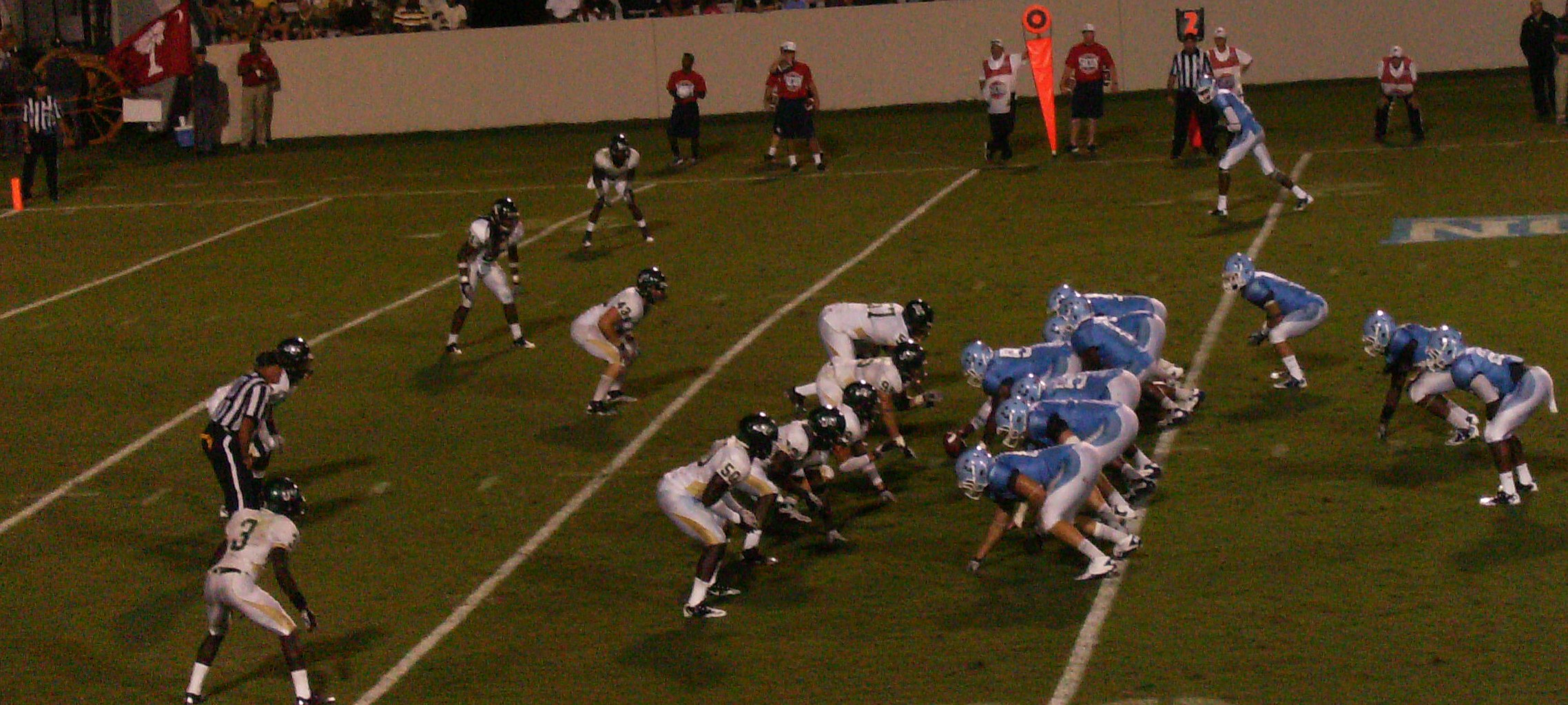
Game Review, 2011: Furman

Furman 16, The Citadel 6.

It wasn’t a terrible performance by the Bulldogs.  It just wasn’t good enough.  I wasn’t completely frustrated by the way things turned out, but I wasn’t overwhelmed with positive vibes either.

Links of interest:

Jeff Hartsell’s article on the game

Hartsell’s post-game notes

The Citadel’s release

Furman’s release

The Post and Courier‘s “photo gallery” of the game

Click on that last link to see photos of the Bulldogs wearing their “Big Red” jerseys.  I was disappointed with the decision to break out these uniforms for the game. This was supposed to be a special, unusual uniform set designed to commemorate the return of “Big Red” (the flag) to The Citadel.

I wrote about these uniforms last year when they were first worn, for Homecoming. What I said then:

I didn’t have a problem with breaking out the red jerseys for this game.  The original Big Red, of course, arrived on campus in March; its disappearance and rediscovery is an interesting tale.  Wearing red jerseys for the Homecoming following that development seemed reasonably appropriate (and a good way to push merchandise).

I’m not sure I would want to see them again, however.  I certainly don’t want the football team wearing red jerseys to become a yearly event.  I think doing that would make it much less special, and also detract from the school’s traditional colors for its sports teams.

Of course, it could be argued that the parade of different football uniform color combinations this season has already devalued the tradition of wearing light blue and white. In ten games, the Bulldogs have worn six different jersey/pant color combos, including four different looks for the six home games.

In fact, I think the fact The Citadel did not have a standard uniform combination this season made the red jerseys seem a little less unusual. Let’s face it, if the Bulldogs had lined up wearing silver or black, nobody would have been all that shocked, so the red jersey wasn’t that much of a departure.

I still feel that way.  If anything, I feel more strongly about it after seeing the game against Jacksonville, when the Bulldogs wore a new uniform that actually looked pretty good.  I am afraid that we are going to continue this multiple uniform combo deal throughout the season.  I also wouldn’t be all that surprised if someone in the department of athletics is trying to figure out how to justify wearing black or silver jerseys/pants/helmets.

I’ll get off my uniform soapbox for now, because I know folks are probably tired of the constant drumbeat about the unis (or at least tired of my constant drumbeat), but I want to make three more points:

— The Bulldogs wore the new helmet logo with this “Big Red” set, which made it look even weirder (and which was obviously inconsistent with the uniform as a whole).

— The game notes now actually feature a chart listing The Citadel’s uniform combinations for each contest.  While it is arguably sad that such a chart is necessary, I will give the media relations staff credit for it, because I think it’s a good idea.  The problem, of course, was that the notes for the Furman game listed the uniform combo as being “Citadel blue tops, white bottoms”.  I guess not everybody got the message.

— The light blue “side panels” on the red jerseys look even worse when compared to the no-panel look of last week’s jerseys.

I’m not going to rehash the game.  I’ll just make some observations, many of which are probably faulty…

— On The Citadel’s first drive to open the game, the Bulldogs threw two passes (both incomplete) in three plays and punted.  I know that the element of surprise is always a consideration, and that Triple O’Higgins probably features more passing than some other triple option offenses, but I would have liked to see the team try to establish an offensive rhythm early by sticking to the ground game.

— This game could have looked a lot like last year’s matchup in Greenville, when Furman scored a TD right out of the gate and the Bulldogs played from well behind for the entire day, but for a big play by Brandon McCladdie on third-and-goal from the Bulldogs 4-yard line.  Chris Forcier would have scored if McCladdie had not kept containment and made what amounted to an open-field tackle.  If The Citadel had come back and won the game, McCladdie’s play would have been huge.  It was still noteworthy.

— Furman’s coaches treated Forcier more like a freshman than a senior in terms of play-calling.  I’m not sure what to make of that.

— Jerodis Williams is a tough back.  Very impressive.  I also thought Paladins linebacker Kadarron Anderson had a good game.

— Things that are still a work in progress:  Ben Dupree’s passing, and the Bulldogs’ o-line play in general.  Both can improve, though.  I’ll take some overthrows and missed blocks now for pinpoint passing and solid line play later.

— Dupree is going to frustrate a lot of SoCon opponents with his ability to turn broken plays into positive yardage.

— On The Citadel’s sixth drive of the game, the Bulldogs chewed up just over seven minutes of possession, eventually facing a 4th-and-8 on the Paladins 35-yard line. The Citadel took a delay of game penalty and then punted.  The punt went into the end zone for a touchback, so the net was 20 yards (a de facto 15-yard net, really, considering the penalty).

I think Kevin Higgins, if he had to do it all over again, would have gone for it.  I certainly believe he should have.  The Bulldogs trailed 13-6 at the time, and there were four minutes remaining in the third quarter.

In that situation, if a field goal attempt isn’t a realistic option, going for it is the right move.  In fact, I think it’s the right move in most situations, but you definitely have to go for it in a game when the possessions are limited.  The Citadel only had eight possessions in the entire contest (and one of those was a one-play drive to end the first half, so the Bulldogs in effect only got the ball seven times).

You simply aren’t going to get that many opportunities to make a play in your opponents’ territory.  Higgins did make the correct decision on The Citadel’s next possession, however, going for it on 4th-and-6 at the Furman 49.  It didn’t work out, but it was the right call.

— The tailgaters were out in force on Saturday.  Larry Leckonby probably spends a fair amount of time wondering how to get most of the people tailgating in the lots surrounding the stadium to actually enter the stadium.  It’s a problem.

Now The Citadel has a week off before its first road game of the season, a trip to Elon. The Phoenix are playing this weekend, as they travel to Durham to face North Carolina Central.  Elon is 1-1, with a loss to Vanderbilt and a victory over Concord.

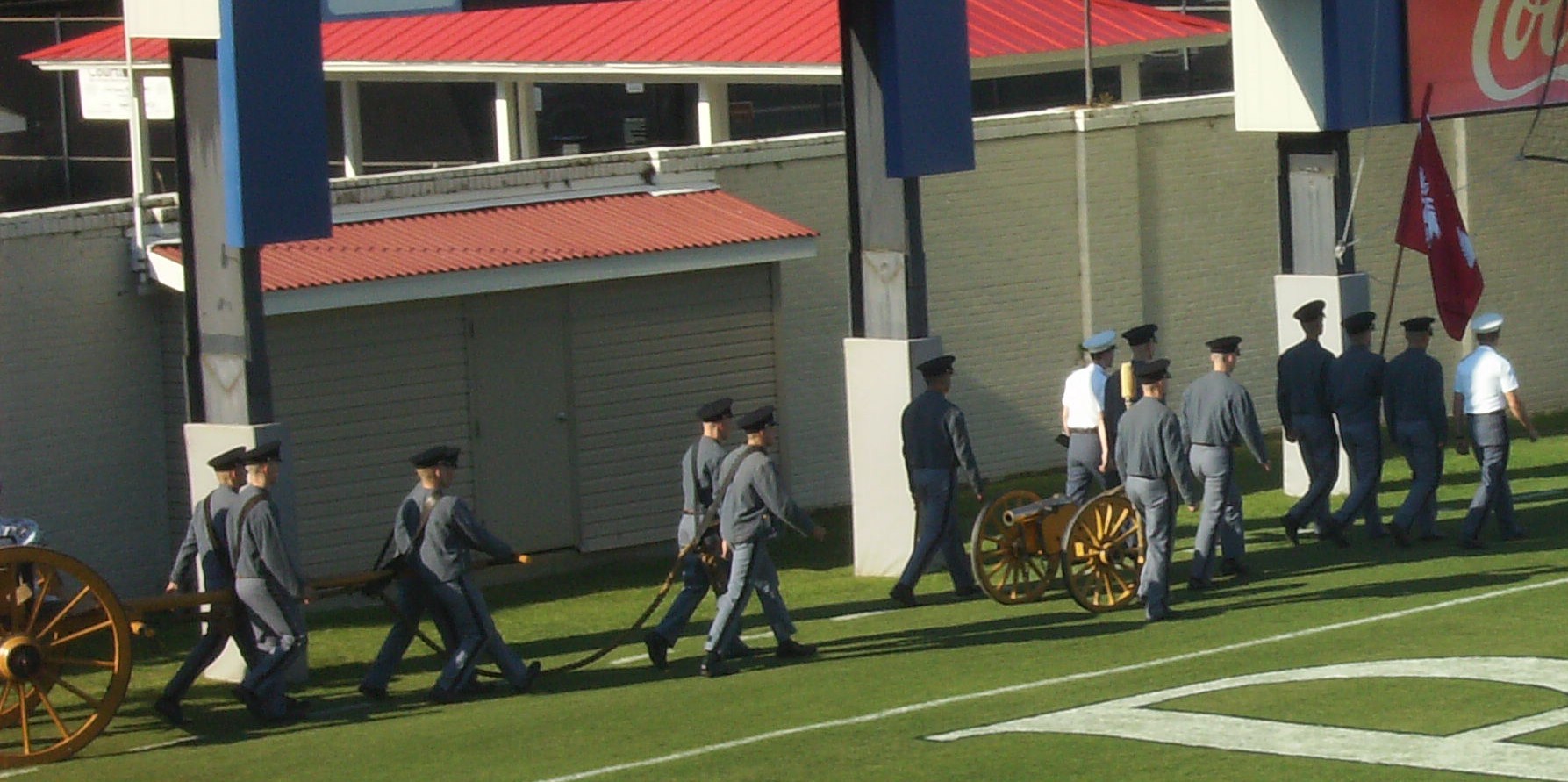
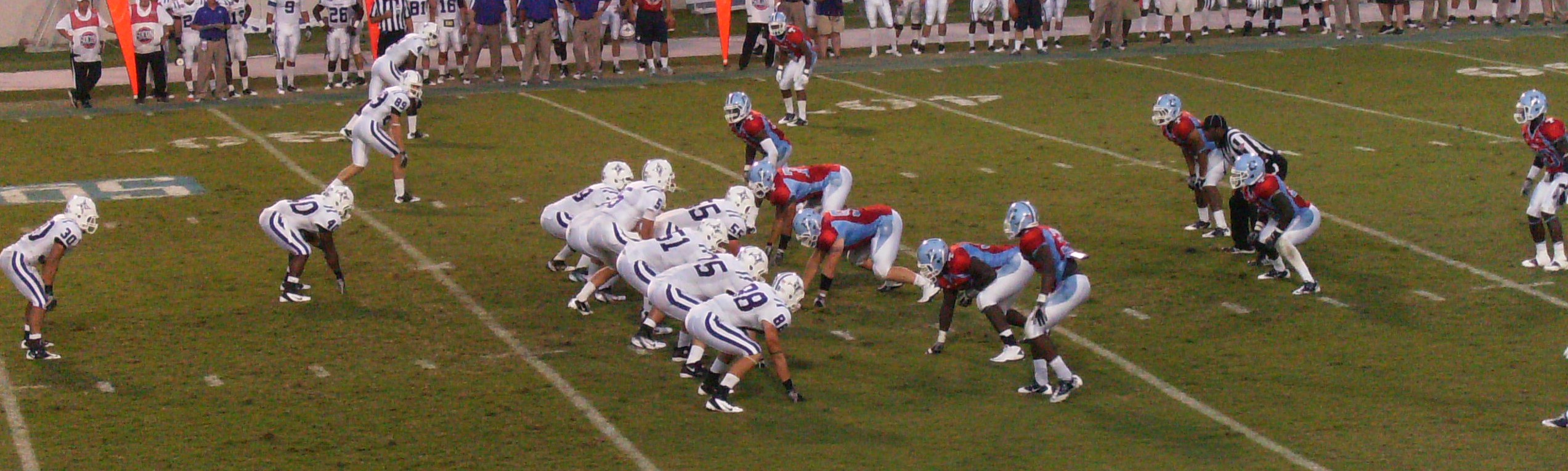
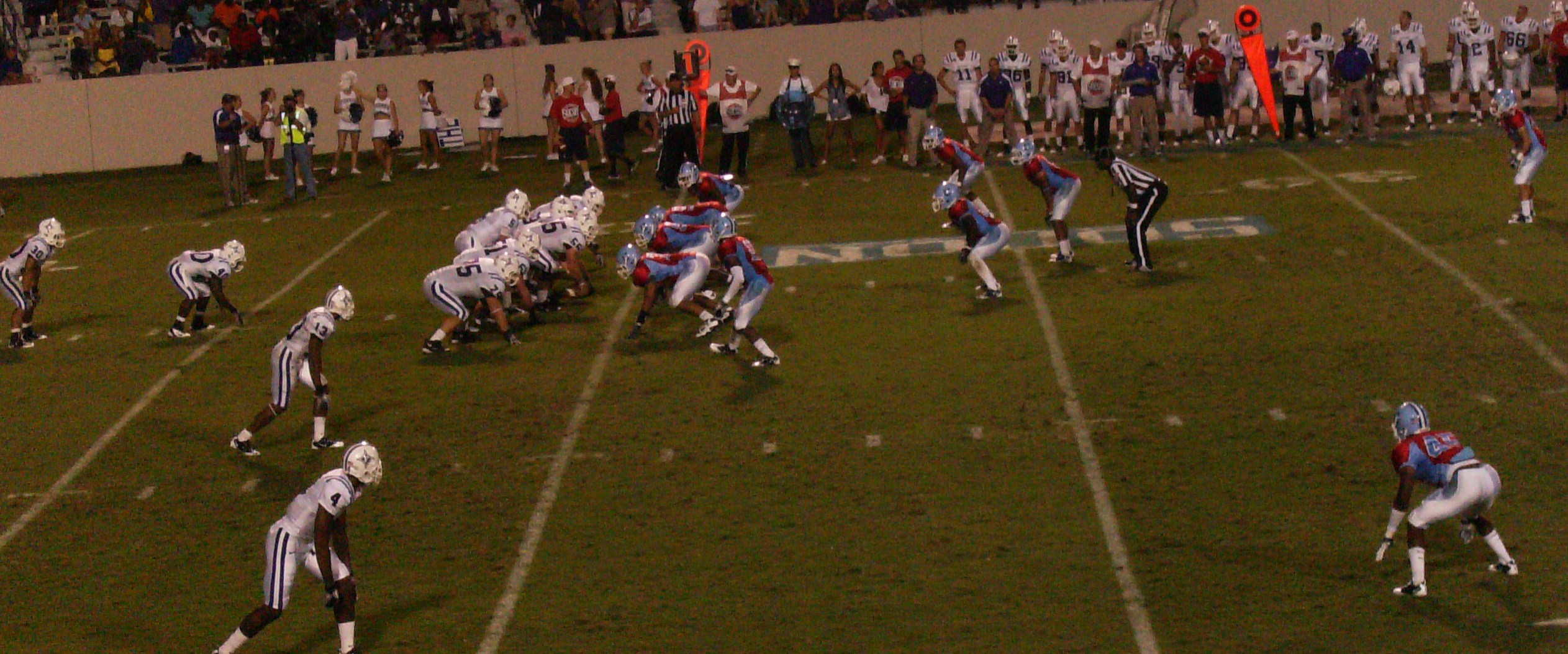
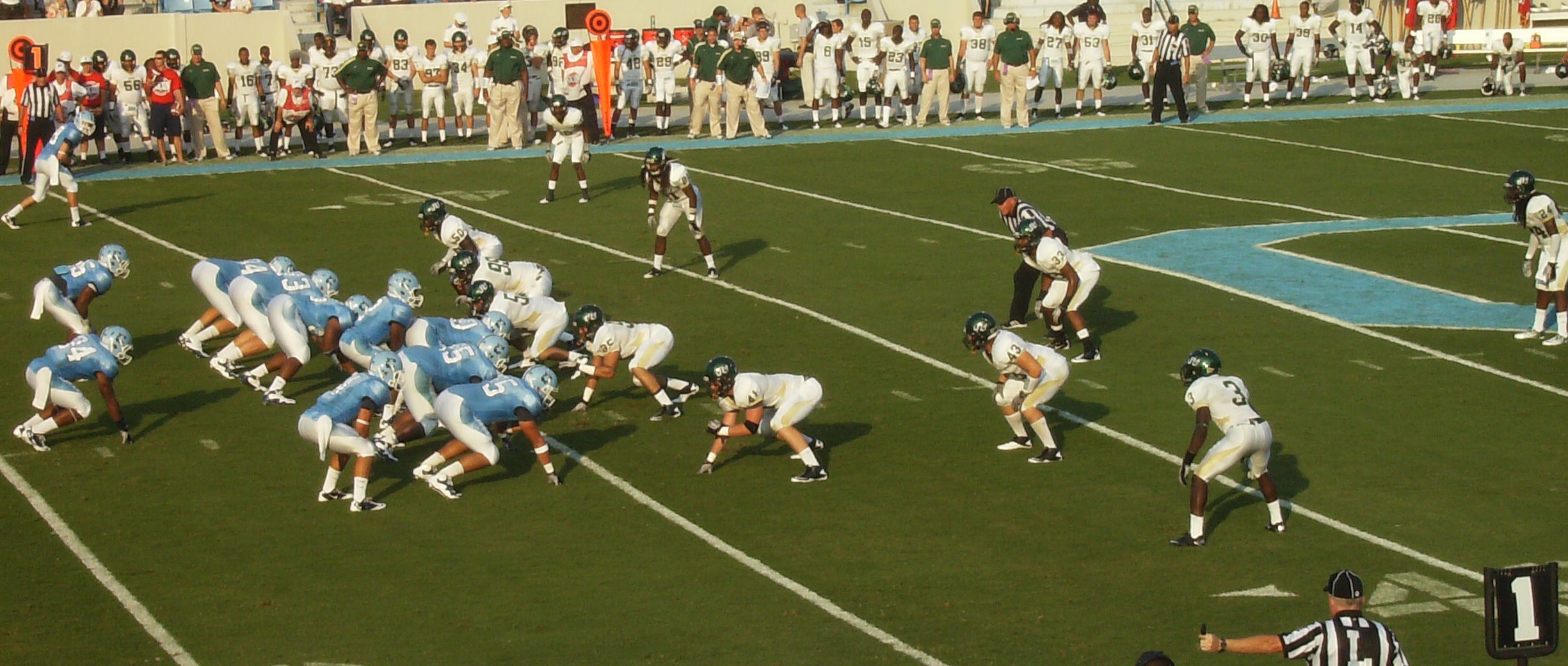
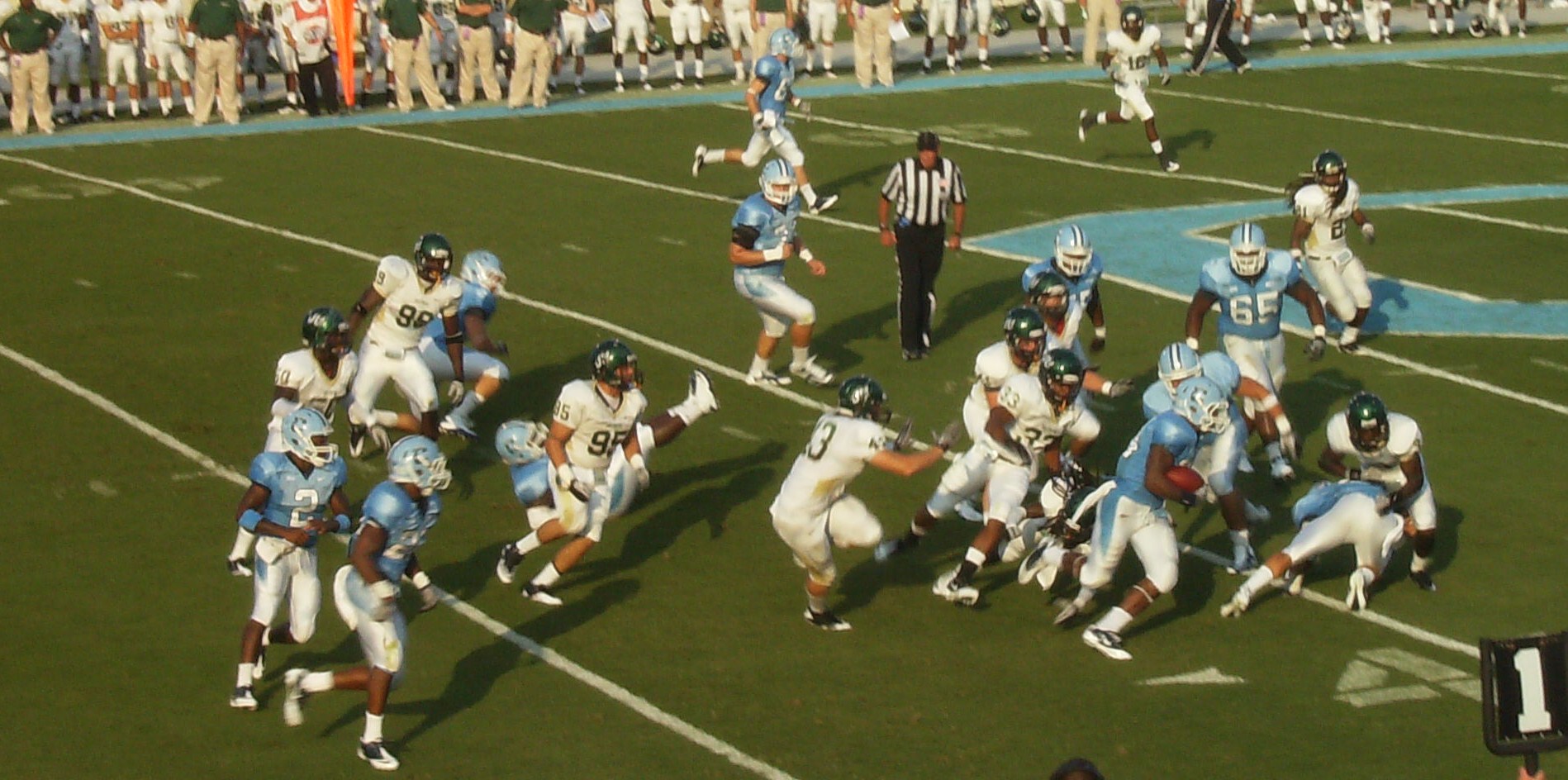
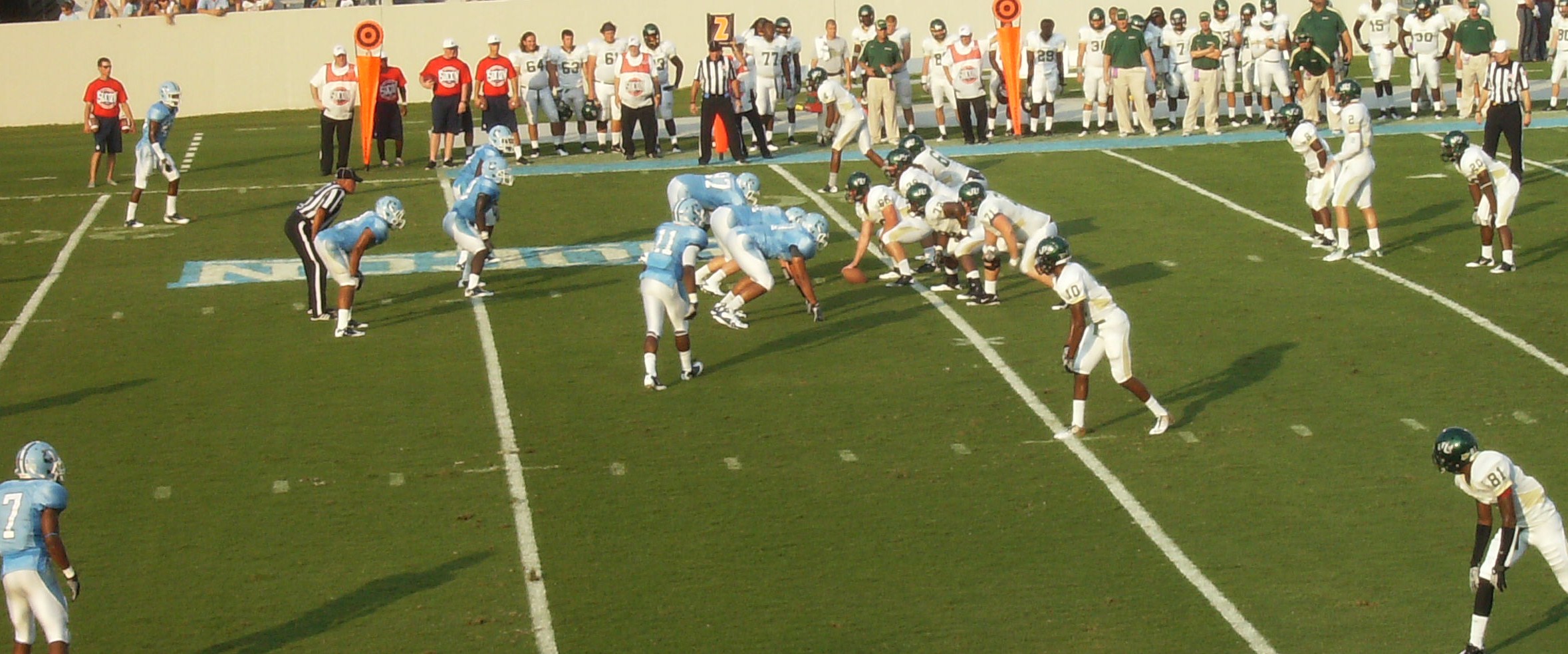
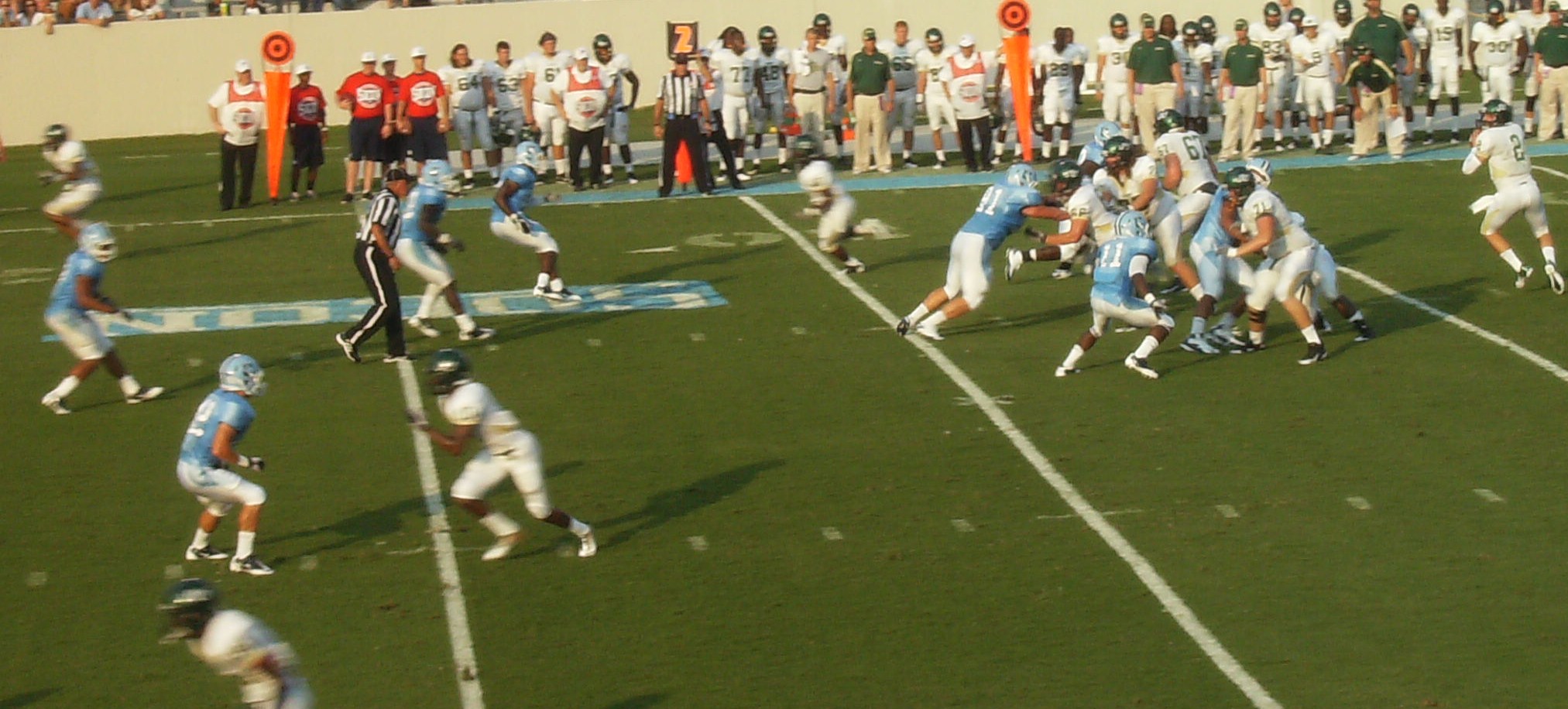
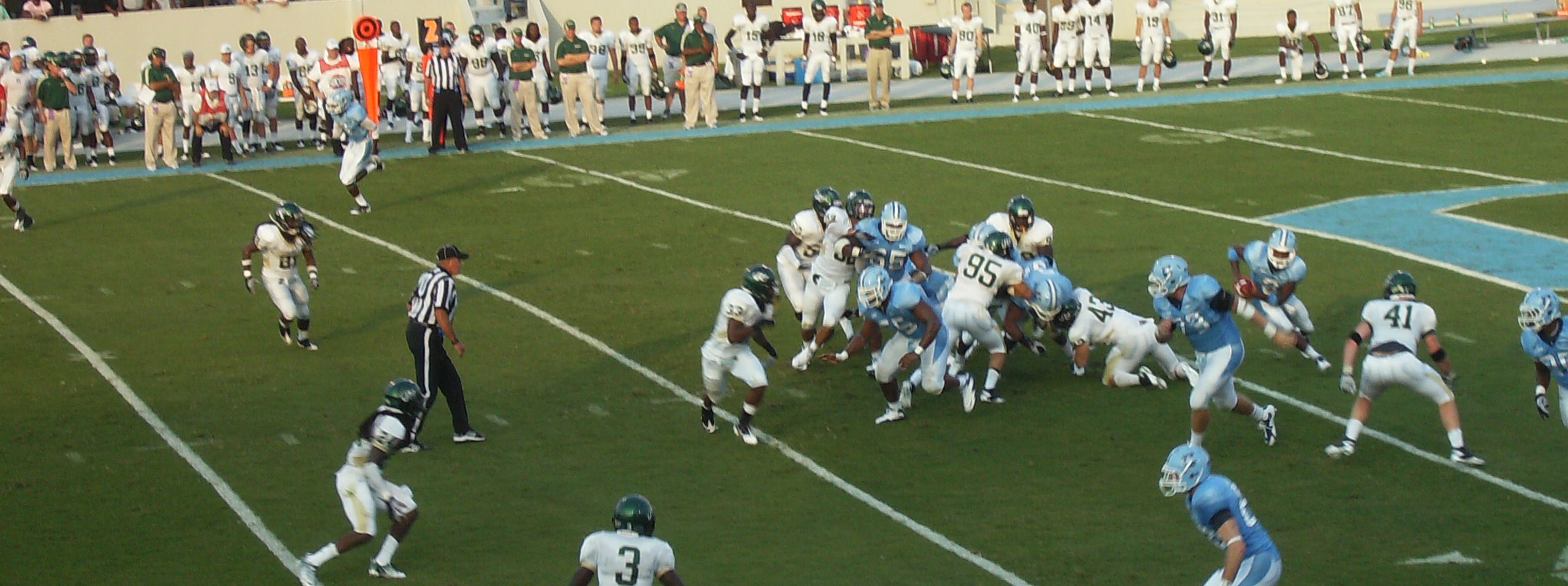
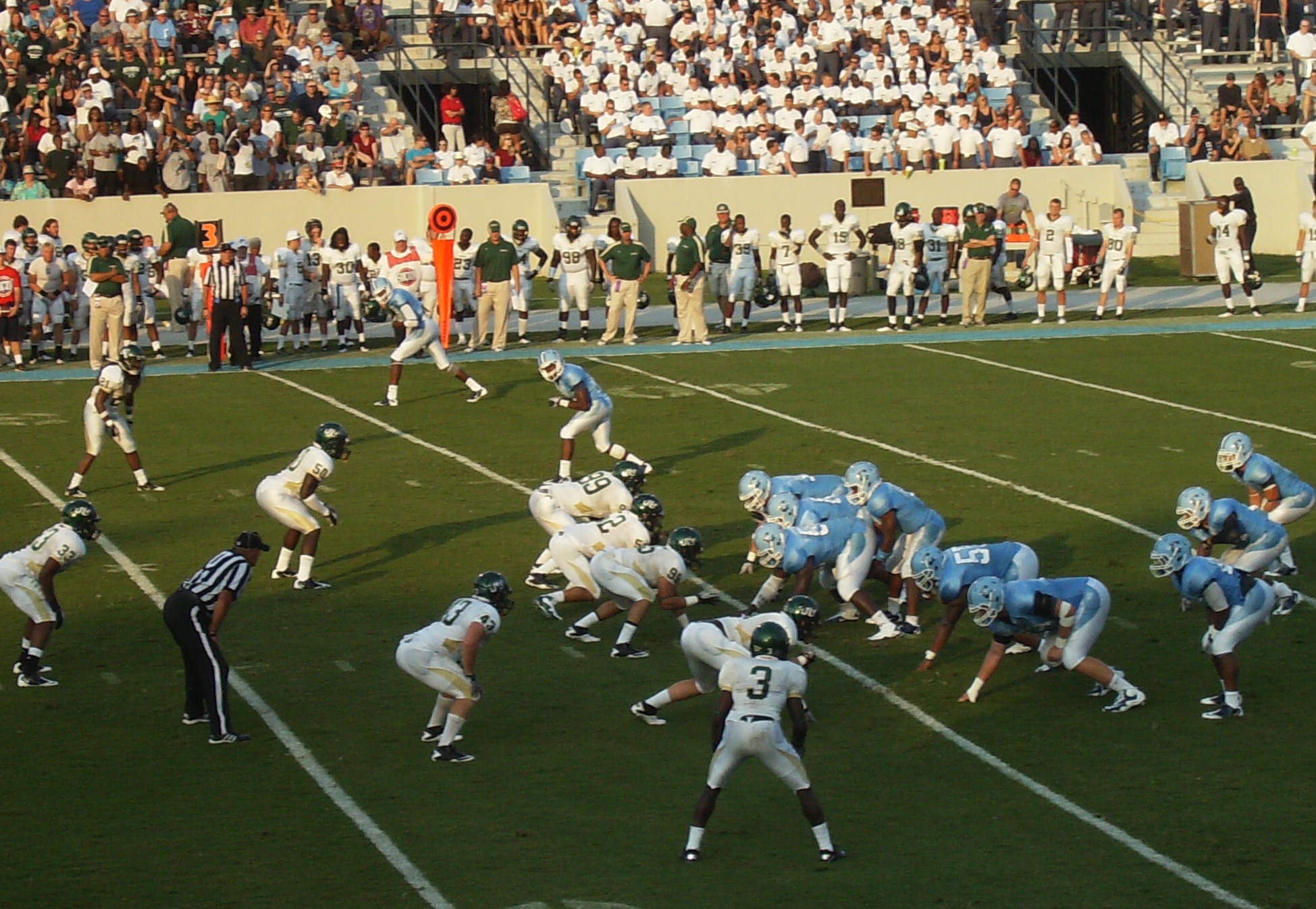
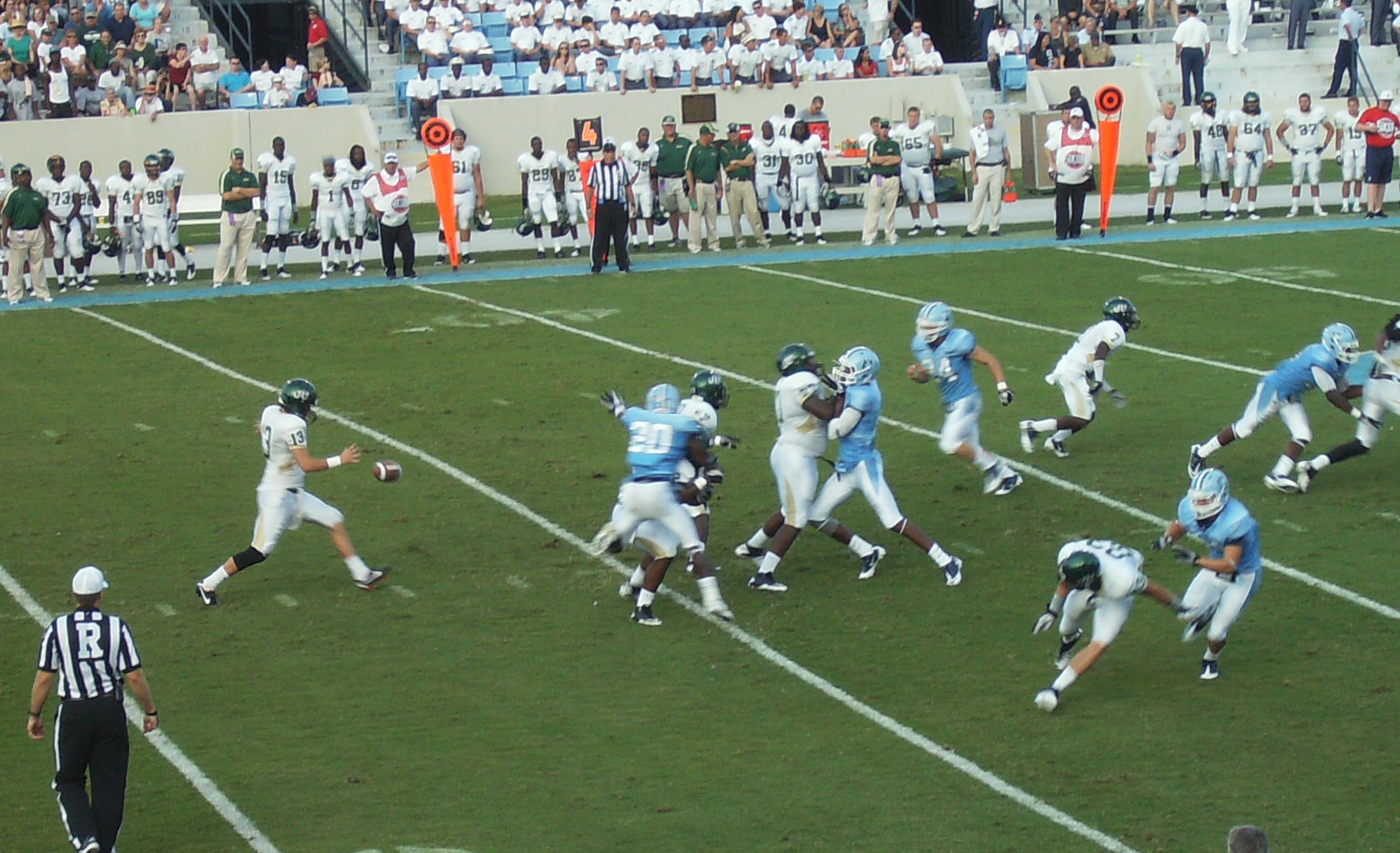
I’ll close with some photos.  My usual lack of skill in picture-taking was combined on Saturday with a dying battery in my camera, so I didn’t take quite as many as usual.  I did get a few off-field shots of note, though, including the 1961 SoCon championship trophy and the mascot for Bojangles, apparently named “Bo” (what a surprise).

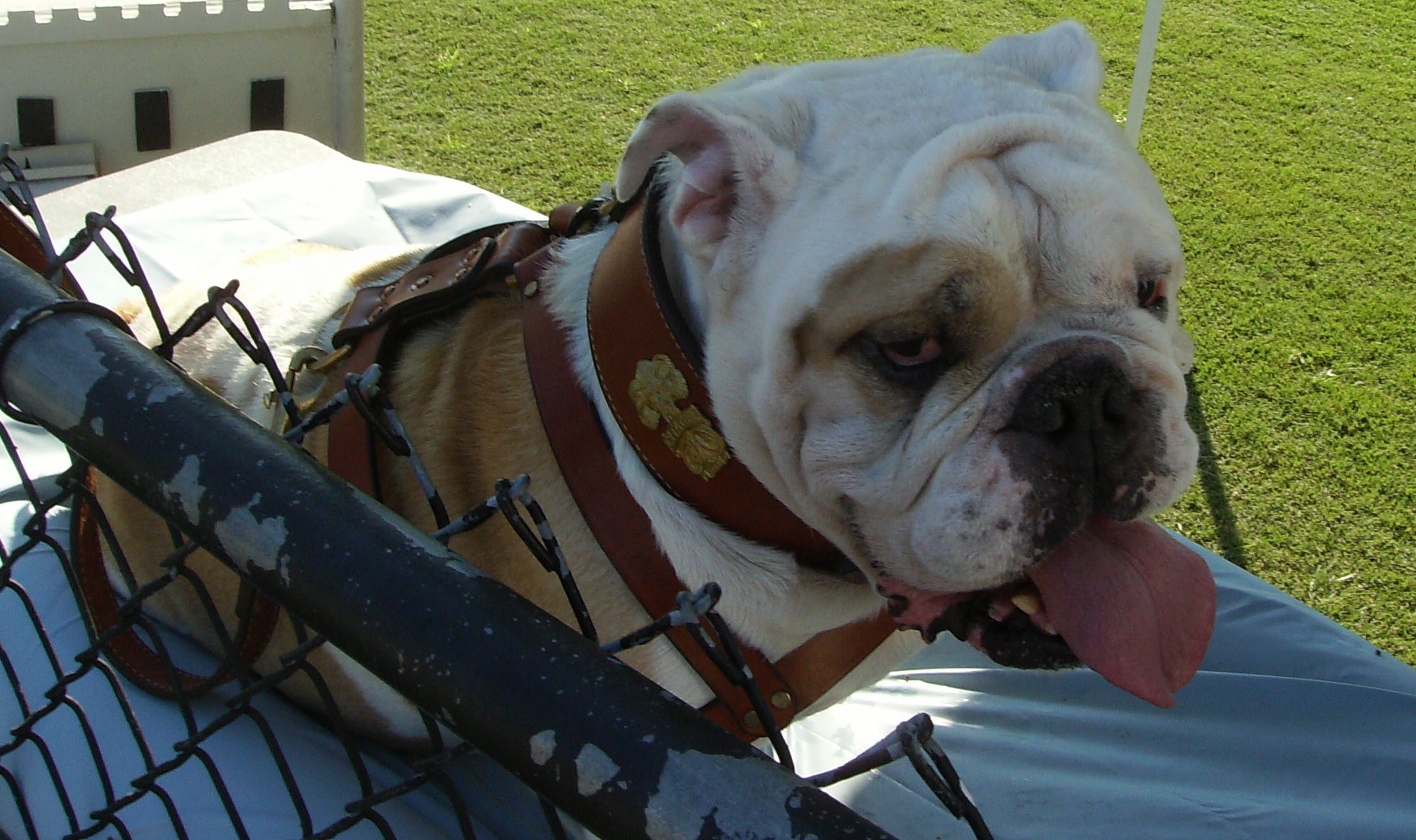
Speaking of mascots, I got a picture of General too, relaxing on a block of ice covered by a blanket.  General is a very cool dog (quite literally on Saturday, despite the late-afternoon heat).  He and his buddy Boo made a lot of new friends, including quite a few Cub Scouts.  I also appreciated Boo’s handler moving the SoCon trophy around so I could get a half-decent shot of it.  Many thanks.

2011 Football, Game 2: The Citadel vs. Furman

The Citadel vs. Furman, to be played at historic Johnson Hagood Stadium, with kickoff at 6:00 pm ET on Saturday, September 10.  The game will be televised on WYMA (Asheville, NC), and will be available on ESPN3.com.  There will also be a webcast on Bulldog Insider (subscription service), and the game can be heard on radio via The Citadel Sports Network, with new “Voice of the Bulldogs” Danny Reed calling the action.

The Citadel begins play in the Southern Conference with a game against traditional rival Furman.  It’s only the third time the two schools have ever met in a league opener, but it’s the second consecutive season that has been the case.

I’m not going to rehash the history of the series in terms of the time of year the game has been held; anyone interested can read what I wrote on the subject for last year’s game preview.  Regardless of whether you think the game should be a midseason clash (my preference) or played at the end of the year (a not-insignificant number of fans from both schools), I think everyone can agree that September 10 is too early for this game to be played.

Jeff Hartsell has reported that, per the SoCon office, next year’s meeting will come at the end of the 2012 season, on November 17.  (The conference does not make league schedules beyond one year in advance.)

I’m okay with that, as long as the Clemson-South Carolina game continues to be played the Saturday after Thanksgiving, as is now the case.  I just don’t want The Citadel and Furman to play on the same day as the matchup between the Tigers and Gamecocks.

Furman was 5-6 last season, its first losing campaign since 1998.  Bobby Lamb resigned after nine years in charge and over a quarter-century at the school as a player or coach.  The Paladins had missed the FCS playoffs for four consecutive seasons, which did not go over well among some supporters.  It was time for Furman to make a change.

The question, though, is did Furman really make a change?

The new coach is Bruce Fowler.  Fowler is a 1981 graduate of Furman who played for Dick Sheridan.  Lamb was a 1986 graduate of FU who had played for Sheridan. Fowler spent 18 years at Furman as an assistant coach.  Lamb had been an assistant coach at Furman for 16 seasons.

One difference is that Fowler wasn’t a complete Furman lifer like Lamb had been.  For the past nine years, he had been an assistant at Vanderbilt, where he was defensive coordinator for Bobby Johnson (and Robbie Caldwell in 2010).  Of course, Johnson had been the head coach at Furman before taking the Vandy job, and before that he had been an assistant under Dick Sheridan.

You may have noticed a pattern here.  Dick Sheridan left Furman after the 1985 season to take over at N.C. State, but his presence is still felt in the program.  All four of the men who have held the head coaching position since Sheridan left (including Fowler) were players and/or assistants under him.

If you were going to have your football program maintain what is in effect a 25-year tie to a former coach, you could do much worse than Sheridan, who did nothing but win throughout his coaching career (even as a 28-year-old rookie head coach at an Orangeburg high school).  It’s a type of continuity that may be worth preserving.

On the other hand, there is always the possibility that Furman risks going to the well once too often.  Fowler isn’t exactly a carbon copy of Lamb, though — for one thing, he’s 52 years old, 13 years older than Lamb was when Lamb got the job.  Also, he’s primarily a defensive coach (though he was the receivers coach at FU for seven seasons).  Lamb was mostly an offensive coach (and a former quarterback) during his time with the Paladins.

Usually when a school is in a position to make a coaching change after a run of disappointing seasons, it brings in somebody to shake things up.  That’s certainly not what Furman has done.  Besides Fowler, three of the assistant coaches played for Sheridan; another has been a Paladins assistant for 13 years.

Before I move on to the Paladins of 2011, I should note that Art Baker, who preceded Sheridan as head coach at Furman (eventually leaving to take the job at The Citadel), hired Sheridan, Jimmy Satterfield, and Bobby Johnson as assistant coaches, all of whom would later ascend to the top job at FU.  Baker had a significant impact on Furman’s coaching tree.

Furman lost 30-23 at Coastal Carolina in its opener.  The Paladins never led the contest.  The game had been tied at 16 and 23 before the Chanticleers scored the game-winning touchdown with 1:23 remaining in the fourth quarter.

Coastal Carolina gained 231 yards rushing and 195 yards passing against the Furman defense, but perhaps more interesting was that the Chanticleers had 59 rushing attempts for the game.  CCU ran 81 offensive plays from scrimmage for the game, while the Paladins had just 58.

As Bruce Fowler noted in the SoCon teleconference, Furman had trouble getting its defense off the field.  Coastal was 7-16 on 3rd-down conversion attempts and made its only 4th-down try, a major reason the Paladins trailed by over 12 minutes in time of possession.  That continued a trend from last season, when Furman finished last in the SoCon in time of possession.

The Paladins do have two impact players on defense, middle linebacker Kadarron Anderson and cornerback Ryan Steed, both of whom are on the Buck Buchanan Watch List.  Another linebacker, Chris Wiley, had fourteen tackles against Coastal Carolina.  Furman defensive end Josh Lynn is tall (6’5″) and rangy, and may be a key factor in how the Bulldogs’ triple action attack fares on Saturday.  Against Coastal, he had five tackles and a sack.

Furman’s starting quarterback against Coastal Carolina was Chris Forcier, of the Forcier Family of Quarterbacks.  I think it’s fair to say that the Forciers are, as a group, somewhat controversial.  I guess it’s a question of style.  When Chris Forcier decided to transfer from UCLA to Furman, the family issued a press release that wound up being posted on Deadspin.

His brother Tate is a former Michigan quarterback who has now transferred to San Jose State (after originally announcing he was going to Miami).  His oldest brother, Jason, also played quarterback at Michigan before transferring to Stanford.  The brothers also transferred to different high schools at various times.

Against the Chants, Forcier was solid, completing two-thirds of his passes while averaging over seven yards per attempt.  A classic “dual threat” quarterback, Forcier also rushed for 50 yards before leaving the game in the third quarter, apparently suffering from cramps.  Without him, the Furman offense sputtered, not scoring in the fourth quarter.

Assuming he is healthy (and there is no reason to believe otherwise), stopping Forcier will be a difficult task for The Citadel’s defense.

If dealing with Forcier wasn’t enough, the Bulldogs must also contend with Jerodis Williams, who rushed for 142 yards and 3 touchdowns against Coastal (including a 68-yard score).  Williams was the Southern Conference offensive player of the week, and also picked up FCS National Back of the Week honors from something called the “College Football Performance Awards“.

Furman had five different receivers catch passes against the Chanticleers (including Williams).  Tyler Maples had five receptions for 65 yards.  Colin Anderson had four catches, and presumably will have a career day against The Citadel, as has often been the case for Furman tight ends.

Along the offensive line, Furman has experienced and well-regarded tackles (one of whom, Ryan Lee, is moving from guard to tackle) and a veteran center, Daniel Spisak (who is Matt Millen’s nephew).  The guards include a first-year starter who came to Furman as a walk-on, and a sophomore who started three times last season before a season-ending foot injury.

Furman placekicker Ray Early was 11-12 on field goal attempts last season, including a long of 52 yards, and only missed one extra point all year (40-41).  Against Coastal Carolina, however, Early’s first field goal attempt of the season was blocked, and he then missed the PAT after the Paladins’ first touchdown.

After that, Early did not attempt a placekick in the game (although he did kick off), giving way to Furman punter Chas Short.  That may be something to watch on Saturday.

Short, incidentally, had a fine year for Furman in 2010.  The Paladins finished in the top 10 nationally in net punting.

With Furman having allowed a bunch of rushing yards to Coastal Carolina, and having lost the time of possession battle so decisively, there may be some hope among Bulldog fans that the Paladins’ defensive issues could play into The Citadel’s hands on Saturday.  As Jeff Hartsell wrote in The Post and Courier:

…on defense, the Paladins’ 4-3 look was blitzed for 237 rushing yards, including 105 yards and two TDs by CCU quarterbacks Aramis Hillary and Jamie Childers. That might bode well for the Bulldogs’ option attack, as QB Ben Dupree went for 141 yards and two scores in a 31-9 win over Jacksonville. Higgins said Dupree was 23 for 23 on his option reads, and The Citadel rushed for 439 yards, the most since 1994.

That does seem promising from The Citadel’s perspective.  I would make this observation, though:

The Bulldogs ran the ball well on Furman last year, dominated time of possession, and lost 31-14.  The Citadel gained 294 net yards rushing on 60 attempts, held the ball for over 36 minutes — and did not score until the fourth quarter.

Actually, The Citadel’s 359 total yards against Furman in 2010 was the most yardage gained by the Bulldogs in any Southern Conference game for the entire season.  The problem?  Three turnovers, a missed field goal, and a failed fourth-down try inside the Furman 25.  Another issue was that The Citadel started very slowly on offense, gaining only 64 total yards on its first five possessions.

Conversely, Furman got out of the blocks fast on offense in each half, scoring touchdowns on its initial drive in both the first and third quarters.  Of the Paladins’ other three scores against The Citadel, two came on drives starting in Bulldog territory after an interception and a failed onside kick.

Kevin Higgins has said in the past that sometimes it takes a triple option team a possession or two to figure out how the defense is playing.  That makes sense.  You could see it in last week’s game against Jacksonville, as the game was well into the second quarter until Triple O’Higgins got fully warmed up.

Against a SoCon opponent, though, it needs to warm up faster.  The Bulldogs can’t go an entire quarter with no offensive production, especially as running the offense generally means there are fewer possessions in the game.  Also, while obvious, The Citadel must control its fumbling problems, which cropped up against Jacksonville (albeit with only one coming on an exchange) and stay “on schedule”.

The other thing that can’t happen Saturday if The Citadel has any chance of winning is for the defense to concede relatively easy touchdown drives right out of the dressing room.  Last season, Furman’s TD drives in each half were for a total of 123 yards and featured only two third-down plays.

What the defense really needs is to force some turnovers.  Last year against Furman, the Bulldogs forced no turnovers and also did not record a sack.

The Bulldogs must also contain Forcier, who is capable of making big plays with his arm or his feet, and prevent Williams from breaking long runs, such as the one he had against Coastal Carolina.  (Also, the defense must watch the tight end.  He’ll be catching the ball over the middle for 15 yards before you know it.  Two or three times.)

I thought Ben Dupree played well against Jacksonville.  What he proved, beyond a shadow of a doubt, is that he has the ability to make big plays.  While the triple option is mostly about moving the chains, it’s important to have a breakaway aspect to the offense, and Dupree can provide that with his running ability.  He is still a work in progress as a passer.  If he continues to improve that part of his game, he will be a very dangerous weapon indeed.

Terrell Dallas’ injury against the Dolphins was not serious, thankfully, but it appears he may not play on Saturday.  That will be a loss, but Darien Robinson showed he is quite capable of handling the fullback position.

I thought the defense really came to play against Jacksonville.  Now it faces another challenge.  It won’t have the size and depth advantage against Furman that it had against the Dolphins.

Odds and ends:

— Check out the game notes to see all the different helmet logos The Citadel has had over the years (page 5).  There have been no fewer than 25 different designs since 1952 (and I think it’s likely there have been a few more that went unrecorded).

Those artist renderings/photos in the game notes came from the Helmet Archive, a good site if you want to peruse helmet histories of other teams as well.

— Has anyone else noticed that there are a lot of entities giving out “player of the week” awards these days?  It’s hard to figure out which ones to take seriously.  I can’t decide if the plethora of “recognition sites” is a boon or a curse for athletic media relations departments.

— The Summerall Guards are performing at halftime, but not at Johnson Hagood Stadium.  The Guards will be in Death Valley for the Wofford-Clemson game (it is Military Appreciation Day at Clemson).  It strikes me as a little odd that they would perform at another stadium on the same day as a home football game, but no big deal.

I’m looking forward to the game.  I am hopeful that the success of the home opener, along with Saturday’s opponent, results in a nice crowd at JHS.  As for the on-field action, I’m not quite sure what to expect.  I was pleasantly surprised by what I saw against Jacksonville.  I would like to be pleasantly surprised again.

Game Review, 2011: Jacksonville

The Citadel 31, Jacksonville 9.

I would have gladly taken a one-point victory (admittedly, that is almost always the case for me), so Saturday’s result was altogether a pleasant one, particularly if you don’t think about the first quarter too much (a stanza that Walt Nadzak referred to in the radio postgame show as “horrendous by any standard”.

First, some recaps from the press:

Jeff Hartsell’s article in The Post and Courier

Hartsell’s notes from the game

Florida Times-Union article (looks to just be the AP story)

The Citadel’s release

The Post and Courier‘s “photo gallery” of the game

That last link is worthwhile if only to check out The Citadel’s new football uniforms, which in my opinion are a vast improvement over those of recent years.  Of course, it wouldn’t be a surprise to see the team break out another set of unis for the game next week against Furman, so we’ll just see how things develop on the uniform front as the season progresses.

Last night’s football uniforms were more along the lines of a “back to basics” look, with no school name on the front (thus avoiding the whole “Citadel” vs. “The Citadel” issue) and no player names on the back of the jerseys (which was a mild surprise). Also absent: ‘TV numbers’ on the shoulder pads.

The infamous ‘side panels’ championed by Nike have been ditched, thankfully.  The weird striping on the pants remains, but it isn’t nearly as hideous without the aforementioned side panels on the jerseys.  The front of the jersey includes small logos for the SoCon and Nike, as well as a “C” on a navy-bordered neckline, which looks respectable.

The most noticeable uniform change was the new helmet logo.  Having a new helmet logo almost every year is one of The Citadel’s oldest traditions, dating back to 1861, when cadets firing on the Star of the West had to stop their assault midway through the action in order to change to a new cap badge.

The 2011 logo is a block “C”, with “navy digital camo” styling.  This picture of Brandon McCladdie in the above-linked photo gallery is a good look at it.  I’m on record as liking the block C as a helmet logo, although I prefer it to be white, but I can get used to the camo.  The only problem is that the chinstraps tend to make it harder to see at times, but I’m not sure there is much that can be done about that.

All in all, I was pleased with the uniforms, and I’m a tough grader.  Good job.

Before I get to the game itself, I want to note that the corps of cadets seemed to be mostly, if not completely, present and accounted for on Saturday night.  I have been concerned at times over the last couple of years that a significant percentage of cadets were not in the stands.  I realize that there are a lot of “duty” cadets, but still. However, on Saturday the cadet section seemed to be appropriately filled.  The corps did make its presence felt at times, and in general the noise level was good. Improvement is possible and necessary, though it was only the first game, so I’ll give the corps a solid “B”.

First, a negative. From Jeff Hartsell’s “notes” column:

[Terrell] Dallas, a senior who led the Bulldogs with 665 rushing yards last year, injured a knee on The Citadel’s first play from scrimmage. Coach Kevin Higgins said it appeared that Dallas injured his medial collateral ligament, but that more tests will be conducted [Sunday].

Losing Dallas for an extended period of time would be a tough break for the Bulldogs (and for Dallas, obviously).  We’ll have to wait and see.

I’ll examine some of the statistical information from the JU contest and try to determine what it means going forward in my preview of the Furman game later in the week.  Just some quick observations:

— Cass Couey had a solid game punting.  His first punt, in particular, was outstanding.  In general, the special teams were very hit or miss.  The Bulldogs had one missed field goal and one very poor coverage job on a kickoff (where Ryan Sellers made up for his missed FG with a touchdown-saving tackle).  Then there was the fumbled punt inside the 5 (that JU converted into a TD) and a near-disaster on another muffed punt (and what a game-changer that could have been; on the next play, Ben Dupree scored on a 58-yard TD run).

The Citadel appeared to tip two of Jacksonville’s punts and was credited with a block on a third, although from my vantage point I wasn’t sure that Domonic Jones really blocked the punt as much as it was simply lined right at him (with a “wormburner” trajectory).

— This was arguably the first game since the debut of Triple O’Higgins in which the offensive execution was good enough that all the options were readily available, so to speak.  Of the five Bulldog fumbles (two lost), only one was on an exchange.  There weren’t so many negative plays this time around, so The Citadel wasn’t constantly in third-and-forever mode and could keep things “on schedule”.

As the game progressed, the Bulldogs were able to key off JU’s defenders, eventually adjusting to what the Dolphins were doing, so after Dupree had burned JU on two long scoring plays, he was then able to pitch out when Jacksonville moved to stop him.  The relative effectiveness of the offense also allowed for things like the end-around play to Kevin Hardy.

I’m not going to pretend to be an expert on offensive line play, but even from the stands some things are easy to figure out, like the fact that Mike Sellers has tremendous potential.  How often is a team’s center considered an offensive weapon?

— I won’t go into great length about the defense, but it was very good for the entire game, as the numbers indicate.  The defensive line as a group was excellent, with Derek Douglas the standout, but the ‘backers and backs were on their game as well. Jacksonville had no big pass plays, and its running game was completely shut down. The only real negative was the lack of forced turnovers (just one).

— The Bulldogs only committed two penalties, continuing a trend from last season.  At The Citadel, the law is respected.

Part of the lack of forced turnovers for the Bulldog D can be credited to JU quarterback Josh McGregor (21-33, 208 passing yards, no interceptions), who I thought was impressive in defeat.  His team suffered from a lack of size and (to a lesser extent) speed, and also from an absence of depth.  Scanning the sidelines, I noticed that Jacksonville had dressed no more than 55 players (and that may be a generous estimate).  If you want to know the difference between scholarship and non-scholarship football, that is it in a nutshell right there.

It’s not going to be easy for Kerwin Bell to get his team to rebound from its loss on Saturday night.  JU had put a lot of eggs into a “playoffs-or-bust” basket, and if those eggs aren’t already broken, most of them are cracked.  To even draw playoff consideration, the Dolphins will have to win their remaining ten games, including Sunday’s game at Western Illinois, a 2010 playoff participant.  9-2 with a Pioneer League title (which would also include an OOC victory over Charleston Southern) would not be good enough.  10-1, quite honestly, probably wouldn’t be good enough unless A) Western Illinois has a good season, and/or B)  The Citadel has a good season.

I certainly hope option B comes to pass.  Will The Citadel have a good season? We’re about to find out.  Over the next seven weeks, the Bulldogs will play six games, all against Southern Conference competition, three at home (including next Saturday) and three on the road.

I’ll conclude this post with some pictures I took at the game.  Traditional reminder:  I’m a bad photographer with a below-average camera.  If you want to see good pictures, be sure to check out that Post and Courier gallery.  I do try to take pictures of offensive and defensive formations, because some people are interested in that (especially the triple option stuff).  I also threw in a couple of special teams photos and a shot of something called “Cosmic Dogs”, which is a new vendor under the stands.  It is, naturally, out of focus.

On to Furman…

2011 Football, Game 1: The Citadel vs. Jacksonville

The Citadel vs. Jacksonville, to be played at historic Johnson Hagood Stadium, with kickoff at 6:00 pm ET on Saturday, September 3.  The game will not be televised, although it will be webcast on Bulldog Insider (subscription service) and can be heard on radio via The Citadel Sports Network, with new “Voice of the Bulldogs” Danny Reed calling the action.

It’s that time of year! College football has arrived and not a moment too soon.  I’m tired of reading about the Summer of Ponzi and all the other scandals that have beset the sport in the off-season, and while I enjoy discussing realignment as much as anybody, the Texas A&M two-step with the SEC is starting to get old.  I’m ready to see some activity on the playing field.

This is an important season for The Citadel’s football program.  I wrote about the program’s status last November; nothing has happened since then to make me think that the 2011 campaign will be anything other than a defining one for Kevin Higgins and his coaching staff.  I’m far from the only person who thinks that success of some sort this season is paramount.   The intensity in the crowd at the recent open scrimmage was palpable.

One thing is certain:  if there ever were a year for the football team to “sneak up” on people, this is the one.  Southern Conference media members picked The Citadel to finish last.  Only one player (Tolu Akindele) made either the preseason all-conference first or second teams.  The SoCon coaches’ vote had The Citadel in next-to-last place, ahead of only Western Carolina; that’s the same verdict rendered by The Sports Network.

Last season, the Bulldogs played three non-conference games before beginning league play.  This year, though, The Citadel will play six of its first seven games against SoCon opposition.  The Bulldogs will have a good idea of where they stand before the fall harvest.

The only non-league game in that group of seven contests is the first one, and it is far from the “gimme game” that the home opener has been in recent years.  Instead of scheduling a glorified scrimmage against the likes of Webber International or Chowan, The Citadel is playing Jacksonville, which went 10-1 last season and shared the Pioneer League title (with Dayton).  The Dolphins, favored to win the PL again, will be a formidable challenge.

Jacksonville University is not to be confused with Jacksonville State University, which is located in Alabama and has a football team coached by Jack Crowe, the man who was on the wrong side of one of The Citadel’s more notable gridiron triumphs. Jacksonville University is located in Jacksonville, Florida, and its football team is coached by Kerwin Bell.  (More on him later.)

Jacksonville began in 1934 as a junior college named “William J. Porter University” after its founder; in 1958 it became a four-year school after merging with the Jacksonville School of Music.  As of today it’s a private, liberal-arts university with roughly 3,500 undergraduate students (60% of whom are women).

JU’s “Timeline” feature on its website includes a lot of concerts in the 1970s and early 1980s, perhaps an indication of the importance of the music school in relation to the rest of the university at that time.  Performers who made their way to Swisher Gym included Dionne Warwick, Neil Diamond, Duke Ellington, John Denver, and Billy Joel; K.C. and the Sunshine Band recorded a live album there.

Jacksonville awarded honorary doctorates to Bob Hope and Jack Benny on the same day in 1972.  Another same-day honorary doctorate duo for JU:  Charlton Heston and Ann Landers (who received hers less than a year after writing that Jacksonville U. was one of “the four top colleges in the nation”).

It’s also worth noting that Jacksonville University has the second-largest NROTC program in the country.

Jacksonville has twenty-one varsity sports.  Its nickname, the Dolphins, came to be in 1947 following a student contest (the original contest winner was “Green Dolphins”; another possibility had been the “Juggernauts”).  The official school mascot is an actual dolphin — 58-year-old Nellie, a Marineland mainstay.

The most famous of all JU athletes is, without a doubt, basketball Hall of Famer Artis Gilmore.  Second place on the school’s famous athlete list is probably occupied by Donnie Hammond.  (Like I said, there is no doubt about #1.)

Gilmore played two seasons at Jacksonville (he started his career at Gardner-Webb, then a junior college) and averaged more than 20 points and 20 rebounds per game, which I think can be best described as “awesome”.  In his junior season, he led the Dolphins to the NCAA title game.

Yes, you read that right.  Jacksonville played in the Final Four in 1970, just twelve years after becoming a four-year school.  We’re not talking Division II, either.  The high-scoring Dolphins beat Western Kentucky, Iowa, and No. 1 Kentucky to win the Mideast Regional.  Jacksonville averaged over 106 points per game in those three contests.

– Tangent #1:  What a weird Final Four that was.  There was nothing strange about UCLA being there (and the Bruins would beat Jacksonville in the final, 80-69), but the other three teams were Jacksonville, St. Bonaventure, and New Mexico State.  The Dolphins and the Bonnies were at the time the two smallest schools to ever make it that far, and they played each other in the semifinals.  Alas, it was a mismatch, as St. Bonaventure star Bob Lanier had injured his knee in the regional final and could not play in the Final Four.  Thus, the spectators at Cole Field House were denied the opportunity to watch two future Hall of Fame centers face each other.

After that season, Dolphins coach Joe Williams left JU and took the job at Furman.

– Tangent #2:  Artis Gilmore and his wife have been married for 39 years.  Her name is Enola Gay.  I thought that was worth mentioning.

Okay, it’s time to talk about JU football…

Jacksonville started its football program in 1998, winning its first-ever game 19-14 over Davidson.  The school’s media guide also lists Davidson as being the first ranked team (at No. 3!) the Dolphins ever played, in a 2001 contest won 45-3 by JU, but I have to seriously question that.  What poll would this have been?  Maybe it was a poll only including Southern Conference schools that don’t play scholarship football.

JU plays its home games at Milne Field, a 5,000-seat facility built specifically for the football program, which averaged 3,761 fans per game last season.  The Dolphins have won nine straight home games, but the real eye-popping numbers are from their road games — not necessarily the results on the field, but the travel involved. Jacksonville has six road games this year.  JU will bus to The Citadel for Saturday’s game.  Later in the year the Dolphins will also take the bus to Campbell, assuming the bus driver can find his way to Buies Creek.

However, the Dolphins will make four road trips by air, flying to the University of San Diego, Drake (which is in Iowa), Marist (New York), and Western Illinois (travelling to WIU on the day of the game).  That is a total of 5,575 miles in the air.

Having multiple long airplane flights is a consequence of playing in the Pioneer League, a non-scholarship FCS conference with ten members.  Jacksonville is the southernmost school in the league, which has three members in the southeast (JU, Davidson, Campbell), five in or around the midwest (Drake, Valparaiso, Dayton, Butler, Morehead State), one west coast entry (USD) and one northeastern school (Marist).

One reason for having such a far-flung league is that all of those schools choose to play football at the non-scholarship level while maintaining a NCAA Division I athletics program.  Since 1993, institutions have had to play football at the same level as their other sports, which affected schools like Dayton (a D-3 power in football during the 1980s) in particular.  There aren’t a lot of D-1 schools that offer non-scholarship football but provide schollies in other sports (which distinguishes these institutions from those in the Ivy League, for example).

Jacksonville is not likely to become a scholarship football program in the near future. That possibility was suggested to the president of the university, who responded:

[It] costs too much for us to do it right now. For us to move into scholarship football because of the rules for gender equity, we would not only have to be able to fund the scholarship program year in and year out, we would also have to fund a similar amount for women’s athletics.

And we simply can’t afford it right now. If we had some major donors that came forward and helped us, then something like that could be possible. It’s simply economics. We need a stadium, our stadium is quaint. We would need a stadium where the fan base would generate revenue.

The revenue we get right now is diminutive. With a stadium, you could start getting money back into the program. There are some positives to it, but it’s simply too expensive right now.

In 2013, two new football programs will join the Pioneer League — Stetson and Mercer.  That should help alleviate Jacksonville’s travel burden to a certain extent.

Kerwin Bell played his high school ball in the small town of Mayo, Florida, where he was known as “The Throwin’ Mayoan”.  Arriving at the University of Florida as a walk-on, in one year he managed to climb the ladder from eighth-string to starter.  In 1984, Bell and the Gators would win the SEC title, winning eight straight games to close out the season.  The SEC title was short-lived, however, as the conference rescinded it the following year due to UF being on probation.  In 1985 Florida would go 9-1-1 for a second straight season, and again was not awarded the league crown (and again could not go to a bowl game) because of NCAA violations.

Two years later Bell began his pro career, which featured multiple stops in the CFL (including a stint in the Canadian outpost of Sacramento), a tour of duty with the Orlando Thunder of the Arena Football League, and a two-year stay with the Indianapolis Colts.  Bell got into one game with the Colts, mopping up in a 1996 contest against the Philadelphia Eagles.  In that game, he threw five passes, completing all five for 75 yards and a touchdown (to Marvin Harrison).  Bell finished with a perfect 158.3 passer rating.  Contained within his Wikipedia entry is this astute observation:

[Kerwin Bell] has the highest career passer rating of any quarterback in NFL history, higher than current and future Hall of Fame members Joe Namath, Steve Young, Joe Montana, Warren Moon, Peyton Manning, Dan Marino and Brett Favre.

Bell’s coaching career actually started in 1990.  While recovering from an ACL injury he worked for one year as a graduate assistant coach for Steve Spurrier, who had taken over the Florida program.  His next coaching job came with the Toronto Argonauts in 2000, where he served as offensive coordinator (while still playing quarterback).

He then spent six years as head coach of a new football program at Trinity High School in Ocala, Florida.   He has been the head coach at JU for the last four seasons (with the upcoming campaign being his fifth).  Bell is 29-17 overall at Jacksonville, with records of 3-8, 9-4, 7-4, and 10-1. In two of the last three campaigns JU has won outright or shared the Pioneer League title, with the 2008 season documented by a “JUDolphins.com best seller”.

It seems reasonable to speculate about whether Bell is striving to follow a career path similar to that of Jim Harbaugh, who started his head coaching career at a Pioneer League school (San Diego) before moving up to Stanford, and who now is in charge of the NFL’s San Francisco 49ers.  Bell said last season that he is not “the kind of guy who needs to be on TV“, but if he continues his successful run at JU, he is likely going to get an opportunity to take a higher-profile job.

Bell’s staff at Jacksonville includes three assistant coaches who played in the NFL. Ernie Logan spent nine seasons in the league as a defensive lineman.  Not surprisingly, he is the Dolphins’ DL coach.

Ernie Mills was a wide receiver who also spent nine years in the NFL, mostly with Pittsburgh.  He caught eight TD passes in 1995, a year in which the Steelers advanced to the Super Bowl.

Jerry Crafts (aka “The Condo”) appeared in two Super Bowls for the Buffalo Bills, one of five NFL teams for which he played, along with three CFL teams, four AFL outfits, two WLAF franchises, and (inevitably) one XFL team (the Los Angeles Xtreme).  He also made an appearance on Howard Stern’s radio program.

Like Bell, Mills also played his college ball at Florida, with their careers in Gainesville overlapping slightly, along with that of Dolphins defensive coordinator Jerry Odom, the only coach the JU athletics website lists as being on Twitter.  He doesn’t appear to take full advantage of the service.

Staff meetings at JU must get confusing at times, what with two coaches named “Ernie”, two named “Jerry”, another named “Kerry” (running backs coach Kerry Webb), and a head coach called “Kerwin”.

The Dolphins have 100 players listed on their active roster.  All but six of them are from Florida.  A couple of notable names on the list who may or may not see action against The Citadel are freshman quarterback Kade Bell, son of the head coach, and freshman WR/TE Andrew Robustelli.  If Robustelli’s name sounds vaguely familiar, it’s because his grandfather was a Hall of Fame defensive end for the New York Giants in the 1950s.

Jacksonville runs a pro-style offense, and while the Dolphins like to pass, the offense is reasonably balanced.  Last season JU rushed 387 times while throwing 348 passes.  I would still describe it as a “pass-first” setup, mainly because I’m guessing a lot of the rushing attempts came at the end of blowouts.

Ah yes, blowouts.  The Dolphins had a lot of those in 2010, with an 86-7 demolition of poor Valparaiso being the biggest (check out that 38-point second quarter).  JU also pummeled Webber International (41-0), Marist (56-14), Davidson (42-15), and Morehead State (61-17).

As you can see, JU likes to put up crooked numbers.  The Dolphins lit up the scoreboard to the tune of 42.2 points per game, just one of several gaudy team offensive statistics.  Jacksonville averaged 486 yards of total offense per game (7.3 yards per play).  JU also averaged an outstanding 9.3 yards per pass attempt, with 35 of its 217 completed throws going for touchdowns (against only seven interceptions).

Leading that offense this year, as he has for the previous three, is 6’2″, 210-lb. senior quarterback Josh McGregor, who has more career passing yards than any returning QB in the nation (8,186).  He has thrown 87 touchdown passes in his 35-game run as the JU signal-caller.  McGregor threw for 300 yards or more seven times last season and is on the Payton Watch List.  A highlight package featuring some of McGregor’s 2010 exploits has been uploaded to YouTube.

His top target is senior wideout Josh Philpart, who has 29 career touchdown receptions.  Philpart averaged 16.7 yards per catch last year.  Another receiver, Larry Thompson, was only a half-step behind Philpart in most statistical categories, other than TDs.  Jacksonville likes to spread things around, as six different players caught at least 18 passes last season (including two running backs).

Incidentally, Philpart did not have a reception in the game last season against Appalachian State.  I’m guessing that the Dolphins will try to get him involved in the game early against The Citadel in order to avoid having him become a non-factor.

Jacksonville’s all-time rushing leader, Rudell Small, has graduated, but the Dolphins have a more than adequate replacement in J.J. Laster, who rushed for 830 yards last season in backup duty (8.5 yards per carry).  Laster rushed for 177 yards in the game against Marist.

JU lost both its starting left tackle and left guard off the offensive line.  Last year’s right tackle, Chad Cypher, is moving to left tackle to protect McGregor’s “blind side”; at 6’6″, 310 lbs., Cypher at least looks the part.  He has drawn some pre-season accolades.

Kevin Higgins briefly discussed Jacksonville’s offense with Jeff Hartsell after a weeknight practice:

They have a multiple offense, a little bit like we were the first couple of years. They will spread you out, the QB is a really smart player who can check at the line of scrimmage. They try to create space on the field, and the QB is experienced and one of the tops in I-AA. And the line is very experienced as well.

As for the Dolphins’ defense, Higgins stated he had no idea how Jacksonville would line up against The Citadel, as JU didn’t face an option team last season (the Dolphins normally feature a 4-3 scheme).

Jacksonville’s defensive line is relatively experienced.  It is also small.  Nose tackle Mike Mayoral weighs 210 pounds.  Defensive end Rolando Fines is a little bigger (245 lbs.) and is expected to lead the group.

As far as JU’s linebacking corps is concerned, Kerwin Bell is quoted in JU’s media guide as saying that “we’re sort of iffy there.”  Layne McCombs is a senior who would be Jacksonville’s top defensive player, except he has a knee problem (torn ACL from last season).  Whether he plays or not is apparently open to question.  The Dolphins are probably going to play some of their younger players in this unit and hope for the best.

Jacksonville is in better shape in the defensive secondary, with three starters returning and a decent amount of depth.  One concern for JU is that none of its DBs are particularly tall.

Jacksonville had an excellent punt return squad last season, averaging a sizzling 11.1 yards per return in 2010, but its top return man graduated.  Its kick return numbers were mediocre at best.  JU did a fairly good job holding down its opponents’ return yardage.

The Dolphins will have a new punter and a new placekicker this season, which could be problematic in a season opener.

The Citadel’s total offense numbers in the eight Southern Conference games in 2010 were as follows:  359, 304, 263, 197, 160, 143, 300, 203.  Those are listed in order of the games as they were played — in other words, the 359 total yards of offense came in the Bulldogs’ first league game (against Furman).  The offense continued to put up fewer yards of offense each week until “breaking through” with 300 yards against a less-than-stellar Elon defense, and then regressed back to 203 yards against a solid Samford D in the season’s final game (which The Citadel managed to win anyway).

On the bright side, the offense only committed one turnover in the final two games (combined), which was obviously a vast improvement from, say, the Georgia Southern debacle (nine turnovers).  The Citadel turned the ball over 32 times in all, which included 23 lost fumbles.  The Bulldogs actually had 44 total fumbles in eleven games, and also had an inordinate number of ball-possession miscues that did not quite result in fumbles but had the effect of ending a play before it really got started.

The lack of yardage can be directly tied to The Citadel’s ball-control woes.  Those issues must be fixed if the Bulldogs are to have a respectable 2011 campaign.  The offense’s ineptitude also had a negative impact on the defense, which had to defend a short field too many times.  Kevin Higgins admitted as much during his radio interview with Phil Kornblut on August 25 (Kornblut also talked to Tolu Akindele and Terrell Dallas).  The head coach didn’t mince words:

We really played, I think, much better defense than people give us credit for, and the reason is because our offense was so bad, the defense was on the field so much, that there was a lot of pressure on them…it was the first year with the option, the ball was on the ground…I remember going home at this time last year and going, ooh.

Fans going home after watching the Bulldogs offense struggle didn’t all say “ooh”…more like “ugh” (or perhaps something unprintable).

There is optimism among those following the team that the second year in the offense will result in significant improvement.  I sure wouldn’t mind winning four more games this season than last, like the Bulldogs did in 1987-88 running Charlie Taaffe‘s wishbone (going from 4-7 to 8-4).

There are also whispers about a special “edge” the Bulldogs now possess.  This edge is reportedly known in certain circles as The Candeto Factor.  It’s all hush-hush.

Sophomore Ben Dupree will be the starter at quarterback (and a team captain as well, which I thought was interesting), after beginning last season as the starter, moving to second string, then third string, making a cameo appearance as a running back, and then returning to the starting lineup as the quarterback for the final two games of the season.  If making the right reads, Dupree, who has shown signs of being an elusive runner, could be a big-play threat.  He is a bit on the small side and needs to improve his passing.

Dupree will be backed up by Matt Thompson and freshman Aaron Miller, who looked good (at least to me) in the Bulldogs’ last open scrimmage.  There is depth at running back, with at least four different players hoping to make an impact, including the Lazarus of the backfield, Rickey Anderson.  Terrell Dallas is the fullback, and he’s a good one.  Against Jacksonville’s smallish defensive line, he may be called upon to do some power running.  His understudy is Darien Robinson, who isn’t afraid to move a pile either.

Mike Sellers, thrown into the line of fire as the starting center as a freshman, is bigger and better.  That should be the case for the offensive line in general (including the imposing Neal Strange), although injured guard Jameson Bryant will not play in the opener.  Keith Carter moves from defense to offense to add athleticism to the o-line.  (I keep wanting to call him Kenny Carter.  Getting old is tough.)

While most triple option offenses don’t throw the ball too often, this isn’t any ordinary triple option offense — it’s the Triple O’Higgins!  Higgins told Kornblut that the ideal number of passes in the TO’H is 10-12 per game.

Several of those pass attempts will undoubtedly be thrown in the general direction of Domonic Jones, the Bulldogs’ leading receiver last season.  At 6’5″, he could prove to be a tough matchup for the short Jacksonville defensive backs.  Actually, he should prove to be a tough matchup for almost any defensive secondary he faces.  One of The Citadel’s other receivers, Luke Caldwell, may be the best passer on the team, if the Samford game last season and the recent scrimmage are any indication.

As mentioned above, the Bulldog D was solid in 2010 for the most part.  I think the only time I was really disappointed in the unit’s play was against Elon.  The defense had trouble getting off the field in that game, and also fared poorly in the “red zone”. Stopping opponents from scoring when inside the 20 should be a point of emphasis this year, as that is an area in which the Bulldogs need to do better (allowing a 64% TD rate last season).

Against Jacksonville, which converted on third down 49% of the time in 2010, it will be even more important to prevent long drives and turn the ball back over to the offense. To do that, The Citadel needs to improve incrementally in defensive statistical categories such as average per pass attempt (7.6 last year) and average per rush (4.3).

The Bulldogs also need to grab more than their fair share of turnovers.  The Citadel finished last in the Southern Conference in interceptions in 2010.  The squad needs to grab a few more and also force more fumbles.

To paraphrase Akindele in his interview with Phil Kornblut, the Bulldogs D needs its playmakers to make more big plays.  Akindele himself is one of those playmakers, having led the team in tackles last season.

He’s joined by a solid group of linemen and linebackers, including Derek Douglas, Chris Billingslea, and Rod Harland, who judging from the recent scrimmage has been ready to lace ’em up again since last season ended.  He was bringing the heat, as the kids say.  (They do say that, right?)

The defense as a whole has a lot of depth (a priority for the coaches), particularly on the line, but also in the secondary, making it easier to absorb the loss of Cortez Allen, now of the Pittsburgh Steelers.  The Bulldogs seem to be in solid shape at cornerback, which is a good thing, as Jacksonville’s group of talented receivers will provide a stern test.

Cass Couey returns for the third straight year as the Bulldogs’ dependable punter. The Citadel in general was okay in most phases of the return game.  Keith Gamble, besides starting at cornerback, is a threat to go the distance as a kick returner (he had an 87-yarder against Elon last year).  He averaged 25 yards per return in 2010.

Ryan Sellers will be the starting placekicker for The Citadel this season.  The kickoff specialist shared PK duties last year, making five of nine, including a 47-yarder against Chattanooga, the season long for a Bulldog kicker by eight yards.  As you would expect of a kicker, he wears a kicker’s number — #99.

The matchup between the Bulldogs and the Dolphins will be a big one for both teams, even though it is only the first game of the season.  In the long run, it may actually mean more to Jacksonville than it does to The Citadel, though.

JU missed out on a bid to the FCS playoffs by a narrow margin last season.  While the Dolphins were 10-1, the schedule strength just wasn’t there to justify Jacksonville receiving a berth in the postseason.  Jacksonville only played two scholarship programs, one of which (Old Dominion) had only re-started its football program the year before.  The other, of course, was Appalachian State, which throttled the Dolphins (not that there was any shame in that).

In fact, Jacksonville has only defeated three scholarship programs in its history — Old Dominion last season, Coastal Carolina (in the Chanticleers’ first season of football in 2003), and Savannah State (in 2008).  In 2011, the Dolphins will have three opportunities to beat scholarship programs, as JU will open the season against The Citadel, Western Illinois, and Charleston Southern (with the CSU game played at Milne Field).

To make its case for an at-large bid (the Pioneer League is not an automatic qualifying conference), Jacksonville needs to win at least two (if not all three) of those games.  Beating up Valparaiso and Marist isn’t going to be enough.  Moreover, if JU cannot beat a team picked to finish last in the SoCon, its case for a bid may completely dissolve.

For The Citadel, getting off to a good start this season is critically important.  The Bulldogs badly need to gain confidence in their offensive system and establish some momentum prior to a run of six consecutive Southern Conference games.  It’s also a home game, and the team must show its supporters that there is reason to believe in the upcoming campaign.

Fans gave the team some leeway last season as the new offense was installed.  It was understood that there would be trying times on occasion in 2010, although some of those times were more trying than anyone would have liked.  Now there has been a year for the coaches and players to get comfortable with the system.  There won’t be any more metaphorical mulligans handed out.

The Citadel has only had one winning season since 1997.  The game against Jacksonville could go a long way in determining whether that trend will continue, or if the Bulldogs can begin to dream of success — for this season, and for future seasons as well.

I’m looking forward to late Saturday afternoon at Johnson Hagood Stadium.

Two weeks until gameday for The Citadel: the scrimmage before the storm

I didn’t think I was going to be able to attend Saturday’s scrimmage at Willson Field, but sometimes the sun shines when you expect rain, and I am quite grateful for that. I am not going to claim to have any fantastic observations about what I saw.  That won’t stop me from typing, though…

I got to campus a little late, but that was okay.  Venturing into McAlister Field House, looking for one of the new football posters, I was almost immediately accosted by a gentleman who asked me if I wanted to eat something.  He pointed to a long table filled with hamburgers and hot dogs, and it suddenly occurred to me that I was hungry.

I was a bit dazed, to be honest, and probably looked like I was on drugs (not guilty!), but no matter.  I grabbed a burger and a cookie (which was very good) and wolfed them down.

Then I got one of the new posters (I took the glossy kind, as I didn’t need it autographed), a magnet schedule (nice), and a team roster (very handy) and made my way to the field.

Jeff Hartsell has a nice writeup on the scrimmage, with some unofficial stats (link). You can also read about it at citadelsports.com (link), which also has a lot of cool photos (link) of the scrimmage, along with the meet and greet that followed it.  (I took some pictures myself, but they are mostly awful, and even the decent ones aren’t nearly as good as the school’s offerings.)

Some quick thoughts:

— I really liked the setup for this event.  Good job all around by the department of athletics.  As always, quality cookies are an easy way to please the masses.

— There were several hundred people there, which was nice to see.  I think that if there had been many more spectators in attendance, though, the venue would have been a little too small, something for the administration to keep in mind if the team enjoys a successful season in 2011.

— The Class of 2015 (i.e. the “knobs”) surrounded the field to cheer on the players. Big fan of that move.

— Maybe for future scrimmages Spike (the cartoon mascot) could make an appearance, to entertain some of the kids.

— The officials working the scrimmage wore long black pants.  In August.  In Charleston.  Luckily for them, while it was kind of muggy it was just overcast enough to keep things from becoming truly oppressive.  I left Charleston before the inevitable thunderstorm (at least I assume it was inevitable).

— Aaron Miller, the freshman QB from Clover, had a big run and seemed to have a presence about him.  He’s a very interesting prospect; one of those guys who doesn’t seem super-fast but nobody seems able to catch him anyway.

— The best pass of the scrimmage was thrown by Luke Caldwell, who is a receiver.  It was a really nice pass, though.  Just like the Samford game last season, it went Caldwell-to-Rickey Anderson, who this time caught it in stride.  Anderson seems to be good at making those downfield catches, which can’t be said for every running back. Kevin Higgins will undoubtedly try to take advantage of that.

— There wasn’t an avalanche of turnovers, so unlike last year’s GSU game I won’t be having nightmares about fumbling for two weeks, but there are still some kinks to be worked out.

— The hitting was solid.  No over-the-top pops, although Rod Harland stood out for his enthusiasm in putting people on the ground.

— The placekicking wasn’t awful, but there is still work to do.

— I didn’t see Larry Leckonby, but I assume he was there.  If so, that would mean that every living person who has served as the director of athletics at The Citadel was at the scrimmage.  (Okay, so that’s just three guys.)  General Rosa was also there, resplendent in bermuda shorts.

One thing I found interesting was the undercurrent of intensity in the crowd watching the action.  The players acted with purpose and intent, but that is to be expected.  What struck me was you could also describe many of the spectators as watching with purpose and intent.

I live in a town where the local school’s squad has high expectations for the season to come, as preseason prognosticators have it contending for league and national honors.  Anticipation is mixed with some anxiety.  There is a lot riding on the upcoming campaign.

The Bulldogs are not expected to contend for league or national honors this year. However, in the crowd today you could feel anticipation and anxiety not unlike that present in the capital city, and for good reason.  There is a lot riding on The Citadel’s upcoming campaign, too.

Two weeks until Jacksonville comes to town.  Two long weeks.

Larry Leckonby’s Lament: The Citadel in 2010-11

The first thing I want to note is that none of what follows is intended to be a negative reflection on any of the individuals who compete for The Citadel in varsity athletics.  I am greatly appreciative of all the young men and women who represent the school on the field of play.

This is about the “big picture”, and the truth is that the big picture for the school year 2010-11 at The Citadel featured a lot of losing.  Just how much losing?

Well, let’s take a look at all the varsity programs under the military college’s banner. The Citadel has fifteen varsity sports, by my reckoning.  I count rifle (listed as both a men’s and women’s sport on the school’s website) as just one sport, because it is co-ed.  I consider indoor track and outdoor track to be separate entities, because the Southern Conference awards championships in both of them (and for both men and women).  The school competes in the SoCon in fourteen of the fifteen sports (the exception is rifle).

The Citadel’s most successful sport in 2010-2011 was, in fact, rifle.  The rifle team won its first conference title since 2001, the conference title in question being the Southeastern Air Rifle Conference championship.  I don’t know a whole lot about this, but it sounds good to me.  The previous four SEARC titles had been won by North Carolina State.  Those four titles had been won by NCSU prior to Debbie Yow being named director of athletics at that school, but there was no indication that sabotage was involved in The Citadel’s triumph.

It seems appropriate that The Citadel has an outstanding rifle program.

The women’s soccer team finished 12-8-1, 7-4 in the Southern Conference (good for 3rd place), and was easily the second-most successful sport at The Citadel this school year.  It was #1 in the “feel good” category by miles and miles, however, since the program had only won three league games in its entire history prior to the 2010 campaign.

In addition, the soccer team was the only squad this year to win a postseason game of any kind for The Citadel, defeating Furman 2-1 in 2OT in the first round of the SoCon tourney.

The wrestling team finished fourth in the SoCon (out of six teams) in what probably could be considered a mildly disappointing season.  On the bright side, at least The Citadel still has a wrestling program, which is more than can be said for second-place UNC-Greensboro or NCAA Division II champion Nebraska-Omaha.

The Citadel finished 5th in the SoCon (out of nine teams) in both men’s indoor and outdoor track, while the women were 9th (out of twelve teams) in both.  This strikes me as perfectly respectable.  Ninth is not as good as first or second, obviously, but perspective has to maintained, especially considering that as of September there were only 142 female cadets overall at The Citadel.  The coaches just need to find another Stephanie McNeill or two in order to vault a few spots in the standings.

The Citadel finished next-to-last in both men’s and women’s cross country in the SoCon (10th/11 men, 11th/12 women).  In this case, though, it may be fair to grade on a curve. I suspect that it is not easy (if even possible) to develop a serious league contender in cross country at a military school located in Charleston, South Carolina. The City of Charleston has a number of charms, but it is certainly not conducive to ideal cross country training.

I noticed when reviewing the league’s history and records that the College of Charleston (since becoming a league member) has generally joined The Citadel in the lower part of the standings.  That’s probably not a coincidence, and neither is the fact that Appalachian State and Chattanooga have dominated the sport in the league over the years.  Incidentally, The Citadel’s 3rd-place result in the 1972 SoCon meet is the best finish in school history.

You know it’s been a bad school year in Bulldog athletics when there are six varsity sports that arguably had worse seasons than a pair of cross country teams that each finished next-to-last in the league…

The volleyball team finished 7-25, 1-15 in the SoCon.  Perhaps not surprisingly, The Citadel made a coaching change.  You have to wonder if the success of the women’s soccer team this year cast a less-than-favorable light on the volleyball program, which has an alltime record in league play of 10-192.  (No, that’s not a typo.)

One of the downsides when a “non-revenue” sport is on the short end of the wins-and-losses ledger is that alums and other interested observers are less likely to read or hear about the players, and some of those cadets are rather accomplished student-athletes.  That’s just another reason why it’s important to maintain competitive teams in all of The Citadel’s varsity programs.

Another program that will be helmed by a new coach next season is the tennis team, which finished 3-21, and failed to win a single Southern Conference match (0-10). The Bulldogs were winless against Division I competition, with the three victories coming against Case Western and Reserve, Johnson C. Smith, and Lenoir-Rhyne.

Then there is the women’s golf team, which was possibly even less competitive in the conference in 2011 than the tennis team.

At this year’s SoCon championships, there was a 79-shot difference between the first-place team (Chattanooga, which won the title by 30 strokes) and the ninth-place team (Appalachian State).  The Citadel finished 10th and last, 70 shots behind App State.

For a lot of graduates, football, baseball, and basketball are the sports that matter. They tend to get the lions’ share of attention and resources, and are thus held to a higher standard by most alums, who are more inclined to follow them and compare the successes and failures of the programs to other schools.  If you are reading this, you undoubtedly know how their seasons went, but a quick recap:

Football:  3-8, 1-7 (tied for last) in the SoCon.  The first year of Triple O’Higgins was often a cover-your-eyes situation, with the nadir being the nine-turnover debacle at home against Georgia Southern.

Basketball:  10-22, 6-12 in the Socon (next-to-last in South Division).  Chuck Driesell’s first year as head coach was not a success, as a senior-laden team and wannabe league contender struggled all season.

Baseball:  20-36, 8-22 in the SoCon (last).  The baseball team missed the SoCon tournament for the first time since 1987 (and back then, only four teams made the tourney).  A twelve-game losing streak to close the season resulted in the Bulldogs finishing last in the league for the first time ever.  The collapse came as a shock, despite expectations being relatively modest following the team’s championship season of a year ago.

The combined 66 losses by the “Big 3” is a record, as you might have guessed.  It’s not often all three programs have a losing season in the same school year.  The last time it happened was in 1993-94, but that year the baseball team got on a serious roll at the end of the season and won the league tournament, making the NCAAs.  The football team was a not-so-terrible 5-6.  The worst record for the three sports that year was the hoops squad’s 11-16 mark.

When it comes to “best year” or “worst year” in Bulldog athletics, of course, it’s really just a matter of opinion.  To me, an especially difficult year would include poor results by the “Big 3” combined with less-than-stellar records for a lot of the other programs.  I want The Citadel to be good at everything, or at least decent at everything.

I went back and looked at some of the records for the past five decades.  I was particularly interested in the 1966-67 and 1986-87 school years, the most recent campaigns (prior to 1993-94) where the “Big 3” programs all finished with losing records.  Exact comparisons could not be made, of course, as The Citadel has sponsored sports in which it no longer fields varsity teams (like men’s golf and men’s soccer) and now has other sports which didn’t exist in previous years (all the women’s teams).

In 1966-67, the baseball team lost 12 in a row (just like this season) and finished 9-16.  That losing streak included losses to Taylor and Pfeiffer.  The basketball team was 8-16, a season that has been well chronicled.  The football team was 4-6, although that campaign did include end-of-season victories over VMI and Furman.

The 1966-67 basketball and baseball teams were not good, and comparable to this year’s editions of those teams, but the football team was probably better than 2010’s squad.  In addition, 1966-67 featured a solid tennis team (3rd in the SoCon) and, most notably, a championship outfit — the wrestling team, which won the Southern Conference title that year and featured Ed Steers, who was named Most Outstanding Wrestler after winning the second of his three league titles in the 145-lb. division.

When comparing 2010-11 to 1986-87, it’s a closer call.  The football team was arguably worse (that was Tom Moore’s final season; the Bulldogs finished 3-8 with some dreadful performances, particularly at home against VMI and Chattanooga), but the hoops squad was better (13-15, 6-10 in the SoCon) and the baseball team was too.  In addition, the other sports were slightly more successful across the board in 1986-87 (with tennis being significantly better).

I did not find another school year in the 1961-2001 era where the varsity sports teams struggled as much as in those two years.  I think a persuasive argument can be made that 2010-11 was the worst school year for varsity athletics at The Citadel in at least 50 years.

What does it mean?  Well, in the short term it probably means that Jerry Baker, Caleb Davis and company will have that much more difficult a time raising money for the Brigadier Foundation. Contributors want to see a winner, and you had to search far and wide to find a winner in The Citadel’s athletics department this year.

For Larry Leckonby, it means that 2011-12 will be an important year, one in which he will have to make key decisions.  His biggest call will be on Kevin Higgins’ future.  The department of athletics pivots off the success of the football team; it’s the most high-profile sport at the school, it’s where the money is made, and I also think that it sometimes establishes momentum for the other sports.

Speaking of coaches, Leckonby also needs to find the right one for the tennis team, which should be better than 3-21 (and yes, I know that NCAA tennis is a different animal than it was two and three decades ago).  I don’t have any good advice on that front, other than if he gets an applicant who drives a Jaguar (with a baby bulldog in the front seat) and appears regularly on television, he should hire him.  It worked fairly well the first time.

While last year was mostly grim, there is hope, and that hope can be found by considering what happened following the 1986-87 school year.  In May of 1987, it would have been easy to be pessimistic about sports at The Citadel, but in the next six years:

— The baseball team won two regular season SoCon titles, one league tourney, and advanced to the College World Series in 1990.

— The football team won at South Carolina, at Army, beat Navy twice (at home and on the road), made three playoff appearances, and won the Southern Conference title for only the second time in school history.

— The basketball team won at South Carolina (the first win over the Gamecocks since the 1943 Southern Conference tournament) and had a 16-win season.

— The tennis team had two top-3 finishes in the SoCon tourney; the golf team had a top-4 finish; and the soccer team had a tie for first place (in 1990).

After the struggles of 1986-87, the department had its best run of success since the early 1960s.  Maybe history can repeat itself.

I hope so.  Losing isn’t any fun…

Bulldog Baseball: revisiting the Battle of 1714

I just wanted to make a quick post about Saturday’s game between The Citadel and the College of Charleston, which struck me as a game deserving of a closer look. The Elias Sports Bureau won’t be providing any statistical minutiae, but I’ll channel my inner Jayson Stark anyway and list a few “nuggets”…

Saturday’s game was the second of a three-game series between the two schools. The Citadel won the opener, 6-2, behind a fine complete-game effort by Matt Talley, while the College of Charleston would win the third game, breaking out to a 10-0 lead before hanging on for a 10-5 victory.

Saturday’s final:  The Citadel 17, College of Charleston 14.  The score doesn’t begin to tell the story:

  • Nine pitchers (five for The Citadel, four for the CofC)  combined to throw 362 pitches — and The Citadel didn’t come to bat in the bottom of the ninth.
  • Eight of the CofC’s nine batters had multi-hit games (the Cougars used no pinch-hitters, not that they needed any).
  • The only Cougar who didn’t get at least two hits was the #9 batter, catcher Robert Pritcher; however, his one hit was a two-run homer that gave the CofC a 6-4 lead in the 5th inning.
  • That home run was one of three plate appearances for Robert Pritcher in which he faced The Citadel’s starting pitcher, sophomore Austin Pritcher.  The two are brothers.  Robert Pritcher also walked and struck out against his younger sibling, but the homer clearly carried the day in the family matchup.

The lesson, as always:  older brothers rule.

  • That strikeout in Pritcher v. Pritcher, by the way, was one of only three times a Cougar batter struck out in the game, and the only one of those that was swinging.
  • With 23 hits, the CofC had a batting average of .489 for the game.  Bulldog batters “only” batted .395 as a group.
  • The Cougars sent 56 batters to the plate during the course of the game.  On 34 of those occasions, the batter reached first base (23 hits, 7 walks, 1 HBP, and 3 runners reached via an error).
  • T.J. Clarkson had an ERA of 3.00 through his first 17 appearances of the season.  His ERA went up to 4.21 after pitching on Saturday.  Ouch.
  • After scoring six runs in the 5th inning, the CofC probably thought it had an insurmountable 12-5 lead, given that The Citadel entered the game 0-12 in contests when its opponent had scored six or more runs.

And yet, The Citadel won this game.  Somehow.

  • Each team had 23 at bats with runners in scoring position.  The Citadel was 9-23 with RISP, but the Cougars were only 4-23 and left 15 men on base (the Bulldogs had just 6 LOB).
  • Clutchness:  the Bulldogs scored 11 of their 17 runs with two outs, including all five runs in the seventh inning.  Nick Orvin’s three-run double in the eighth, which proved to be the game-winner, also came with two outs.
  • Orvin was 5-5 at the plate (with three doubles), drove in five runs, scored twice, and walked once.  I guess that’s a pretty good day for a leadoff hitter.
  • Matt Simonelli had both a sacrifice bunt and a sac fly in the game — and on both occasions, he reached base after Cougar errors.
  • The BABIP and defensive efficiency (or lack thereof) numbers for this game were, uh, horrendous…

The Citadel’s pitchers had a combined BABIP (batting average on balls in play) of .560 in this contest, which is much worse than even the below-par .370 number for the team entering the series against the College of Charleston.  As I noted earlier, this is often a reflection of defense (and sometimes luck).

The Citadel had a mind-numbing defensive efficiency rating (DER) of .463 for the game; in other words, only 46% of balls put into play were turned into outs.  (The average D-1 squad this season is turning about 65% of balls put into play into outs.)

However, the College of Charleston’s defensive numbers were even worse, as Cougar pitchers had a combined .577 BABIP.  The team DER on Saturday was .449; by comparison, the DER in the Cougars’ 24-4 loss at South Carolina was a much more respectable .590 (the team pitching BABIP that day, incidentally, was .556).

It remains to be seen if this game might help The Citadel recover from a bad start to the season.  It didn’t seem to matter much on Sunday, but winning the series against the CofC might prove to give the team a much-needed confidence boost going forward.  The bats seem to be coming around, at any rate.  Grabbing a spot in the eight-team Southern Conference tournament becomes the goal for the rest of the regular season.

A few thoughts on Bulldog baseball

Wow, this place is dusty.  I guess I need to post more often.

It’s been a tough year so far for The Citadel’s baseball team, to say the least.  One year after claiming the Southern Conference regular season and tournament titles, the Bulldogs are 10-19 overall, 5-10 in the SoCon (entering a weekend series against the College of Charleston).  If the season ended today The Citadel would barely qualify for the league tournament.  The Citadel failing to make the SoCon tourney, held again this year at Riley Park, would obviously be a painful outcome for the program and could have repercussions going forward (in terms of future SoCon tourneys in Charleston).

Obviously when a team is 10-19 there are multiple issues at play, but let me put my own spin on things…

The Citadel is 2-9 in one-run games, and 1-5 in two-run games.  Yes, that’s a lot of one-run games (tied for most in the nation heading into the weekend).  The Bulldogs played 12 one-run games all last season (going 6-6 in those contests).

One thing to keep in mind is that there have been more one-run games this season in college baseball.  Across the board, 10% more games have been decided by one run this year (through the first 45 days of the season) than last.  That means that almost one-fourth of all Division I games are being decided by one run.  There are also more games going into extra innings.

The reason for all the close games?  The games are lower-scoring, thanks to the new bats.  The new bats also make it very hard to compare statistics from last season to this season, but I’ve taken a look at a couple of things with regards to The Citadel that I want to note.

Before I start, I want to say that some of the general information I’m posting comes courtesy of CollegeSplits.com, although most of the numbers are not posted on that site (which provides analytical and data services to about half of MLB).  However, occasionally one of the site administrators publishes an article on ESPN Insider and discusses some of the data they have compiled.

Defensive efficiency is a statistic that measures the rate batted balls become outs — in other words, plate appearances that lead to the ball being put into play, as opposed to walks, homers, strikeouts, etc.  It’s a good way to judge a team’s defensive ability, as it doesn’t have the biases inherent in fielding percentage.

Last season South Carolina and Texas were the two teams that had the highest defensive efficiency in the country, which should come as no surprise to anyone.  They each rated at 72.6%.  This year, more balls are being put into play (thanks to the decline in homers), so the national leader after 45 days has a higher rate (74.6%).  That would be Louisville, led by former Bulldog second baseman Dan McDonnell.

What this means is that defense is arguably even more important this year than in previous years.

I can’t calculate exact defensive efficiency data for The Citadel in 2010 and 2011, mainly because I don’t know the number of runners who have reached base via an error.  I could get that data if I went through each game log for the past two seasons, but I can only be a dork for so many hours at a time.  At any rate, I have the BABIP data, which tells more than enough of a tale.  BABIP means batting average on balls in play, for anyone wondering.  The numbers for The Citadel are instructive.

Last season in Division I, the average BABIP was .351 (so slightly more than 35% of batted balls that weren’t homers turned into hits).  This year, with the new bats, that number is down markedly, to .334, as more balls are being gobbled up by fielders and turned into outs.

In 2010, The Citadel had an impressive .332 team BABIP.  In 2011, though, it’s at .370 through 29 games.

Yikes.  In my opinion, that goes a long way to explaining the team’s struggles, particularly in close games.  Those are extra outs Bulldog pitchers are having to get, and they aren’t always getting them.

Last season Matt Talley had a .302 BABIP; through April 7 of this year, it’s at .370 (right at the team average).  Drew Mahaffey had a .267 BABIP last season, which wasn’t likely to hold up this year, but as of today he’s got a .431 BABIP.  Wow (and not in a good way).  In other words, 43% of balls hit into play against Mahaffey are turning into hits.  Either teams are hitting screaming line drives off him, or a lot of bloops are finding holes.  I think it’s the latter.

It isn’t just about defense.  The Bulldogs have not pitched as well this season as last, although interestingly they are striking out batters at a very high clip (almost a batter per inning).  The Citadel is also averaging about a walk allowed per two innings, significantly higher than last season.  Neither of those numbers are in line with the “new bats data”, as strikeouts are just slightly up nationally, and walks are down.

The Bulldogs’ bats have been very slow to get started, as some of the returning regulars have struggled with the new “lumber”, although there are signs that they are heating up.  Good thing, too, as The Citadel is 0-12 in games in which the opponent scores 6 or more runs.

I have been impressed with two of the freshmen.  Drew DeKerlegand has had a solid year at the plate, and looks like he will be manning the hot corner for the next few seasons.  Joe Jackson (the great-great-great nephew of The Shoeless One) can really hit, too.  I am not sure yet about his abilities as a receiver, although I haven’t seen anything to suggest he won’t eventually become a fine catcher.  With that bat, he’ll play somewhere regardless.  I’m hopeful that he will develop more power with time, too.

One of the problems Fred Jordan has had is figuring out a way to keep the five returning regulars from last season in the everyday lineup (including all three of last year’s outfielders, catcher Grant Richards, and 2010 primary DH Brad Felder) without leaving out Jackson (DeKerlegand being set at third base).  All the jumping around has probably had an effect on the defense, particularly at shorstop, but also including the outfield.

However, I can’t blame Jordan for shuffling things around trying to find the right combination.  If I had a suggestion, it would be to settle on the best defender at shortstop and stay with him.  Easy to say from a distance, to be sure.

Another thing I want to mention briefly is the baserunning.  While the Bulldogs’ stolen base totals are okay, I don’t think the baserunning has been good at all.   Too many guys have been picked off, and there have been multiple miscues on the basepaths.  In a lower-scoring environment, The Citadel cannot afford giving up outs (and killing potential rallies) with bad baserunning.

Personally, I think The Citadel is better than its record suggests, but as Bill Parcells would say, “You are what your record says you are.”  The Bulldogs still have time to salvage the season, but the team needs to avoid losing confidence as a whole.  I’m a little worried about that — two of the last three games have been blowout losses — but I believe the squad will perservere.

The recipe for success over the remainder of the season?  Hope, faith, and less charity on defense…

Schools that have never made the NCAA Tournament — the 2011 Edition

Updated: The 2016 edition

Now updated: the 2015 edition

Editor’s note: this post is from 2011. For the 2014 update, click here.

For the 2013 update, click here.

For the 2012 update, click here.

It’s conference tourney time, and that means it’s time to see if there is a chance that a longtime D-1 school with no NCAA tournament history will finally get its moment in the sun.

Last year I wrote about the twenty schools with the most years in Division I basketball without an NCAA tournament appearance.  There are other schools out there that have gone a long time waiting for a return invitation, like Harvard (which participated in the 1946 tournament) or Rice (which has made four tourney appearances, but none since 1970).

However, I’m only discussing those schools with no NCAA D-1 tourney history.  At least Harvard and Rice (and Dartmouth and Columbia, two other longtime absentees) have played in the event.  Imagine rooting for a team that has never been to the Big Dance, even before it was called the “Big Dance”.  Unfortunately, I don’t have to imagine it…

Last year I briefly outlined the chances of each of the twenty longest-waiting schools finally breaking through.  Alas, none of them did, so it’s the same group of twenty this season.  I guarantee the list will change next year, though, but only because this is going to be Centenary’s last season as a Division I school. (After this year’s tournament is over, UMKC will be the next school on the clock, unless the Kangaroos pull a stunner in the upcoming Summit League tourney.)

As always, the evaluation starts with the Forgotten Five (the five schools that have never made the NCAAs despite being members of Division I since the modern re-classification of the division in 1948).  Records listed are as of February 28:

— Northwestern:  At the beginning of the season, there was a buzz that this might be the year the Wildcats made it.  Instead, Northwestern is 16-12 and currently sits in ninth place in the Big 10.  It’s not going to happen this year.

— Army:  The Bulldogs of the Hudson have lost 18 games and are in last place in the Patriot League.  Things do not look promising.

— St. Francis (NY):  The Terriers have a winning record (15-14) and finished the regular season in fifth place in the NEC.  It’s been one of SFC’s better campaigns in recent years.  It’s unlikely the Terriers make a run in the league tourney, but it’s worth keeping a half-closed eye on the team.

— William & Mary:  With 21 losses and in next-to-last place in the CAA (behind only woeful Towson), I think the Tribe is going to have to wait another season.  William & Mary was a lot more competitive in the previous two years, but its window of opportunity for making the NCAAs appears to have closed, at least for now.

— The Citadel:  There were hopes prior to the season that the Bulldogs could make some noise in the SoCon.  Instead, new coach Chuck Driesell has presided over what is arguably the most disappointing season in school history.  Now, The Citadel has to win four straight games in the league tournament.  What are the chances of that happening?  Not good.

St. Francis looks like the best hope out of the Forgotten Five, but that’s mostly by default.  What about the rest of the schools in our group of 20?

— Centenary (NCAA Division I member since 1960):  Sadly, Centenary finished its five-decade run in D-1 with no NCAA tournament appearances.  The school is moving to Division III next season.  The Gents were 1-29 this year, with the sole win coming in the next-to-last game of the season.  There will be no Summit League tournament, so Robert Parish’s alma mater is done in D-1.

— New Hampshire (class of 1962):  The Wildcats, 12-17 overall, finished seventh in the America East after losing their last three games.  UNH is 344th in the country in field goal percentage, just additional evidence that suggests New Hampshire is not a team capable of springing a big surprise in the AE tournament.

— Maine (class of 1962):  The Black Bears may have peaked too early.  Maine won seven straight games in the month of January.  Then the team lost six straight in February.  The Black Bears are 15-14 and finished third in the America East.  It’s not inconceivable Maine could make a post-season run, but a big change in momentum would be required.

— Denver (D-1 from 1948 to 1980, then back to the division in 1999):  The Pioneers are 13-16 overall but did manage a winning record in the Sun Belt (9-7).  Denver has to rebound better to have any chance of running the table in the league tourney, though; the Pioneers are last in all of D-1 in rebounds per game (23.9).

— UT-Pan American (class of 1969):  The Broncs are 5-23 and finished last in the Great West, a conference that doesn’t even have an automatic bid.  So much for that.

— Stetson (class of 1972):  The Hatters lost 12 of their last 14 games to finish 8-23 overall.  Stetson failed to qualify for the Atlantic Sun tournament, so the dream is dead for another year.

— UC Irvine (class of 1978):  UCI is only 13-17 overall, but has won its last two games, both in double overtime.  The Anteaters feature Mike Wilder, a first team Afro All-American.  I could see UCI doing some damage in the Big West tourney.  Whether it’s capable of doing three games worth of damage is another question.

— Grambling State (class of 1978):  Hey, Doug Williams is back as head football coach again!  Good thing, too, because at 8-19, the basketball team isn’t getting a lot of positive press.  On the other hand, the Tigers do play in the SWAC, so winning the league tourney can’t be completely ruled out.

— Maryland-Eastern Shore (D-1 in 1974 and 1975, and then for good in 1982):  The Hawks are 7-21 overall and tied for last in the MEAC.  This isn’t going to be the year.

— Youngstown State (D-1 in 1948, back again in 1982):  The Penguins have lost 20 games and are tied for last in the Horizon League.  This isn’t going to be the year.

— Bethune-Cookman (class of 1981):  Whoa, a team in first place in its league?!  The Wildcats, currently 18-11, have in fact clinched the MEAC regular season title.  B-C did lose its sole meeting with Todd Bozeman’s Morgan State squad, but at the very worst an NIT bid is in the cards…and look — that’s Cy McClairen driving the bandwagon!  (Why not, he did everything else at the school.)

— Western Illinois (class of 1982):  I think the season for the Leathernecks can be summed up in eight words: “this is the team that lost to Centenary.”  Like the Gents, WIU did not qualify for the Summit League tournament.

— Chicago State (class of 1985):  Earlier in this post I noted that UT-Pan American is 5-23 and plays in the Great West, a league without an automatic bid.  The difference between Chicago State and UTPA?  The Cougars are 6-23.

— Hartford (class of 1985):  The Hawks contributed one of the season’s worst box scores in a loss to Stony Brook.  Hartford isn’t quite that bad, and actually beat Stony Brook in the rematch.  However, a team that can’t shoot (bottom 10 nationally) or rebound (bottom 50 nationally) probably isn’t going to shock the world in the league tournament.

— Buffalo (class of 1985):  The Bulls have just missed making the NCAAs a couple of times in recent years.  Buffalo is currently 16-11 with two MAC league games left before conference tourney play begins.  The Bulls likely will have to win four games in the MAC tourney, which is a tall order, but there isn’t a dominant team in the league, so you never know.

It looks like Bethune-Cookman has by far the best shot of making the big show out of the twenty schools.  Maine, Buffalo, and possibly St. Francis have not completely unreasonable chances.  For the rest, the chances are slim and none, like they are most every year.

Someday, though, that moment of triumph will come.  Uh…right?

Bulldog hoops: the most disappointing season

The Citadel’s last victory on the hardwood came at Davidson, on January 26.  As this post is going up on February 20, that is a problem.  The Bulldogs have lost seven straight games, with two regular season road games remaining before the Southern Conference tournament.

It is not out of the question that The Citadel could finish the season on a ten-game losing streak.  The last time the Bulldogs ended a season with a double-digit losing streak was 2005, when Pat Dennis’ team started 12-5 before losing its last eleven contests.

This is not what most people were expecting when the season began.  The Citadel returned many experienced players, including three mainstays (Cameron Wells, Zach Urbanus, and Austin Dahn) in its rotation.  While picked to finish fourth in the South Division of the SoCon in the preseason, many people expected at the very least a winning campaign, and possibly something more than that.

I was one of those people, as I thought The Citadel could win 17 or 18 games.  The Pomeroy Ratings also projected the Bulldogs to win 18 games.

It has been a tough season for new coach Chuck Driesell.  After a four-game winning streak pushed the Bulldogs to a still-not-great 9-13 record, the bottom seemed to fall out of the campaign.  Five of the seven losses in the recent run were at home.  Two of the defeats were particularly awful (Savannah State and the recent loss at Georgia Southern).

Driesell hasn’t had a lot go his way, but I think his decision to shorten his rotation to just seven players, which initially resulted in some impressive victories, ultimately torpedoed the season.

The Citadel has traditionally struggled at the end of basketball seasons, a phenomenon Jeff Hartsell of The Post and Courier recently called “getting heavy-legged” while speaking on the ‘Citadel Grayline’ radio program.  These end-of-year collapses are generally ascribed to the difficulties of competing in a long sport season while fulfilling the duties associated with being a cadet.

The historical numbers for the Bulldogs bear out the fact that it has been a problem. Just look at the last six years before this one, for example:

— 2010:  finished 16-16 after losing four of their last five games

— 2009:  finished 20-13 after losing three of their last four games (following an 11-game winning streak)

— 2008:  lost 18 of their last 19 games (of course, that team only won six games all year)

— 2007:  lost 12 of their last 13 games (a seven-win team)

— 2006:   lost 18 of their last 22 games (a ten-win team)

— 2005:  as mentioned above, lost 11 straight to finish 12-16

You can find more years like those, even when concentrating on some of the more respectable teams (like 1998, when the Bulldogs lost six of eight to finish 15-13).  The best evidence of “tired legs”, of course, is The Citadel’s stupefying lack of success in the Southern Conference tournament; even though the Bulldogs haven’t had that many good teams over the years, you would have thought The Citadel would have gotten lucky in the league tourney once or twice.  Nope.

Wells, Urbanus, and Dahn have combined to play over 82% of the minutes available to them over the last four years, which is amazing.  What’s not amazing is the rough finishes the team has had, perhaps as a consequence of that.  The trend has continued this season.

In conference play Urbanus has averaged over 38.5 minutes per game, tied for first in the league.  Wells is fourth in the league in minutes, with 36.5 per contest, while Dahn is 14th (32 mpg).  Early foul trouble in a couple of games is the only reason Wells and Dahn haven’t played even more (Urbanus, on the other hand, is one of two players in the entire country averaging less than one foul per forty minutes of play).

Driesell has tried expanding his rotation as the losing streak has continued, although he’s been hamstrung by Cosmo Morabbi’s injury and the general ineffectiveness of the two transfers he brought in for this season (Morakinyo Williams and Mike Dejworek).

I wish that Driesell had decided to wait a year before fully implementing his system. The current roster is obviously built for Ed Conroy’s slower-tempo style of play.  It has been frustrating to watch a team struggle so when it features seniors like the school’s alltime leading scorer and assist man (Wells), career three-point shooting leader (Urbanus), along with a versatile four-year starter (Dahn) and a handy post defender/offensive garbageman (Bryan Streeter).

Then you have the emergence of sophomore Mike Groselle, who has been a revelation in terms of offensive efficiency.  Yet with all that, the team is 9-20, and not by a fluke, either.  No, this is a team that has never put it together on either side of the court, save for that one four-game run in the middle of the season.

For most of the year, The Citadel has lacked an offensive identity and has been poor defensively.  I suspect the offensive problems have contributed to the defensive woes; that is the nature of the game.

I feel badly for the team’s seniors, who I think deserved to go out on a much better note, but at least they will always have memories of the 2009 season, one of the finest in school history.  I am glad they chose to come to The Citadel; it’s one of the best hoops classes the military college has ever had, if not the best.

As for Chuck Driesell, I certainly haven’t given up on him.  He’s got some work to do, however.  Next year’s recruiting class is supposed to be quite good, and Driesell has a well-deserved reputation as a solid talent evaluator.  Now he has to put that talent together (and keep it, never an easy thing at The Citadel).

Driesell seems to prefer outstanding athletes, which is fine, but he must also find room in his system for players like Groselle, whose eFG% in conference games is currently second in the league.  Groselle has a 66.9 FG% in SoCon play and a 3.7 GPA in Civil Engineering;  The Citadel needs as many players like that as it can get, whether they can jump or not.

Regardless, this season has to go down as the most disappointing season in the modern history of The Citadel’s basketball program.  Admittedly, that’s in part because it was the rare season where expectations were fairly high.  That doesn’t make it any less deflating, though.