Football, Game 5: The Citadel vs. Western Carolina

This week’s edition of the game preview is a bit of a ramble.  I don’t know if that’s good or bad…

In last season’s preview of the Western Carolina game, I wrote (among other things) about how WCU has some built-in problems when it comes to competing successfully in football in the Southern Conference.  At the time, the Catamounts were 0-5.  It was a game The Citadel was supposed to win.

The Bulldogs lost, 14-10.

That’s the lesson to be learned when it comes to The Citadel competing in the SoCon.  The Bulldogs may face a team that is struggling and/or lacks (as a program) certain resources.  However, The Citadel will never be in a position to just show up and win while playing its “C” game.  The military school doesn’t have the capacity to do that, and never will, because of its own restrictions (note that I said restrictions, not disadvantages).

At its best as a program, The Citadel could beat any league team — and could lose to any league team.  That’s just the way it is.  In terms of physical talent, no other conference squad will ever be overmatched by the Bulldogs.

This season, Western Carolina is 1-3, including a 24-point home loss to Tusculum, a Division II school.  On Saturday, on the road at Johnson Hagood Stadium, Catamounts coach Dennis Wagner will give a true freshman quarterback his first career start.  It is a game The Citadel is supposed to win…

Western Carolina opened its season by losing 48-7 to North Carolina State, which no one could get too upset about.  Then, however, the Catamounts were embarrassed by Tusculum 54-30 (in a game that ended with 2:39 still on the clock after a lightning strike).  Plenty of Catamount fans were upset about that.

WCU followed that up with a somewhat surprising 28-14 win over Gardner-Webb, which had just upset Akron.  Last week’s 27-21 loss to UT-Chattanooga was also a bit of an eyebrow-raiser, as the game wasn’t supposed to be that close.

I decided to discount the NC State game when looking at WCU’s statistical record. Western Carolina actually scored first in that game before allowed 48 unanswered points.  Still, that was against a currently undefeated BCS school.

Against Tusculum (as mentioned above, a Division II school, and one that only won three games last season), the Catamounts gave up fumble return touchdowns of 90 and 60 yards and were also victimized by a blocked punt that resulted in a TD one play later.  Ouch.  Just before halftime, the score was 27-0.  It was just a complete debacle.

Also noteworthy:  Tusculum only had 42 net yards rushing, but threw for 410 yards without being intercepted.  The stats for this game were very different from the other WCU games in several respects — the Catamounts finished with more first downs and more time of possession, for example.

That game looks like a situation where things started terribly, and the Catamounts were simply incapable of reversing the momentum.  That may be an indication of how fragile WCU’s program is, but I think Western Carolina’s 9-40 record since 2006 is enough of an indicator.

Then came the promising performances against Gardner-Webb and UTC.

Against G-W, Western Carolina only picked up 7 first downs on offense (to the Bulldogs’ 24) and was on the short end of time of possession by almost 16 minutes. So how did the Catamounts prevail?  By taking advantage of six turnovers, that’s how. WCU intercepted five passes, returning one for a score, and also returned a fumble for a TD.  Torrez Jones had four of the five picks (although not the pick-6).

WCU’s other two scores in the game were on a 78-yard pass reception and a 60-yard run, so big plays ruled the day.  Gardner-Webb couldn’t overcome all of them, even at home.

The UT-Chattanooga game was a similar story.  The Mocs had 24 first downs to WCU’s 12 (with the Catamounts not picking up a single first down by rushing).  In this game Western Carolina committed four turnovers, all by Brandon Pechloff, the freshman who will be starting against The Citadel on Saturday (three interceptions, one fumble).

However, WCU forced four turnovers of its own, including three fumbles, one of which it returned for a TD.  WCU also scored on a trick play.  After a UTC punt gave the Catamounts great field position, WCU scored on its first play following the change in possession on a wide receiver pass.

To sum up, the Catamounts are not the type of team that sustains long scoring drives. The Catamounts have had to count on big plays, both offensively and defensively, to stay in games.    I could see The Citadel rolling up a huge edge in time of possession in this game, but it won’t mean much if the Bulldogs turn the ball over.

The big play motif is probably a key factor behind WCU coach Dennis Wagner’s decision to start Pechloff, a 6’7″ left-hander, at quarterback.  The starter for the UTC game, Zac Brindise, left that game after completing 10 of 14 passes, but for only 34 yards.  That wouldn’t be good enough for any team, and certainly not one like WCU. Pechloff may have thrown three interceptions, but his yards-per-attempt rate of 6.04 was a lot better than Brindise’s 2.43 YPA.

It’s hard to blame Wagner for taking a shot with the young QB.  It’s up to the Bulldog defense to take advantage of his inexperience and collect a few turnovers of its own.

Tangent:  Chattanooga beat writer John Frierson noted in a Tweet that “WCU coach Dennis Wagner might be the only college head coach who wears shorts on game day. I bet others wish they did.”


I don’t recall ever seeing a college head coach wear shorts during a game.  In a way it’s amazing that no one else has (or that I can’t think of anyone else, anyway). Saturday is supposed to be clear with a high of 77 degrees, so I’m guessing Wagner breaks out the long pants against The Citadel.

Frierson also noted in another tweet that Pechloff “looked good once he settled down a bit”, so this probably won’t be a case of the Bulldogs going up against an overly anxious quarterback.  Pechloff could be a find for WCU, too; he led his high school team in Illinois to the 5A championship as a senior after not starting his junior year (which according to him is the reason bigger schools did not offer him a scholarship).

Like every other high school prospect, Pechloff had a Youtube video.  You can see it here.

I would say that The Citadel needs to pressure Pechloff, but you could say that every week about every quarterback the Bulldogs defense faces.  I think another thing to do, though, is to give him different looks and force him to make reads under duress.

I also wouldn’t bet against Brindise making an appearance for WCU against the Bulldogs.

I wrote about things the Bulldogs did well/need to improve in my review of the Furman game, so I’m not going to rehash that here.  I’ll make a couple of quick points, though:

— With the triple option, there is a significant element of “take what the defense gives you” to the offense.  Terrell Dallas’ stat lines against Presbyterian and Furman the last two weeks are a good example of that.  However, I think there is still a place in the triple option to feature certain players in some situations.  The Citadel has to get the ball to its best playmakers.

It may not be that easy to free up a fullback like Dallas, but I would like to see more opportunities for Jones.  That would be Van Dyke Jones and Domonic Jones, or any other Jones on The Citadel’s campus who can be a gamebreaker.  Terrance Martin did struggle with the science of going in motion against Furman, but regardless he is another player capable of making big plays.  I hope he gets more chances to change the game.

— It’s about time for Milford Scott to block another punt.  He also has to lead all levels of football in the head-over-heels flipperama move, which is a little scary.  The special teams in general (jinx alert) have looked better this year so far, although the placekicking remains a concern.

Let’s wrap this up with a couple of sort-of-but-not-really related observations:

— One “new” tradition at Johnson Hagood Stadium that I like is the corps singing the “Olé Olé Olé” song, a la European/South American soccer matches.  In fact, I will go so far as to say that it wouldn’t be a bad idea for the corps to emulate more soccer traditions (well, maybe not the hooliganism, racism, and setting off of flares).

There is something very natural about a crowd singing/chanting without prompting or assistance from a loud, obnoxious sound system/video board.  It just felt right to me when the corps did its chant.  The best sounds to be heard at the game were that, and the band.

If the corps could throw in some large soccerstyle banners, too, that would be cool. (The “Star Wars” one [actually two] that the Toronto fans did killed me.)

— The “get fired up” shorts featuring defensive players that are repeatedly aired on the video board…well, it gets old fast, especially when the same short gets played three or four times in a row between plays.  Maybe those should be more judiciously employed.

I’m ready for Saturday.

Review: Furman

Furman 31, The Citadel 14.

From The Citadel’s perspective, the general takeaway from this game has been fairly positive, both from the point of view of the coaches and the fans.  While the Bulldogs lost, there were signs of progress.  The Citadel outgained Furman, ran 28 more plays, and had a significant edge in time of possession (by almost 14 minutes).  The Bulldogs rushed for almost 300 yards and averaged nearly five yards per carry.

All of that is well and good, but on the other hand, the team lost by 17 points.  I like to look at the bright side of things, too, but a loss is a loss.  However, it’s a transition year.  As long as the squad shows improvement, most supporters are going to be reasonably satisfied, and that’s the way it should be.

Just a few observations:

— It’s hard to win on the road in the Southern Conference when the defense does not force a turnover or sack the quarterback.  The Bulldogs’ d-line did provoke the Paladins into committing two holding penalties.  (Jon Gruden claimed during the Packers-Bears game on Monday Night Football that a holding penalty was just as good as a sack, and if Gruden said it, it must be true.)

— Here is something I haven’t seen discussed much, but I think it’s worth noting.  Of Furman’s 296 total yards, 123 came on the two drives to open each half, both resulting in touchdowns.  The Paladins only faced a third down three times during those drives (technically just two, actually, because one third down was wiped away by a Bulldog penalty).

Furman’s other three scores were a field goal at the end of the first half that came after a busted coverage in the secondary resulted in a 45-yard pass completion, and two short touchdown drives at the end of the game following an interception and failed onside kick, respectively.

It’s just one game, but the defense has to be able to adjust more quickly on opening drives.  The Citadel’s offensive and special teams units aren’t good enough to offset points given up by the defense like that.  Kevin Higgins has noted that the offense has done better following its first possession (or two) after seeing how the opposing defense is playing the triple option.  That’s understandable, but the Bulldog defense can’t be afforded the same luxury.  It has to stop the opponent right out of the gate.

— I like the idea of using both quarterbacks in each game.  My general impression (which could be wrong) is that Matt Thompson played better after re-entering the game.  Perhaps watching Sam Martin from the sidelines helped give him a greater understanding of what was happening on the field.  While as a rule I think it’s best to have one clear-cut starter at QB, this year is different — again, it’s a transition season. Let’s see what both players can bring to the table.

— I have been pleasantly surprised at the improvement of the offensive line, particularly considering those players weren’t recruited for this type of offense.  That is a credit to them and to the coaching staff.  There are still blocking issues, but that has more to do with the slotbacks and receivers than the line.

—  It was a tough day at the office for punter Cass Couey, who had been so good the first three games.  I expect him to bounce back on Saturday.

— Somebody, anybody, catch the ball…

— In the past 15 games, Bulldog placekickers are 4 for 4 converting field goals against FBS opposition, but 7 for 15 against everyone else.

Now it’s back to Johnson Hagood Stadium for consecutive games, the first on Saturday against Western Carolina, which will be starting a 6’7″, left-handed true freshman quarterback.  Here is his first-person account of his recruitment.  More on that game later.

Football, Game 4: The Citadel vs. Furman

Now that all the non-conference games have been played, it’s time for Southern Conference action to begin.  The Citadel will begin the SoCon slate by going on the road to face its traditional league opening game opponent…Furman.

Uh, Furman?  As the first conference game of the season?  In September?  When has that ever happened?

It’s happened once before.  In 1976, the Bulldogs and Paladins met on September 25 (same date as this year) in Greenville (same locale as this year) to play the league opener for both schools (same situation as this year).  The Citadel edged Furman that day, 17-16 (hey, that can be the same too, as far as I’m concerned).

The other 88 gridiron meetings between the Palmetto State schools took place in October or November.  Occasionally you will hear someone (often a Paladin supporter, but sometimes a Bulldog fan) gripe about how the game should be played at the end of the season, “like it used to be,” and blame somebody (The Citadel’s former AD, Walt Nadzak, usually plays the bogeyman) for the end of “the tradition” that was the season finale.

I want to delve into this a little, because the notion that Furman and The Citadel used to always play at the end of the season is wrong, and so is the idea that there is an implied tradition with regards to end-of-season meetings for either school.

The Citadel and Furman have met 89 times.  On 19 of those occasions, the game was the last game of the (regular) season for both schools.

The Citadel and Furman met in the season finale in 1965, 1966, and 1967, and then for sixteen straight years, from 1977 through 1992.

Prior to that 16-year stretch, though, the game was generally a midseason clash, much like Clemson-South Carolina was for many years (“Big Thursday”).  The opponent that has been Furman’s season-ending opponent most often is actually Clemson, and the Paladins also have had numerous seasons end with games against Wofford and UT-Chattanooga (which replaced The Citadel in the last-game rotation for a decade).  Furman has finished campaigns with opponents as diverse as Georgia and Maryville; as recently as the 1970s, the Paladins ended seasons against Louisville and Wake Forest.

Tangent #1:  While researching Furman’s football history, I enjoyed looking through the school’s excellent media guide, which includes some cool photos.  My personal favorite is the picture of the 1927 squad, known as the “30-Mule Team”, which went 10-1 and appears to have been sponsored by Target.

The Citadel has finished its season with Furman more than any other school, but has ended its season with South Carolina almost as many times (17), and has concluded numerous campaigns with Davidson, Wofford, and VMI.  The full list of final opponents for the Bulldogs is long and includes both Florida State (during the Lee Corso era) and Florida (during the Tim Tebow era), along with Clemson, Vanderbilt, North Carolina State, Sewanee, and the Parris Island Marines, just to name a few.

Tangent #2:  The Citadel actually has finished with Furman in twenty different seasons. In 1942 the two schools played on November 2.  That would wind up being the last game of the year for The Citadel in a shortened season, as every available upperclassman was called up to serve in World War II.  The Paladins played two more games that year.  Furman also had its fair share of students who went to serve their country; neither school would field a football team again until 1946.

The argument over whether the two schools should meet at the end of the season can be looked at in two ways:  1) How important is it to play a “rival” at the end of the season, and 2) how much tradition does The Citadel-Furman have as a year-end rivalry game?  My answers would be 1) it’s of limited importance, and 2) not a whole lot.

There are great end-of-season rivalries, of course — Army-Navy, Michigan-Ohio State, Harvard-Yale.  However, there are also great midseason rivalries, like Oklahoma-Texas, or Alabama-Tennessee.  Then you have Southern Cal-Notre Dame, which is a midseason game in South Bend but is played near the end of the year in Los Angeles.

What those end-of-season games have in common, for the most part, is that they have been the final game for each school for decades.  That’s not something that can be said for The Citadel-Furman, a game that has been played more often in October (51 times) than in November (37).

Part of this, of course, is how each individual fan views the series.  For me, I have always thought of it as a midseason contest.  When the game is played in Greenville, I picture a mid-October fall day with the leaves just beginning to change color.  When it’s in Charleston, I think of gorgeous October afternoons, crisp and clear as the late-summer low country heat finally dissipates.

Okay, so maybe the weather isn’t always so nice.  Just work with me…

I also think it’s not a bad thing that it is played at a different time of year than Clemson-South Carolina.  I always felt the matchup was given short shrift from the state’s media entities when it was played on the same day.  Having it at midseason gives it a time and place of its own in the state, and some additional publicity.

I can understand why some Furman fans want the game to be the season finale. Back in that stretch during the 1980s when it was the final game of the year, Furman was at its zenith as a football program.  Alums remember those days fondly and want to revisit them in every way possible.  Homecomings on the Greenville campus usually feature men wearing Members Only jackets and women with shoulder pads bigger than those of the football players, many of them gyrating to the sound of their favorite band, Winger.  Big hair is everywhere.

The scene is very different at The Citadel, of course, as it is renowned as a forward-thinking institution, and its alums have led the way into the 21st century.

Since this is a blog that tends to focus on The Citadel, I’ll now return to the 21st century.  Let’s take a brief look at the game to be played on Saturday…

Adam Mims is good.  He already holds the Furman career record for receptions (157), and he added to that mark in a major way against a very good South Carolina defense on Saturday.  Mims had 10 catches for 202 (!) yards, which included a 72-yard TD reception.  Just for fun, he also had two rushes for 26 yards.  In his previous two games against the Bulldogs, Mims has totaled 15 receptions for 156 yards and two touchdowns.

Furman was trailing 31-19 with less than six minutes to play against the Gamecocks, but had the momentum and was driving for another score before an ill-fated pass resulted in a pick-six that iced the game.  It would have been very interesting to see what would have happened if the Paladins had scored to get within a touchdown.  I would not have bet against a 3-and-out for the Gamecock offense, and Furman then having the chance to drive down the field for a game-winning TD.

That it didn’t happen doesn’t take away from Furman’s solid performance.  The Paladins scored as many points against South Carolina as the Gamecocks’ first two opponents combined, and those opponents were Southern Mississippi and Georgia.

The bad news for the Paladins is that its two-quarterback rotation was reduced to one, as Chris Forcier (the “running” QB) suffered an injury against the Gamecocks and is out for the season.  That leaves the reigns entirely to Cody Worley, the “passing” quarterback.

This will be a blow for Furman (Forcier was averaging over 15 yards per rush, including an 85-yard TD against Colgate), but Worley seems more than capable of shouldering the load.  I’m not sure how much more of a passer Worley really is as compared to Forcier, and at any rate I would expect him to do his fair share of running too.

Furman rushed for 377 yards against Colgate, which is probably a better approximation of what to expect from the Paladins’ running attack than its numbers versus the Gamecocks.  Tersoo Uhaa rushed for 126 yards on 16 carries.  With that kind of success on the ground, the Paladins only attempted 18 passes, completing eleven — interestingly, to seven different receivers.

Furman had two tight ends each catch one pass in that game, which is about four catches less than that position seems to historically have against The Citadel on a per-game basis.  Speaking of history, starting tight end Colin Anderson is a direct descendant of the man who commanded Fort Sumter at the beginning of the Civil War.

On defense, Furman appears improved from last season, although obviously it’s hard to tell after just two games, with one of those against an FBS opponent.  The Paladins may be susceptible to the pass, but that isn’t likely to be a problem for them against the Bulldogs.  However, I do expect The Citadel to go to the air a few more times than would normally be the case.

The key man in the defensive unit is safety Max Lerner, who spends most of his time somewhere other than where the opposition wants him to be.  He’s a very good player.  How Furman chooses to employ him against The Citadel’s triple option attack will be something to watch on Saturday.

Furman has dangerous return men.  Mims handles the punt return duties, and the kickoff returners include Mike Brown, who had a 76-yard kickoff return for a TD against The Citadel in that nutty 2007 game.

Saturday’s game is going to be a “white out” for Paladin fans.  I’ve always been a little leery about the effectiveness of these types of things (with occasional exceptions).  I think it’s because I remember the time a few years ago when South Carolina had a “black out” for a night game against Florida.  The Gator QB was Rex Grossman.  After the game, an easy Florida win, someone asked Grossman about it, and he said something like “you couldn’t see any of the fans, it was like nobody was there.”

The Citadel is going to have a “red out” for Homecoming.  I’m on record (from my preview of the Presbyterian game) as being a touch dubious about that one too, especially given the opponent, but it’s all in the name of merchandising.

I don’t pretend to be an insider when it comes to The Citadel, so I certainly won’t try to suggest I know the inner workings in Paladin Land, but I have to wonder how big a year this is for Bobby Lamb.  Furman fans are getting antsy about a playoff drought, and about being an also-ran for the SoCon crown in recent years.  Losing three of four to The Citadel would not help the cause.

For The Citadel to emerge victorious in this game, it must win the battle of clichés.  By that I mean it has to win the turnover battle and control the clock and field position. The time of possession is something that I think the Bulldogs can have some success in managing, but only if the defense can prevent the Paladins from those long, 70+-yard drives that Furman has specialized in over the years.  You’ve seen the script:  the throw down the middle to an open tight end…the delayed handoff on 2nd and 7 that goes for nine yards…the quarterback keeper for six yards…etc.

The Bulldogs also need to avoid penalties.  The Citadel committed only two infractions against Arizona, but regressed against Presbyterian.  Penalties on offense are particularly costly in the triple option, as they throw the team “off schedule”.

I don’t think The Citadel’s squad has many advantages in this game.  One possible advantage is that the pressure should be on Furman, which has greater expectations this season and which excited its fan base with its excellent effort against South Carolina.  With that considered, a good start for the Bulldogs would be particularly welcome.

Regardless of how you feel about what time of year these two schools should play their annual football game, I think everyone agrees that September 25 is too early.  For that, we can all join together to blame the SoCon league office.  However, I’m sure all the fans and players will be ready to go at 2 pm this Saturday anyway.

Review: Presbyterian

The Citadel 26, Presbyterian 14.  It was a good win.  Of course, any win is a good win.

I was worried about this one, even though PC has now lost 17 in a row, because I wasn’t sure the Bulldog offense was capable of scoring a lot of points against any FCS/FBS competition, and I remembered how the Blue Hose had gashed The Citadel’s defense last season.  In last season’s game, Presbyterian had 190 yards passing and 204 yards rushing.  

On Saturday night, though, the Bulldogs held PC’s offense to 212 total yards.  The Blue Hose attempted 26 passes, but only managed 90 yards through the air, and suffered three interceptions. Of those 26 throws, 11 were completed, but 8 of the 11 went for a combined 32 yards.  (PC had a drive in the second quarter that went like this:  pass completion for -1 yard, pass completion for 1 yard, pass completion for no gain, punt.)

Trandon Dendy had another good game against The Citadel, again going over the 100-yard mark, with 103 yards on 15 carries, including a 43-yard TD run in the first quarter.  I was a bit surprised he didn’t carry the ball more often.  Sometimes I think teams try to have an “ideal” run/pass balance when they would be better off concentrating on what is actually effective. 

The play that seemed to jump-start the Bulldog defense was an ill-advised post pass by the Blue Hose that was intercepted by Demetrius Jackson (the first of two picks for Jackson).  Prior to that play, Dendy had run the ball four consecutive times, picking up a first down and then six more yards on first-and-ten.  The Citadel would eventually convert the interception into the go-ahead touchdown. 

The Bulldogs would hold Presbyterian to 73 total yards on the Blue Hose’s next eight possessions.  Other than Dendy’s first-quarter TD run and a six-play, 76-yard drive late in the game, when The Citadel’s D seemed to lose focus, PC was unable to move the ball.  A Cass Couey punt inside the five set the stage for the game’s final points, a quarterback sack in the end zone for a safety (that should have been ruled a fumble/TD, not that it mattered).

Speaking of Couey, he has arguably been The Citadel’s most effective player over the first three games of the season.  He’s been very solid.

The Bulldog offense looked better against PC than it did against Chowan, which was good to see, although there is still plenty of room for improvement.  There were six fumbles (two lost), eight penalties (one which cost the Bulldogs a touchdown), dropped passes (including an easy would-be TD), and missed blocks (particularly on the perimeter). 

Odds and ends:

— There were some good play calls in this game.  Unfortunately, two of the best ones didn’t work out.  A perfectly-timed post pass for a TD was called back by an illegal formation penalty. The Bulldogs showed good composure to overcome that disappointment and score on the drive anyway (Van Dyke Jones getting the TD he should have had three plays earlier).

Another fine call was the slotback option pass by Ben Dupree, a cinch TD that was dropped.  Those have to be caught, obviously.  Dupree looked comfortable in the slotback position and could be quite a weapon for The Citadel.  I wouldn’t mind seeing the Bulldogs try that play once per game.

— I also liked the fact The Citadel went for it on 4th-and-5 on the PC 37 on its opening drive.  Matt Thompson made the right read, gave the ball to Terrell Dallas, and 37 yards later the fullback was in the end zone.  Very nice.

—  Warning:  Xs-and-Os discussion to follow.  There is no guarantee I actually know what I’m talking about in the next two paragraphs.

Presbyterian had some interesting alignments along its defensive front.  In particular, the Blue Hose had a setup where the DL lined up directly opposite the center, left guard, and tackles, but left the space opposite the right guard empty, with no obvious (at least to me) coverage from the linebackers.

PC appeared to be keying on the quarterback, and it looked to me like the DBs were “cheating” like crazy throughout much of the game.  As a result, some of the option plays that went to the slotbacks didn’t go so well.  On the other hand, if the guy assigned to the fullback whiffed, there was no safety net.  Hence, Terrell Dallas’ 80-yard TD run where he wasn’t touched.

— I sometimes worry I’m a little negative when I write these reviews (or previews), so let me give a shout-out to the radio team for calling a fine game.  I thought Walt Nadzak had one of his better efforts in the analyst’s chair, and Darren Goldwater deserves a lot of credit for correctly identifying players, a very difficult task because of the conditions and the uniforms.

— Ah yes, the uniforms…

Putting aside for the moment that navy blue is supposed to be an accent color, not the pre-dominant one, in The Citadel’s uniforms, it appears in this photo that The Citadel had at least four different shades of blue (including the helmet) in its uniform on Saturday.  Maybe that’s just the lighting in the photo.  I would like to think so, but I suspect otherwise. 

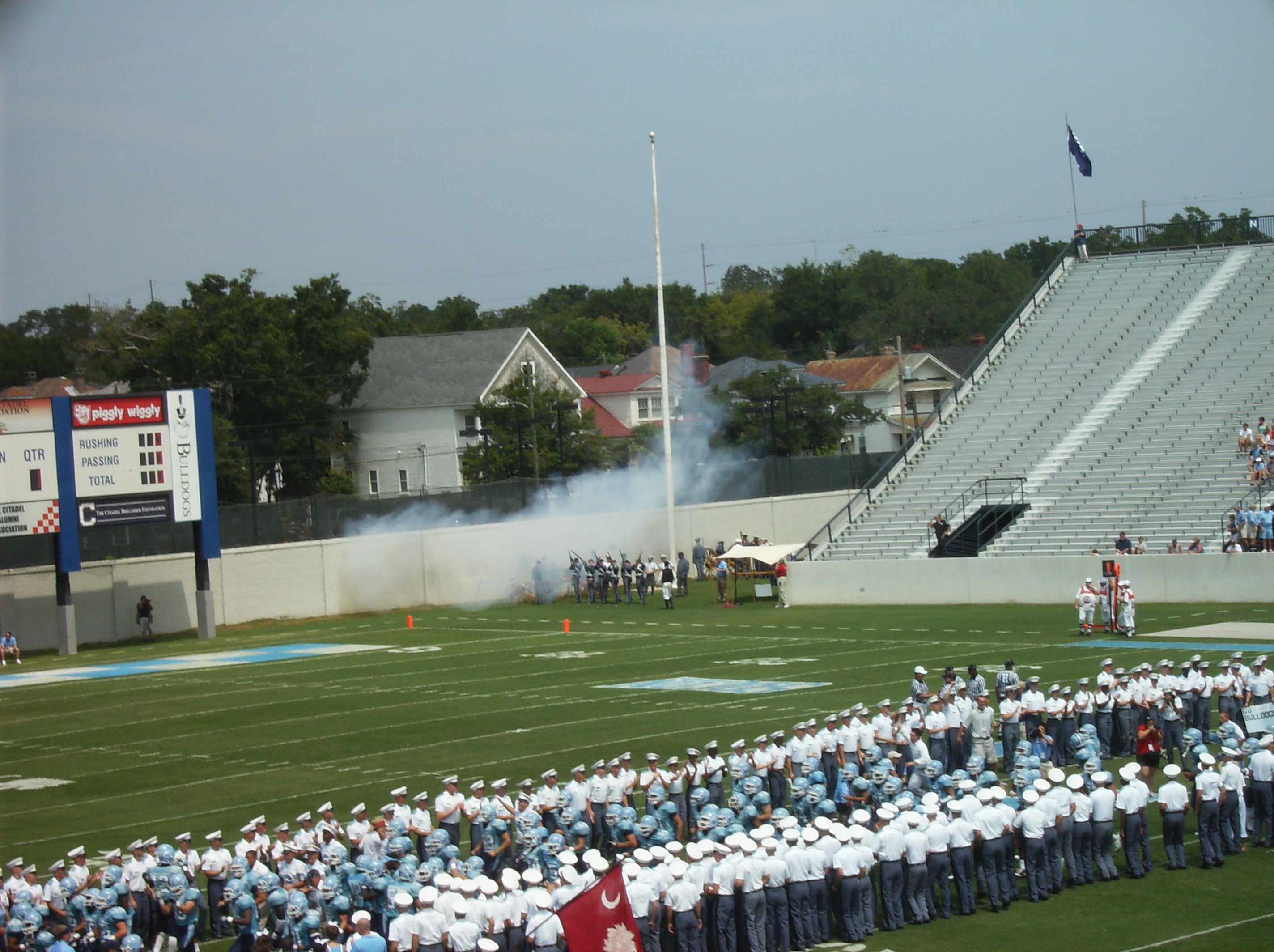
One unaccounted-for consequence of wearing navy jerseys with medium (not light) blue numerals is that it made it harder to ID players, particularly at night, following a storm, and with cannon fire smoke hanging in the air.  I’m guessing nobody in the press box was crazy about the uniforms — at least, nobody whose job involves trying to figure out which players are in the game/making tackles/carrying the ball/etc.

As usual, the uniform fails to include the full (and correct) name of the school in the lettering on the front of the jersey.  I have no idea why it’s so difficult to do this.  Maybe it’s a Nike thing.

— 

All in all, a good night for The Citadel’s football team.  The team completes its non-conference slate with a 2-1 record, which is what was expected, but not guaranteed. 

I’ll conclude this by saying that I like the idea of playing Presbyterian on a regular basis; maybe not every season, but more often than not.  PC fits the bill of what The Citadel needs in a non-conference home opener better than just about any other alternative, particularly with the way the schedule will shake out over the next few years (including the revival of the series with VMI).

On to Furman.

Football, Game 3: The Citadel vs. Presbyterian

Gametime:  7 pm ET, at Johnson Hagood Stadium

TV:  Uh, that would be a no.

The final non-conference game of the season for The Citadel is a matchup with in-state foe Presbyterian, a traditional opponent from days gone by, but now back on the schedule for a second consecutive year after an absence of almost two decades.  I wrote about the series history in my preview for last year’s contest, for anyone interested.

With the Bulldogs’ 46-21 victory in 2009, The Citadel now holds a commanding 49-11-1 lead in the series, including a 27-3 mark at Johnson Hagood Stadium, which has been the site for every game between The Citadel and PC since 1950 save one (a 1963 contest played in Savannah; I’m not sure why).  The Blue Hose last defeated the Bulldogs in 1979; since then, The Citadel has won eleven straight games in the series.

Tangent:  Last year’s preview includes links to some photos taken by Life magazine in 1955; a reporter for the weekly was on campus to write a story about Mark Clark’s new job as president of the school.  He was joined by a staff photographer, who took a lot of photos of cadet life, including a series of shots of the Homecoming football game against PC (none of which were used in the article).

I don’t have a copy of the issue (it’s from November 28 of that year), but from what I can tell, the actual feature on Clark is only about two pages in length.  I’m amazed at how many photographs were taken for such a short piece.  I’m glad they were taken, though; as a whole, they’re fascinating.   If you want to surf Google’s archive for the 1955 Clark/The Citadel Life photos (albeit while wading through some pictures not related to the military college), go here.

The road to FCS status has not been an easy one for the Blue Hose.  As recently as 2005, Presbyterian won the (Division II) South Atlantic Conference with a 10-2 overall record, the first conference title for PC since winning the SAC in 1979 (coincidentally, the last time the Blue Hose beat the Bulldogs).  However, as Presbyterian has made the transition from D-2 to FCS, the win-loss record has naturally declined, leading to last season’s 0-11 record.

Those eleven losses included only one game in which PC lost by less than seven points, a 41-37 setback against Coastal Carolina in Conway, which is also the team/locale of the Blue Hose’s last road victory (in October of 2007).  Presbyterian has lost 16 straight games overall, and has also lost 16 consecutive road games.  PC opened the 2010 campaign with two “automatic” losses, to Wake Forest and Clemson, by a combined score of 111-34.

Having noted all that recent gridiron misery for the Blue Hose, it would not be a shock if Presbyterian defeats The Citadel on Saturday.  Disappointing, yes, and perhaps a bit surprising, but not a shock.

Presbyterian hung around in last season’s game against the Bulldogs for the better part of three quarters, and now The Citadel will have to compete while continuing to work the kinks out of a brand-new offense that struggled at times against Chowan, to say nothing of Arizona.  It’s exactly the kind of situation that would give a team like Presbyterian hope.

After all, PC moved the ball on The Citadel’s defense last year, including 204 yards rushing.  Trandon Dendy was responsible for 147 of those rushing yards, and he’s back this year.  Joining him on the Blue Hose offense is Michael Ruff, who caught two touchdown passes last week against Clemson, and who also caught a TD pass on this much-seen trick play against Wake Forest.

PC won’t be afraid to throw some more “trickeration” The Citadel’s way, so the Bulldog defense needs to be prepared.  I do wonder if the Blue Hose might have been better off saving some of their best stuff for a more competitive game.  The fake against Wake was a great play, but even with it PC still lost by 40.  On the other hand, you’re probably not going to make SportsCenter if you run the play in an untelevised game.

Last year I wrote that against Presbyterian, the defensive line was occasionally  “pushed around by an offensive line that included a 258-lb. left tackle and a 240-lb. center.”  That won’t happen this year…because PC’s offensive line is much heavier. The starting center for the Blue Hose weighs 260 lbs., and the left side of the o-line averages 297 lbs.  So far, this year’s edition of The Citadel’s defensive front has shown a lot of potential.  It better show more than potential this Saturday.

The challenge for the Bulldog offense is to have the same type of production against PC it had last season, but without Andre Roberts.  The Blue Hose had no answer for Roberts, who caught 12 passes for 184 yards and 4 TDs against Presbyterian.  Andre won’t be in Charleston on Saturday; he’ll be in Atlanta, preparing to (hopefully) make his NFL debut with the Arizona Cardinals the next day.

Which player will (or should) be running Saturday’s offensive attack has been a subject of interest.  Kevin Higgins has announced that Matt Thompson will again get the call as the starter at QB, which I think is fine.  Thompson did struggle against Arizona, but that was Arizona — he’s not the only guy who struggled.  Sam Martin did do a fine job running the triple option when he entered the game in the third quarter, and should see his share of time too.

Really, at this point it doesn’t matter much who starts.  Both should play, both will probably get plenty of work, and in this transition season, anointing a permanent starting quarterback strikes me as probably a waste of time and possibly counter-productive.  I was a little surprised that Game 1 starter Ben Dupree was so quickly moved to slotback, but I gather that the coaching staff wants him on the field, regardless of position.  I also wouldn’t be all that surprised if Dupree is still in the mix at QB, even with the switch.

Things on offense that must continue to improve include the perimeter blocking, the center-QB exchange (something that affected both Thompson and Martin, despite Martin not actually losing a fumble), the pitch plays (both QBs threw some scary pitches, especially Thompson, with one of his resulting in a lost fumble), and the pass catching.  In this offense, you really can’t afford to drop passes, because there aren’t many reception opportunities as it is, and they tend to be big plays when successfully completed.

I would like to see more “playmaking” from the back seven, particularly the linebackers.  Other things that need to improve on defense include the tackling, which was better against Arizona but still not optimal (the Wildcats’ first TD came after Juron Criner gained an additional 20 yards following a missed tackle), and assignment pickups (with the DBs missing some reads against Chowan).

A few other random observations not related to the actual play on the field:

– I noticed during the Arizona game that the coach who sends in the offensive signals on the sideline wears a red shirt, presumably to make him easier for the QBs to see. He was wearing a plain Nike shirt; given that The Citadel is trying to push “Big Red” apparel, maybe the coach could wear a Big Red polo shirt instead.  Just a thought.

– Speaking of Big Red, The Citadel is going to have a “red out” at Homecoming.  Now, Arizona is having a “red out” against Iowa this Saturday, which should go well, since red is one of Arizona’s colors and Iowa wears black and gold.  I’m not necessarily criticizing The Citadel’s administration for the basic idea behind the “red out”, given the aforementioned push for Big Red, but as it happens the Bulldogs’ opponent for Homecoming is Elon.  The primary school color for the Phoenix is…red.

I don’t believe enough thought was put into that decision.

– Against Chowan, The Citadel introduced a new cartoon mascot, apparently to replace the shako-wearing Spike.  Here is a photo of the “new” Spike (if he is actually being called Spike; I’m not sure about that):  Link

There have already been complaints about the “look” of the new mascot, which has floppier ears than the old one, and of course does not wear the shako.  I don’t know, but I wouldn’t be surprised if the shako may have been a bit problematic when it came to wear and tear.

I don’t think the new mascot really looks like a rabbit, as was suggested in that thread I linked above, but I do think that if that’s going to be the new cartoon image, then The Citadel probably needs to adjust its mascot “mark” accordingly.  It should be consistent.  Of course, consistency has never been a hallmark of The Citadel’s logos/marks/branding history; it’s almost as bad as the school’s lack of stability in its football uniform history.

Ultimately, of course, my opinion about the new mascot doesn’t matter, and the same is true for any other alumnus.  That’s because the cartoon mascot isn’t intended to entertain the alums; it’s there for their kids.  If your typical five-year-old likes the mascot, then it’s good enough for The Citadel.  Adults are supposed to be entertained by good cut-block technique and superior tailgating.

Presbyterian will certainly be up for this game, as it represents a very real chance to break its long losing skid.  If the Bulldogs were to lose to PC, it would be the beginning of a very long season.  However, I am hopeful that the offense can generate enough points to avoid the upset, and I suspect the defense will be more than ready to assert itself.

I’ll be very curious about the attendance, what with Clemson (on TV) and South Carolina (at home) playing at the same time as The Citadel.  The weather should be more conducive to watching football than it was for Chowan, at least (please, no more 1 pm starts in early September).

Go Dogs!

Review: Arizona

Well, it was about what I expected.

Arizona is probably a better-than-average Pac-10 team, possibly a contender in that league (although Oregon has to be the favorite).  The Wildcats did what top-25 FBS teams are supposed to do when playing an outmanned FCS squad.

I don’t believe in moral victories, but I do believe in looking at the positive side of things when it’s warranted.  Some points in The Citadel’s favor:

1.  It wasn’t a complete debacle.  I was worried that even if The Citadel were not completely overmatched, the nascent offensive system would turn the ball over repeatedly and give Arizona a bunch of easy points.  Other than a couple of mini-stretches late in the first half and early in the second, however, that didn’t happen.  52-6 may not look that great, but it’s a lot better than 82-6.

2.  Apparently the Bulldogs came out of the game relatively unscathed.  Kevin Higgins mentioned Alex Carr and Tolu Akindele had been banged up in his press conference, but he didn’t rule any player out for the game against Presbyterian.

Two players Higgins didn’t mention but who I wondered about (in terms of injuries) were Johnathan Glaspie and Tyler Starnes, both of whom took big hits during the game.  Glaspie actually re-entered the game after taking a shot earlier in the contest.  (Judging from his expression as he walked off the field, I wasn’t sure he knew if he was in Tucson or still playing for Spring Valley High School.)  Starnes got somersaulted on a carry near the end of the game; it’s a wonder he didn’t suffer a serious leg injury.

— Edit:  According to Jeff Hartsell, Higgins did mention Starnes in his Monday presser.

3.  The defensive line was solid.  The Bulldogs appear to have found a potential star in Derek Douglas, who was singled out for praise by Higgins, and deservedly so.  He wasn’t the only lineman to make a play or two in the game, though.  I particularly liked the lick Erik Clanton laid on one unsuspecting Wildcat running back.  Of course, it helps when nobody blocks you…

4.  Sam Martin did a nice job running the offense when he entered the game.  I went back and noted who was in the game for Arizona on defense when Martin began his first drive.  The Wildcats had nine of their eleven defensive starters in the game, plus two other players who were in their regular rotation on the line.  In other words, he wasn’t playing against walk-ons when he led The Citadel to its first score.

5.  Although he didn’t throw the ball real well and didn’t have much luck moving the team, Matt Thompson never seemed to panic and maintained his poise.

6.  I agree with Higgins that the tackling was better against Arizona.  However, I think it still needs improvement.

7.  Terrell Dallas showed flashes of what he’s capable of accomplishing in this offense, which is a lot.

8.  The Citadel got an encouraging performance from its special teams units.  Cass Couey had an excellent game.  I bet he enjoyed punting in the desert air.  Sam Keeler made both of his field goal attempts; I hope that will improve his confidence.  The coverage teams did a nice job, and freshman Terrance Martin established himself as The Citadel’s primary kick returner.

9.  The Bulldogs only committed two penalties for a total of nine yards, my favorite statistic from the game.  More of that, please.

Obviously, there were negatives unrelated to the competition that need to be addressed.  Some of those for the offense would be the center-QB exchange, the pitch techniques, and the dropped passes (hopefully an anomaly).  The defense must continue to concentrate on tackling, and the back seven must show more dynamism.

There are more observations to make about what will (or should) happen going forward, of course.  I’ll try to mention those in my preview of the Presbyterian game.

A quick look at The Citadel’s future football schedules

One of the many curious things about college football is that fans often are just as interested (if not more interested) in what will happen in the future than what is happening right now.  I’m talking mostly about recruiting and scheduling, of course.

With this post, I’m going to wildly speculate on potential scheduling options for The Citadel.  This is something Jeff Hartsell briefly mentioned Tuesday.  The Citadel will play eight Southern Conference games each season.  In 2011 and 2012, that means the Bulldogs will play three non-conference games (11-game regular season).  In 2013 and 2014, the calendar will allow for a 12-game regular season for FCS schools, meaning The Citadel can play four non-conference games.

Each year one of The Citadel’s non-conference games has to be a road “guarantee” game against a BCS opponent, for budgetary reasons.  Also returning to the Bulldogs’ schedule in 2011 is VMI.  The battle for the coveted Silver Shako will resume at Johnson Hagood Stadium, with the teams alternating home-and-home for six years. It is my understanding that those years are consecutive, although I haven’t been able to confirm that yet.

Another non-conference game each season will take place against a non-conference opponent that won’t demand a return trip — in other words, teams like Chowan and Webber International (or more preferably, Presbyterian and Newberry).  I’ll call this game the Designated Home Opener, or DHO.

The 2011 non-conference schedule will feature VMI (home), South Carolina (away), and a DHO to be determined (home).

The 2012 non-conference schedule will feature VMI (away), North Carolina State (away), and a DHO to be determined (home).  In that season, the Bulldogs will only play five games at Johnson Hagood Stadium.

Starting in 2013, things get a little interesting.  Again, assuming the VMI series is for six consecutive years (assumptions always being dangerous), The Citadel’s non-league slate would feature VMI (home), Clemson (away), a DHO (home), and another team to be determined.

The 2014 season would include a road game against VMI, a DHO, and two games to be determined (with one of them definitely having to be a guarantee game).

That leaves Larry Leckonby with important decisions to make about scheduling in 2013 and 2014.  Do you add a second BCS guarantee game in those seasons?  Or do you add a second DHO-type team?

There is another possibility, one that would be very popular with alumni, and that is to schedule a game against Army or Navy (or Air Force, I suppose, although I don’t think there is nearly as much interest in that potential matchup).

A quick scan at future schedules for Army and Navy shows that there is a spot possibly available for an FCS opponent in 2013 for Army and 2014 for Navy (in 2014, Army has scheduled Fordham, which would have been a tough ticket seven decades ago; Navy is playing Delaware in 2013).  Of course, there is a chance that none of the academies would be interested in playing The Citadel anyway.

Scheduling a service academy or a second BCS school would be more problematic in 2014, as the VMI game would be played on the road that year.  I don’t know that Leckonby wants to put the team in position to play only five home games and seven road contests, with two of those being against FBS opponents (and that’s assuming he can find two FBS opponents).

One of the things that will be a factor is attendance at Johnson Hagood Stadium.  If The Citadel continues to have disappointing numbers at the gate, Leckonby may be more likely to eschew a possible sixth (or seventh) home game to grab a more lucrative road guarantee.

Another possibility would be a series like the one The Citadel had with Princeton, a two-game home-and-home (in 2013-2014) against an FCS school from outside the SoCon.   That seems a less likely option to me, but you never know.

We’ll see what happens.  All of the above is mostly uninformed guesswork by yours truly, of course, and should be taken with a grain of salt, assuming that it even deserves the grain.

Why exactly is The Citadel playing Arizona in the first place?

I didn’t touch on this in my preview of the game between The Citadel and Arizona, but I figured I could make a quick post out of the question:  why exactly is The Citadel playing Arizona in football in the first place?  I’m sure fans of both schools are a little curious about that.

Well, for money, of course.  The Citadel has to play at least one football “guarantee” game every season to balance (or attempt to balance) its budget for athletics.  On the other hand, surely The Citadel could find an FBS opponent a little closer to home, an ACC or SEC team, or even a Big East squad.  After all, the Bulldogs have played teams from all those leagues in the last few seasons, along with a Big XII team (Texas A&M), a Big 10 outfit (Wisconsin)…oh, wait a second.  I see a pattern — a pattern created by none other than Les Robinson.

That’s right, The Citadel’s national tour of BCS conferences is a result of one of former AD Les Robinson’s grand ideas.  You can read about it here:  Link

The game against the Pac-10’s Arizona is the last of the “BCS series” for The Citadel, which in the past five years has traveled to play against the aforementioned Texas A&M and Wisconsin, along with Pittsburgh of the Big East, Florida of the SEC, and North Carolina and Clemson of the ACC.

Just prior to that five-year run the Bulldogs traveled to Oxford to play Mississippi and Tallahassee to tangle with Florida State.  The coach for all these games has been Kevin Higgins, so keep that in mind when evaluating his 25-32 record at The Citadel. I think there is a good chance Higgins is the only head coach in the country to have played teams from all six BCS conferences in the last five seasons.

After this game the Bulldogs will have completed the Robinson Quest, having played teams from all six BCS leagues.  Robinson even set up a “bonus” two-game series with Princeton of the Ivy League.  I am not sure current AD Larry Leckonby is crazy about scheduling the likes of Arizona or (to a lesser extent) Wisconsin, as the travel for those games eats into the guarantee.  It was also a significant issue for the game at Princeton.

I can certainly understand that, and in the future I expect most, if not all, of The Citadel’s football guarantee games to come against SEC/ACC schools.  However, I don’t think it hurts the school to travel out of its home region on occasion.  I agree with the comment Robinson made in the linked article about such games providing needed national exposure.  Another thing they provide is an opportunity for alums living outside the southeast to attend a game.

The Citadel brought a very good crowd to the Princeton game last year.  I can attest to the number of PA/NJ/NY alums in attendance, most of whom showed up with their families, and some with friends too.  We need to play games like that once in a while, if only for those fans.

The game against Arizona will give some of our alums on the west coast a chance to see their team in action.  Admittedly, a game against UCLA or Stanford might have been a better bet in terms of Bulldog supporters showing up — I’m not sure how many alums live in Arizona — but still, it’s in the general area.

Anyway, I hope the following gives a little insight into how this game came to be.  I don’t think we’ll be seeing any other matchups on the gridiron between The Citadel and Pac-10 teams in the near future, but you never know.

Football, Game 2: The Citadel vs. Arizona

Gametime:  10 pm ET, September 11.

Telecast:  KWBA, local channel 58 in Tucson, and on Fox College Sports Pacific (FCS-Pacific), joined in progress; announcers are Dave Sitton, John Fina, and sideline reporter Glenn Howell

There won’t be many schools this season who will face in consecutive weeks opponents as different as Chowan and Arizona.  Chowan is a small Division II school in North Carolina.  Arizona is a large Division I (FBS) school, the flagship university of a populous western state.  Chowan has about 1,100 undergraduate students. Arizona has 30,000.  Indeed, Arizona has more undergraduate and graduate students than The Citadel has living alumni.

The difference is reflected in the football teams as well, of course, and thus The Citadel’s football team has its work cut out for it this week as it ventures to Tucson, the longest trip in program history.  Since The Citadel has never played Arizona (or any Pac-10 school) before, let’s take a brief look at the history of the University of Arizona’s football team.

The Wildcats (originally just known as the “Varsity”) started playing football in 1899, 14 years after the school’s founding.  Keep in mind that Arizona didn’t become a state until 1912 (it was the 48th and last of the contiguous states).  It had been a recognized U.S. territory since 1862.

The first official coach of the football team was “Pop” McKale, for whom the McKale Center (UA’s basketball arena) is named.  McHale also coached the basketball team for a time and was the school’s longtime director of athletics.

McHale was also a central figure in the story of Arizona’s great tradition, its motto “Bear Down”.  In 1926, Arizona quarterback and student body president John “Button” Salmon was critically injured in a car accident after the first game of that season. McHale regularly visited Salmon in the hospital until Salmon’s death on October 18.

During the coach’s final visit, Salmon told McHale to “tell them…tell the team to bear down.”  McHale reportedly told the team just that, repeating Salmon’s words during a game against New Mexico State which the Wildcats managed to win, 7-0.  It’s a tale not unlike Knute Rockne’s “Win one for the Gipper” speech for Notre Dame.

Ever since, “Bear Down” has been the official slogan for all of the university’s athletic teams.

Salmon is one of two players to have his jersey retired at Arizona.  The other, running back Art Luppino, led the nation in rushing twice in 1954 and 1955.

Arizona first joined a conference in 1931, becoming a charter member of the Border Conference, and remaining in that league until it disbanded in 1961.  Other schools in the league included Texas Tech, UTEP, New Mexico, New Mexico State, and Arizona State.  They were joined at various times by Hardin-Simmons, Northern Arizona, and West Texas A&M.  The Wildcats won three league titles while in the Border Conference and played in one bowl game during that time, losing the 1949 Salad Bowl (yes, Salad Bowl) to Drake (yes, Drake).

Arizona then became a founding member of the Western Athletic Conference (WAC). That league was basically a merger of the Border and Skyline Conferences, except not every school in those leagues was invited (New Mexico State, for example).  Also in the original WAC:  Arizona State, BYU, Utah, New Mexico, and Wyoming.  Arizona won two league titles in the WAC and played in one bowl game, the 1968 Sun Bowl (losing to Auburn).

Arizona and Arizona State gradually outgrew the WAC, mostly because the state of Arizona was outgrowing (by percentage) most of the other states in and around the mountain time zone.  The development of air conditioning helped produce a population boom in the state, and the increase in population/resources trickled down to the state universities.  The two schools joined the Pac-8 (renamed the Pac-10) in 1978, and have remained in that conference since then.

The hallmark of the program in that time, much to the frustration of  Arizona’s fans, has been its inability to make a trip to the Rose Bowl.  Its rival, Arizona State, has been to the big game twice (winning once), but the Wildcats have never been.  Arizona has come close on two occasions, both times under the direction of Dick Tomey.

In 1993, Arizona shared the Pac-10 title with UCLA and Southern California, but lost a tiebreaker to UCLA for the Rose Bowl berth.  This is the only time the Wildcats have claimed even a piece of the Pac-10 crown.  Arizona had lost earlier in the season to UCLA, but as late as November 14 still had a shot at Pasadena after a UCLA loss. However, the Wildcats blew a 20-point lead and lost to California, 24-20, eliminating them from Rose Bowl consideration.

The Wildcats did rebound from that disappointment, beating their rivals in Tempe and then dominating Miami 29-0 in the Fiesta Bowl to finish the season 10-2, with the bowl game arguably being the pinnacle of Arizona’s “Desert Swarm” defense, which was the national identity of the program in the mid-1990s (and personified by Tedy Bruschi).

The Fiesta Bowl victory was a major reason why Sports Illustrated ranked Arizona No. 1 in its 1994 preseason issue, but after starting the campaign 4-0 the Wildcats were upset at home by Colorado State.  Arizona also suffered road losses to Oregon and Southern California and finished with a Freedom Bowl loss to Utah and a disappointing 8-4 season.

In 1998, Arizona finished 12-1, losing only to UCLA (albeit at home by four touchdowns).  However, the Wildcats were looking good for a Rose Bowl appearance anyway, as the Bruins completed their Pac-10 schedule undefeated and were poised to play for the mythical national title at the Fiesta Bowl.  That would have sent Arizona to the Rose Bowl.

Unfortunately for Arizona (and the Bruins, as it turned out), UCLA had to play a December game originally delayed by a hurricane against the Hurricanes — and lost to Miami, 49-45.  That result meant the Bruins took the berth in the Rose and the Wildcats had to settle for the Holiday Bowl (which they won, beating Nebraska).

When I was looking at Arizona’s football history, and wondering what was preventing Arizona, a big school in a BCS conference with success in a lot of sports other than football, from grabbing the brass ring, one thing stood out.  It must have stood out to Joe Tessitore and Rod Gilmore too, because while calling the Wildcats’ 41-2 dismantling of Toledo last Friday on ESPN, they mentioned (and marvelled at) the following factoid:

Arizona hasn’t had a quarterback drafted by the NFL since 1985.

Think about that.  There can’t be that many BCS programs who have gone that long between QB draft picks.  In fact, that QB (10th-round pick John Conner, who did not throw a pass in the NFL) is the only quarterback out of Arizona drafted since 1972 (when another Wildcat signal-caller who never played in the league, Brian Linstrom, was selected in the 16th round).  It’s not like Arizona’s been running the wishbone all this time, either.

Arizona’s football program has had three different quarterbacks make a total of 29 starts in the NFL, none since 1974.  So in all the time UA has been in the Pac-10, it’s never developed an NFL quarterback.

It’s hard to win big games, or even get to big games, without a pro-caliber quarterback.  Since 1975, only one Arizona alum has thrown a TD pass in the NFL — a punter, Josh Miller, who did it for the Pittsburgh Steelers in 2003 (an 81-yard pass play, incidentally).  Here is a little chart comparing alums from Arizona, The Citadel, and a mystery school:

TD passes thrown in the NFL since 1975

Arizona — 1

The Citadel — 1

Mystery School — 0

If you’re wondering, the graduate of The Citadel with a touchdown pass is Stump Mitchell.  Now, that mystery school that hasn’t had a grad with a TD toss in the NFL in the last 35 years?  Well, it’s a school that has quite a bit in common with Arizona on the athletics front.  It’s a “basketball school” that has won multiple titles in other sports, but hasn’t been able to parlay its success in those sports into a nationally prominent football program.

Like Arizona, a good argument can be made that the reason for that has a lot to do with never having an “NFL ready” quarterback.  What school is that?  Why, it’s the BCS school The Citadel played last season.

North Carolina.

I wrote about UNC’s football history in my preview of The Citadel’s game against the Heels last year.  At the time, I noted that the overall QB rating for players from The Citadel to have thrown a pass in the NFL (which would be just two, Mitchell and Paul Maguire) was exactly 100 points better than their UNC counterparts (119.6-19.6). Arizona is a little better than North Carolina in this respect (47.7), but again the mighty Bulldogs prevail.

What will this mean on Saturday?  Not much, since it’s probable the Wildcats have finally found themselves an NFL prospect at QB in Nick Foles.  Foles is a native of Austin (went to the same high school as Drew Brees) who began his collegiate career at Michigan State before transferring to Arizona after one season.

He has NFL size (6’5″, 245 lbs.) and a good arm.  Last season he completed 63% of his passes for 19 TDs (9 interceptions).  His yards per attempt was not that high (just over 6 yards), but he was only sacked 13 times all season (so not a lot of negative plays).  His three 300-yard games included a 4-TD effort against league champion Oregon.

Foles isn’t the only impressive skill-position player on the Wildcat offense.  Nic Grigsby, when healthy, is an outstanding running back.  Grigsby averaged over seven yards per carry last season.  His problem was a bad shoulder that cost him three games and limited him in several others.  He appears to be healthy now.  Then there is Juron Criner, a rangy 6’4″ wideout who hauled in nine touchdowns last season.

Criner had a ridiculous game against Toledo on Friday, catching eleven passes for 187 yards and a touchdown.  Forty-five of those reception yards came on a one-handed, falling-down circus catch in the third quarter.  His TD grab was almost as good.

Arizona had to replace seven defensive starters from last season, but you would have never known it against Toledo, which did not score on the Wildcat defense (the Rockets’ only two points came on a safety called for offensive holding in the end zone).

Arizona is as good a bet as any team to make a run at the Pac-10 title.  Oregon, the defending champ (and coming off a 72-0 demolition of hapless New Mexico), probably has to be the favorite, but if the Ducks slip it’s possible the Wildcats could be the team to make the move to the top and claim the school’s first Rose Bowl trip.

Arizona was picked in the middle of the conference pack in most preseason polls, likely thanks to getting manhandled 33-0 in the Holiday Bowl by a certain Mr. Suh and Nebraska.  Its most recent impression among those who vote in pre-season polls was not a good one.  Otherwise, I think a team with the talent (particularly on offense) that Arizona has might have been nationally ranked to start the season.

Arizona’s coach is Mike Stoops, also known as “Bob Stoops’ brother”.  He has very slowly built the program since arriving in 2004 (wins per year:  3, 3, 6, 5, 8, 8).  Some Arizona supporters have become a bit impatient.  He needs to have a good year this year.  He’s probably going to have one, so I wouldn’t assign him “hot seat” status, but if the Wildcats were to tank this season, I think he would be out the door.

It could be a long night for The Citadel.  In fact, it would be surprising if it weren’t.  The problem is that the defense is going to have some matchup problems (particularly with Criner), and will not be likely to get much help from the offense.

Last season against BCS foe North Carolina the defense got no help from the offense either, but the UNC offense wasn’t dynamic enough to take full advantage of its field position and time of possession.  As a result, the Bulldogs lost, but only by a 40-6 score.  Arizona may not have as good a defense as UNC did, but The Citadel’s offense will be worse (as it is still in its embryonic stage in the triple option) and the Wildcat offense is considerably more talented than the Heels’ O was.

I wrote about some on-field things that concerned me in my review of the Chowan game.  I am hoping that the blocking improves, that the quarterbacks get more comfortable taking the snap and making the proper reads, and that the defense does a better job in assignments and tackling.   Against Arizona, I don’t really expect to see much visible progress from the offense, although I am willing to be pleasantly surprised.

I do think that the one player who might not be physically out of place in the game for The Citadel’s offense is Domonic Jones.  I could see him making a play or two.  First, of course, the QB has to get him the ball, or at least give him a chance to get the ball.

On the other hand, I do expect the defense, even against a squad as talented as the Wildcats, to avoid multiple mental errors and not miss tackles.  That should happen. If it doesn’t, things could get ugly.

I’ll be watching anyway…

Review: Chowan

It was hot.

That wasn’t surprising.  An early September day in Charleston is a good candidate to be hot.  I think the heat/humidity combo in Charleston at this time of year is actually worse than that of Columbia, and everyone knows how hot Columbia can get.  The game started promptly at 1 pm.  Thus, it was hot.

The heat probably was a factor in the announced attendance of 9,106.  That’s the lowest home attendance for a Bulldog home game since the 2004 game against Benedict (5,127).  I was there for that one too; that was a Thursday night “experiment” played during the period the home stands had been dismantled.

Also a factor, of course, was the anonymity of the opponent and the program’s lack of success in recent years.  I think that even if The Citadel had been playing a name opponent after coming off a winning season, though, the 1 pm start time might have turned off a lot of people.  The early afternoon start times are convenient for me, but in the main most fans (or potential fans) don’t want to be in the stands at that time during late summer.

As was pointed out to me, however, the Frosty accompanying the attendance announcement on the scoreboard filled up anyway.  Imagine if we had 15,000 or so in attendance; the cup would have overflowed.  What a waste of Frosty that would be.

As for the game itself, some quick points:

— Late in the second quarter, Chowan gave up 28 points in 1:18 of game time, which is not easy to do.  The score went from 21-0 to 49-0 while a good chunk of the crowd was underneath the stands, having left early for halftime.  I’ll say this for the Hawks, though — they didn’t quit.  It would have been easy to mail it in after such a demoralizing sequence of events, but Chowan scored on its first two possessions of the third quarter and played hard throughout the second half.

— The “triple option” offense, it seemed to me, was for the most part restricted to two options rather than three.  There weren’t a lot of plays that led to a pitch, or the chance of a pitch.  I thought the game plan was conservative, which was not inappropriate, but wasn’t all that effective either.  The blocking needs to be improved, particularly on the perimeter.

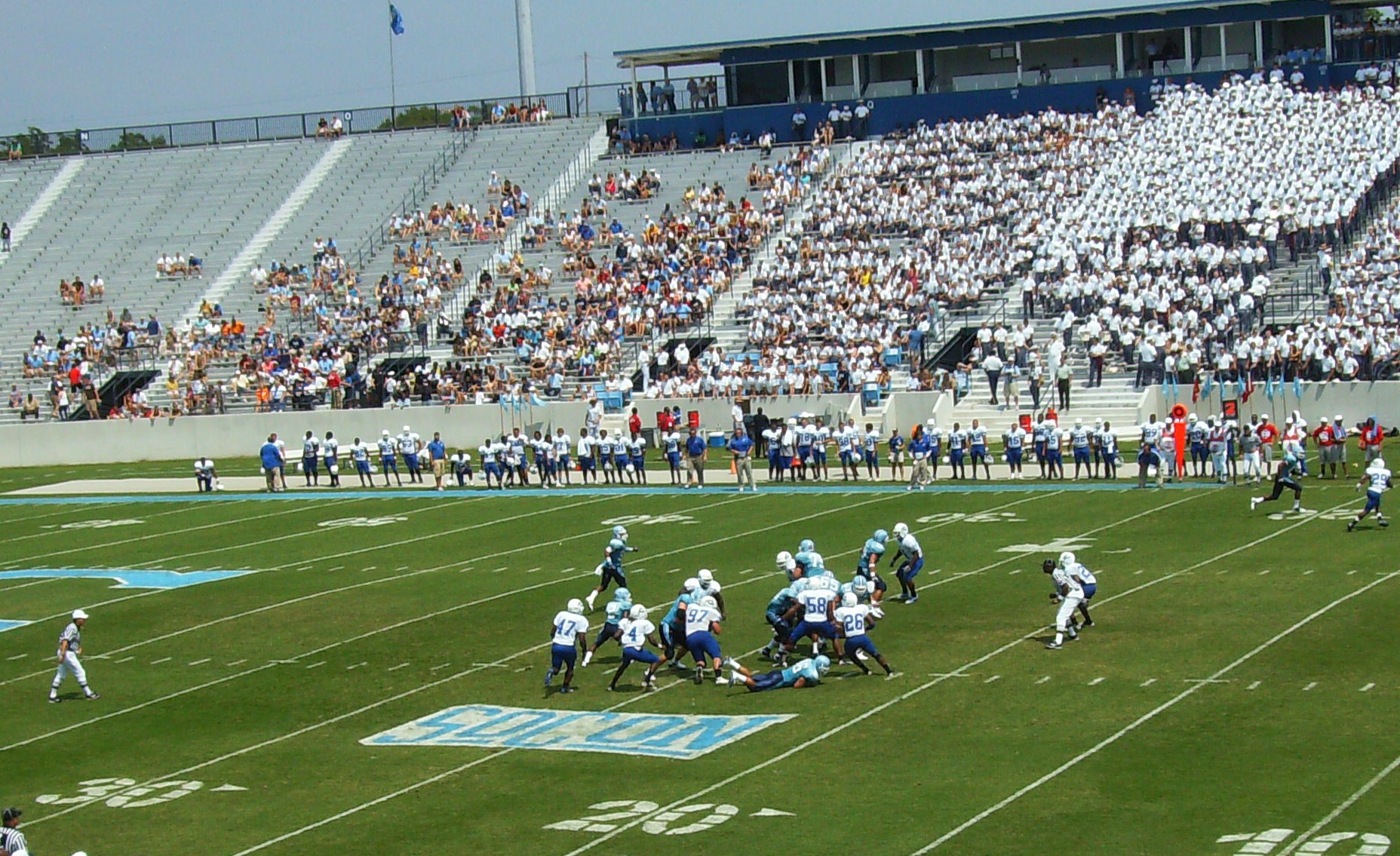
Here are some (distinctly unprofessional) pictures of the offense for anyone interested.  There is a shot of the offense in its basic formation; one with multiple wideouts; and a really bad “action” shot of the offense:

— I was a little disappointed in the defense, which allowed a number of long drives and big plays.  Twice Chowan got to the Bulldog 1-yard line in the first half and failed to score.  I guess you can credit The Citadel’s D for making the stops when it mattered, but in both cases it had more to do with Chowan shooting itself in the foot than superior defensive play.

The defense missed too many tackles, and the secondary blew some coverage assignments.  Part of the latter had to do with different personnel getting a chance to play, which is understandable.  There is no excuse for missing tackles, though.  The defensive line played well, although the second Chowan TD came on a play during which a lineman whiffed on an easy sack.

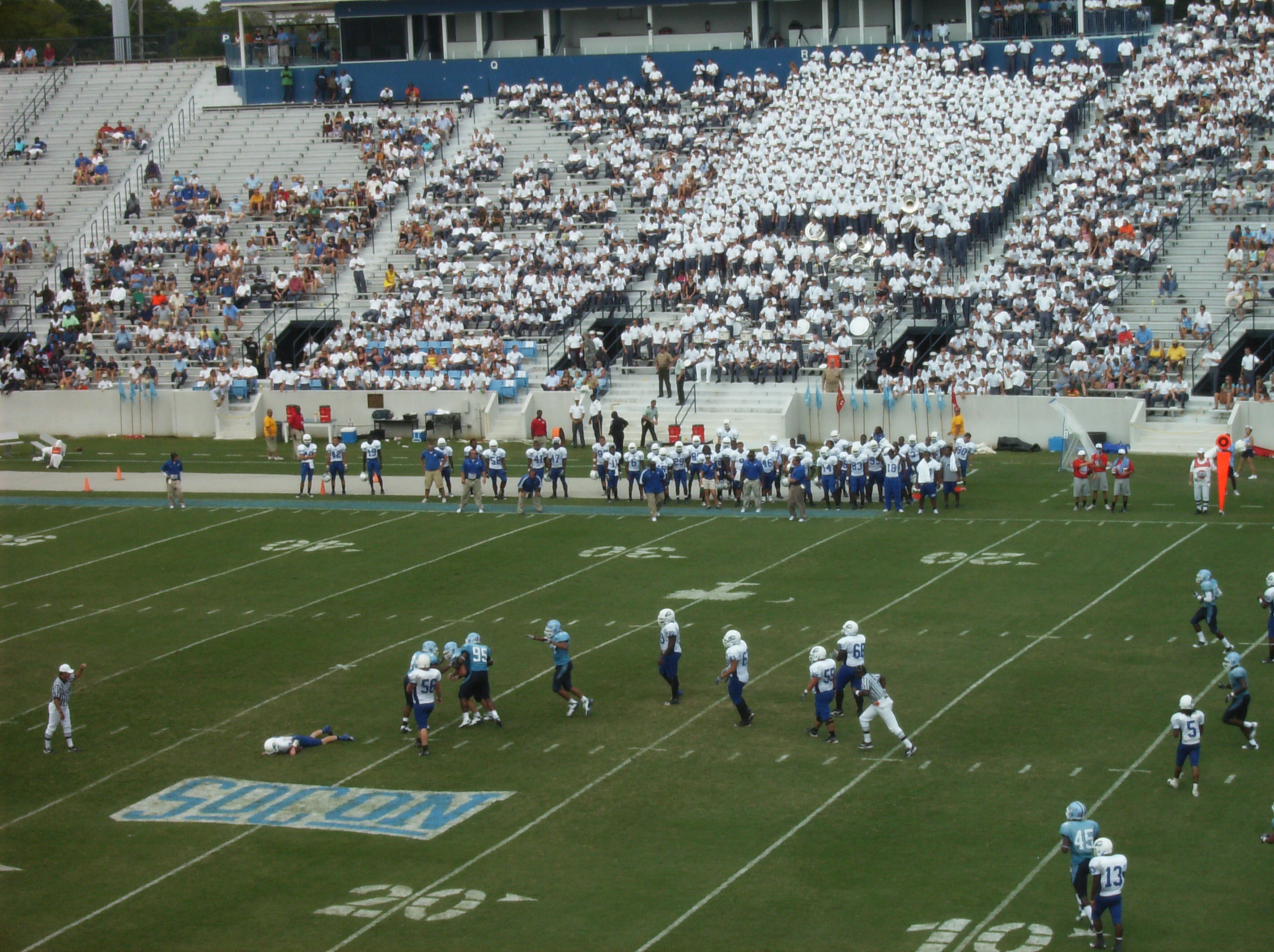
Here is a before/after shot sequence for fans of the D to enjoy, though.  Chowan is about to snap the ball on a 4th-quarter play where it has the ball on the Bulldog 12, second-and-7.  The second picture shows the aftermath of the play, thanks to Derek Douglas (Chowan would eventually miss a FG on the drive).

— I thought Matt Thompson had a good game, although I wouldn’t anoint him the permanent starter just yet.  I think Ben Dupree deserves to get some time, too, and I also think Sam Martin should continue to get some looks.  Thompson did show a good throwing arm.

It helped that he had Domonic Jones as a target.  Jones is 6’5″ and plays every inch of that.  He should be causing problems for SoCon defenses for several years to come.

— I noticed there were no names on the jerseys, which I thought was interesting.  The light blue jersey/navy pants combination still looks awful.

I’ll write about the Arizona game in my preview of that matchup, but suffice to say it’s going to be a major challenge for the Bulldogs.  I was impressed with the Wildcats when I watched them play on Friday night at Toledo.  Arizona has serious playmakers at quarterback, running back, and receiver, and a solid defense.  The one thing going for the Bulldogs is that the desert heat should not present any problems, after playing in the heat and humidity of midday Charleston.

The new “Kids Zone” debuted on Saturday.  This is a good idea and I was glad to see it. I even took a couple of pictures of the KZ (in one, a cadet is staring almost directly into the camera, clearly wondering to herself why someone would be taking pictures).

I took this picture (which includes the captains about to go onto the field for the coin toss) just to show how hot it was.  It was apparently too hot for General and Boo (note the absence of the doghouse, to say nothing of the dogs themselves).

Edit:  I just noticed that one of the dogs (probably General) is standing on top of a table near the top left of the picture, just outside a tent, being held on a leash by (I think) Mike Groshon.  So there was at least a cameo appearance by the live mascot.  You can also see the doghouse under the tent.  Looks like they were trying to keep him in the shade as much as possible, which strikes me as a very good idea.

I went to the Holliday Alumni Center to get my first in-person look at Big Red, the original.  It is actually a little smaller than I thought it would be, but it’s still arresting visually.  (For those unfamiliar with Big Red, its backstory.)

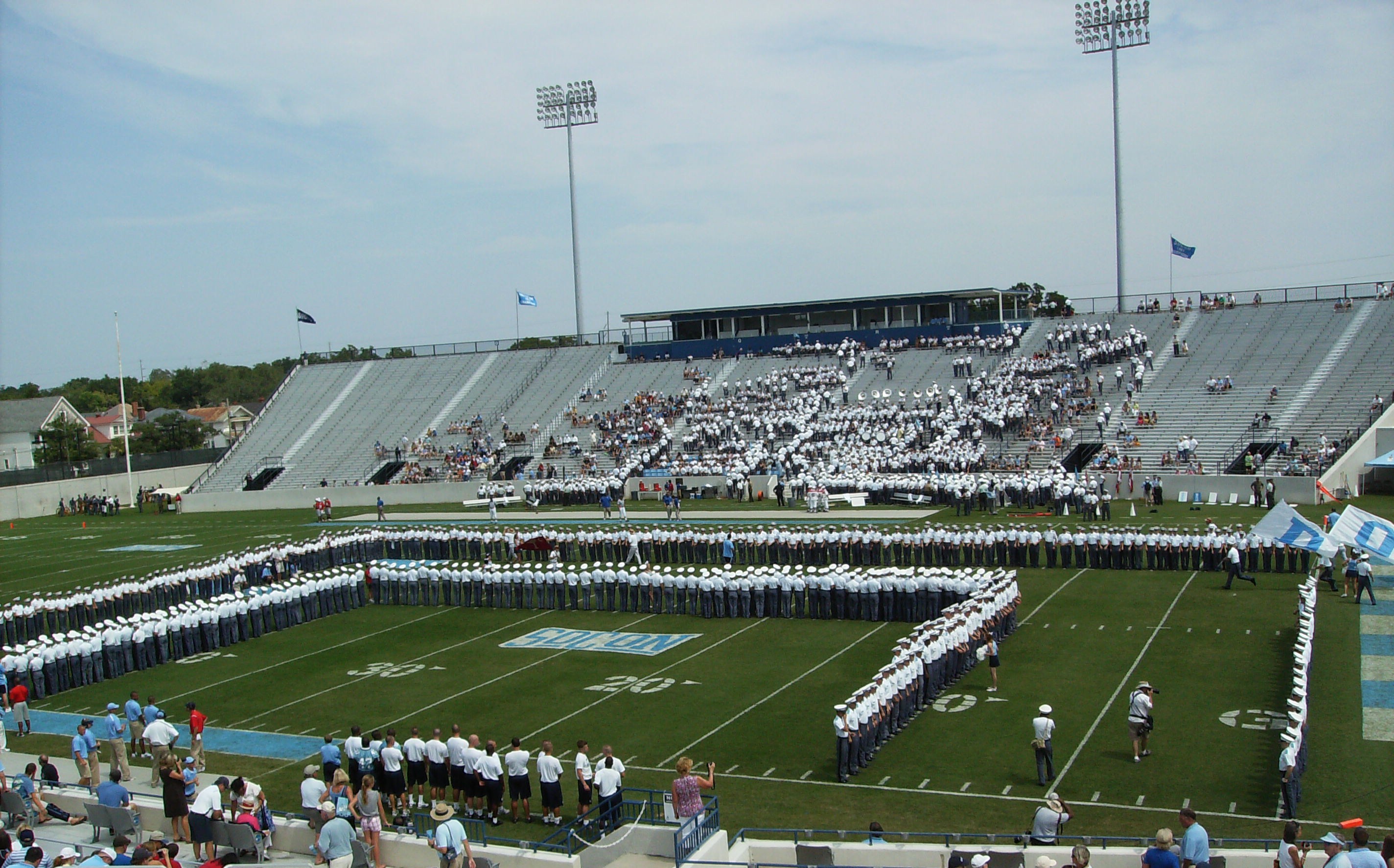
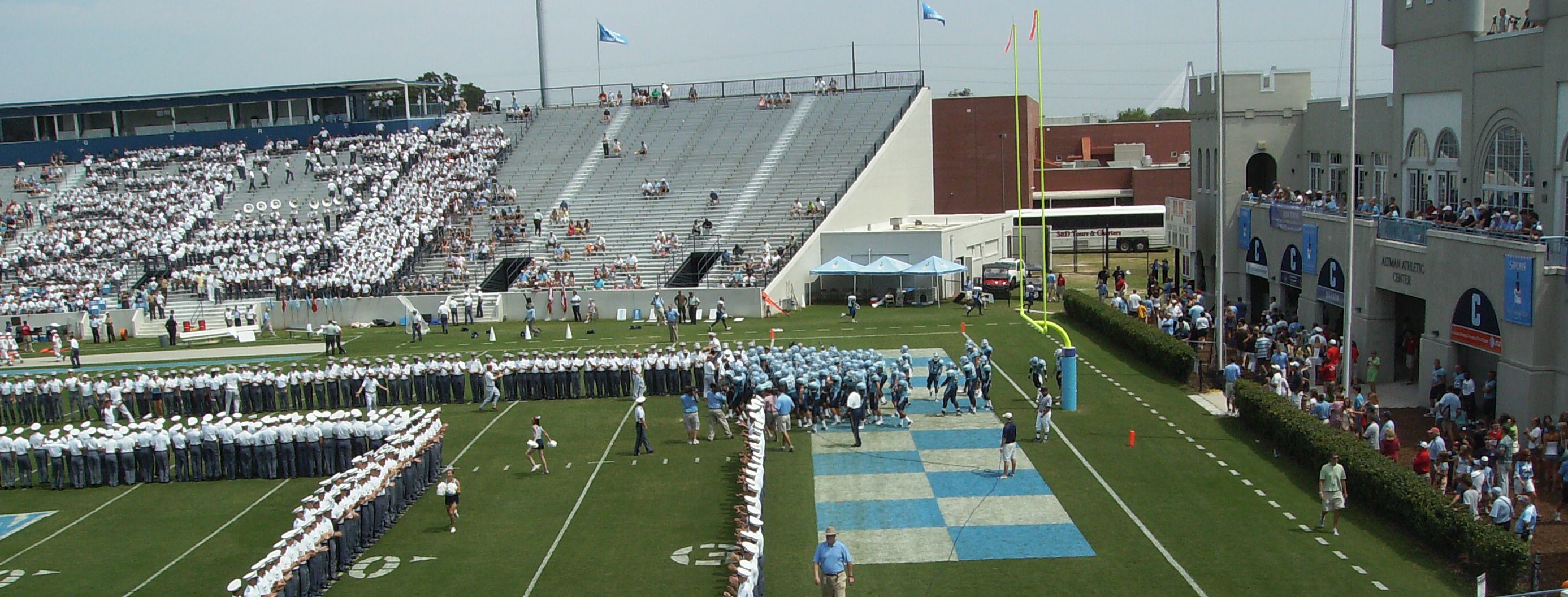
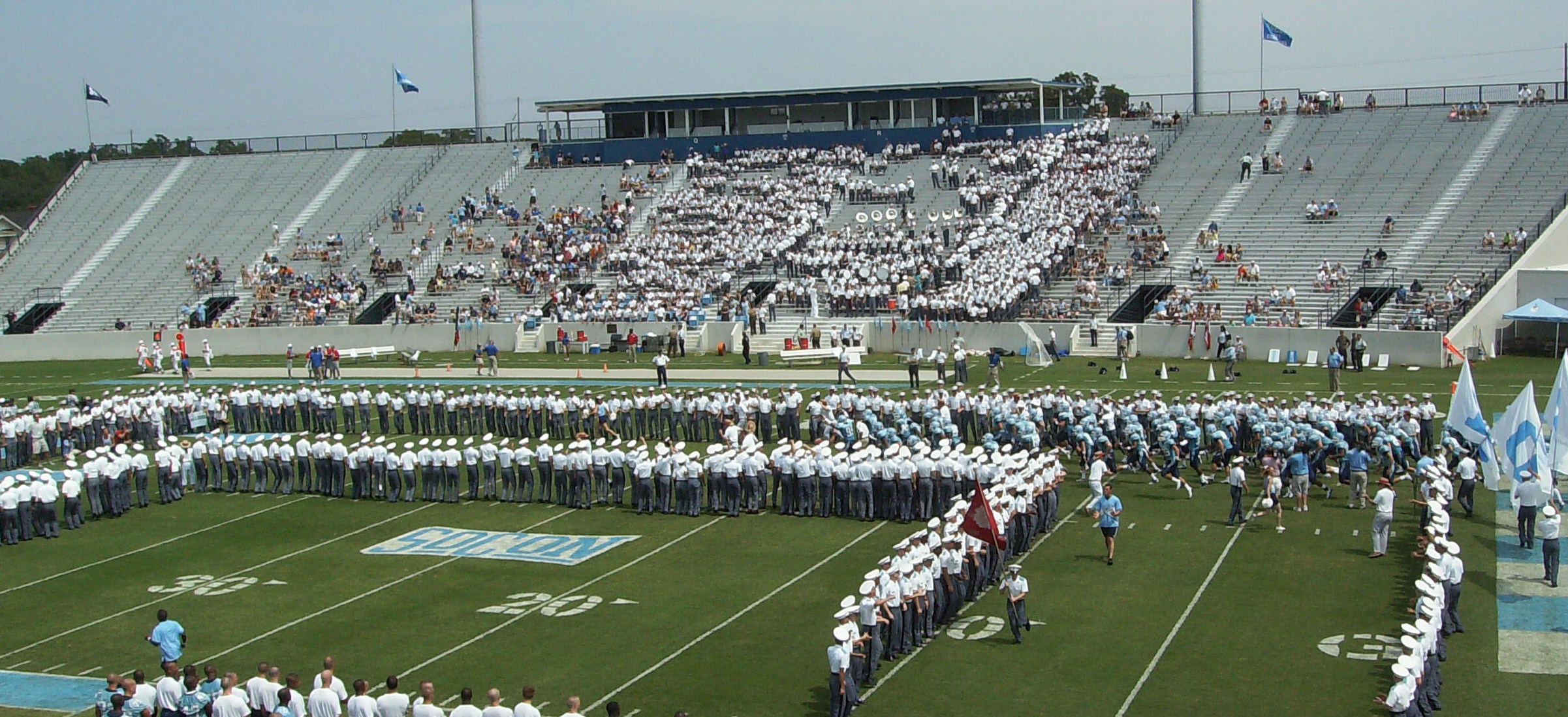
Here are a few more pictures to end this post.  These are just some shots of the field just prior and during the team’s entrance.  The last one includes some cannon fire in the background.