The Citadel’s “crossroads” moment — a review with commentary

This post basically serves to review and comment on an article published in The Post and Courier on Saturday, October 12. The writer of the story is Andrew Miller, regular P+C beat writer for The Citadel’s football program.

I appreciated this article. I don’t necessarily agree with everything stated in the piece, though most of those points of contention emanate from people quoted in the story, not Miller himself. I do quibble with certain aspects of the article that I think needed to include alternative, on-record opinions. There was also one “factoid” in the piece which was monumentally misleading. I’ll address that later.

Having said that, I was glad to see the feature published. It brings up multiple issues facing The Citadel and its department of athletics, all of which richly deserve public scrutiny.

I would encourage anyone at all interested in The Citadel to read the article.

I’ll break down my commentary by each portion of the story (excluding the introductory section).

The bottom line

The athletic department is projected to lose nearly $2 million this year…[Operating expenses] in the 2021-22 academic year amounted to $3.2 million. The projected operational budget for this year is expected to be $5.5 million, or an increase of 71 percent.

To make ends meet, the budget was cut by 10 percent with reductions in scholarships for the current season, according to an athletic department source.

“We’re having to cut expenses and scholarships,” the source said.

The football team’s operating budget, which does not include scholarships, was cut $200,000 to $1 million. It also lost the equivalent of 2½ scholarships.

The basketball team experienced a similar fate, another source said.

But according to Walters, there have been no budget or scholarship cuts.

The school is projected to spend $4.7 million on scholarships this year, having spent $4.1 million in 2022 and 2023, Walters said.

“The coaches have a budget, and they have to manage that budget, but we need to give them more tools to help them out,” Walters said.

Two different sources told Andrew Miller that the department of athletics is undergoing budget and scholarship cuts — but this was denied by Gen. Walters. That is more than a little curious.

Along those lines, there is something else worth noting that is not in the article.

If you go to the webpage for The Citadel’s Procurement Services Department, you will find a link to the school’s “Awards” site for procurement. This includes solicitations, sole sources, and the occasional emergency purchase.

It can be an interesting site to follow. Those perusing the page will see that The Citadel has a sole source justification for SoCon-mandated baseballs, for example, and will notice that the league also requires a specific vendor for video database and data analysis software.

The site also has a link to a sole source for a “Financial Consultant”. The advertisement for this sole source was posted on June 13 (expiring two weeks later). The school listed a potential contract amount of $250,000 (over the course of one year) for “a financial consultant to advise and assist in financial planning.”

That is a very generic description, but the person named as the sole source, Rick Kelly, is not generic at all. He is a former executive director of the S.C. Budget and Control Board, and later served as the Chief Financial Officer at the University of South Carolina. Kelly is an auditor by trade and has actually been hired as a consultant by The Citadel before (in July of 2020).

It is my understanding that Kelly recently completed an audit of The Citadel’s department of athletics, and that his findings are to be presented to the Board of Visitors in the near future — perhaps as soon as the BOV’s next scheduled meeting.

Revenue sources

Walters hopes to renew a series of outdoor concerts at Johnson Hagood Stadium, which had been put on hold after complaints by local residents who feared the added traffic and noise.

Then there’s naming rights to the playing field and stadium that could bring in money.

Remember, The Citadel was not successful in its June appeal to the City of Charleston’s Board of Zoning Appeals for approval for the outdoor series. The school was defeated by a combination of NIMBY-ism and an unfriendly zoning board (the vote was 7-0 against The Citadel).

Of course, the board couldn’t outright tell the military college that any concerts at Johnson Hagood Stadium are off the table. Otherwise, other neighborhoods could presumably block similar events at venues all over the city (as The Citadel’s VP for communications noted in the linked article). However, it is reasonable to expect that the same people who opposed the concert series will continue to fight against any major events held at the stadium, so relying on that as a regular source of income might be a dicey proposition.

It seems to me that profiting off naming rights to the stadium would also be hard to accomplish. You can’t rename Johnson Hagood Stadium right now without violating the state’s Heritage Act (unless two-thirds of state lawmakers could be convinced to approve a name change; good luck with that).

Until or unless the Heritage Act is successfully challenged in court, I’m not sure what The Citadel can do. And even if that were to happen, it is possible potential candidates for naming rights (banks, grocery stores, etc.) would be hesitant to be the “replacement” name under those circumstances.

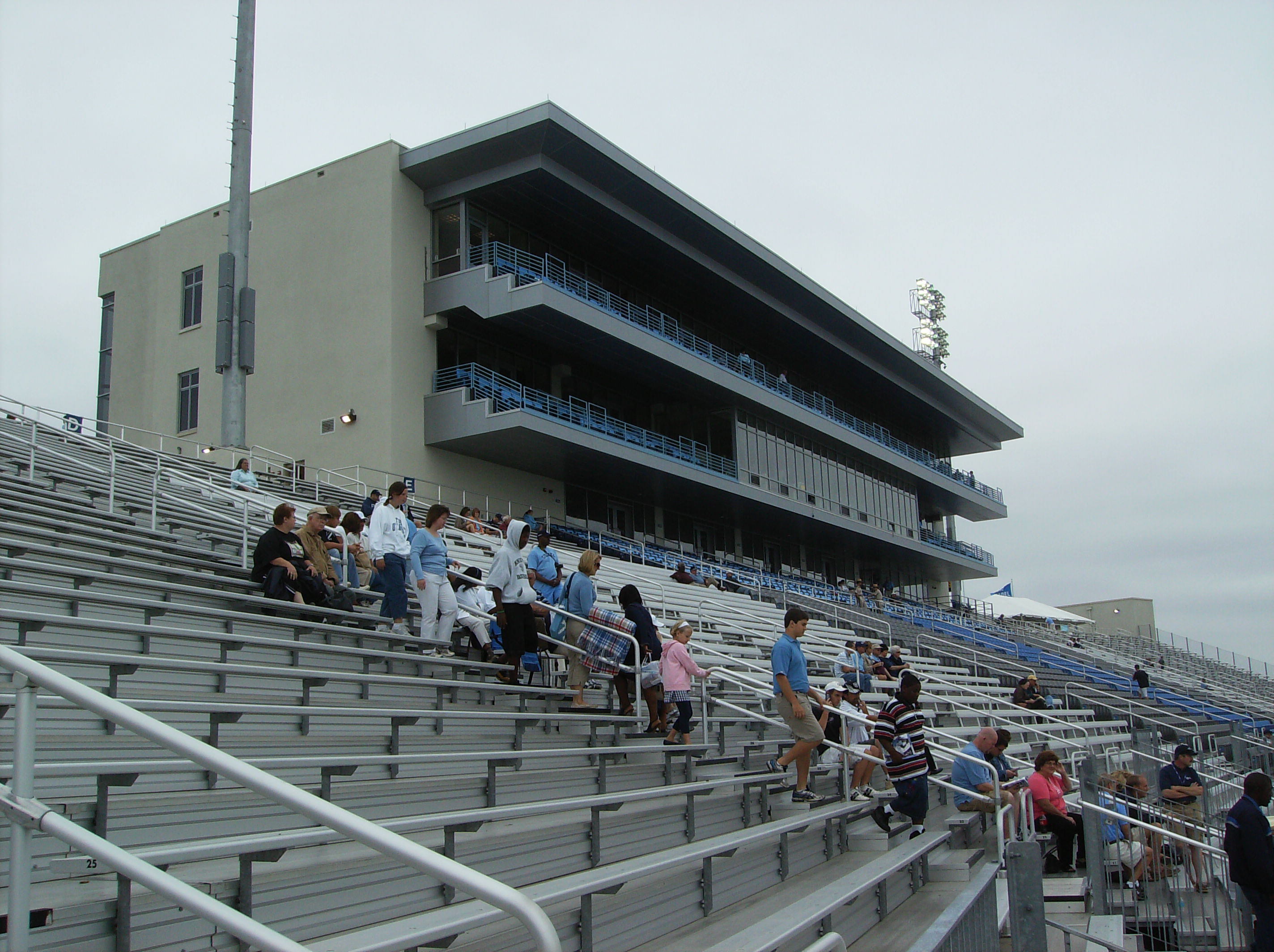
The NCAA settlement [the “House” case] and what it will mean for The Citadel has been one of the many reasons for the delay in finishing the east side stands at Johnson Hagood Stadium...But the pandemic and other delays, including funding for the $5 million project, have postponed construction.

Capaccio said he hopes to have the east side stands ready for the 2025 football season.

“We have more than $3 million on hand and more than enough pledges to cover the rest,” Walters said.

I would be very pleasantly surprised if the rebuilt East stands are ready by the time the 2025 football campaign rolls around. The first game of the season next year is a home game on August 30 against North Dakota State.

It would be nice if the stadium were ready when the Bison’s travelling supporters arrive in Charleston. I just find that timeline hard to believe, particularly given the history of the project. I will be happy if my skepticism is unfounded.

Another thing worth mentioning is that the phrase “many reasons for the delay” is doing a lot of work in that paragraph. There seems to be a lag of about a year in the overall approval process which cannot be easily explained by COVID-19, related construction issues, or general fundraising.

Moving on down

One of the biggest fears from alumni is that the administration and athletic department will grow weary of the constant losing and financial struggles and decide to drop down to Division II or even Division III, where no athletic scholarships are awarded, to save money and be more competitive…

Walters said there’s no plan to move down in classifications.

“Not on my watch,” he said. “We’re not going Division II.”

Here, at least, there appears to be near-unanimity on a topic, and I was glad to see it. Dropping down a division (or two) would be a terrible idea on a lot of levels, and also completely unnecessary.

Besides the likely exodus of donors mentioned in the story, Division III makes no sense from a geographic perspective. What schools would The Citadel even play? There are no D3 football schools in South Carolina. There are two in Georgia — Berry and LaGrange. The North Carolina institutions with D3 football programs are Brevard, Greensboro College, Guilford, Methodist, and North Carolina Wesleyan.

That obviously wouldn’t work for The Citadel.

As for Division II, I get the impression that more schools are trying to leave that tier than move to it. And here again, the list of local institutions in the division do not as a group “match up” with The Citadel from a historical or practical standpoint. (D2 football schools in South Carolina: Allen, Benedict, Erskine, Limestone, Newberry, North Greenville.)

In terms of dropping down, VMI actually did something similar (at least philosophically) at the beginning of the century when it left the SoCon to join the Big South. That move did not work out for the folks in Lexington, VA, and they were thrilled to be able to re-join the Southern Conference after a decade out in the cold.

Now, there is a facet to this worth discussing. It is possible that in the future The Citadel’s athletics programs could be in a tier called “Division II” that would actually mostly resemble the current Division I. If there is a breakaway from the NCAA of 20-40 schools (the inevitable “Superleague”) for football and a slightly larger number of institutions for basketball (50-70, perhaps), then the eventual NCAA setup could look like this (at least for football):

  • Division I — P4 schools left out of the Superleague, the majority of G5 schools, maybe a few FCS institutions with historic success and decent revenue potential (the Montana and Dakota schools, for example)
  • Division II — The vast majority of FCS, plus a few G5 schools that still want to play football but would not be in an ideal financial position in the new order of college athletics

There wouldn’t be any problem with The Citadel being in that type of Division II. It would still likely play the same schools as before. It is just a question of nomenclature. There would also be an opportunity to play the “Division I” schools, as is the case now.

In that system, schools could compete in a revised D1 in basketball, baseball, and any other sport in which they wished to do so, and the remainder of their varsity teams would play in a D2 with fewer financial and infrastructure commitments.

That could wind up being just fine for a school like The Citadel.

Transfer portal, NIL, and non-cadet athletes

I’m going to split this section, separating NIL from the other two listed issues.

As for NIL:

Some Citadel alumni are against NIL, but barring athletes from making deals with local businesses would be against the law.

“Sometimes we’re our own worst enemy,” [former Bulldogs quarterback and past BOV member Jack Douglas] said. “We can’t get out of our own way. We need to be more welcoming to people and businesses. The gates around the campus aren’t there to keep people out, it’s to keep the cadets in. We’re not taking advantage of some of the resources in Charleston, people and businesses that don’t really have a connection to the school but could be friendly to us and help us out.”

One of those alumni who might have a problem with NIL, however, is the school president. From the minutes of the Board of Visitors meeting on April 24, 2024:

[Walters] then discussed the impact of the current rules/laws on the Southern Conference (SoCon) and The Citadel. He stated there has been little impact to date for The Citadel with only a few athletes participating. Of those, only one currently receives monetary compensation. The others receive products for their endorsements.

He stated that although The Citadel, the SoCon, or the NCAA cannot prohibit an athlete from entering NIL contracts, The Citadel can and will develop a policy that will impose limitations on its student athletes. Among the limitations discussed:

  • Specific prohibitions on when and where student athletes can appear in advertisements for third parties.
  • Prohibit student athletes from appearing in NIL opportunities while wearing team jerseys.
  • Prohibit student athletes from endorsing tobacco, alcohol, illegal substances or activities, banned athletic substances, and gambling, including but not limited to sports betting.
  • Prohibit endorsement of products which compete with school sponsorship agreements or contracts.

It was also discussed prohibiting endorsement of products which conflict with The Citadel’s institutional values, but it was noted that such a rule would likely raise First Amendment concerns.

Personally, I think there is a distinction to be made between general NIL rights and a school-sponsored “collective”, which should be a non-starter at The Citadel.

It is one thing for cadets to work with local businesses, learning the value of networking, etc., or engaging in activities such as sports camps or individual instruction. I have no problem with that; nobody should. It would be like someone in the regimental band teaching local students how to play the bagpipes or the trumpet (and being compensated for it).

A school-sponsored collective implies pay-for-play, however, and that is not the route The Citadel needs to take going forward. Doing so would fly in the face of the school’s overall mission.

It won’t be the route most of The Citadel’s peers will take, either, and that matters in the long run when schools form alliances (or new conferences) as a reaction to the “modernization” of college athletics.

I know there are currently schools in the SoCon that are banking on collectives, and pay-for-play. In the short term, they’re going to have an advantage over The Citadel in certain sports (particularly basketball). That isn’t really something which is controllable.

In ten years, there is a decent chance that The Citadel is not in the same conference with a school like, say, East Tennessee State. That won’t matter, though, if The Citadel is still aligned with VMI and Furman and other schools which could be construed as having a similar reputation (a hard-to-define combination of history, prestige, and cachet).

And yes, I realize that some of those “similar reputation” institutions are currently putting a lot of money into certain sports (like hoops). I’m thinking about what the outlook will be in 10-to-20 years, not 3-to-5.

Now about the transfer portal and non-cadet athletes:

Many of the old guard don’t want the Bulldogs to recruit and sign transfers. The vast majority of transfers signing with The Citadel recently have been graduate students. A handful of undergraduate day students have also transferred into the school.

The balance between cadet-athletes and non-cadet athletes has been a point of contention with some alumni…

…Walters said there are no caps or limits to the number of transfers each team can have.

“We have to give our coaches every opportunity to be competitive,” Walters said. “I’m sure most of the alumni would prefer to have all cadets on our teams, but they also want to win. We had 10 knobs on the basketball team last year and only a couple came back. I can’t hamstring Coach Conroy and have him sign 10 new freshmen every year. He wouldn’t be able to build a program.”

The current basketball roster includes a half-dozen transfers.

Attracting graduate students has been an issue as well. While many graduates want to take advantage of the school’s business program, The Citadel provides just $950 a month to graduate transfers for expenses.

“No one can live in Charleston on $900 a month,” [Citadel Football Association president Robbie Briggs] said. “You can’t pay rent and eat on that. Charleston is expensive. It would take a minimum of $2,000 in my opinion to live in Charleston.”

Ironically, it costs less for the school to sign a non-cadet transfer than to bring a freshman on campus. Freshmen student-athletes cost the school about $10,000 more a year than other undergraduates or graduate transfers due to providing uniforms and equipment.

First, I sincerely hope that coaches are not under any pressure to bring in non-cadets rather than freshmen in order to save money. I would consider any attempt to implement such a policy to be worthy of dismissal.

As to expenses for living in Charleston, I think the problem there is partly with the SoCon. In an appearance on an ETSU-affiliated podcast last December, East Tennessee State AD Richard Sander said this:

“The SoCon is the only conference in the country that limits cost of attendance. So we can only provide 28 student-athletes cost of attendance…we’re limited as to the [league’s] cap…that’s $2000.00. Well, our [actual] cost of attendance at ETSU is $6900.00.

We [ETSU], Chattanooga, a couple of other places [want to change that], but I’ll be honest, the private schools don’t want to change that. They think it’s a competitive advantage for us because our cost of attendance is high compared to theirs.

When we’re recruiting against, pick somebody in basketball…Western Kentucky or College of Charleston, they’re giving [players] total cost of attendance and we think in that kind of situation we think [the league rules] are creating a real difficult situation for us.”

It is possible the SoCon’s CoA rule might be working against The Citadel. I could be wrong about this interpretation, to be sure, but I don’t think the military college is one of the schools blocking a potential increase in the limit.

Briggs is absolutely correct about trying to live in Charleston on $950 per month, and that certainly has had a deleterious effect on the recruitment of certain athletes. We’ve all heard the stories.

Having said that, I am one of the alums who would greatly prefer that almost all (if not all) of our athletes are in the corps of cadets, or are recent graduates from the corps. There are arguments on both sides about this, of course, but I come back to a couple of things.

– “I’m sure most of the alumni would prefer to have all cadets on our teams, but they also want to win.” — Gen. Walters

Well, yes, but when is the last time a transfer-heavy squad at The Citadel was legitimately successful? I’ll wait on your answer. It will be a long wait.

The fact is that we have allowed our coaches to supplement their rosters with large numbers of transfers in recent years, and in no situation has it resulted in a significant increase in winning. Sometimes, it seems to have boomeranged in the opposite direction.

Also, while I understand the point about the problem of cycling through rosters due to freshman attrition, that has always been an issue at The Citadel, long before the transfer portal existed. I might add that the constant one-year “rental” of graduate students hasn’t done anything for continuity (or general competitiveness) either.

– There is another rationale involved here. For whom do the varsity teams at The Citadel primarily exist as a benefit? Well, the players themselves, obviously.

They also exist for the alumni and other supporters, including those in the local community. And they exist, most importantly, for the corps of cadets. I think it is natural and right for the corps to be able to cheer for a team that consists mostly (if not entirely) of fellow cadets.

This isn’t just about a pie-in-the-sky notion of utopia, either. There is also a financial consideration, after all. As Miller pointed out in his article:

Each cadet pays around $3,000 a year in student athletic fees, among the highest in the country. That comes out to approximately $6.4 million, the largest source of revenue for the athletic department.

If cadets are going to front the plurality of the funds which support varsity athletics, it seems to me that those teams should represent them in something close to totality. That means the players should mostly be cadets, too.

Some alumni have also bristled at the sight of long hair and facial hair among some graduate transfers.

“There are a lot of older alumni that believe this place was some kind of nirvana back in the day, and it’s just not true,” Walters said. “We had graduate students playing sports back when I was here in the 1970s, and we had guys with hair flowing out of the backs of their helmets when I was here. People don’t remember that, but I do.”

I wish Andrew Miller had quoted an alumnus with a strong opinion about the issue at hand. I would have liked him to interview one of those who had “bristled”. I think that would have been appropriate, and would have also avoided Walters’ comment coming off as a bit of a ‘strawman’ construct (which clearly wasn’t the intent).

Walters’ quote interested me, though, because I could not recall graduate students playing football in the 1975-78 time frame when he was at The Citadel (he’s a 1979 grad). I’m not old enough to know for sure, though, so I will defer to Walters on this.

To be fair, Walters didn’t specifically refer to grad students in football, but rather he just made a comment about “guys with hair flowing out of the backs of their helmets”.

From perusing the 1978 football media guide, which featured the team that played during Walters’ senior year, I can see how that might have occasionally been the case. Kenny Caldwell is on the cover with Art Baker, and Caldwell’s hair is a little longer than what you would see today at The Citadel.

It was a 1970s thing, I guess. The photos of the coaching staff are instructive as well; offensive coordinator Rick Gilstrap had a lot of lettuce, and running backs coach Mike O’Cain sported a world-class moustache.

However, I don’t think the hairstyles of the 1970s, groovy as they might have been, are really applicable to today. I expect varsity athletes to conform to the current standards of the corps, regardless of status.

That means relatively short hair and no beards or moustaches. The Citadel is a military college. The players that represent it (and the corps of cadets) need to look like they belong, whether on the field, court, track, road, mat, course, range, or diamond.

Also, while a lot of the issues mentioned in the article are hard problems to solve, this isn’t one of them. Just tell the guys to get a shave and a haircut. The world won’t end, and it won’t cost hundreds of thousands of dollars.

Texas A&M model

Oh, boy…

It was during the annual summer talking season in the early 2000s when [Ellis Johnson], the former football coach, brought up the idea of The Citadel adopting a Texas A&M model where the school would open its campus to more non-cadets.

The idea was met with a resounding silence.

As well it should have. However, there is (unfortunately) more:

Up until 1964, Texas A&M required all students to be members in the Corps of Cadets. That year, school president James Earl Rudder opened up the school to women and Blacks for the first time. A year later, membership in the corps became voluntary.

Today, Texas A&M is the second-largest university in the nation with more than 72,000 students. Of those, 2,500 —including 300 women — are cadets.

The idea of allowing non-cadets into The Citadel isn’t even that new. Red Parker, the Bulldogs head coach from 1966-72, was a proponent of letting in non-cadets.

“You have to remember this was in the middle of the Vietnam war and the military wasn’t that popular back then,” said [Charlie Baker], who played linebacker for Parker in the early 1970s. “People think we’d lose our identity as a military school, but we wouldn’t. Look at what Texas A&M has done. They still have a Corps of Cadets, and the school is doing great.”

Texas A&M last year had a $17.2 billion endowment.

I’ll get to the most disingenuous sentence in that quote in a few paragraphs.

However, first let me say this. I have great respect for both Ellis Johnson (who played at The Citadel and also served as its head football coach) and Charlie Baker (another former player who has done great things for The Citadel, and who bleeds light blue).

And they’re both incredibly wrong about this.

Why do people think The Citadel would lose its identity as a military college? Well, because it would.

Do most people today think of Texas A&M as a military school? Of course not. The only time that even comes up in general discourse is when sports fans at other schools make fun of the Yell Leaders.

The Citadel, on the other hand, is chiefly identified as a military college. If you marginalize that essential component, it ceases to be The Citadel, both in the minds of the overwhelming majority of its alumni and among the public at large. It becomes Palmetto A&M, an entity with no history and no justification for having one.

It could be argued the best thing the State of South Carolina has going for it from a higher education standpoint is that (despite the best efforts of some of its leaders over the years) it has produced among its colleges and universities a unique, undeniably successful institution on the banks of the Ashley.

The Citadel has incredible value in its current form. It might be better positioned for the new era of university education than 95% of its fellow schools in this country — and that might be an underestimation.

Colleges and universities are desperately trying to differentiate themselves in order to attract a limited number of future students. It is not an easy thing to do.

However, that isn’t a problem for The Citadel. You can’t get the experience of being a cadet in an online format. You have to be there. You have to feel the no-see-ums. You have to accept a difficult challenge and ultimately pass a test of will, and you have to pass that test in the presence (and with the assistance) of others.

Not only am I diametrically opposed to reducing The Citadel’s value as an alumnus, but I also resent the suggestion as a citizen of the state. Why diminish something so beneficial for no real advantage (and a lot of obvious pitfalls)?

Ellis Johnson also said this:

“Seventy percent of Citadel graduates don’t go into the military,” Johnson said. “They go start businesses, they become entrepreneurs, they go into politics, and they are good, productive citizens. What’s wrong with producing good people and good citizens? Sometimes I think the school caters to that 30 percent of the alumni base a little too much.”

I didn’t understand this comment, on two levels. First, I don’t really think the school caters to its veteran alums more than its other graduates. I’ve never noticed that myself.

More to the point, though, is the idea that the veteran alums are those most against the gradual dissipation of the corps of cadets as the school’s focus. I don’t think that is true at all.

I haven’t done a survey or anything, but I know plenty of non-veterans who are dead-set against turning the school into Palmetto A&M. I’m one of them.

I’m not even sure that a higher percentage of veterans than non-vets are against that concept. I would suspect that there is uniformity in the opposition, regardless of background.

This might be a digression, but I think it is a necessary one. The line in the article that I found particularly misleading was this one:

Texas A&M last year had a $17.2 billion endowment.

In the context of the story, that brief statement tends to imply that Texas A&M began admitting non-cadets and things have gone fantastically well ever since, including an amazing endowment which surely is directly related to the school’s change of mission.

The truth is that there cannot possibly be anything more unrelated than Texas A&M’s endowment and the status of its Corps of Cadets. It might be the most unrelated thing in the history of unrelatedness.

The actual reason Texas A&M has a large endowment is a 19th-century provision established in the Texas Constitution that created something known as the Permanent University Fund (PUF):

In 1876, the Texas Constitution set aside land in West Texas to support The University of Texas and Texas A&M systems of higher education. Today, that land – encompassing 2.1 million acres – is leased to oil and gas companies whose wells generate revenue that flows into the PUF. Land also is leased for grazing, wind farms and other revenue-generating activities.

The Texas A&M system receives one-third of the annual proceeds of the PUF, while the University of Texas system gets the other two-thirds (and thus UT’s endowment is even more monstrous than TAMU’s).

Texas A&M’s share of the PUF return in 2023 totaled slightly over $410 million. That’s for one year. It will get more money this year, and even more cash next year, and presumably every year after that as long as the wells don’t completely run dry.

The provision that set up TAMU (and UT) for all that moolah was enacted 88 years before the school began admitting non-cadets.

The reference to Texas A&M’s endowment should not have been in the article.

The Citadel doesn’t need to be like Texas A&M, and it couldn’t be like Texas A&M even if everyone wanted that outcome. And most people don’t anyway.

Earlier this week, there was another piece in The Post and Courier about The Citadel’s future in athletics, this one in the form of a column by Scott Hamilton that was centered around the upcoming search for a new director of athletics. I wanted to highlight one part of it:

Some initial thoughts are if The Citadel might consider moving down a level. Should dropping to Division II – or perhaps even Division III – be on the table?

No, they just need to know exactly who they are and what their mission is,” said Rob Yowell, president of Arizona-based Gemini Sports. “And that’s (to be) more like West Point, Annapolis and Air Force. Not Coastal Carolina, Liberty and Louisiana-Monroe.

Yowell, whose firm runs major events such as the PGA Tour’s Waste Management Phoenix Open and the Fiesta Bowl, is spot-on. Having an identity would simplify things so much. The service academies embrace who they are, just as traditional Group of 5 schools realize they’re not competing on and off the field with the likes of Alabama and Ohio State.

It is nice to read something as perceptive as that from an outsider — in this case, a Duke graduate who lives in Phoenix. Wonders will never cease.

I will say that The Citadel does share some things in common with Coastal Carolina and ULM, so it isn’t an “exact opposite” comparison when it comes to those two schools (and coincidentally, the AD at Louisiana-Monroe is John Hartwell, a graduate of The Citadel).

“There are a lot of older alumni that believe this place was some kind of nirvana back in the day, and it’s just not true,” Walters said.

Walters is 100% correct about that. I can sympathize with him as he tries to navigate the school through a lot of choppy water, trying to justify various decisions to alumni, a few of whom think it is still 1950, or who wish it were still 1950.

In terms of sports, this is a very trying time for the military college. I believe that the current climate in college athletics is the worst it could be from The Citadel’s perspective since the Sanity Code was enacted in 1948.

Of course, we all know what happened then. The Citadel became one of the famed “Sinful Seven”, and the Sanity Code was eventually revoked.

It didn’t come without controversy, however. For one thing, an attempt was made to expel those seven schools from the NCAA in 1950 — not put them in probation, mind you (probation as we know it today didn’t exist) — but throw them out of the association entirely.

And more than half of the schools in the NCAA voted to expel The Citadel, and the other six schools.

That’s right. Of the 203 delegates, 111 of them cast a ballot to toss out The Citadel and company. The president of the NCAA actually announced that the motion had passed — and then he was reminded that a two-thirds super-majority was needed, and that the motion had thus failed by 25 votes.

That failure essentially ended the long-term viability of the Sanity Code (though it wasn’t formally repealed until the following year).

I think about that occasionally. It is a reminder that things are always going to be a bit testy for The Citadel when it comes to its place in college sports. More than half of its fellow NCAA members once voted to throw the school out of the club.

It is also not strictly coincidental that The Citadel struggled mightily in varsity athletics in the years following the original enactment of the Sanity Code (there were admittedly other reasons too).

From 1948 through 1954, the Bulldogs’ football program had a record of 21-44-1, with no winning seasons in those seven years. In basketball it was even worse. From 1949 through 1956, the hoopsters were 28-135.

Does that sound vaguely familiar?

Things changed, though. The climate around college athletics eventually turned a bit (not too much) in The Citadel’s favor. By the late 1950s, backed by a new school president who didn’t like to lose, and playing in a conference with schools much more on its level than in the previous 20 years, The Citadel started winning consistently in almost all sports.

That can happen again. It will require patience, though. I just hope the folks running the institution (and the alumni and other supporters) maintain that patience.

I want to win, too. I just don’t want to throw away what makes The Citadel great in the process.

Game Review, 2011: Western Carolina

The Citadel 35, Western Carolina 7.

The Bulldogs did exactly what they were supposed to do on Saturday. Facing an inferior opponent that was in a state approaching disarray, The Citadel started fast (!), took a commanding lead and never let Western Carolina into the game.  The game was a must-win, and the Bulldogs came through with a very solid performance.

Random thoughts:

— Kevin Hardy’s opening kickoff return, which went for 59 yards and set up the game’s first touchdown, was by far The Citadel’s best all season. Kickoff returns have been an area of concern for the Bulldogs; here is hoping Hardy’s effort will lead to more big plays in the return game.

— Six different Bulldogs rushed for at least 40 yards (Aaron Miller added 30). Eight different Bulldogs carried the ball, led by Darien Robinson’s 106 yards.

One of the more interesting aspects of the game is that while it was a “must-win” (at least from a fan perspective), a number of reserves saw significant time.  That had been the case on defense in the previous two games, but against WCU several offensive backups played a lot of snaps.

That may be one reason the offense had a bit of a lull midway through the contest, but with a three-touchdown lead that was basically unassailable, I didn’t have any problems with the coaching staff giving younger players an opportunity to get experience.

— The passing game is still a problem.  On Saturday, the Bulldogs completed 2 of 5 passes for just 12 yards, with an interception.  Speaking of the interception, I think the play call leading to it may have been a mistake.

The Citadel’s first drive of the third quarter was going rather well, with runs of 4, 6, 57, and 5 yards (the 57-yarder coming from Rickey Anderson).  On 2nd-and-5 from the WCU 25, though, Miller attempted a pass that was intercepted near the goal line.

A 21-0 lead early in the third quarter is not insurmountable (although Saturday’s game might have been the exception to the rule).  I would have liked to have seen the Bulldogs continue to run the ball against a defense which at that point seemed unable to stop the run, and grab a four-touchdown margin.  Instead, the pick ended the drive and kept Western Carolina at least nominally in the game.

Now, there are decent reasons to throw the ball in that situation (keeping the defense honest, letting Miller get comfortable making decisions when passing, etc.), but I favored a no-nonsense ground assault in that sequence.  Not a big deal, obviously, and I risk being the type of fan who complains when the team doesn’t throw it, then complains when it does.  Then again, as a fan, I have a constitutional right to be irrational.

— It would have been nice for the defense to get a shutout, but that will have to wait for another time and place.  Incidentally, The Citadel’s last road shutout in Southern Conference play came in 1992, against Appalachian State. We all know what else happened in 1992.

— I would be surprised if Western Carolina coach Dennis Wagner is back after this season; he may not last the rest of the campaign.  Included in the game story in the Asheville Citizen-Times were three paragraphs noting the lack of fans in the stadium after halftime, along with quotes from dissatisfied students.

That was coupled with an editorial (from the same writer who penned the game story) entitled “Cats Uninspiring in Homecoming Debacle”, which included the following commentary:

In 12 years of covering this program, I have never seen the Catamounts play so poorly at home as they did in a 35-7 loss to The Citadel — not even when D-II Tusculum chopped the Cats up like firewood last fall.

— The school’s release includes two video clips of post-game interviews with Kevin Higgins and Tolu Akindele.  If you want to see how a pro responds to a leading question that he has no interest in answering, check out the Higgins clip at around the 48-second mark. He doesn’t really care if WCU didn’t have an “edge”, and isn’t about to throw a fellow coach under the bus anyway.

— I believe the reporter in the video asking Higgins and Akindele those questions was Asheville Citizen-Times scribe Tyler Norris Goode, who wrote the above-linked game story and editorial.  If you had read the game story in The Post and Courier, you may have noticed that he also wrote that article.

Regular beat writer Jeff Hartsell didn’t write the game story because he wasn’t in Cullowhee, as The Post and Courier elected not to send a writer to the game, a decision apparently not made by the newspaper’s sports department.  It’s the first time I can recall the paper not sending a reporter to cover a Southern Conference game involving the local football team in…well, I can’t remember another time.

Obviously these are tough times for the newspaper business, so it’s not shocking the paper would cut an occasional corner.  This time it came at the expense of coverage for The Citadel’s football team, which should be a concern for any fan of the military college.

I’m hopeful it was just a one-time thing.  Presumably there will be no issues with coverage for the remaining four games on the schedule, which includes two home games and road games against nearby opponents Georgia Southern and South Carolina.  It’s a situation that bears watching, however.

Next up: VMI.  It’s time for the long-awaited return of the Military Classic of the South, as the two schools battle for the coveted Silver Shako.  I’m looking forward to this one.

Game Review, 2011: Furman

Furman 16, The Citadel 6.

It wasn’t a terrible performance by the Bulldogs.  It just wasn’t good enough.  I wasn’t completely frustrated by the way things turned out, but I wasn’t overwhelmed with positive vibes either.

Links of interest:

Jeff Hartsell’s article on the game

Hartsell’s post-game notes

The Citadel’s release

Furman’s release

The Post and Courier‘s “photo gallery” of the game

Click on that last link to see photos of the Bulldogs wearing their “Big Red” jerseys.  I was disappointed with the decision to break out these uniforms for the game. This was supposed to be a special, unusual uniform set designed to commemorate the return of “Big Red” (the flag) to The Citadel.

I wrote about these uniforms last year when they were first worn, for Homecoming. What I said then:

I didn’t have a problem with breaking out the red jerseys for this game.  The original Big Red, of course, arrived on campus in March; its disappearance and rediscovery is an interesting tale.  Wearing red jerseys for the Homecoming following that development seemed reasonably appropriate (and a good way to push merchandise).

I’m not sure I would want to see them again, however.  I certainly don’t want the football team wearing red jerseys to become a yearly event.  I think doing that would make it much less special, and also detract from the school’s traditional colors for its sports teams.

Of course, it could be argued that the parade of different football uniform color combinations this season has already devalued the tradition of wearing light blue and white. In ten games, the Bulldogs have worn six different jersey/pant color combos, including four different looks for the six home games.

In fact, I think the fact The Citadel did not have a standard uniform combination this season made the red jerseys seem a little less unusual. Let’s face it, if the Bulldogs had lined up wearing silver or black, nobody would have been all that shocked, so the red jersey wasn’t that much of a departure.

I still feel that way.  If anything, I feel more strongly about it after seeing the game against Jacksonville, when the Bulldogs wore a new uniform that actually looked pretty good.  I am afraid that we are going to continue this multiple uniform combo deal throughout the season.  I also wouldn’t be all that surprised if someone in the department of athletics is trying to figure out how to justify wearing black or silver jerseys/pants/helmets.

I’ll get off my uniform soapbox for now, because I know folks are probably tired of the constant drumbeat about the unis (or at least tired of my constant drumbeat), but I want to make three more points:

— The Bulldogs wore the new helmet logo with this “Big Red” set, which made it look even weirder (and which was obviously inconsistent with the uniform as a whole).

— The game notes now actually feature a chart listing The Citadel’s uniform combinations for each contest.  While it is arguably sad that such a chart is necessary, I will give the media relations staff credit for it, because I think it’s a good idea.  The problem, of course, was that the notes for the Furman game listed the uniform combo as being “Citadel blue tops, white bottoms”.  I guess not everybody got the message.

— The light blue “side panels” on the red jerseys look even worse when compared to the no-panel look of last week’s jerseys.

I’m not going to rehash the game.  I’ll just make some observations, many of which are probably faulty…

— On The Citadel’s first drive to open the game, the Bulldogs threw two passes (both incomplete) in three plays and punted.  I know that the element of surprise is always a consideration, and that Triple O’Higgins probably features more passing than some other triple option offenses, but I would have liked to see the team try to establish an offensive rhythm early by sticking to the ground game.

— This game could have looked a lot like last year’s matchup in Greenville, when Furman scored a TD right out of the gate and the Bulldogs played from well behind for the entire day, but for a big play by Brandon McCladdie on third-and-goal from the Bulldogs 4-yard line.  Chris Forcier would have scored if McCladdie had not kept containment and made what amounted to an open-field tackle.  If The Citadel had come back and won the game, McCladdie’s play would have been huge.  It was still noteworthy.

— Furman’s coaches treated Forcier more like a freshman than a senior in terms of play-calling.  I’m not sure what to make of that.

— Jerodis Williams is a tough back.  Very impressive.  I also thought Paladins linebacker Kadarron Anderson had a good game.

— Things that are still a work in progress:  Ben Dupree’s passing, and the Bulldogs’ o-line play in general.  Both can improve, though.  I’ll take some overthrows and missed blocks now for pinpoint passing and solid line play later.

— Dupree is going to frustrate a lot of SoCon opponents with his ability to turn broken plays into positive yardage.

— On The Citadel’s sixth drive of the game, the Bulldogs chewed up just over seven minutes of possession, eventually facing a 4th-and-8 on the Paladins 35-yard line. The Citadel took a delay of game penalty and then punted.  The punt went into the end zone for a touchback, so the net was 20 yards (a de facto 15-yard net, really, considering the penalty).

I think Kevin Higgins, if he had to do it all over again, would have gone for it.  I certainly believe he should have.  The Bulldogs trailed 13-6 at the time, and there were four minutes remaining in the third quarter.

In that situation, if a field goal attempt isn’t a realistic option, going for it is the right move.  In fact, I think it’s the right move in most situations, but you definitely have to go for it in a game when the possessions are limited.  The Citadel only had eight possessions in the entire contest (and one of those was a one-play drive to end the first half, so the Bulldogs in effect only got the ball seven times).

You simply aren’t going to get that many opportunities to make a play in your opponents’ territory.  Higgins did make the correct decision on The Citadel’s next possession, however, going for it on 4th-and-6 at the Furman 49.  It didn’t work out, but it was the right call.

— The tailgaters were out in force on Saturday.  Larry Leckonby probably spends a fair amount of time wondering how to get most of the people tailgating in the lots surrounding the stadium to actually enter the stadium.  It’s a problem.

Now The Citadel has a week off before its first road game of the season, a trip to Elon. The Phoenix are playing this weekend, as they travel to Durham to face North Carolina Central.  Elon is 1-1, with a loss to Vanderbilt and a victory over Concord.

I’ll close with some photos.  My usual lack of skill in picture-taking was combined on Saturday with a dying battery in my camera, so I didn’t take quite as many as usual.  I did get a few off-field shots of note, though, including the 1961 SoCon championship trophy and the mascot for Bojangles, apparently named “Bo” (what a surprise).

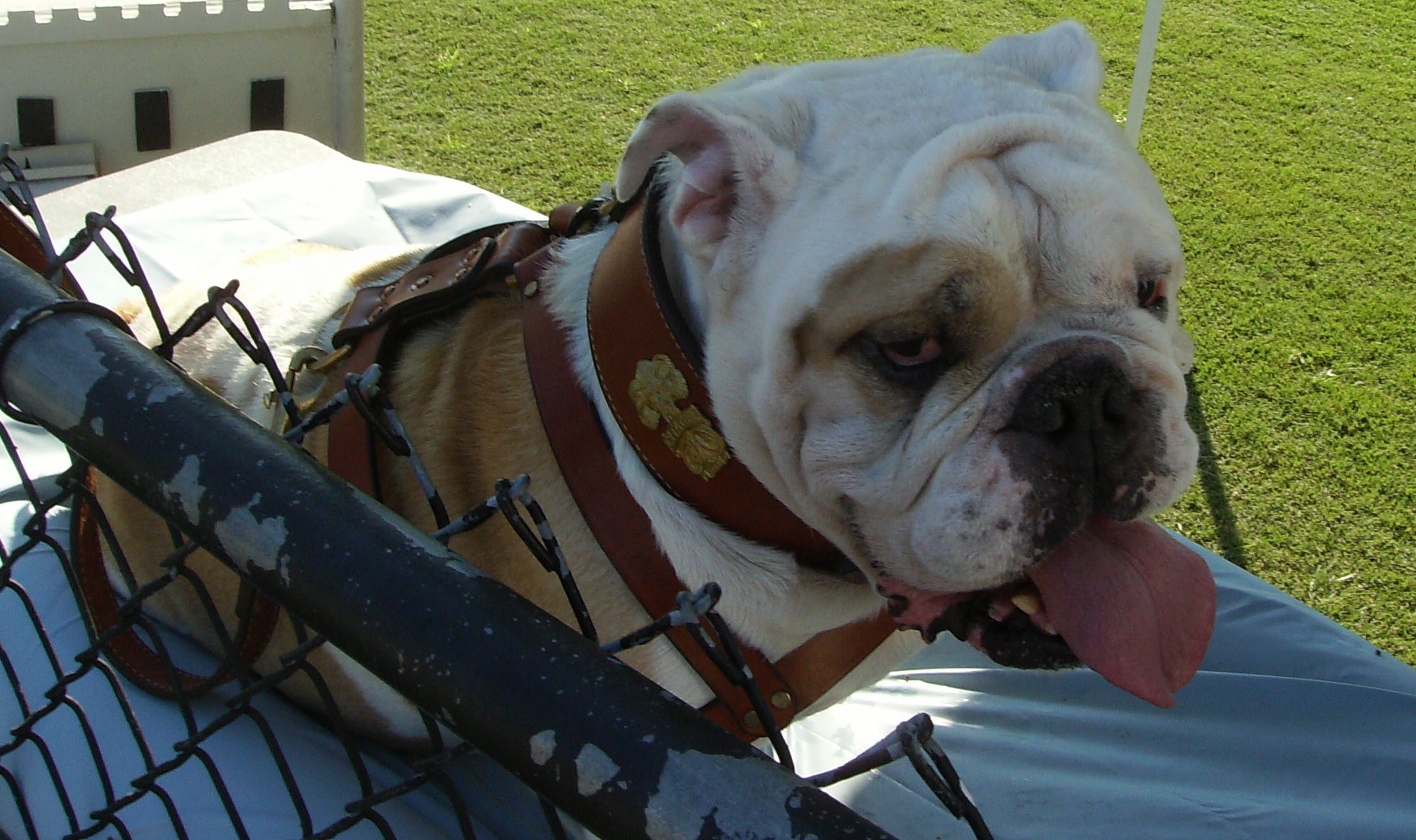
Speaking of mascots, I got a picture of General too, relaxing on a block of ice covered by a blanket.  General is a very cool dog (quite literally on Saturday, despite the late-afternoon heat).  He and his buddy Boo made a lot of new friends, including quite a few Cub Scouts.  I also appreciated Boo’s handler moving the SoCon trophy around so I could get a half-decent shot of it.  Many thanks.

2011 Football, Game 2: The Citadel vs. Furman

The Citadel vs. Furman, to be played at historic Johnson Hagood Stadium, with kickoff at 6:00 pm ET on Saturday, September 10.  The game will be televised on WYMA (Asheville, NC), and will be available on ESPN3.com.  There will also be a webcast on Bulldog Insider (subscription service), and the game can be heard on radio via The Citadel Sports Network, with new “Voice of the Bulldogs” Danny Reed calling the action.

The Citadel begins play in the Southern Conference with a game against traditional rival Furman.  It’s only the third time the two schools have ever met in a league opener, but it’s the second consecutive season that has been the case.

I’m not going to rehash the history of the series in terms of the time of year the game has been held; anyone interested can read what I wrote on the subject for last year’s game preview.  Regardless of whether you think the game should be a midseason clash (my preference) or played at the end of the year (a not-insignificant number of fans from both schools), I think everyone can agree that September 10 is too early for this game to be played.

Jeff Hartsell has reported that, per the SoCon office, next year’s meeting will come at the end of the 2012 season, on November 17.  (The conference does not make league schedules beyond one year in advance.)

I’m okay with that, as long as the Clemson-South Carolina game continues to be played the Saturday after Thanksgiving, as is now the case.  I just don’t want The Citadel and Furman to play on the same day as the matchup between the Tigers and Gamecocks.

Furman was 5-6 last season, its first losing campaign since 1998.  Bobby Lamb resigned after nine years in charge and over a quarter-century at the school as a player or coach.  The Paladins had missed the FCS playoffs for four consecutive seasons, which did not go over well among some supporters.  It was time for Furman to make a change.

The question, though, is did Furman really make a change?

The new coach is Bruce Fowler.  Fowler is a 1981 graduate of Furman who played for Dick Sheridan.  Lamb was a 1986 graduate of FU who had played for Sheridan. Fowler spent 18 years at Furman as an assistant coach.  Lamb had been an assistant coach at Furman for 16 seasons.

One difference is that Fowler wasn’t a complete Furman lifer like Lamb had been.  For the past nine years, he had been an assistant at Vanderbilt, where he was defensive coordinator for Bobby Johnson (and Robbie Caldwell in 2010).  Of course, Johnson had been the head coach at Furman before taking the Vandy job, and before that he had been an assistant under Dick Sheridan.

You may have noticed a pattern here.  Dick Sheridan left Furman after the 1985 season to take over at N.C. State, but his presence is still felt in the program.  All four of the men who have held the head coaching position since Sheridan left (including Fowler) were players and/or assistants under him.

If you were going to have your football program maintain what is in effect a 25-year tie to a former coach, you could do much worse than Sheridan, who did nothing but win throughout his coaching career (even as a 28-year-old rookie head coach at an Orangeburg high school).  It’s a type of continuity that may be worth preserving.

On the other hand, there is always the possibility that Furman risks going to the well once too often.  Fowler isn’t exactly a carbon copy of Lamb, though — for one thing, he’s 52 years old, 13 years older than Lamb was when Lamb got the job.  Also, he’s primarily a defensive coach (though he was the receivers coach at FU for seven seasons).  Lamb was mostly an offensive coach (and a former quarterback) during his time with the Paladins.

Usually when a school is in a position to make a coaching change after a run of disappointing seasons, it brings in somebody to shake things up.  That’s certainly not what Furman has done.  Besides Fowler, three of the assistant coaches played for Sheridan; another has been a Paladins assistant for 13 years.

Before I move on to the Paladins of 2011, I should note that Art Baker, who preceded Sheridan as head coach at Furman (eventually leaving to take the job at The Citadel), hired Sheridan, Jimmy Satterfield, and Bobby Johnson as assistant coaches, all of whom would later ascend to the top job at FU.  Baker had a significant impact on Furman’s coaching tree.

Furman lost 30-23 at Coastal Carolina in its opener.  The Paladins never led the contest.  The game had been tied at 16 and 23 before the Chanticleers scored the game-winning touchdown with 1:23 remaining in the fourth quarter.

Coastal Carolina gained 231 yards rushing and 195 yards passing against the Furman defense, but perhaps more interesting was that the Chanticleers had 59 rushing attempts for the game.  CCU ran 81 offensive plays from scrimmage for the game, while the Paladins had just 58.

As Bruce Fowler noted in the SoCon teleconference, Furman had trouble getting its defense off the field.  Coastal was 7-16 on 3rd-down conversion attempts and made its only 4th-down try, a major reason the Paladins trailed by over 12 minutes in time of possession.  That continued a trend from last season, when Furman finished last in the SoCon in time of possession.

The Paladins do have two impact players on defense, middle linebacker Kadarron Anderson and cornerback Ryan Steed, both of whom are on the Buck Buchanan Watch List.  Another linebacker, Chris Wiley, had fourteen tackles against Coastal Carolina.  Furman defensive end Josh Lynn is tall (6’5″) and rangy, and may be a key factor in how the Bulldogs’ triple action attack fares on Saturday.  Against Coastal, he had five tackles and a sack.

Furman’s starting quarterback against Coastal Carolina was Chris Forcier, of the Forcier Family of Quarterbacks.  I think it’s fair to say that the Forciers are, as a group, somewhat controversial.  I guess it’s a question of style.  When Chris Forcier decided to transfer from UCLA to Furman, the family issued a press release that wound up being posted on Deadspin.

His brother Tate is a former Michigan quarterback who has now transferred to San Jose State (after originally announcing he was going to Miami).  His oldest brother, Jason, also played quarterback at Michigan before transferring to Stanford.  The brothers also transferred to different high schools at various times.

Against the Chants, Forcier was solid, completing two-thirds of his passes while averaging over seven yards per attempt.  A classic “dual threat” quarterback, Forcier also rushed for 50 yards before leaving the game in the third quarter, apparently suffering from cramps.  Without him, the Furman offense sputtered, not scoring in the fourth quarter.

Assuming he is healthy (and there is no reason to believe otherwise), stopping Forcier will be a difficult task for The Citadel’s defense.

If dealing with Forcier wasn’t enough, the Bulldogs must also contend with Jerodis Williams, who rushed for 142 yards and 3 touchdowns against Coastal (including a 68-yard score).  Williams was the Southern Conference offensive player of the week, and also picked up FCS National Back of the Week honors from something called the “College Football Performance Awards“.

Furman had five different receivers catch passes against the Chanticleers (including Williams).  Tyler Maples had five receptions for 65 yards.  Colin Anderson had four catches, and presumably will have a career day against The Citadel, as has often been the case for Furman tight ends.

Along the offensive line, Furman has experienced and well-regarded tackles (one of whom, Ryan Lee, is moving from guard to tackle) and a veteran center, Daniel Spisak (who is Matt Millen’s nephew).  The guards include a first-year starter who came to Furman as a walk-on, and a sophomore who started three times last season before a season-ending foot injury.

Furman placekicker Ray Early was 11-12 on field goal attempts last season, including a long of 52 yards, and only missed one extra point all year (40-41).  Against Coastal Carolina, however, Early’s first field goal attempt of the season was blocked, and he then missed the PAT after the Paladins’ first touchdown.

After that, Early did not attempt a placekick in the game (although he did kick off), giving way to Furman punter Chas Short.  That may be something to watch on Saturday.

Short, incidentally, had a fine year for Furman in 2010.  The Paladins finished in the top 10 nationally in net punting.

With Furman having allowed a bunch of rushing yards to Coastal Carolina, and having lost the time of possession battle so decisively, there may be some hope among Bulldog fans that the Paladins’ defensive issues could play into The Citadel’s hands on Saturday.  As Jeff Hartsell wrote in The Post and Courier:

…on defense, the Paladins’ 4-3 look was blitzed for 237 rushing yards, including 105 yards and two TDs by CCU quarterbacks Aramis Hillary and Jamie Childers. That might bode well for the Bulldogs’ option attack, as QB Ben Dupree went for 141 yards and two scores in a 31-9 win over Jacksonville. Higgins said Dupree was 23 for 23 on his option reads, and The Citadel rushed for 439 yards, the most since 1994.

That does seem promising from The Citadel’s perspective.  I would make this observation, though:

The Bulldogs ran the ball well on Furman last year, dominated time of possession, and lost 31-14.  The Citadel gained 294 net yards rushing on 60 attempts, held the ball for over 36 minutes — and did not score until the fourth quarter.

Actually, The Citadel’s 359 total yards against Furman in 2010 was the most yardage gained by the Bulldogs in any Southern Conference game for the entire season.  The problem?  Three turnovers, a missed field goal, and a failed fourth-down try inside the Furman 25.  Another issue was that The Citadel started very slowly on offense, gaining only 64 total yards on its first five possessions.

Conversely, Furman got out of the blocks fast on offense in each half, scoring touchdowns on its initial drive in both the first and third quarters.  Of the Paladins’ other three scores against The Citadel, two came on drives starting in Bulldog territory after an interception and a failed onside kick.

Kevin Higgins has said in the past that sometimes it takes a triple option team a possession or two to figure out how the defense is playing.  That makes sense.  You could see it in last week’s game against Jacksonville, as the game was well into the second quarter until Triple O’Higgins got fully warmed up.

Against a SoCon opponent, though, it needs to warm up faster.  The Bulldogs can’t go an entire quarter with no offensive production, especially as running the offense generally means there are fewer possessions in the game.  Also, while obvious, The Citadel must control its fumbling problems, which cropped up against Jacksonville (albeit with only one coming on an exchange) and stay “on schedule”.

The other thing that can’t happen Saturday if The Citadel has any chance of winning is for the defense to concede relatively easy touchdown drives right out of the dressing room.  Last season, Furman’s TD drives in each half were for a total of 123 yards and featured only two third-down plays.

What the defense really needs is to force some turnovers.  Last year against Furman, the Bulldogs forced no turnovers and also did not record a sack.

The Bulldogs must also contain Forcier, who is capable of making big plays with his arm or his feet, and prevent Williams from breaking long runs, such as the one he had against Coastal Carolina.  (Also, the defense must watch the tight end.  He’ll be catching the ball over the middle for 15 yards before you know it.  Two or three times.)

I thought Ben Dupree played well against Jacksonville.  What he proved, beyond a shadow of a doubt, is that he has the ability to make big plays.  While the triple option is mostly about moving the chains, it’s important to have a breakaway aspect to the offense, and Dupree can provide that with his running ability.  He is still a work in progress as a passer.  If he continues to improve that part of his game, he will be a very dangerous weapon indeed.

Terrell Dallas’ injury against the Dolphins was not serious, thankfully, but it appears he may not play on Saturday.  That will be a loss, but Darien Robinson showed he is quite capable of handling the fullback position.

I thought the defense really came to play against Jacksonville.  Now it faces another challenge.  It won’t have the size and depth advantage against Furman that it had against the Dolphins.

Odds and ends:

— Check out the game notes to see all the different helmet logos The Citadel has had over the years (page 5).  There have been no fewer than 25 different designs since 1952 (and I think it’s likely there have been a few more that went unrecorded).

Those artist renderings/photos in the game notes came from the Helmet Archive, a good site if you want to peruse helmet histories of other teams as well.

— Has anyone else noticed that there are a lot of entities giving out “player of the week” awards these days?  It’s hard to figure out which ones to take seriously.  I can’t decide if the plethora of “recognition sites” is a boon or a curse for athletic media relations departments.

— The Summerall Guards are performing at halftime, but not at Johnson Hagood Stadium.  The Guards will be in Death Valley for the Wofford-Clemson game (it is Military Appreciation Day at Clemson).  It strikes me as a little odd that they would perform at another stadium on the same day as a home football game, but no big deal.

I’m looking forward to the game.  I am hopeful that the success of the home opener, along with Saturday’s opponent, results in a nice crowd at JHS.  As for the on-field action, I’m not quite sure what to expect.  I was pleasantly surprised by what I saw against Jacksonville.  I would like to be pleasantly surprised again.

Game Review, 2011: Jacksonville

The Citadel 31, Jacksonville 9.

I would have gladly taken a one-point victory (admittedly, that is almost always the case for me), so Saturday’s result was altogether a pleasant one, particularly if you don’t think about the first quarter too much (a stanza that Walt Nadzak referred to in the radio postgame show as “horrendous by any standard”.

First, some recaps from the press:

Jeff Hartsell’s article in The Post and Courier

Hartsell’s notes from the game

Florida Times-Union article (looks to just be the AP story)

The Citadel’s release

The Post and Courier‘s “photo gallery” of the game

That last link is worthwhile if only to check out The Citadel’s new football uniforms, which in my opinion are a vast improvement over those of recent years.  Of course, it wouldn’t be a surprise to see the team break out another set of unis for the game next week against Furman, so we’ll just see how things develop on the uniform front as the season progresses.

Last night’s football uniforms were more along the lines of a “back to basics” look, with no school name on the front (thus avoiding the whole “Citadel” vs. “The Citadel” issue) and no player names on the back of the jerseys (which was a mild surprise). Also absent: ‘TV numbers’ on the shoulder pads.

The infamous ‘side panels’ championed by Nike have been ditched, thankfully.  The weird striping on the pants remains, but it isn’t nearly as hideous without the aforementioned side panels on the jerseys.  The front of the jersey includes small logos for the SoCon and Nike, as well as a “C” on a navy-bordered neckline, which looks respectable.

The most noticeable uniform change was the new helmet logo.  Having a new helmet logo almost every year is one of The Citadel’s oldest traditions, dating back to 1861, when cadets firing on the Star of the West had to stop their assault midway through the action in order to change to a new cap badge.

The 2011 logo is a block “C”, with “navy digital camo” styling.  This picture of Brandon McCladdie in the above-linked photo gallery is a good look at it.  I’m on record as liking the block C as a helmet logo, although I prefer it to be white, but I can get used to the camo.  The only problem is that the chinstraps tend to make it harder to see at times, but I’m not sure there is much that can be done about that.

All in all, I was pleased with the uniforms, and I’m a tough grader.  Good job.

Before I get to the game itself, I want to note that the corps of cadets seemed to be mostly, if not completely, present and accounted for on Saturday night.  I have been concerned at times over the last couple of years that a significant percentage of cadets were not in the stands.  I realize that there are a lot of “duty” cadets, but still. However, on Saturday the cadet section seemed to be appropriately filled.  The corps did make its presence felt at times, and in general the noise level was good. Improvement is possible and necessary, though it was only the first game, so I’ll give the corps a solid “B”.

First, a negative. From Jeff Hartsell’s “notes” column:

[Terrell] Dallas, a senior who led the Bulldogs with 665 rushing yards last year, injured a knee on The Citadel’s first play from scrimmage. Coach Kevin Higgins said it appeared that Dallas injured his medial collateral ligament, but that more tests will be conducted [Sunday].

Losing Dallas for an extended period of time would be a tough break for the Bulldogs (and for Dallas, obviously).  We’ll have to wait and see.

I’ll examine some of the statistical information from the JU contest and try to determine what it means going forward in my preview of the Furman game later in the week.  Just some quick observations:

— Cass Couey had a solid game punting.  His first punt, in particular, was outstanding.  In general, the special teams were very hit or miss.  The Bulldogs had one missed field goal and one very poor coverage job on a kickoff (where Ryan Sellers made up for his missed FG with a touchdown-saving tackle).  Then there was the fumbled punt inside the 5 (that JU converted into a TD) and a near-disaster on another muffed punt (and what a game-changer that could have been; on the next play, Ben Dupree scored on a 58-yard TD run).

The Citadel appeared to tip two of Jacksonville’s punts and was credited with a block on a third, although from my vantage point I wasn’t sure that Domonic Jones really blocked the punt as much as it was simply lined right at him (with a “wormburner” trajectory).

— This was arguably the first game since the debut of Triple O’Higgins in which the offensive execution was good enough that all the options were readily available, so to speak.  Of the five Bulldog fumbles (two lost), only one was on an exchange.  There weren’t so many negative plays this time around, so The Citadel wasn’t constantly in third-and-forever mode and could keep things “on schedule”.

As the game progressed, the Bulldogs were able to key off JU’s defenders, eventually adjusting to what the Dolphins were doing, so after Dupree had burned JU on two long scoring plays, he was then able to pitch out when Jacksonville moved to stop him.  The relative effectiveness of the offense also allowed for things like the end-around play to Kevin Hardy.

I’m not going to pretend to be an expert on offensive line play, but even from the stands some things are easy to figure out, like the fact that Mike Sellers has tremendous potential.  How often is a team’s center considered an offensive weapon?

— I won’t go into great length about the defense, but it was very good for the entire game, as the numbers indicate.  The defensive line as a group was excellent, with Derek Douglas the standout, but the ‘backers and backs were on their game as well. Jacksonville had no big pass plays, and its running game was completely shut down. The only real negative was the lack of forced turnovers (just one).

— The Bulldogs only committed two penalties, continuing a trend from last season.  At The Citadel, the law is respected.

Part of the lack of forced turnovers for the Bulldog D can be credited to JU quarterback Josh McGregor (21-33, 208 passing yards, no interceptions), who I thought was impressive in defeat.  His team suffered from a lack of size and (to a lesser extent) speed, and also from an absence of depth.  Scanning the sidelines, I noticed that Jacksonville had dressed no more than 55 players (and that may be a generous estimate).  If you want to know the difference between scholarship and non-scholarship football, that is it in a nutshell right there.

It’s not going to be easy for Kerwin Bell to get his team to rebound from its loss on Saturday night.  JU had put a lot of eggs into a “playoffs-or-bust” basket, and if those eggs aren’t already broken, most of them are cracked.  To even draw playoff consideration, the Dolphins will have to win their remaining ten games, including Sunday’s game at Western Illinois, a 2010 playoff participant.  9-2 with a Pioneer League title (which would also include an OOC victory over Charleston Southern) would not be good enough.  10-1, quite honestly, probably wouldn’t be good enough unless A) Western Illinois has a good season, and/or B)  The Citadel has a good season.

I certainly hope option B comes to pass.  Will The Citadel have a good season? We’re about to find out.  Over the next seven weeks, the Bulldogs will play six games, all against Southern Conference competition, three at home (including next Saturday) and three on the road.

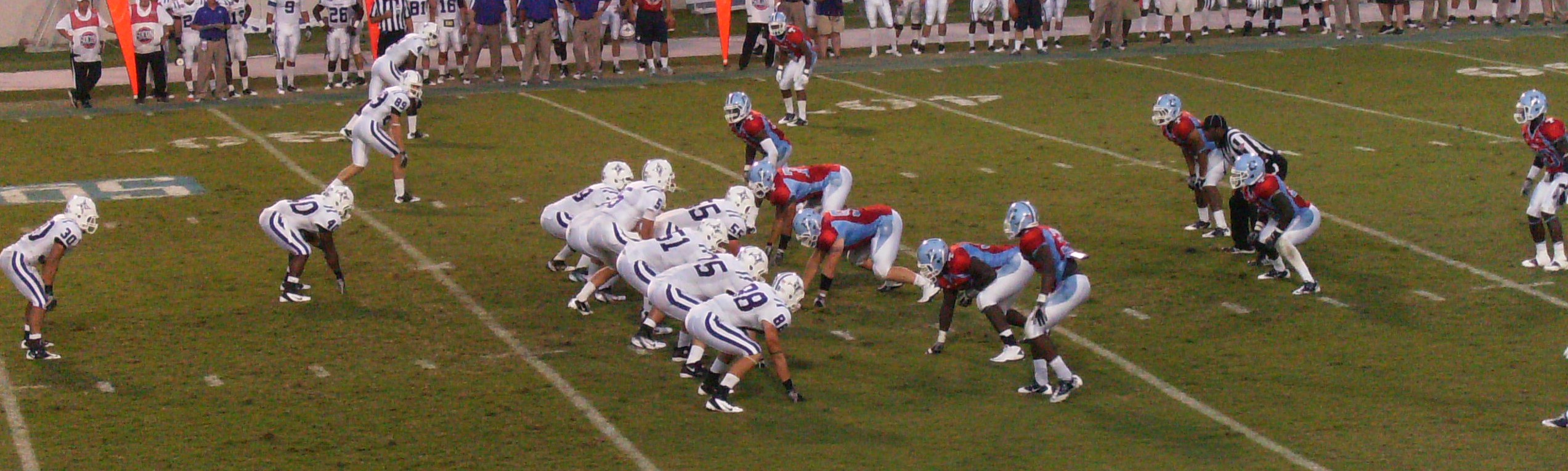
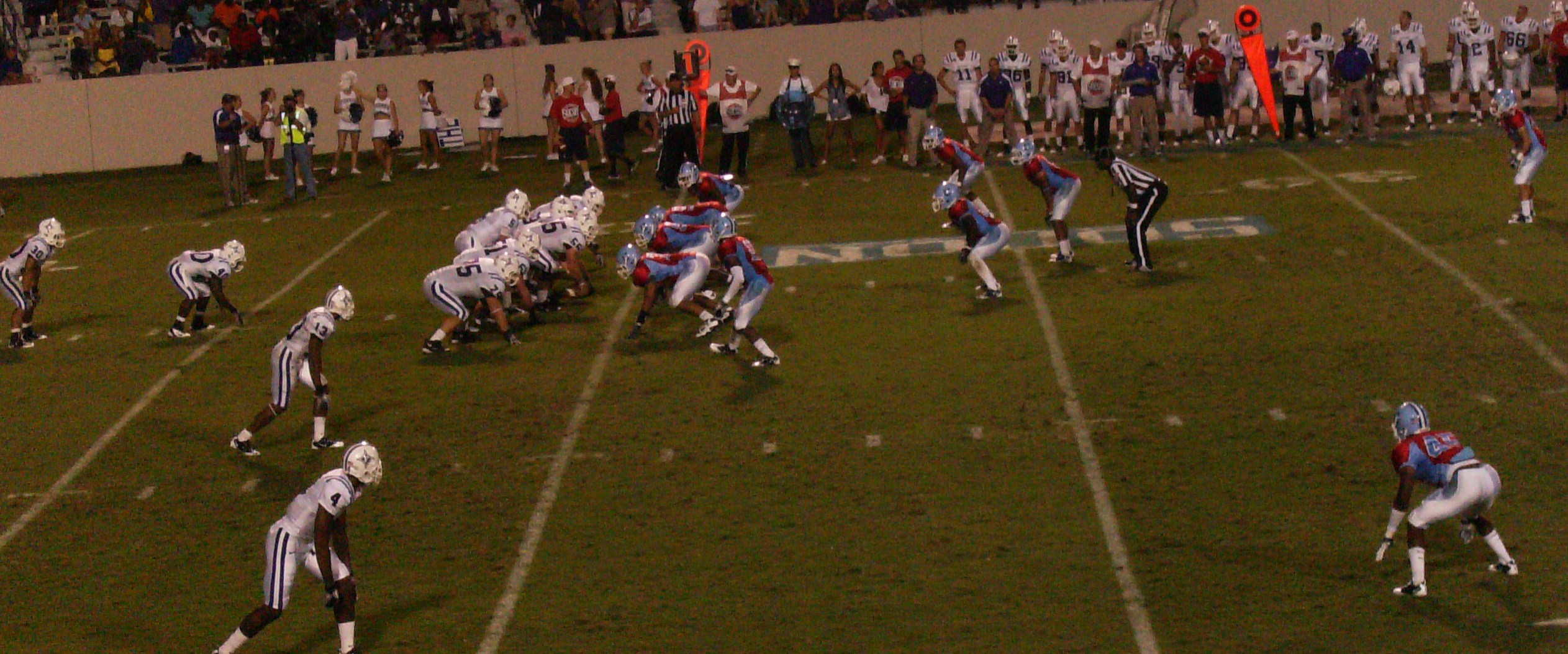
I’ll conclude this post with some pictures I took at the game.  Traditional reminder:  I’m a bad photographer with a below-average camera.  If you want to see good pictures, be sure to check out that Post and Courier gallery.  I do try to take pictures of offensive and defensive formations, because some people are interested in that (especially the triple option stuff).  I also threw in a couple of special teams photos and a shot of something called “Cosmic Dogs”, which is a new vendor under the stands.  It is, naturally, out of focus.

On to Furman…

Football, Game 7: The Citadel vs. Appalachian State

Time and Place:  6:00 pm ET, Kidd Brewer Stadium, Boone, NC

Television:  a tape-delayed broadcast on a local cable channel called MTN-18 that really needs to improve its website

This will be only the second Saturday night game played in Boone since 2001.  I gather that many of the Mountaineer fans wanted a night game; why you would want one in the mountains in mid-October, I have no idea, but their wish has been granted.  Appalachian State also played a Saturday night game against Presbyterian two years ago.

Note that I specified “Saturday night”.  In the last three seasons, the Mountaineers have played two Friday night games in Boone, one a I-AA semifinal against Richmond, the other a regular season game against Wofford televised (unfortunately for Wofford) on ESPN2.  So a night game in Boone isn’t a novelty; it’s just a little unusual.

This preview is a fairly short one, because I am in the middle of a busy stretch that includes some travel.  Among other things, that means I won’t be able to even listen to the dulcet tones of Darren Goldwater on the radio.  I won’t find out how the game went until late Saturday night.  I can probably make a decent guess as to how it will go, though.

Just a few brief observations, while I have a few minutes:

— Appalachian State is ranked #1 in both the FCS Coaches Poll and The Sports Network poll.  The last time The Citadel defeated the top-ranked I-AA team, it was 1988, and the opponent was Marshall.  That is still the most “electric” atmosphere for any game at Johnson Hagood Stadium that I have attended.

The upset on that sunny afternoon was keyed by an outstanding performance by the Bulldog defense.  To stay competitive on Saturday night, The Citadel will need a similar effort from its defensive unit.

— Sam Martin was hurt during the Chattanooga game.  This excerpt from Jeff Hartsell’s Tuesday report in The Post and Courier concerned me:

…early in the second quarter, Martin got hit by Mocs tackle Nick Davison and another player. He got to his feet and called a timeout, to Higgins’ consternation.

“I said, ‘Sam, why did you call a timeout?’ ” Higgins said at his Monday news conference. “He said, ‘Coach, I couldn’t see anything.’ So we got him off the field, and I determined it was a concussion. I’m not sure if that is what our medical staff is calling it, but we didn’t put him back in the game. He was doing fine after the game.

“We’ll keep giving him tests, but (Sunday) he was fine, (Monday) he was fine. I think he will be OK and we’ll get him practicing this week.”

Okay, a couple of things:

1)  Kevin Higgins has considerable coaching expertise, but I’ll go with the medical staff’s determination on whether or not a player has a concussion.

2)  If he really suffered a concussion, he wouldn’t be practicing.

As to what really happened to Martin during the UTC game, I have no idea.  I’m no doctor.  It sounded a little bit like what happened to Notre Dame quarterback Dayne Crist during the Irish’s game against Michigan State, though.  Crist was reportedly diagnosed with an “ocular migraine”.  He left that game, but later returned (and played very well).

I might add that we are less likely to find out these days exactly what a player’s medical condition is/was due to privacy laws, and I think that’s a good thing.  I also have full confidence in our medical/training staff.

— Alex Sellars tore his ACL and is done for the year.  It’s been a tough season for the fifth-year senior, who had previously suffered from back problems.  He had some outstanding moments for the Bulldogs during his career; it’s a shame there apparently won’t be any more on the field.

— Armanti Edwards is now a Carolina Panther, meaning that in terms of success, he’s gone from the penthouse to the outhouse.  He gets paid better to stay in the outhouse, though.

— His successor, DeAndre Presley, has already been named SoCon offensive player of the week three times this season, including last week against Elon, when he amassed 374 yards of total offense and scored three touchdowns.  Presley has yet to throw an interception this season in 118 attempts.

Presley was injured late in that game, but is expected to play on Saturday.

— The Mountaineers’ offensive line has remained intact through all five games so far this season.  Four of those five linemen also started every game last year, and the fifth (Daniel Kilgore) started on the line for every game in 2008.

— Speaking of experience, Appalachian State has three receivers (Matt Cline, CoCo Hillary, and big-play threat Brian Quick) who seem to have been playing for the Mountaineers since the late 1990s.

— As you can see, Appalachian State had lots of starters on offense coming back, save the quarterback position, and Presley obviously has made the transition from Edwards fairly seamless.  However, the Mountaineers have some new faces on defense, and that’s been a bit of a problem (at least, as big a problem as an undefeated team could have).

Appalachian State is allowing 254 passing yards per game and 381 total yards per contest, both below-average numbers.  However, its average points allowed per game (23.8) isn’t as bad as those peripheral statistics.  App State games are like track meets, and opponents find it difficult to keep up.  No lead is safe, either, as Chattanooga found out (ASU prevailing 42-41 after scoring 28 points in the fourth quarter).

— In last year’s game against the Mountaineers, the Bulldogs just missed pulling off a big upset (30-27, OT).  What The Citadel did well in that game was run the football, compiling 214 yards rushing while in a spread attack, including one of the more spectacular runs in the history of Johnson Hagood Stadium (Van Dyke Jones’ 69-yard TD).

The Bulldogs will need more than 214 yards rushing to compete with App State on Saturday, at least as long as the offense continues to average less than 60 yards passing per game.  Incidentally, The Citadel’s 247.7 ypg rushing is actually less than ASU’s (264.6 ypg).

— Appalachian State has already had ten different players score offensive touchdowns this season.  Five of those players have scored three TDs or more (Presley has eight).

— If the Mountaineers punt, don’t be confused when you hear Sam Martin’s name mentioned.  That’s the name of the ASU punter, no relation (I’m guessing) to the Bulldog quarterback.

— You may have read that Appalachian State is going to conduct a feasibility study on the possibility of moving up to FBS (I-A).  Of course, just last year fellow Southern Conference member Georgia Southern commissioned its own study on the topic, which I wrote about (probably too extensively) here.

In general, I am skeptical about schools moving up to FBS land; while fans and administrators dream of being the next Boise State, the truth is most schools are much more likely to become the next Louisiana-Monroe.  However, I can understand why App State is exploring the terrain.

It’s a strange time right now in the world of FCS.  The CAA is a good example.  Villanova is the reigning FCS champ, but has an offer to move to I-A and the Big East.  Two league schools (Hofstra and Northeastern) dropped the sport last year.  Georgia State and Old Dominion are now fielding teams and will join the league.  Rhode Island is considering a move to the Northeast Conference (motto:  we’re cheaper).

That’s just one league.  Back in the not-so-gentle world of the Southern Conference, it wasn’t that long ago the league included East Tennessee State, VMI, and Marshall.  Things change, and it’s important to evaluate things once in a while.  After all, as recently as 1995, The Citadel studied I-A as a possible option.

I think Appalachian State is marginally better positioned to move to FBS than Georgia Southern.  However, I greatly suspect that the feasibility study will show that ASU should stay right where it is, which I think would satisfy most of its fan base.  However, if “right where it is” were to no longer exist, the school should have a better idea of what its options are.

There won’t be a specific review post of the Appalachian State game on the blog next week.  Writing the preview of the Georgia Southern game is going to be enough of a struggle as it is; I’ll undoubtably take a look back at the ASU game as part of that preview.  The TV schedule post will still happen, possibly a day later than normal.

Go Dogs!

Football, Game 1: The Citadel vs. Chowan

It’s time for college football!   This year the scene at Johnson Hagood Stadium should include a lot of the following:  great tailgating, photo ops with Bulldogs both live and bronze, and, uh, fumbles…

Okay, so maybe that wasn’t the sunniest intro of all time.  I have to be honest here, though.  While I am looking forward to the season, this year I am a bit apprehensive about what lies ahead for the Bulldogs on the gridiron.  The Citadel is going to the triple option on offense, with a head coach who has never run the offense (or any similar offense) before, and with players who were mostly recruited for a very different kind of system.

The players who were recruited with the triple option in mind, of course, are all true freshmen.  The quarterback position will likely be manned by one (or more) of those true freshmen. The “knob”-starting quarterback double is a rare one, and for a reason. It’s an exceedingly difficult combination.

The Southern Conference media and coaches agree that this season could be a long one for The Citadel, just as the last two seasons have been.  The media picked the Bulldogs to finish last in the league.  The coaches ranked The Citadel eighth out of nine teams, ahead of only Western Carolina.

The Catamounts finished last in 2009, with only one league win.  That one WCU victory came against The Citadel, which tied for next-to-last.  More of the same is expected by those who follow the SoCon.

Before beginning league play, though, The Citadel will play three non-conference games.  Next week’s game at Arizona should be…interesting.  The following week the Bulldogs will take on Presbyterian, a team that went 0-11 last season, including a 46-21 loss to The Citadel.  However, even the Blue Hose would be favored against the Bulldogs’ opponent on Saturday, Chowan University, a Division II school located in Murfreesboro, North Carolina.

When the Hawks were announced as the opposition for the home opener, a collective yawn could be heard from The Citadel’s less-than-thrilled fans.  It’s hard to blame anyone for not being excited about Chowan being on the schedule, with all due respect to that school.  I’m guessing this game’s not going to be a sellout.

Having said that, let’s take a look at Chowan.

I wish I could say with confidence exactly how “Chowan” should be pronounced.  This is probably something that should concern Bulldogs play-by-play announcer Darren Goldwater a lot more than me, but I like to know these things.  I even sent an e-mail to Chowan’s department of athletics asking the question, and quickly got a response:

It’s pronounced CHO-WAN with a hard CH, just like CHOKE or CHICKEN. CHO-WAN.

That’s from somebody who works at the school, so she ought to know, but two different people have insisted to me that it’s actually pronounced “Shuh-WONN”, with the “Sh” sound at the beginning and the accent on the second syllable.  Since both of them are natives of eastern North Carolina, the region of the state that actually has decent BBQ, I tend to trust them.

“Chowan” is a derivative of “Chowanoke”, the name given to the native tribe of the region by 16th-century European explorers.  My guess is that if you were French, you pronounced it with the “Sh”, and if you were English, you went with the hard “Ch” sound.  It’s kind of like Beaufort (BO-fert), North Carolina, and Beaufort (BYOO-fert), South Carolina.

You like to-ma-to, I like to-mah-to, let’s call the whole thing off…

There is also a Chowan river, and a Chowan County — but Chowan University isn’t located in that county, but in the adjoining county of Hertford.  Naturally, this school in northeastern North Carolina is named to honor a tribe whose name means “people of the south”.

Regardless of its pronunciation, the school has been around in one form or another since 1848, when it was founded as Chowan Baptist Female Institute.  The school remained all-female until 1931, but in 1937 it became a junior college.

It reverted back to four-year status in 1992, and changed its name to the current Chowan University in 2006.  This fall, it will offer its first Masters Degree program, in Elementary Education.  Chowan remains affiliated with the Baptist State Convention of North Carolina.

About 1100 students attend Chowan.  I thought the section titled “Who we serve” on the school’s website was interesting:

The Chowan University community is committed to serving average students. By “average” we mean students with a GPA from 2.25-3.25 and “average” SAT scores (around 1300 for the three part SAT). Students below these criteria may be admitted if they show a commitment to the Chowan University experience and academic potential…

Many of our students are first generation college students which means their parents did not attend college or complete a college degree. Because of Chowan’s commitment to individual attention in a Christian environment, these students thrive here.

I liked this statement.  Too many schools insist on presenting themselves as wannabe Ivies, when everyone knows better.  Here we have a school that knows exactly what its mission is, and what it wants to do, and isn’t apologetic about it in the least.  Good for Chowan.

Chowan had a fine run in football as a junior college, almost entirely under James Garrison, who was the head coach at the school for 43 years (and for whom its football stadium is named).  Quite a few Chowan alums went on to four-year schools and then the NFL, including George Koonce, Curtis Whitley, and Mark Royals.

However, Chowan has struggled on the gridiron since becoming a four-year school itself.  Since 1993, the Hawks (formerly the Braves) have a cumulative record of 39-168-1 in Division III and (since 2005) Division II.  That includes Saturday’s 59-10 loss to Lenoir-Rhyne.

Chowan has been a football member of the Central Intercollegiate Athletic Association since the 2008 season (and is now a full member of the conference). Chowan is the first non-HBCU member of the CIAA in the league’s 98-year history.

The CIAA now has 13 members, and as a result the conference’s slogan for this year is “Triskaidekaphobia: Fear the 13!”  I’m not sure what the Southern Conference’s slogan would be — “The SoCon: The Nation’s Most Transient League”?

For Chowan football, the last five years have looked like this:

2005 — 2-8, including a 56-10 loss to North Greenville (now of Willy Korn fame) and a 42-21 defeat at the hands of Allen, which dropped its program after the season

2006 — 0-10, including losses of 42-0 to Western Carolina, 52-6 to North Greenville, and 28-0 to Webber International; Webber played The Citadel the following season, with a slightly different result

2007 — 2-9, including a lot of total beatdowns:  51-0 (Coastal Carolina), 56-14 (North Greenville), Presbyterian (62-10), and Newberry (67-0)

2008 — 2-8, which featured an early-season 69-20 loss to VMI (which had concluded its 2007 campaign in memorable fashion)

2009 — 2-8, although most of the games were more competitive; the Hawks did lose 36-21 to Old Dominion, the Monarchs’ first game since restarting its program after a 68-year hiatus (ODU did finish the season 9-2, though)

Those last two seasons came under the direction of the current head coach, Tim Place.  Place is a Washington & Lee alum who was previously the head coach at Urbana, an NAIA school in Ohio.

One of the members of Place’s coaching staff is Omar Nesbit.  Nesbit was an All-SoCon lineman at The Citadel, graduating in 2002.  He is the Hawks’ offensive line coach.

According to the school’s pre-season football guide, the team runs a “multiple” offense and a “multiple” defense.  Thirteen starters are back from last year’s outfit.

Last season the Hawks scored 25.3 points per game, not bad, but allowed 35.2 ppg. While the Hawks were a respectable passing team, all 25 of its TD passes were thrown by C.J. Westler, who was the offensive player of the year in the CIAA, and who is not among the returnees.  Much like The Citadel, Chowan has to find a quarterback (it played two in the Lenoir-Rhyne game).

Chowan turned the ball over three times per game, almost double its opponents’ totals, and averaged an anemic 2.9 yards per rush.  The Hawks gave up 48 sacks.

Defensively, the Hawks allowed 4.6 yards per rush and 9.3 yards per pass attempt, which is obviously not good.  Opponents scored touchdowns 70% of the time when they entered the “red zone”.  Chowan was also not a particularly efficient punting or placekicking team.

Against Lenoir-Rhyne, Chowan allowed 513 rushing yards (6.9 per attempt).  This is noteworthy in that L-R is running the same offensive system this season it ran last year under the direction of then-offensive coordinator Tommy Laurendine — who of course is now the offensive coordinator at The Citadel.

Laurendine has his work cut out for him, based on early reports.  For example, this is how Jeff Hartsell began his recap of the August 21 scrimmage:

After watching his quarterbacks combine for six interceptions and at least five fumbled snaps in Saturday’s scrimmage, Citadel football coach Kevin Higgins stated the obvious.

“Offensively, we have a lot of work to do,” said Higgins…

You could say that, coach.  On the bright side, nine of the eighteen pass attempts in the scrimmage were caught by Bulldogs.  Alas, six of them were defenders.  At least on those plays the QB got the snap from center.  Unofficial totals from the scrimmage had the first-team offense rushing 27 times for 67 yards.

At least the defense apparently looked good, although how much of that was due to the offense’s struggles is open to question.  The kicking game again failed to impress, a problem Higgins has been unable to solve for the last two seasons.

The scrimmage on August 28 was apparently better, based on some anecdotal reports.  At this point it appears the Bulldogs will play two “true” freshman quarterbacks, Ben Dupree (from Pennsylvania) and Matt Thompson (from Florida).

Terrell “First Sergeant” Dallas will be the fullback.  There are several candidates to fill the slotback positions, led by Van Dyke Jones and injury-plagued Rickey Anderson (everyone’s crossing their fingers for you, Rickey).  The offensive line has some experience, but not at center, which in part explains the center-QB exchange problems.

We won’t know for sure exactly how the new offense will look until Saturday, but it probably will be a slightly different variation than Charlie Taaffe’s version of the wishbone.  It’s not going to be quite like Wofford’s option attack, either.

It’s probably going to most resemble the setup run by Paul Johnson at Georgia Southern, Navy, and now Georgia Tech.  With that in mind, I wouldn’t be surprised if Kevin Higgins, with a personal history of running spread passing offenses, throws the ball a little more often than you see in most triple option offenses.

He has to figure out a way to get talented tight end Alex Sellars involved in the offense. Higgins has also commented on the big-play ability of Domonic Jones, a 6’5″ redshirt freshman.  I like the idea of isolating a tall receiver on a smaller defensive back in this offense.  Of course, you have to have a quarterback capable of getting the ball to Jones.

I linked this in an earlier post, but to get up to speed on how this offense will probably operate, check out The Birddog (helmed by a grad/fan of the Naval Academy), the triple option devotee’s website of choice.  Here is a primer on the TO:  Link

While the offense is filled with question marks, the defense should have a lot of answers.  There is depth and talent on that side of the ball, particularly in the defensive backfield.  Cortez Allen has drawn pre-season accolades.  Other DBs with the potential to shine include Keith Gamble (who had an 89-yard interception return against Presbyterian last season) and Joseph Boateng (who intercepted two passes in his collegiate debut against North Carolina).

Former safety Rod Harland is now a linebacker, joining team leader Tolu Akindele and Jeremy Buncum as likely starters.  The defensive line should be solid, if a little young.  Chris Billingslea had some impressive moments last season (and made the All-SoCon freshman team as a result).  Keith Carter is a redshirt freshman who should draw notice, if only for being a defensive tackle who wears #33.

The other defensive lineman (at least that’s his roster designation) I want to mention is Milford Scott, a special teams terror who blocked three kicks last season and created havoc many other times.  He’s tall, has long arms, and describes himself as a “Charleston homeboy” from the beach.  He’s a weapon.

Unfortunately, Scott’s dynamism on special teams was an exception (not counting Andre Roberts, obviously).  While punter Cass Couey fared reasonably well, the Bulldogs continued to struggle in the placekicking department.  That’s two seasons in a row The Citadel has had sub-optimal kicking, and early returns suggest it might be three in a row.

I don’t blame the kickers.  I blame the coaching staff.  It’s the job of the staff to get that aspect of the squad fixed, either by improving the kickers on the squad or finding somebody else to kick.

The Citadel also could stand to improve its punt coverage team (Scott aside) and its kickoff return unit.  The Bulldogs will sorely miss Andre Roberts as a punt returner; look for that component of special teams to not be as effective this season.

There has been a lot of turnover in the coaching staff, not only with the new offensive scheme (where the aforementioned Laurendine is joined by offensive line coach Bob Bodine), but with the defense as well.  Higgins recruited former Wofford assistant Josh Conklin to join the staff, and later named him defensive coordinator.

Conklin will get help from another new assistant, Denny Doornbos, who was the defensive coordinator at Army during the Bob Sutton years, which were mostly good ones.  I have to gleefully point out, though, that he was the DC for this game…and for this game, too.

While all the talk in the off-season has been about the offensive scheme, and how the coaches will implement it, I think the new coaches on the defensive side of the ball will be just as important.  Generally, you would like to have more staff continuity than The Citadel has had, but in the case of the defense, I think a fresh approach may be just what was needed.

There was a sense over the last two seasons that the defense had underachieved; in particular, some observers felt the unit was not aggressive enough.  The Bulldogs’ D must be pro-active this season, and give the offense short fields with which to work. The defense will likely also have to bail the offense out on a regular basis.

This is going to be an important year for Kevin Higgins.  The off-season issues, not surprisingly, did not sit well with the alumni — and I’m not just talking about the big boosters or the message board regulars.  He also has had back-to-back disappointing seasons on the field.

The move to a new offense, and the overhaul of his coaching staff, were both bold moves made by someone who expects to stick around for a while.  They weren’t short-term stopgaps.  That is to his credit, I think.

Now, however, even with modest on-field expectations, he needs to get the fan base to buy into his program again.  After all, Larry Leckonby and company need to sell tickets and sponsorships.  Jerry Baker has Brigadier Club membership goals to obtain, whatever his methods are (high-tech, low-tech, begging, etc.).

A 1:00 pm start time against Chowan on Labor Day weekend in Charleston probably isn’t going to be a big winner as far as attendance goes.  I fully expect one of those hot-and-humid Lowcountry days that are fairly typical for this time of year. Ugh.  Of course, that’s assuming a hurricane doesn’t come into play.

I’ll be there anyway, though.  I’m ready for some football.

Ruminating about off-field football troubles at The Citadel

It’s been a busy and occasionally difficult time for yours truly, which partly explains the lack of recent posts.  With regards to the Rice/Starks situation, I also wanted to wait and see how things shook out.  As it is, things haven’t become that much clearer as of late, but I figured I could make some comments about what we know right now.

They aren’t earthshaking observations, to be sure, but I wanted to weigh in on the matter in a little more detail.  I’m going to concentrate on just a few points.  There are two issues worth addressing that I’m not going to mention right now, because I simply don’t have enough information (not that I have any extra-special info on what I’m actually going to write about).

Before I delve into the recruitment of Reggie Rice and Miguel Starks, I wanted to briefly focus on an article in The Post and Courier from March 10 written by Schuyler Kropf. On the whole, I don’t have a big problem with the media coverage of the Rice/Starks arrests, but this particular piece gave me pause.

Kropf interviewed several alums, asking them about how the arrests might affect The Citadel’s image.  All fine and good, and he got on-record quotes from three different graduates, one of whom I actually know.  Kropf apparently could not get anyone to go on record with a “gloom and doom” quote, however, so he had to do what any intrepid reporter does when faced with such a dilemma.

He got quotes from anonymous message board posters.

Seriously, that’s what he did.  I had to read the article a couple of times to make sure I wasn’t missing something.

I’m not completely sure Kropf understands the nature of message boards.  I’ll give him the benefit of the doubt, I suppose, but it strikes me as poor reporting.  For one thing, how sure is he that the posts he quotes are from actual graduates of The Citadel?

Now, maybe he did some checking, or asked permission from the posters in question before quoting their comments, but even then can he really be sure they are who they say they are?  (He certainly didn’t indicate that he had confirmed anyone’s identity.  Heck, he didn’t even mention the usernames associated with the quotes.)

Kropf was unable to get a negative quote from any current cadet (or alum) on the record, although he did write this, a time-honored crutch for a struggling scribe:

…several cadets declined to speak about the mood inside the ranks, quickly turning their heads around to see if anyone had seen them talking with a reporter.

With all due respect, Mr. Kropf, get over yourself.

Now, as it happens, the two message board quotes in the article are, I believe, from actual alumni of The Citadel.  I can’t guarantee that, but I’m fairly sure — but then, I’m an occasional poster on that forum myself, and thus may be able to differentiate from regular posters and “trolls”.  Whether Kropf can do so is another matter.

That particular message board doesn’t have nearly as much traffic as you would see from forums devoted to larger schools. Sites such as InsideMDSports or  Phog.net may have several thousand members, with hundreds of posters online at one time, while thelordsofdiscipline.net has slightly over 500 registered members, with about a dozen of them online at extreme “peak” times.

What that means, among other things, is that when you have an event like the Rice/Starks arrests, the board is arguably more susceptible to being overwhelmed by people posting as fans of the school who aren’t really fans, just to stir things up.  It’s been known to happen.

Kropf could easily have wound up quoting a 13-year-old posing as a graduate of The Citadel.

There is obviously a big difference between getting something on record from a living, breathing person and grabbing a comment from the internet.  The first line of the article stated, “Whether The Citadel has an image problem depends on who’s doing the talking.”   Well, not only does the article not adequately identify those behind part of “the talking”, it doesn’t identify them at all.

It appears to me that the reporter wanted to write the story from a certain angle, but could not get the confirming quotes he needed, so he took a cheap way out.  In my view, that is not quality journalism.

Should Reggie Rice have been admitted to The Citadel?  Based on what he has done since enrolling, the answer is no, but should have that been the answer all along?

For those not familiar with Rice’s history prior to receiving an athletic scholarship to the military college, this column gives the basic story:

During Rice’s senior season [in high school], he was spectacular. He had three 200-yard games, including one against perennial state power Lincoln County.

However, his final season was cut short when he was suspended after eight games following his arrest and subsequent guilty plea in juvenile court to a statutory rape charge. Rice [was] tried in juvenile court because the three girls involved were deemed to have been willing participants.

Rice was placed on 24 months of probation and ordered to perform 56 hours of community service. He was given something else after the 2006 incident: a second chance.

Several area leaders went to bat for Rice, and even assisted in him being admitted to The Citadel, where he had been offered a football scholarship.

Early on during his career as a cadet, it appeared Rice was redeeming himself…

There was a racial aspect to the statutory rape case.  Rice (and one of the other males involved) were black, the girls white, and some in the community felt the charges were only brought due to race.  It appears that some of those “area leaders” quoted in the piece thought he was being more or less railroaded, including a superior court judge (and graduate of The Citadel) who sent the case back to juvenile court.

Tangent:  if you think you’ve heard a similar tale before, maybe you have.  I was reminded of another, more notorious case in Georgia, one that involved Marcus Dixon (now of the Dallas Cowboys).

Besides being a fine football player, Rice was intelligent and personable.  He impressed a lot of people, including the aforementioned judge and, later, a prominent businessman in the Charleston area (and alumnus).  It has been interesting to read comments from people — experienced “men of the world” types, presumably naturals at spotting a fraud — who liked Rice, trusted him, and were shocked at his subsequent problems.  Some people might call Rice a born con artist, or maybe even a sociopath.  I don’t know what he is, and it doesn’t really matter now.

Given that background, should Rice have been admitted to The Citadel?  No, he should not have.  It should have been clear then, as it is now.  I lay the blame for that on the admissions office more so than Kevin Higgins, as Rice was in Higgins’ first recruiting class, and the coach would not have been that familiar with the school.  I think it is clear that General John Rosa believes Rice’s admission was in error.  From his March 4 letter to alumni:

As did many colleges in the country, The Citadel revised its admission application process following the tragedy at Virginia Tech. We now require more information from candidates. Additionally, if the director of admissions has any concerns regarding an application, he presents them to me for consideration before final action is taken.

In other words, “that’s not happening again.”

It shouldn’t have happened in the first place.  Most people understand that The Citadel is not a reformatory for wayward boys, but every now and then someone gets confused about the school’s mission and talks about its capacity to “redeem” a student.  In the first column I linked, note that the author says that “it appeared Rice was redeeming himself.”

There are schools, many of them very good schools, where Rice would have been a reasonable candidate for admission.  The Citadel is not one of them.  You don’t go to The Citadel for redemption, because that’s not what the college is about.  The Citadel “experience” tends to highlight your natural, innate personality traits, as opposed to developing others.

The Citadel, at its essence, is about testing yourself, and learning exactly who you are. This is a very good thing, because young men and women fresh out of high school usually have no idea who they really are.  It’s also about learning how to deal with pressure, and about perseverance.

It’s not a second-chance type of place.  Maybe Kevin Higgins didn’t realize that when he first arrived on campus, but there surely were officials in positions of authority who could have guided him.

I can’t give Higgins a pass for the recruitment (and subsequent “handling”) of Miguel Starks, however.  Starks was a project in more ways than one.  He was always the most impressive-looking player on the sidelines during a game, as he looked great in a football uniform.  At The Citadel, though, that’s not the most important uniform.

Higgins saw in Starks the potential of a special player, and treated him accordingly.  Higgins may have chosen to  overlook some red flags that were raised during Starks’ high school career.  Some of those apparently included being dismissed from the basketball team and being suspended for a playoff game (for an on-field fight).

There have been numerous complaints raised in various quarters that Higgins essentially “enabled” Starks at The Citadel, going to bat for him on multiple occasions when Starks got in trouble for not adapting to the military system.  When you give preferential treatment to a star (or potential star) player, you run the risk of alienating the corps of cadets, not to mention his fellow football players.  This may go a long way towards explaining some of the angst expressed by current cadets concerning corps squad issues.

Also, running interference for an athlete (or any cadet, for that matter) is ultimately a pointless exercise.  You can’t make a person want to make it at The Citadel — he’s got to want it for himself.  If he doesn’t, all the interceding and pleading in the world won’t make a difference.

Coaches at The Citadel have a learning curve when it comes to recruiting.  One of the key things they have to learn is that keeping attrition low often correlates directly to on-field success.  One of the important ways to prevent attrition is to recruit cadets who can become good players, as opposed to recruiting players and trying to make them cadets.  Sometimes it takes a coach several years before he figures that out.  There have been coaches at The Citadel who have never figured it out.

I’m not advocating firing anybody.  I’m fairly confident that this episode is an isolated incident.  However, I think coaches and administrators need to be put on notice.  It’s one thing to have a losing record on the football field.  At The Citadel, though, you better be undefeated off the field.  One loss off the field is one loss too many.

The Citadel needs to win at least one more regular season game

The loss to UNC-Greensboro on Saturday was very disappointing, but oddly Ed Conroy wasn’t too worried about it.  At least, that’s what he told Jeff Hartsell of The Post and Courier:

“I thought we did some really good things,” said Conroy. “We shared the ball well, only had six turnovers, shot the ball well from 3-point range. We just didn’t convert a lot of shots on the interior. We got some good looks there, but they didn’t go.”

There was also a reference earlier in the article to “a touch of fatigue and illness,” so perhaps the team’s energy level wasn’t as high as it normally was.  Also less than energetic was a largely absent corps of cadets.  The corps’ apathy and/or lack of presence this season during games at McAlister Field House (not to mention the homecoming game in football) has been noticeable.  It’s an issue General Rosa and company must address.

Back to the court, The Citadel was outrebounded 41-24  by UNCG, which was basically the difference in the game, as it’s hard to overcome such a discrepancy without a huge edge in turnovers or shooting percentage, and the Bulldogs did not shoot particularly well (36%).  The loss means that to clinch an overall winning season, as well as a winning season in Southern Conference play, The Citadel needs to win one of its two final regular season games.

That won’t be easy, as they are both road contests.  Thursday the Bulldogs travel to Greenville to play an improving Furman club, followed by a Saturday game in Spartanburg against Wofford.

The Citadel beat Furman 70-60 in Charleston on January 23.  In that game, Cameron Wells had 22 points and 12 rebounds.  He was only 6-17 from the field, but went to the foul line repeatedly and converted (8-8).  Bryan Streeter also had a double-double in the contest.  The Bulldogs were a solid 8-20 from 3-point land and also won the turnover battle against the Paladins (11-8).

Furman’s Amu Saaka scored 19 points (on only 12 shots) and figures to be a problem again for the Bulldogs this time around.  The Paladins will also have Jordan Miller available for this game after he missed the first meeting.  Miller scored 31 points against UT-Chattanooga, but has followed up that great performance with two games in which he shot a combined 4-14 from the field.

Getting a win against Furman at Timmons Arena would be nice for several reasons. Assuming the two teams don’t meet in the Southern Conference tournament, it would be the first time The Citadel had swept the Paladins in consecutive seasons since the 2000-2001 campaigns.  Of course, there were only three games played in those years, as Furman screwed up in 2000 and scheduled too many games, leading to a penalty that resulted in only one game on the hardwood between the two schools that year.

The Citadel also won the second game played in the 1999 season, so it did win four straight against Furman from 1999-2001.  That was the last time the Bulldogs won four straight in the series.  The last time the Bulldogs won both home-and-away in consecutive seasons against the Paladins?  1939-1940 (part of a six-game win streak against Furman, the longest for The Citadel in the series’ history).  The Citadel hasn’t won consecutive games in Greenville since 1992-1993.

The Citadel had a late lead against Wofford in the game played on January 21, but couldn’t hold on and lost 44-42.  As the score indicates, it wasn’t an offensive masterpiece.  The Bulldogs shot 32% from the field.  Wofford shot no better (30%), but outrebounded The Citadel 38-33 and committed one fewer turnover.  The Terriers’ stated strategy of stopping Cameron Wells worked, as the rest of the Bulldog squad (save Zach Urbanus) combined for more turnovers (10) than made field goals (6).

You can bet Wofford will try to hold down Wells’ production again to win its sixth straight game over the cadets, but it may not be so easy this time, as the other Bulldogs have done a better job in recent games of shouldering the offensive load.  Of course, the Terriers are likely to be better at putting the ball in the hoop on Saturday as well.

Noah Dahlman was his usual solid self in the first meeting (15 points, 6-12 FG, five rebounds).  Odds are at least one of his teammates will provide offensive support.  I anticipate a higher-scoring game this time (but not much higher — we’re not talking about a pair of run-and-gun teams here).

Just a few stats to finish off this post…

— With one more regular season victory, The Citadel will clinch its second consecutive winning season.  The last time the Bulldogs had two straight winning campaigns? 1979-1980.  Before that, you have to go back to 1964-1965.  The Citadel had four straight winning seasons from 1958-1961.  Speaking of the 1958-61 era…

— If The Citadel beats Furman and/or Wofford, it will enjoy a second consecutive winning season in Southern Conference play.  The last time the Bulldogs had two straight winning SoCon campaigns?  1960-1961.

You read that correctly.  Actually, from 1958-1961 The Citadel had four straight winning seasons in conference play.  The first three came under the direction of Norm Sloan, who then became the head coach at Florida.  His successor at The Citadel, Mel Thompson (best known as Pat Conroy’s head coach at The Citadel, I suppose) would go 10-3 in SoCon action in his first season in charge.

Sloan took over a program that had not had a winning SoCon season since 1945. Actually, that doesn’t really tell the story.  Let’s put it this way:  from 1946 to 1956, The Citadel was 12-102 in league play.  The five years preceding Sloan’s arrival in Charleston featured a combined conference record of 2-49.

Sloan was 5-9 in the SoCon in his first season, and then had league records of 9-6, 7-4, and 8-4.

Sloan won the national championship in 1974 while coaching North Carolina State. He had proved his worth as a coach many years earlier, though, at a small military college.

Incidentally, the only other time The Citadel had back-to-back winning years in the Southern Conference came in the 1938-1939-1940 seasons, when the Bulldogs had three straight winning SoCon campaigns, mostly under head coach Rock Norman (who coached the team in 1938 and 1939, and for the first eight games in 1940 before being replaced by Ben Parker).

There is definitely potential for The Citadel to make a little history with a win in either of its two games this week.  I wouldn’t mind if instead of winning one of them, it won both.

Same song, different year

In college football, there are not that many games in a season, at least when compared to other sports.  For an FCS school, there are just eleven opportunities.  It’s important to make the most of each and every one of them.

The Citadel has played nine games this season.  In three of those games, the team’s performance has been absolutely awful, and I mean awful in the “did they know there was a game today?” sense.  That’s fully one-third of the games.

In sports, every now and then you’re going to have a bad day where nothing goes right (the same is true for life in general).  Most fans can understand that.  Having it happen once every three games — well, that’s not so understandable.  Worse, all three thud-fests were conference games (Elon, Western Carolina, and now Wofford).

In past posts, I called the Elon game a debacle, and the WCU loss a disaster.  I’m not sure what adjective applies to The Citadel’s game on Saturday against the Terriers.  Perhaps I should call it “disheartening” just to stay with the D-word theme.

Speaking of D:

  • On the second Wofford series, the Terriers were faced with a 3rd-and-8, and promptly converted it by completing a 23-yard pass — this from a team that rarely throws the ball (Wofford entered the contest last in the nation in passing yardage per game).  You just knew it was going to be a long day for the Bulldogs when that happened.
  • That third-down conversion was one of seven the Terriers picked up in eleven tries.  Wofford had come into the game only converting 38% of its third downs.
  • Of course, Wofford had 13 first downs in which it didn’t even need to convert a third down.
  • Wofford had lost 13 fumbles and thrown 6 interceptions prior to Saturday’s game, but the only Terrier turnover on Saturday came deep in Bulldog territory with Wofford already leading 29-10.
  • That fumble would be the only time the Terriers failed to score in the “red zone” in seven tries (four touchdowns, two field goals).

The defense’s day was probably best epitomized by a play in the second quarter.  Wofford faced a 3rd and 1 at The Citadel’s 33 yard line.  As the Terriers broke their huddle, an image of Terrence Reese in full “make some noise, get pumped up” mode appeared on the video board.  Wofford ran an inside handoff for three yards and a first down, with Reese then penalized for a late hit.  The Terriers scored four plays later.

The defensive issues weren’t particularly surprising, given the Bulldogs’ struggles on D for most of the season, and the success Wofford has had against The Citadel in recent years.  During the Kevin Higgins era, the Terriers have scored at least 28 points in every game against the Bulldogs.

However, unlike last season’s game against Wofford, on Saturday the Bulldog offense was equally disappointing.

I’m not sure what to make of the way the quarterbacks were utilized during the game.  Obviously, Bart Blanchard and Miguel Starks were both coming off injuries, and if they couldn’t play, that would be one thing.  As it happened, they both played, although whether either should have seemed debatable.

Blanchard was clearly struggling with a bad toe (and he’s had a bad ankle all year).  Never the fastest of QBs, he was no threat to run.  Any nominal “option” plays that The Citadel ran with Blanchard in the game were really just handoffs to Terrell Dallas or Van Dyke Jones, and Wofford treated them as such.  He also appeared to be a sitting duck in the pocket.

After the game, according to a story in The Post and Courier, Blanchard was wearing a walking boot in the locker room, just as he had in prior games against Furman and Samford, when he didn’t play.  I’m not sure why he played against Wofford, either.

I appreciated the effort and the determination, though.  Even with a bad wheel, he threw a really impressive pass to Kevin Hardy that would lead to a field goal; I’m not sure all of the fans in the stands appreciated how good a throw that was.  Blanchard did not get much help from his receivers, as there were several dropped passes (a recurring issue for most of the season).

Blanchard was in the game late in the first half when The Citadel got the ball on its own 6 yard line.  There were only 61 seconds left on the clock, and the Bulldogs actually had a little momentum, having scored on their previous drive to cut Wofford’s lead to seven, at 17-10.  The Terriers had just one timeout left, so the Bulldogs could have run out the clock.

However, on first down Blanchard went back to pass and was sacked, fumbling the ball.  Lincoln Kling recovered in the end zone for the Bulldogs, but the result was a safety.  Wofford returned the ensuing free kick to the Bulldog 40 and would eventually kick a field goal to take a 22-10 lead into the locker room.  It was like giving away five free points and all the momentum.  Wofford then got the ball first to open the third quarter, drove right down the field and scored.  Ballgame.

Tommy Edwards replaced Blanchard just before the end of the third quarter, moved the Bulldogs 38 yards in five plays, and then threw an interception.  On the Bulldogs’ next series (now trailing 43-10), Miguel Starks started taking the snaps.  He would lead The Citadel to the game’s final score on his second series of the game.

This I really didn’t understand.  If Starks was injured and couldn’t start, why put him in the game with 10 minutes left and the team trailing by five touchdowns?  I didn’t see the point in that.  If he had been healthy enough to play at all, he should have started over the clearly ailing Blanchard, or come into the game when the outcome was still in doubt.

Kevin Higgins noted that Edwards “doesn’t have much experience at all”, and that’s certainly true, but in retrospect I wonder if it would have been better for all concerned if Edwards had played instead of either Blanchard or Starks.

Of course, I’m just a yokel watching the game.  I don’t have any inside information on what the thinking was regarding playing Blanchard/Edwards/Starks.  It may be that Starks’ injury is the type that won’t get worse, but won’t get much better anytime soon.  If that’s the case, the coaches may have wanted to see what he was capable of doing, so they could take that into account for next week.

To have such a trouncing occur on Homecoming was also a bit dispiriting.  Without the TD at the end of the game, the Bulldogs would have suffered their worst Homecoming loss since 1989.  It’s not the best way to impress visiting alums, that’s for sure.

Things I may or may not have heard in and around the various reunion tents:

  • “Why don’t we run the wishbone?”
  • “Well, we’re a basketball school, anyway.”
  • “Maybe the guys on the team would play better if we rewarded a good season by letting them stay at the beach house during second semester, instead of the barracks.”
  • “How long have we been wearing navy pants?”
  • “Skip the orange juice, just give me what’s left in that bottle.”

A few observations about some off the field issues:

— Over the past couple of years, I’ve noticed that a significant number of cadets don’t make it to the game, and I’m not the only one who has spotted this trend.  At Saturday’s game I guesstimated that at least one-third, if not more, of the corps was not in the stands during the game.  Where were they?

This is something that the school administration needs to address before next season.  I know there are some legitimate absences, but the bottom line is that at least 90% of the corps of cadets needs to be in the stands at Johnson Hagood Stadium at every game.  Right now, that’s not happening.

— I’ve said this before, but if I attend too many more games at Johnson Hagood I’m going to eventually go deaf, thanks to the sound system speakers, which, apparently inspired by Spinal Tap, are set at “11”.  At least on this particular Saturday A) the referee’s microphone worked, and B) they didn’t play the “clap your hands” riff as the Bulldogs lined up to punt.

— Video board, good:  the Randy Bresnik message intro was great.  Excellent job setting that up.  I can’t imagine going into outer space.  Of course, I’m not crazy about heights…

— Video board, unintentionally amusing:  the Anthony Maldanado speech (through no fault of his own, of course).  Thank you.  Thank you.  Thank you.  Thank you.

— I thought the attendance was okay (Wofford didn’t bring a lot of fans).  Plenty of alums were wandering around, taking in the sights at the almost brand-new stadium, marveling at bathroom facilities that weren’t holdovers from the 19th century.  Everyone was ready to cheer; there just wasn’t anything worth cheering about, at least on the field.

— MVPs for the day, school of business administration:  both the Class of ’59 and the Class of ’69 presented enormous monetary contributions to the school on Saturday.  Major, major thumbs-up for those two classes.  Outstanding.

— MVPs for the day, school of recreation and leisure:  this would go to the Class of ’89, which had a huge throng of partiers at its reunion tent, all of whom appeared to be having a good time.  Great turnout by that group of youngsters.

The Citadel now has two games left on the schedule, road contests against UT-Chattanooga and Georgia Southern.  A winning season is still a possibility, but it will be a tall order to triumph against both an improved Mocs squad and the traditionally tough Eagles.  The Bulldogs will certainly have to play much, much better than they did on Saturday if they hope to win either of those games, much less both of them.