2015 Football, Game 11: The Citadel vs. South Carolina

The Citadel at South Carolina, to be played in Columbia, South Carolina, at Williams-Brice Stadium, with kickoff at 12:00 pm ET on Saturday, November 21. The game will be televised on the SEC Network [alternate feed], with play-by-play from Taylor Zarzour, analysis by Charles Arbuckle, and reporting from Paul Finebaum.

The game can be heard on radio via the various affiliates of The Citadel Sports Network. WQNT-1450 AM [audio link], originating in Charleston, will be the flagship station. WQNT will have a two-hour pregame show prior to each home football game. 

Mike Legg (the “Voice of the Bulldogs”) will call the action alongside analyst Lee Glaze. Jay Harper will report from the sidelines; he will host the first hour of the pregame show as well.

It is also possible to listen to the action with a smartphone, using a TuneIn Radio application.

Links of interest:

– The Citadel confident in its playoff rĂ©sumĂ©

– 25 years later, The Citadel’s upset of South Carolina still resonates

– Game notes from The Citadel and South Carolina

– SoCon weekly release

– SEC weekly release

– Mike Houston on the SoCon teleconference

– Shawn Elliott discusses The Citadel (video)

– Gamecocks have reason to be wary of The Citadel

– South Carolina defensive coordinator Jon Hoke discusses The Citadel’s triple option (video)

– Mike Houston’s 11/17 press conference (with comments from Mitchell Jeter and Tyler Renew)

– The Mike Houston Show (video from his radio show)

– Preview of The Citadel-Chattanooga from The State (video)

– Everette Sands coaches against his alma mater on Saturday (with video)

– Triple option challenges South Carolina’s defense

– Quinlan Washington and Eric Goins added to “watch lists”

– FCS Coaches’ Poll

Besides being televised on an alternate feed of SEC Network (611-1 on DirecTV, and available on most cable/satellite systems), the game between The Citadel and South Carolina will also be the site of the “SEC Nation” pregame show. The on-air crew will include Joe Tessitore, Marcus Spears, Tim Tebow, and Paul Finebaum.

In addition to his duties on the pregame show, Finebaum will also be the SEC Network’s sideline reporter for the football game that follows. It will be the first time Finebaum has assumed that role:

“I thought it’d be fun, a non-traditional approach. I imagine it’ll mostly be chatter about next week [when the Gamecocks host No. 1-ranked Clemson].”

Essentially, then, he won’t be paying attention to the game on the field. I find that extremely disappointing, both from Finebaum and ESPN.

The last time The Citadel played South Carolina, in 2011, I wrote about a great gridiron victory by the Bulldogs over the Gamecocks. I didn’t write about the 1990 game, though. Instead, I focused on the 1950 clash, which was played at Johnson Hagood Stadium and may have been an even bigger upset.


Instead of doing a copy/paste job, I’ll just link that year’s preview post. The first half of the post is a story on that 1950 contest, won by The Citadel 19-7: Link

Okay, let’s talk about the FCS playoffs…

First, the basics. Twenty-four teams will make the playoffs; ten will get automatic bids, fourteen will be at-large selections.

Sixteen of those teams play in the first round. The eight teams that advance from that group play eight “seeded” teams in the second round (in other words, those seeded teams get byes; they also will be the automatic host teams for the second round unless something strange happens).

From there, teams advance to the quarterfinals, semifinals, and finals. The title game will be played January 9, 2016, in Frisco, Texas.

Three conferences do not get automatic bids. The Ivy League doesn’t participate in postseason football action, while the SWAC and MEAC champs will play in the new Celebration Bowl instead.

However, one caveat: SWAC and MEAC teams can receive at-large bids. A team could finish 2nd in the MEAC, for example, and go to the FCS playoffs, while the champion of that league plays in the Celebration Bowl.

This year, that could be an issue, at least in the MEAC. I’ll get to that later.

Here are the leagues that get automatic bids, and the teams that have clinched bids so far:

Patriot League – Colgate
Ohio Valley – Jacksonville State
Pioneer League – Dayton
Southern – Chattanooga
Southland – McNeese State
Big South – Charleston Southern
Colonial
Big Sky
Missouri Valley
Northeast

The Northeast Conference title will be decided in a winner-take-all game between St. Francis (PA) and Duquesne. No other school in that league will get a bid.

The other three leagues that haven’t had auto-bids decided yet will have multiple teams in the field.

Here are the teams that are “locks”. No matter what happens Saturday, these teams will have their names called on Selection Sunday:

Colgate, Fordham, Jacksonville State, Dayton, Chattanooga, McNeese State, Charleston Southern, Coastal Carolina, William & Mary, James Madison, North Dakota State, South Dakota State, Illinois State, Portland State

The winner of St. Francis-Duquesne also gets in, obviously, so that’s fifteen teams in the field. There will be nine more that make it. Here, in roughly the order I think they would be in if the season ended today, are the contenders for those nine spots. I believe there are sixteen teams that still have a shot:

Southern Utah
Sam Houston State
Northern Iowa
Richmond
Montana
Northern Arizona
Eastern Washington
The Citadel
North Dakota
Central Arkansas
Villanova
Towson
Eastern Kentucky
Eastern Illinois
New Hampshire
Bethune-Cookman

Four of these teams (Southern Utah, Montana, Northern Arizona, and Richmond) could grab auto-bids. The latter three have to win and hope other results go their way; Southern Utah just has to win its game to be the outright Big Sky champion.

Now, I’m going to list the games Bulldog fans should be following on Saturday, including times (ET), lines, and TV/streaming options, with teams to pull for (if you root for The Citadel) mentioned in bold.

The matchups are (very) roughly in order of importance, but don’t make too much of that. There aren’t any absolute must-wins (or losses) on the board as far as The Citadel is concerned, and you could also make an argument in two of these matchups that it would be better if the other team won the game.

  • Villanova-James Madison, noon, MadiZONE streaming video (on JMU’s website); James Madison favored by 6 points
  • William & Mary-Richmond, noon, CSN-MidAtlantic/SNY; William & Mary favored by 4 points
  • North Dakota-Cal Poly, 9:05pm, Big Sky Digital Network; Cal Poly favored by 7 points
  • Florida A&M vs. Bethune-Cookman (in Orlando), 2:30pm, ESPN Classic; Bethune-Cookman favored by 19 points
  • Montana-Montana State, 2:10pm, Root-Southwest/Rocky Mountain/Northwest; Montana favored by 7 points
  • Southern Illinois-Northern Iowa, 5:00 pm, ESPN3; Northern Iowa favored by 11 points
  • Northern Arizona-Southern Utah, 5:00pm, Big Sky Digital Network; Southern Utah favored by 10 points
  • Portland State-Eastern Washington, 5:05pm, Big Sky Digital Network; Portland State favored by 5 points
  • Rhode Island-Towson, 2:00pm, Towson All-Access (on TU’s website); Towson favored by 20 points
  • Maine-New Hampshire, 1:00pm, pay-per-streaming (on UNH’s website); New Hampshire favored by 10 points
  • Eastern Kentucky-Eastern Illinois, 2:00pm, ESPN3; Eastern Illinois favored by 4 points
  • Sam Houston State-Central Arkansas, 7:00pm, ESPN3; Sam Houston State favored by 4 points

Quick notes on some of these games:

– A loss almost certainly knocks out every non-bolded team on this list, with the possible exception of Richmond. The Spiders would be 7-4 with a loss, against a respectable schedule, and also have a road win over James Madison.

Richmond’s issue is that it would have finished the season on a three-game losing streak, and would be competing with New Hampshire and/or Towson to be the 3rd CAA team in the field (having lost to New Hampshire, and having not played Towson).

– I believe the winner of Sam Houston State-Central Arkansas gets in, and the loser is left out. Part of me would root for Central Arkansas in this game, because UCA has a lopsided loss to Samford on its rĂ©sumĂ©, so The Citadel would compare favorably if that is taken into consideration.

However, my fear is that both SHSU and Central Arkansas could get in if UCA wins this game, despite Sam Houston State only having 6 D1 wins in that scenario. The problem is that the Bobcats are a “name” in FCS, and are currently ranked 12th.

I think it might be better for The Citadel if Sam Houston State won this game, essentially punching its ticket, and the Southland gets its standard two teams in the playoffs — rather than risking three Southland postseason entrants.

You could argue it either way.

– The loser of Eastern Kentucky-Eastern Illinois is out. The winner may get in, but it wouldn’t be a lock. The Citadel has a better case than either of them anyway, in my opinion.

– North Dakota has a victory over an FBS team. Admittedly, that FBS team is Wyoming, which probably wouldn’t finish in the top 3 of the Big Sky this season, but any FBS win will look good to the selection committee. I could see UND making a late move up and grabbing a bid, especially if it can win on the road at Cal Poly.

– Right now, I think The Citadel would be in with a couple of spots to spare. However, the Bulldogs could be “jumped” by a few teams. I am worried about the logjam in the Big Sky (a league that has historically fared well when bids are handed out) and the CAA (with a couple of last-gasp pushes by Towson and New Hampshire).

– Bethune-Cookman is the wild card in all of this, and may be the team that concerns me the most. The Wildcats are playing 1-9 Florida A&M on Saturday, and a win would move B-C to 9-2 on the season, with 8 Division I victories.

Bethune-Cookman is unlikely to get the MEAC’s bid to the Celebration Bowl even if North Carolina A&T loses this week, because of the tiebreaker setup in that conference. However, if B-C ties for the league title (or even if it finishes second), it would not be completely surprising to see B-C’s name on the bracket on Sunday.

I don’t think it would be deserving, as the Wildcats’ schedule strength is not good at all, but I’m not on the committee.

There is also the issue with the MEAC electing not to send its champion to the playoffs any longer, and instead having it represent the conference in a bowl game. Some members of the selection committee might consider that decision an abdication of participation by the MEAC in the FCS playoffs, regardless of its non-champion teams being eligible.

Let’s assume The Citadel makes the playoffs. Where would the Bulldogs play? Could they host?

Generally, the NCAA prefers to break things down regionally when it comes to placing teams in the FCS playoffs. It’s not unlike the college baseball tournament in that respect.

The Citadel would not get a seed, even with a victory over South Carolina on Saturday. Possible first-round opponents include Coastal Carolina, William & Mary, James Madison, and Richmond. I don’t think the Bulldogs would play Charleston Southern in the first round (if CSU didn’t get a bye), but I could see the bracketing leading to a potential second-round matchup with the Buccaneers (in fact, that might be likely).

Incidentally, Coastal Carolina’s hopes at getting a bye were all but dashed with its loss on Thursday night to Liberty. That could increase the possibility of a Coastal Carolina-The Citadel first-round game, with the winner playing Charleston Southern.

The home/road situation for the first round is usually determined by which school made the highest bid to host. From the first link in the “Links of Interest” section:

Meanwhile, The Citadel has put in its bid to host a first-round game on Nov. 28, submitting a bid higher than the $30,000 minimum, according to a school source. And Citadel athletic director Jim Senter is working the phones.

Excellent.

Also excellent: this effort by the Media Relations staff. Very well done.

I think The Citadel has a very reasonable chance of getting an at-large bid. The numbers largely break in the Bulldogs’ favor.

As long as there aren’t a lot of weird results on Saturday (or some political maneuvering in the committee room), The Citadel should be a part of the selection show (which airs on Sunday at 11:00 am ET on ESPNU).

Of course, The Citadel could make all of this analysis moot by winning on Saturday. That would be fine with me.

Normally, in this part of the preview I would compare the opposing team’s season statistics to those of The Citadel. However, since South Carolina is an FBS squad that plays in the SEC, that comparison struck me as largely irrelevant.

I’ll just note a few things that caught my attention while going over South Carolina’s numbers. The Gamecocks’ advanced statistical profile looks very much like a team with a 3-7 record.

– South Carolina does have some talented players on the defensive side of the ball. Linebacker Skai Moore (6’2″, 218 lbs.) leads the team in tackles (and tackles for loss). Moore is arguably the main reason North Carolina is not undefeated (well, maybe he shares that honor with Marquise Williams).

– On his radio show, Mike Houston mentioned that 12 different Gamecocks would rotate along the defensive line, including Gerald Dixon Jr. (6’3″, 327 lbs.), a massive nosetackle. Houston also noted the fine play of free safety Isaiah Johnson (6’0″, 209 lbs.), who is second on the team in tackles. Johnson will probably be an important player for the Gamecocks when defending the triple option.

– The defense has not been very good against the run, ranking 105th in rushing defense, allowing 5.04 yards per carry (110th nationally). The Gamecocks have been better at home in that category, however, allowing 3.86 yards per rush in Williams-Brice Stadium.

– On 3rd down and between 7 and 9 yards to go, South Carolina ranks next-to-last in rushing yards allowed. Opponents have run the ball nine times against the Gamecocks in that situation, gaining 81 yards. Obviously, that’s not much of a sample size.

– If The Citadel can keep the game close, perhaps this chart will come into play. It includes some situational statistics regarding South Carolina’s defense against the run:


Situation G Att Yards Avg. TD
SC winning By 15+ Pts 1 2 -7 -3.5 0
SC winning By 8-14 Pts 2 5 12 2.4 0
SC winning By 1-7 Pts 6 66 304 4.61 5
Tied 8 95 498 5.24 5
SC losing By 1-7 Pts 10 119 705 5.92 4
SC losing By 8-14 Pts 6 79 326 4.13 3
SC losing By 15+ Pts 4 35 185 5.29 2

– South Carolina has not been good at finishing drives, averaging 4.1 points per possession inside the opponents’ 40-yard line. That ranks 110th out of 127 FBS teams.

– Starting quarterback Perry Orth (6’1″, 203 lbs.) has an older brother, Calvin, who played baseball at The Citadel from 2011-14.

– Average size of the projected starting offensive line for the Gamecocks: 6’5″, 296 lbs.

That projected group of starters includes 6’8″, 295 lb. Blake Camper, a freshman expected to start at right tackle in place of Mason Zandil, who suffered a high ankle sprain last week.

Left tackle Brandon Shell (6’6″, 328 lbs.) is an NFL prospect. He has made 46 starts along the line during his college career.

– I would imagine South Carolina’s offensive strategy in this game will be fairly simple. The Gamecocks will undoubtedly run Brandon Wilds (6’2″, 220 lbs.) and David Williams (6’1″, 222 lbs.) behind that huge offensive line, grinding out first downs and trying to control the clock. When not doing that, South Carolina will probably get the ball in the very talented Pharoh Cooper’s hands at every opportunity.

At least, that’s what I would do. Cooper (5’11”, 207 lbs.) is really good. He has 51 catches for 700 yards this season, and is also averaging 6.1 yards per carry in limited rush opportunities.

South Carolina has an excellent placekicker/punter combo in Elliott Fry (6’0″, 164 lbs.) and Sean Kelly (5’10”, 189 lbs.).

Fry is 16-23 on field goal attempts this season, with a long of 52. He is a Type 1 diabetic who has managed to carve out a fine career at South Carolina.

Kelly (who is also the holder for placekicks) is averaging 43.3 yards per punt. Of his 47 boots, 21 have landed inside the 20-yard line, against only 3 touchbacks. He has had 12 punts of 50+ yards this season.

The Gamecocks have dangerous return men. Pharoh Cooper is the primary punt returner, while freshman Rashad Fenton (5’10”, 180 lbs.) ran a kickoff back 96 yards for a touchdown against LSU.

Odds and ends:

– South Carolina isn’t really excited about mentioning the 1990 game, if its game notes are anything to go by:

The teams met every year from 1907 until 1937, and 11 more times from 1940 to 1954, but got together just twice in the ‘60s and three times in the ‘80s. This is the second matchup between the two schools since the turn of the century. The Gamecocks posted a 41-20 win on Nov. 19, 2011 in the last encounter.

Let’s just gloss over the 1990s, shall we?

– Those South Carolina game notes also mention this factoid: in nine games against FCS opponents since 2006, the Gamecocks are 9-0, with an average score of 38-13.

– There are 40 players from South Carolina on the Gamecocks’ roster. Other states represented: Georgia (27), Florida (18), North Carolina (7), Alabama (5), Virginia (3), Maryland (2), California (2), and one each from Texas, Ohio, Pennsylvania, Missouri, Massachusetts, and Illinois.

– Per one source that deals in such matters, South Carolina is a 20-point favorite over The Citadel. The over/under is 57.

Other lines involving SoCon teams: Furman is an 8-point underdog at Wofford; Western Carolina is a 14-point favorite at VMI; Samford is a 3-point favorite at Mercer; and Chattanooga is a 30.5-point underdog at Florida State.

East Tennessee State is a 1.5-point home underdog against Kentucky Wesleyan on Saturday.

– Per the S&P+ ratings, South Carolina has a win probability of 93.1% on Saturday. Only five teams have a higher win probability this week: Middle Tennessee State (over North Texas), West Virginia (over Kansas), Florida State (over Chattanooga), Clemson (over Wake Forest), and Alabama (which has a 99.9% win probability over Charleston Southern).

– Among FCS teams, The Citadel is 19th in this week’s Massey Ratings. The ratings for other league teams: Chattanooga, 13th; Western Carolina, 23rd; Samford, 45th; Wofford, 49th; Furman, 54th; Mercer, 55th; VMI, 81st.

North Dakota State now sits atop the Massey FCS Ratings, followed by Illinois State, Jacksonville State, South Dakota State, and Dartmouth. East Tennessee State is 123rd, just ahead of Mississippi Valley State and Arkansas-Pine Bluff.

– The weather forecast for Saturday in Columbia, according to the National Weather Service: sunny, with a high around 58 degrees, a northeast wind around 7 mph, and a 20% chance of rain after 1 pm.

– Saturday is Military Appreciation Day at Williams-Brice Stadium.

– South Carolina is beefing up security for the game. Keep that in mind while deciding when to leave the tailgating areas and enter the stadium.

– The Citadel will wear white jerseys and hideous gray pants on Saturday.

The Citadel could win on Saturday. It wouldn’t blow anybody’s mind, at least not anybody who was paying attention.

That said, South Carolina, even with its struggles this season, is still an SEC team. It has huge resource advantages, and a lot of talented players.

In addition, the “look ahead” factor for this game is probably slight, despite Clemson coming to town next week. South Carolina wants to win a game — any game. It isn’t like the Gamecocks have 6 to 8 wins already and are cruising to a bowl game.

I think The Citadel will move the ball (at least occasionally) against South Carolina’s defense. I am concerned about the Bulldogs’ D, though.

Regardless, I’m looking forward to this one. For one thing, it’s a home game for me.

It is also a great opportunity for the team. Don’t be afraid to make a little history, guys.

Go Dogs!

Game review, 2015: Mercer

Links of interest:

Game story, The Post and Courier

Photo gallery, The Post and Courier

School release

Video from WCSC-TV, including interviews with Mike Houston, Isiaha Smith, Cam Jackson, Tyler Renew, and Tevin Floyd

Video from WCIV-TV (starting at the 8:00 mark)

Post-game video interview with Mercer head coach Bobby Lamb

Game video highlights

Box score

The Citadel didn’t play its best game of the season on Saturday afternoon, not by a long shot. However, the end result was still a victory, and that’s what mattered.

Mike Houston, in his post-game press conference:

The big key is finding a way to win when you don’t play your best.

The Bulldogs lost two fumbles, botched a field goal attempt (and were generally unimpressive on special teams), committed a couple of ill-timed penalties, and had trouble moving the ball on offense for the first 20 minutes of the game. The game could easily have been lost, particularly because Mercer was playing solid, mistake-free football (no turnovers, only three minor penalties).

However, The Citadel played well on defense throughout the game (aside from the Bears’ final drive), and the offense eventually righted itself.

Random thoughts and observations:

– The Citadel has clinched a winning season. That matters a lot to longtime followers of the military college.

– For the first time since joining the Southern Conference in 1936, The Citadel has won its first five league contests.

Only once in program history has the Bulldogs won six conference games. That was in 1992, the last time The Citadel won the SoCon. On five other occasions, the Bulldogs have won five league matchups — in 1959, 1961, 1988, 1991, and 2012.

– October was good for The Citadel, which went 4-0 during the month. I decided to check the records to see how often the Bulldogs had gone undefeated in October while playing at least four games.

It turns out to have happened seven other times:

  • 1909: Sam Costen’s tough-minded squad didn’t begin play until October, but came out of the gates strong, going 4-0-1 during the month. Two of the wins came against College of Charleston; the tie came against Georgia (0-0). The Bulldogs also beat Porter 99-0, which is still the largest margin of victory in school history.
  • 1928: This was another team that didn’t start its season until October. Carl Prause’s men won their first four games that season by a combined score of 111-8, defeating Stetson, Newberry, Davidson, and Erskine.
  • 1959: For the only time in school history, a team won five games in October. Four of those victories by Eddie Teague’s crew were in SoCon play, the first time The Citadel won four league contests in October. The second time? That happened this past Saturday.
  • 1960: This edition of the Bulldogs went 4-0-1 in October; the tie came against Florida State, an often-referenced 0-0 battle.
  • 1961: Yes, The Citadel had a three-season stretch in which October was a very enjoyable month. This team won the league, of course; three of those SoCon victories came in the tenth month of the year.
  • 1984: Tom Moore’s best team averaged almost 27 points per game in four October victories, three of which were conference affairs. The fourth win came against Davidson, a popular opponent in this month; the 1928, 1959, and 1960 teams also beat the Wildcats in October (the ’61 squad was a little impatient, defeating Davidson on September 30 that season).
  • 1988: Four of seven consecutive wins during Charlie Taaffe’s second season in charge occurred in October, including three conference victories. The week after October that year wasn’t too bad, either; on November 5, The Citadel beat top-ranked Marshall 20-3 in one of Johnson Hagood Stadium’s most memorable games.

– Of course, Mike Houston had an astute observation about what month matters most:

Fans and alumni — they remember teams that play well in November.

– The biggest play of the game, almost without question, was Isiaha Smith’s 83-yard run right up the middle near the end of the first half. It gave the Bulldogs a lead they would never relinquish, and it came after a half in which The Citadel had mostly been on the back foot. It was a brutal play for Mercer, which had done just about everything right up until that moment.

Smith’s burst was the sixth-long rushing play in school history. In what I consider a statistical oddity, only once has a pass play by The Citadel resulted in a longer gain.

That came in 1983, when current football radio analyst Lee Glaze threw an 84-yard TD pass to John Murphy. Glaze was starting quarterback Robert Hill’s backup at the time; the future All-SoCon wide receiver came into the game briefly after a minor injury to Hill, and almost immediately threw the pass that still stands today as The Citadel’s longest completion.

It should come as no shock to anyone reading this that the Glaze-to-Murphy toss came against Davidson, and in October.

– The Citadel just missed on being ranked last week in the FCS Coaches’ poll. The Bulldogs will almost certainly be in this week’s poll, however.

Eight ranked teams lost on Saturday, including #17 Montana, #18 Montana State, #22 Dartmouth, and #23 Indiana State. At least two of those teams will probably drop out of the rankings, with The Citadel moving into the Top 25.

– For the first time this season in conference play, The Citadel did not improve its rushing yards/play numbers. The Bulldogs averaged 6.0 yards per rush against Mercer, slightly lower than the 6.2 yards per rush The Citadel had versus Furman.

Six yards per carry is still good enough.

– Occasionally you will hear some rumbling noises from the West Stands when there is a heavy dose of the fullback dive. That happened at times on Saturday, particularly in the first half.

It reminded me of the game earlier this season against Western Carolina. In that game, The Citadel gave the ball to the fullback on seven straight plays in the third quarter.

In the first half versus Mercer, Tyler Renew had a stretch in which he carried the ball on seven consecutive plays. Later in the half, Renew rushed on five straight downs.

That may seem like overkill. There is a method to the madness, however — and it is hard to argue about the effectiveness of the strategy when Isiaha Smith is racing 80 yards down the field for the go-ahead touchdown.

– While I didn’t question the usage of the B-Backs, I wasn’t quite as enthusiastic about Mike Houston’s decision in the second quarter to punt on 4th-and-1 from the Mercer 40-yard line.

The Citadel trailed 10-0, and I thought the percentage play was to go for it. It also seemed out of character, both for the head coach and the offense in general.

I can only surmise that Houston just wasn’t confident in the offense to that point in the game, and settled for changing field position.

Mercer did move the ball on the ensuing possession, gaining 52 yards of total offense before punting. The Citadel then marched 80 yards down the field and scored a touchdown to get back into the game.

– For the first time this season, The Citadel won a game but did not “cover”. No one paying attention was surprised.

– Mitchell Jeter now has 30 tackles for loss in his career. He also had a sack on Saturday, giving him 7 for the season.

– I was disappointed in the attendance. It was a beautiful afternoon, The Citadel had won three straight games, both Clemson and South Carolina were playing road games…and there were only 10,006 people in the stands at Johnson Hagood Stadium.

The crowd next week will be larger, if only because it will be Homecoming. I’m at a bit of a loss to explain what happened on Saturday, though.

Next week, The Citadel plays VMI, with the coveted Silver Shako on the line.

The following week, the Bulldogs travel to Chattanooga to face the Mocs, with the Southern Conference title at stake. The winner also receives an automatic bid to the FCS playoffs.

The week after that, The Citadel journeys to Columbia to do battle with South Carolina. This is the 25th-anniversary season of “38-35”.

What does all that mean? It means the next three weeks are going to be really intense, and just a little crazy, and maybe — just maybe — a whole lot of fun, too.

I can’t wait.

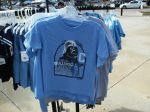
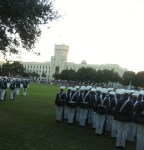
The pictures, as usual, range from mediocre to bad. The first one is a reminder that a Jedi Knight is the closest equivalent to a graduate of The Citadel in the entire galaxy.

aaa


Game review, 2014: Furman

Members of The Citadel’s 1990 College World Series team were honored at halftime of the football game on Saturday. This reminded me of a comment from the late great Chal Port after that squad defeated Cal State-Fullerton in the College World Series:

I thought that was one great game. It was not great baseball, but my God that was exciting.

If you substitute “football” for baseball, Port’s comment could easily have applied to the gridiron battle between Furman and The Citadel at Johnson Hagood Stadium. It wasn’t necessarily the most elegant of contests, but it kept the fans guessing for over three hours.

Against Cal State-Fullerton, The Citadel’s baseball team won despite committing seven errors. The football Bulldogs had to overcome a similar number of mistakes against the Paladins to prevail — and, like that 1990 baseball game, regulation wasn’t enough to decide matters.

Links of interest:

Game story, The Post and Courier

“Notes” column, The Post and Courier

Game story, The Greenville News

Game report, WCSC-TV; also, additional comments from Mike Houston

Game report, WCIV-TV

Box score

When it comes to Southern Conference officiating, “open mic night” takes on a whole new meaning…

Late in the fourth quarter, just prior to The Citadel scoring the game-tying touchdown, the game referee had a conversation with Vinny Miller. The running back had been called for three highly dubious holding penalties during the game and was clearly upset (justifiably so), particularly with the last call. What the referee did not know was that his microphone was still on.

After the talk with Miller (whose comments were inaudible), the referee chatted with the umpire and had this to say:

He came to apologize…16 [Miller] came to apologize for being a jackass…why is he staring at me over there, Warren?…The head coach…

Well, I would guess that Mike Houston was staring at you because you had just announced to over 11,000 people that (in your opinion, and your opinion only) one of his players had been acting like a farm animal.

Shortly afterwards, still unaware his microphone had not been turned off, he remarked:

I like excitement. I just don’t like to be involved in the excitement, you know what I mean?

Unfortunately for the players and coaches on both teams (and their increasingly frustrated fans), the officials were all too involved in the excitement of Saturday’s game.

I’m not going to list all the questionable and simply bad calls and non-calls. I’ll just say it wasn’t a good day for the men in stripes.

Despite the officiating, the team that won the game deserved to win it. Some Furman fans may not feel that way, and I understand their misgivings.

However, Furman has now lost eight straight games, and the last half of the fourth quarter (plus overtime) was a partial demonstration of why the Paladins are on their current losing skid. With two golden opportunities to all but ice the game, Furman fumbled the ball away on The Citadel’s 1-yard line, and missed a relatively easy field goal. Teams that do those kinds of things late in close games generally don’t win those games.

Conversely, The Citadel made the big play late in the game when it had to do so, and dominated the OT session on both sides of the ball.

Random thoughts and observations:

– The two teams combined for 509 yards of total offense in the first half.

Furman entered the game last in the SoCon in total offense, averaging just over 305 yards per game. In the first half, though, the Paladins had 212 yards of total offense. Starting QB P.J. Blazejowski accounted for 194 of those yards (including 124 through the air).

– I’ve never seen fewer Furman fans at Johnson Hagood Stadium for a game. It was a bit startling, to be honest. I guess the long string of losses during the season has taken a toll on the fan base.

Those Paladin fans probably wondered about a few of their coaches’ offensive playcalls during the game, including operating out of the shotgun on 4th down and less than a yard; the play near midfield in the third quarter where Blazejowski threw a weird third-and-short pass to no one in particular; and the abandonment of the running game during the overtime period.

– There was some discussion in the stands about the number of fullback carries the Bulldogs had on Saturday. Indeed, Tyler Renew and Isiaha Smith combined for 38 rushes.

That’s a lot. It was almost half of The Citadel’s 78 rushing attempts.

However, it’s also true that those carries by Renew and Smith were good for an average of 4.55 yards per rush. Both backs were consistently getting yardage that put the Bulldogs in manageable down-and-distance situations, a key factor in the 30-18 edge The Citadel had in first downs.

I also wondered if the coaches wanted to avoid overusing the slotbacks, given how thin the Bulldogs currently are at that position. At any rate, all the fullback action set things up nicely on the outside, as the trio of Jake Stenson/Vinny Miller/Jonathan Dorogy averaged 6.9 yards per carry.

Overall, the offensive efficiency was excellent.

– The special teams for the Bulldogs were not very special on Saturday. To review, The Citadel fumbled the opening kickoff, botched a PAT, gave the Paladins great field position with a bad punt, allowed a long kickoff return to open the second half, missed a field goal, and committed two penalties on returns.

Without all those miscues in the kicking game, the Bulldogs probably would have won the game with a little room to spare. As it was, the mistakes in the kicking game made things a lot more difficult for The Citadel.

– On Aaron Miller’s 32-yard touchdown run in the first quarter, it appeared that Miller was running diagonally through a maze. I noticed on the replay that wideout Jorian Jordan essentially blocked two Paladins on the play, which gave Miller his final lane to the end zone.

– There were several outstanding receptions by The Citadel. The first was Brandon Eakins’ sideline grab in the first quarter, which may have been lost in the shuffle. It was an important catch, though, because it came on third down and kept the Bulldogs’ initial drive alive.

Then there was Alex Glover’s acrobatic snag of a 40-yard pass on 3rd-and-3 in the second quarter. He showed a great deal of athleticism in making that play.

Jonathan Dorogy’s late-game catch was particularly impressive given the fact he was interfered with (though it wasn’t called) and caught the ball anyway. It was also Dorogy’s first career reception. Everyone should clap their hands in appreciation.

That said, I think Jake Stenson’s catch-and-run for a TD was the play of the day, and maybe the best individual play by a Bulldog I’ve seen all season. It had a little bit of everything.

He showed good hands in making the grab near ankle level, shrugged off one would-be tackler, met another defender head-on and bowled him over, and then had the presence of mind (and understanding of the situation) to leap for the goal line, showing great field awareness in the process. It was a very impressive effort.

– Aaron Miller completed only eight passes in the game, but they went to six different receivers. He has options, and he uses them.

– The Bulldogs tried to convert a two-point PAT out of their standard unbalanced formation, and failed spectacularly. It was the third time The Citadel had tried to get two points on that setup, and the first time it hadn’t worked.

Of course, the Bulldogs lost both games in which they successfully converted the two-point trick play, and won on Saturday when they didn’t make it. What does that mean? Nothing.

– I wasn’t a huge fan of going for two at the end of the first half. I felt that was a little too early to begin chasing points, especially when the two teams had combined for eight touchdowns in two quarters of action. It worked out for The Citadel, though.

– The Citadel did not commit a false start penalty in the game. In fact, none of the Bulldogs’ offensive linemen were called for a single infraction. The o-line had a fine day at the office, and the statistics reflect that.

– The kicking contest at the end of the third quarter featured not one, but two cadet kickers. Both of them made their field goal attempts, much to the glee of the Homecoming crowd.

– The regimental band/pipes performance at halftime was excellent. The band needs to be more of a presence during the game, of course. I’ve mentioned this before, and I know the powers that be are working on it.

The crowd at Johnson Hagood Stadium got what it wanted, which was a fun football game that ended with the home team celebrating. What was gratifying (and a little surprising) to me was how many people stayed throughout the contest.

Usually at Homecoming games, there is even more action than usual going on outside the stadium. While there were plenty of parties in full swing on Saturday (I can attest to that), the west stands remained mostly full and engaged.

In overtime, the atmosphere was tremendous. I remember looking around at one point and thinking, “This is great.”

I wish it were always that way. It can be. It’s going to take a little time, though — and a few more victories for the Bulldogs.

Homecoming was a lot of fun. I got a chance to reconnect with a lot of old friends. We told a few stories, most of them funny, and counted our blessings.

The new overhead video scoreboard at McAlister Field House is a pleasure to see in person. It’s fantastic. Well done, Class of 1964.

After viewing the scoreboard, I wandered over to the parade ground and watched the Joe Riley announcement. After he leaves office as Charleston’s mayor in January 2016, Riley will be teaching at The Citadel as the first professor in an endowed chair named in his honor, which is outstanding.

I watched the twilight parade, and then went to a reunion party. There, I learned that having multiple food trucks available for sampling at one’s leisure is a very fine thing indeed.

Tailgating on Saturday was quite enjoyable, too.

It was a great weekend. The win over Furman was just the icing on the cake.

Very tasty icing.

This week’s pictures range from surprisingly decent to incredibly bad. It’s a diverse mix, to be sure.

The collection starts with some non-football photos. It was Homecoming, after all…


2013 Football, Week 4: The Citadel vs. Old Dominion

The Citadel at Old Dominion, to be played in Norfolk, Virginia, on the grounds of Foreman Field at S.B. Ballard Stadium, with kickoff at 6:00 pm ET on Saturday, September 21. The game can be heard on radio via the thirteen affiliates of The Citadel Sports Network. Danny Reed (the “Voice of the Bulldogs”) will call the action alongside analyst Josh Baker, with Lee Glaze roaming the sidelines. The contest will also be televised in the Hampton Roads (VA) metropolitan area by Cox Communications, with play-by-play from Doug Ripley and analysis by John Bunting.

WQNT-1450 AM [audio link], originating in Charleston, is the flagship station for The Citadel Sports Network; audio of the game is also available at Bulldog Insider.

Links of interest:

The Citadel game notes

Old Dominion game notes

SoCon weekly release

SoCon media teleconference: The Citadel head coach Kevin Higgins

The Kevin Higgins Show

Video of ODU head coach Bobby Wilder’s Monday press conference (with a transcript)

ODU improves, now prepares for The Citadel

Kevin Higgins says that ODU is ahead of Appalachian State and Georgia Southern in its FBS transition

Catching up with…Brandon McCladdie

Strength and Conditioning video, featuring the football travel squad

A few thoughts on the game against Western Carolina:

– Each team had eight possessions in the game (not counting The Citadel’s touchdown off of a fumbled punt as a possession). With so few drives, it becomes even more important to cash in on opportunities.

You can argue about the play call that led to the Bulldogs’ only turnover of the game. I understand the notion that the play was open for a TD before the untimely deflection.

I think the decision to pass was probably a mistake, though, not as much because of the result but for the fact that 14 of The Citadel’s previous 16 plays (all rushes) had resulted in a gain of at least  five yards. There was no reason at that point in the game to believe the Catamounts were going to hold the Bulldogs to less than eight yards over the next three plays (assuming The Citadel would have gone for it on 4th down if necessary).

Then there was the sequence at the end of the first half. The Citadel probably missed a chance at either a TD or an easier field goal attempt by not calling a timeout once inside the Catamounts’ 40-yard line. I can understand the reasoning (why give the other team momentum when you’re up 21-0), but the field position definitely was in the Bulldogs’ favor. The Citadel had all three timeouts available, but elected not to use any of them until only four seconds remained in the half.

– A bunch of the “true” freshmen came to play. Devan Robbins. Tyler Renew. Tevin Floyd. Also mixing it up are guys like Jorian Jordan, Nick Jeffreys, Ryan Bednar, Rudder Brown, and DeAndre Schoultz.

All of them can and will help the Bulldogs all season long. That’s an especially good thing at The Citadel, which has historically struggled with depth. So far, so good for this year’s crop of freshmen.

– Not committing any penalties in a league road game is very impressive.

– Carl Robinson had nine more tackles in the WCU game. He is now tied for the SoCon lead in tackles for the season, with 39. James Riley led the Bulldogs in tackles against the Catamounts, with eleven.

Old Dominion was founded in 1930. It was originally an extension of the College of William & Mary, set up in Norfolk as a two-year school. The following year, Virginia Tech began offering classes at what came to be known as “The Division” (a nickname/setup that is vaguely reminiscent of “The Arsenal”).

The school would eventually become a four-year institution (first awarding bachelor’s degrees in 1956), was spun into an independent entity in 1962, and attained university status in 1969.

Incidentally, Old Dominion College was chosen as the new name of the independent school in 1962 over (among others) College of the Atlantic and Thomas Jefferson College.

The school played football from 1930 to 1941, competing as the “Braves” (the Monarchs nickname came about in 1961). As a two-year college, the Norfolk Division compiled a record of 62-19-4 in twelve seasons. One of the nineteen losses came against Miami (FL); the Hurricanes apparently thought they were scheduled to play William & Mary, and wound up competing against the Braves instead (the final was 6-2).

The football program was dropped when a rule was passed that precluded freshmen from playing. However, Foreman Field (built in 1936) remained, and served as the host of the Oyster Bowl for many years. Foreman Field was the site where The Citadel’s Gene Brown rushed for 286 yards in a 1988 game against VMI (on only 13 carries); it also was the setting for a Crosby, Stills, Nash & Young concert in 1974.

The Citadel played four times in the Oyster Bowl at Foreman Field, all matchups with VMI, winning three of those contests.

By the time the 21st century rolled around, it occurred to a few people that it might be neat for ODU to have a football team again, particularly since it was now a four-year school with almost 20,000 undergraduate students, and located in an area noted for having a lot of talented football players. In other words, it was a natural.

Bobby Wilder, then an assistant at Maine, was hired to revive the program, and in 2009 the Monarchs returned to the gridiron. Wilder has orchestrated a very successful startup.

ODU is 39-12 during his tenure, including an 11-2 record last year. The success of the team on the field, as well as the support off of it (home games at 20,068-seat Foreman Field are regularly sold out), certainly helped the school gain admission to Conference USA, where it will begin play next year as a full-fledged member of that league.

The school’s decision process for moving to FBS took about 6 1/2 weeks, which is borderline insane. Actually, forget borderline — it’s just insane. A good read on that time period can be found here: Link

There are many things to digest from that article. I’ll just mention two of them:

– Halfway through that 6 1/2 week period, ODU called fifteen of its biggest donors to gauge their interest in FBS football. The result of those calls: $3 million raised in less than two weeks.

– During that time, Old Dominion representatives talked to CUSA honchos, of course, and also had discussions with league officials from the MAC, Atlantic 10, ACC, and Big East — but never spoke to anyone from the Sun Belt.

From The Post and Courier:

ODU’s quick rise is due to three main factors: Quarterback Taylor Heinicke, a 6-1, 205-pound junior from Atlanta; a rabid fan base that has sold out all 30 of its home games to date at 20,068-seat Ballard Stadium, and bought more than 14,000 season tickets for this season; and the fertile recruiting area around its home base in Norfolk, Va.

“It’s amazing to see what they’ve done,” [Kevin] Higgins said. “You look at teams like Georgia State that have struggled making that adjustment. People don’t realize how fervent a football area Virginia Beach is. They put a team there, and now everyone is coming out to see them.

“They picked the right guy in Bobby Wilder, a guy from a solid program in Maine. And he hit right away on this guy Taylor Heinicke.”

Did he ever, coach. Did he ever.

Heinicke won the Walter Payton Award as the top player in FCS last season, passing for 5,076 yards and 44 touchdowns last season.

Heinicke threw 7 TD passes against Campbell, but that wasn’t even his best game. Nor was his 6-TD performance in the playoffs against Coastal Carolina.

No, Heinicke’s most absurd day came against New Hampshire, a come-from-behind 64-61 victory in which he threw for 730 (!) yards and five touchdowns. He also rushed for 61 yards in that game (he’s versatile enough to have rushed for 11 TDs last season).

He’s really, really good, and The Citadel’s D has its work cut out. Last week against Howard, Heinicke threw for 406 yards in a little over two quarters of action. That 406-yard effort didn’t even crack his personal best top 5.

Against East Carolina (a 52-38 loss), Heinicke was 38-51 for 338 yards, completing passes to seven different receivers. He struggled the following week versus Maryland, with only 166 passing yards and three interceptions.

In terms of style and scheme, Higgins said ODU’s spread attack most resembles that of App State, among teams The Citadel has played in recent years.

“They are going to spread it out, and there will be a lot of bubble screens on the outside, trying to get matchups there,” he said. “And as good a thrower as the quarterback is, he is deceptively fast.”

Heinicke likes to spread the wealth, as the ECU game would attest, and he has a lot of options. Antonio Vaughan only caught one pass against Howard, but it was for 76 yards and a TD. Vaughan had three 100-yard receiving days last season.

Redshirt freshman Zach Pascal caught nine passes against Howard. Another wideout, Larry Pinkard, has 18 receptions in three games. Starting tailback Colby Goodwin can also catch the ball (11 receptions this year).

ODU has a lot of experience along the offensive line, with four returning starters who all weigh at least 300 lbs. Left guard David Born is 6’8″, 328 lbs. Right tackle D.J. Morrell is 6’6″, 330 lbs. Yes, they’re big.

The Monarchs scored 49 points in the first half against Howard, and 76 for the game. Among the things that might make a Bulldog fan shudder:

– ODU scored on its first 11 possessions. Nine of those scores were touchdowns.

– Nine of those eleven scoring drives were of less than two minutes’ duration.

Defensively, ODU has struggled. Part of that probably has to do with trying to replace six starters from last year’s team. How will that impact The Citadel as it runs the triple option?

Well, Old Dominion had major problems with Georgia Southern’s triple option attack in the FCS playoffs, allowing 1200 yards of total offense in two games against the Eagles. This year, the Monarchs have a new defensive coordinator, Rich Nagy. Also of note is that backup quarterback David Washington ran the triple option during ODU’s spring practice.

Strong safety Fellonte Misher is Old Dominion’s leading tackler, with eighteen through three games. Linebacker John Darr, a 232-lb. redshirt senior, is the second-leading tackler on the squad and had nine stops against Howard.

Starting middle linebacker Richie Staton is a true freshman, one of ten such freshmen on ODU’s two-deep.

Putting aside the triple option issue and focusing purely on this year’s ODU defense, it’s not the numbers from the ECU or Maryland games that would really concern a Monarchs fan. Let’s face it, plenty of teams wouldn’t be able to cover Maryland wide receiver Stefan Diggs.

The Howard game, though…hmm. Lost in the shuffle of ODU’s 76-19 obliteration of the Bison:

– Howard ran 85 plays on offense, including a staggering 51 in the first half, for 331 total yards. That’s in one half.

– The Bison had four drives of 60+ yards in the first half, and another that went for 49.

What did Howard in? Turnovers, five of them (Old Dominion had none). The Bison also were stopped on fourth-and-goal from the eight in the first half after a 74-yard drive. Thanks to two first-half turnovers and that stoppage on downs, ODU only allowed 10 points in the half. Five different Monarchs accounted for those five turnovers, by the way.

Old Dominion’s special teams include a fine placekicker, Jarod Brown, who has not missed a FG or PAT so far this season. Jake Walsh is ODU’s punter; in keeping with recent college football trends, he’s a native of Australia.

To recap, ODU scored on its first 11 possessions, while last week The Citadel only had 8 possessions the entire game. It is in the Bulldogs’ interest to keep that possession total down for both teams. Holding on to the football, both in terms of offensive time of possession and turnover avoidance, is critical against the Monarchs.

There were 211 snaps in the Howard-Old Dominion game, according to Bobby Wilder. The Citadel needs to make sure that number is substantially lower.

Field position is something else to watch. ODU had a 76-yard kickoff return against the Bison, just one reason its average starting field position against Howard was the Monarchs’ 40-yard line. The Citadel’s special teams units must be at their best in Norfolk, or they will be punished.

Odds and ends:

– Saturday night’s game at Foreman Field has been designated a “blackout” for the home fans (the Howard game was a “whiteout”). It’s important to be color-coordinated for sporting events these days.

I’ve never quite bought into having a blackout for a night game, to be honest. I remember South Carolina having a blackout against Florida when Rex Grossman was the Gators’ quarterback. Asked about it after the game, Grossman said that it felt like no one was in the stands.

– The Citadel is getting a $250,000 guarantee for this game. Originally, the Bulldogs were supposed to play East Carolina this season, but ODU and ECU wanted to play each other, and a deal was worked out.

– ODU is a 17.5-to-18 point favorite over The Citadel, per various Las Vegas sources.

It could be argued that this is the least important game on The Citadel’s entire 2013 schedule (aside from that check for $250,000). That doesn’t mean it is meaningless.

A win would obviously go a long way to erasing the memory of a difficult start to the season, though it wouldn’t affect the SoCon race. It would be a nice chip if the Bulldogs made a late-season playoff push, to be sure.

What I want from this game (besides no injuries) is for the team to regain more of its confidence. The offense needs to continue to get back to where it was at the close of last season while incorporating some of the talented newcomers who have arrived on the scene.

The defense will get a stern test from ODU. It needs to be able to take some positives from the game, regardless of the final score. Playing ODU will at the very least be a good way to prepare for Appalachian State.

I’m not expecting a victory, though I’m not counting out the Bulldogs either.

I never do that.