SoCon football geography: where are the prime recruiting areas for the league?

On Thursday, Benn Stancil of the analytics website Mode published an article called “Where Football Players Call Home“. It includes an interactive map that shows the hometowns of every Division I (FBS and FCS) football player, using ESPN as its information resource. The map further breaks down the findings by conference, team, and position.

You could spend hours looking at the various combinations offered up by the map. I’m not saying it would be healthy, but you could do that…

Some of the results are predictable. While big population centers like Los Angeles and Houston are responsible for the most players in terms of volume, the southeast produces the most on a per capita basis.

Then there is the reach of a program, in terms of how wide a recruiting area it has. Stancil came up with a measure of a school’s geographic diversity, describing it as follows:

 I calculated a rough measure of geographic diversity, based on how many states are represented on each team and how many players come from each state. For example, a team with 50 players from one state would have the lowest diversity score, while a state with one player from each of the 50 states would have the highest.

It probably doesn’t come as a shock that the “least diverse” schools from a geographic perspective are located in large, talent-rich states. The 22 least diverse football programs are all from California, Florida, and Texas. They have no need to expand their recruiting areas, so they don’t.

It is also not surprising that the list of most geographically diverse schools includes all of the Ivy League institutions and a couple of the service academies.  Notre Dame and Holy Cross are also near the top in this category. So are two D.C. schools, Georgetown and Howard.

The Mode map accounts for 907 Southern Conference football players on league rosters in 2013, with another 18 from “unknown or unmapped locations”.

Fulton and Gwinnett counties each had 35 SoCon players, part of the talent overload in metro Atlanta. Cobb County had 23 and DeKalb 15.

Other areas of interest to SoCon recruiters: the Charlotte area (including Mecklenburg County, home to 31 league players); Hillsborough County, FL (with 14 players, the most from a county outside the league’s geographic base); Wake County, NC (19); Guilford County, NC (14); Jefferson County, AL (20); Hamilton County, TN (16); and Spartanburg County, SC (17).

Odds and ends from perusing the map of the 2013 SoCon:

– Hennepin County, Minnesota, had four SoCon players. Three of them were at Wofford.

– Mobile County, Alabama, had nine players in the league. Eight of them were Bulldogs — four from Samford, and four from The Citadel.

– Even though it isn’t in the league’s geographic footprint, I think it’s surprising that only five of last season’s SoCon players hailed from Texas. Also, there were only three players from Mississippi, two from Louisiana, one from Oklahoma (The Citadel’s Nick Jeffreys), and none from Arkansas.

– In order, from most geographic diversity to least in 2013:

Wofford
Elon
The Citadel
Furman
Samford
Appalachian State
Western Carolina
Chattanooga
Georgia Southern

– As for the new members, Mercer would have slotted in between Chattanooga and Georgia Southern. It will be interesting to see if that program continues to recruit mostly close to home in future years.

VMI would have been between Samford and Appalachian State. In what may illustrate one of the issues the Keydets have had in trying to be competitive on the gridiron, VMI had the least geographically diverse squad in the Big South last season.

While the state of Virginia has a lot of talented football players, the dilemma for VMI is that A) many other instate schools are recruiting those players, and B) being a military college significantly reduces the number of potential recruits.

The school needs to extend the geographic reach of its recruiting efforts if it wants to establish football relevancy in the Southern Conference. That may be difficult, given certain restrictions.

All in all, I thought this was a neat tool. It may also help to demonstrate which areas will be swarmed with recruiters in the weeks leading up to Signing Day…

A brief review of The Citadel’s 2013 football season

Edit: less than 24 hours after I posted this, Kevin Higgins resigned as head coach of The Citadel to take an assistant coaching position at Wake Forest. Obviously that makes part of the review a bit dated, but I’m leaving the post unchanged from when it went up. 

In my preview of The Citadel’s 2013 football campaign, I wrote the following:

…this could be a season of what-ifs rather than the big-win campaign that is the hope for Bulldog supporters. As always when it comes to the gridiron, the margin for error at The Citadel is small. To illustrate this, think of the task the team faces this year from what might be called the most negative point of view:

– The Citadel will play four opponents that are either FBS or transitioning to FBS (and thus will have more scholarship players). Three of those games will be on the road.

– The Citadel will play two other opponents that defeated the Bulldogs last season by a combined score of 66-17. Both of those teams return most of their key players.

– One opponent hasn’t lost to the Bulldogs during Kevin Higgins’ tenure as head coach of The Citadel, while another has beaten The Citadel four times in the last five meetings.

– Of the remaining four opponents, last season The Citadel trailed one of them midway through the third quarter; was in a one-point game late in the third quarter to another; barely held off a late rally from a third; and was tied at halftime with the fourth.

I guess I could say I told you so, except I really can’t. I thought the Bulldogs would be a little better than they were, despite the seemingly difficult schedule. I was hoping that The Citadel would contend for the league title and/or a playoff berth.

That didn’t happen. It didn’t come close to happening, either.

The Bulldogs’ disappointing season was all the more frustrating by the way the season played out in the Southern Conference. The league wasn’t nearly as good as expected.

Appalachian State proved to be eminently beatable, and Georgia Southern was certainly no well-oiled machine. Wofford finished 5-6.

It was all there for The Citadel, ready for the taking…and the Bulldogs finished with a losing record.

Entering 2013 there were concerns about the defense, particularly the D’s ability to stop the run. How did the defense fare?

Comparing 2012 and 2013 (league contests only, per game average):

2012 points allowed: 26.75
2013 points allowed: 23.25

2012 total yards allowed: 395
2013 total yards allowed: 362.38

2012 rush yards allowed: 237.13
2013 rush yards allowed: 178.75

2012 pass yards allowed: 157.88
2013 pass yards allowed: 183.63

These numbers show some improvement from 2012 to 2013, which might surprise a few people. On a per-play basis, the defense improved from 5.75 yards per play (2012) to 5.47 (2013), though the yards allowed per pass attempt increased (from 6.5 in 2012 to 7.2 in 2013).

The Citadel forced twelve turnovers in league play this season, similar to 2012 (eleven). The Bulldogs recovered five fumbles in 2013, which matched 2012’s total.

The defense was credited with 28 passes defensed in eight conference games in 2013. Exactly 25% of those (seven) resulted in interceptions. That is slightly above the national average for defensed passes; basically, the Bulldogs intercepted one more pass in league play than would have been expected. That isn’t insignificant, especially if you think of the “extra” pick as, say, Mitchell Jeter’s grab in the Appalachian State game.

In all, The Citadel had breakups/interceptions on 13.7% of opponents’ passes in 2013 SoCon action. That was a slight improvement on 2012 (12.4%).

Ideally, the Bulldogs would have a higher percentage of passes defensed than 13.7%, though to be honest I suspect the benchmark for excellence in this area varies depending on defensive concepts. For example, Tulane tied for the national lead in FBS this past season in passes defended, with 84 in 12 games. The Green Wave had a breakup/pick rate of 20.7%.

However, Michigan State’s defense was arguably the most highly regarded in the entire country this year, and the Spartans’ PD rate was 14.4%. That didn’t stop MSU’s Darqueze Dennard from winning the Jim Thorpe Award as the nation’s best defensive back.

– Incidentally, Dennard was a “two-star” recruit from Dry Branch, Georgia.

The comparative per-game statistics in league play for The Citadel’s offense aren’t as positive.

2012 points: 29.75
2013 points: 24.25

2012 total yards: 382.5
2013 total yards: 350.25

2012 rush yards: 299.5
2013 rush yards: 256.63

2012 pass yards: 83.0
2013 pass yards: 93.63

The Bulldogs averaged just over six yards per play in 2012, but that number fell to 5.4 y/p in 2013. Rushing yards per play declined from 5.8 to 5.1.

While The Citadel’s passing yardage increased by over ten yards per SoCon game, that was due to an increased number of attempts (more than three per contest). The Bulldogs’ yards per pass attempt actually declined, from 7.2 (2012) to 6.4 (2013).

The Citadel threw the ball on 18.3% of its 2012 plays. That percentage increased to 22.6% in 2013.

It won’t surprise anyone reading this that in terms of total offense, The Citadel’s numbers were worse at the start of the conference season than at the end. The Bulldogs struggled out of the gate, averaging 314 yards per contest in their first three SoCon games, but by the end of the campaign seemed to have mostly put things together (404 yards per contest in the three final conference matchups).

The spring practice/preseason concentration on diversifying the offense backfired. It’s as simple as that.

The Citadel’s offense suffered a dropoff in “red zone” efficiency in 2013. When The Bulldogs advanced inside the opponents’ 20-yard line in 2012, they scored a touchdown 69% of the time. This past season, The Citadel scored TDs on only 60% of its trips inside the 20.

(Note: red zone numbers are for all games, not just Southern Conference matchups. All the other statistics I’ve mentioned above are for league games only.)

I think if the offense had performed at its 2012 levels in 2013, the Bulldogs would have finished no worse than 6-6 and probably should have been 7-5 (and maybe even 8-4). However, instead of finishing 5-3 in SoCon play (as it did in 2012), The Citadel was 4-4. That doesn’t even account for the embarrassing loss to Charleston Southern in the season opener.

The game against the Buccaneers probably didn’t help the Bulldogs’ confidence for the start of the league campaign, and so after five games The Citadel was 1-4 and the hopes and aspirations for 2013 were just about kaput. Breaking down the remaining seven games, the Bulldogs essentially performed up to preseason expectations (2-2 against App/GSU/UTC/Sam, wins over Elon and VMI, a loss to Clemson).

It was that early-season boondoggle that did in the Bulldogs. Furman played very well over the second half of 2013, but wasn’t nearly as good when the season began. The Citadel should have won that game, particularly given the Paladins’ QB issues at the time.

Against Wofford, the Bulldogs didn’t score an offensive touchdown. We all know what happened against Charleston Southern.

When Phil Kornblut asked Kevin Higgins to describe the season (prior to the game against Clemson), the coach was candid:

It was disappointing, for sure. We had much higher expectations than that. We played a lot of close football games throughout the season, [but] that’s not an excuse. We were hoping to finish a couple of those games off, but didn’t…the one positive was our guys kept fighting [and] never gave up.

Higgins is expected to still be the coach next season, and I’m okay with that. However, there are some Bulldog supporters who think a change should have been made, and I don’t think it’s ridiculous to feel that way.

There is a lot of frustration in the fan base with the struggles of the football program over the last two decades, and Kevin Higgins has now been the coach for nine seasons. He took over a program that could be reasonably described as unstable. That should be kept in mind when evaluating his time at the school. However, some aspects of his record are, well, not so good:

– He has only had a winning record twice in nine campaigns
– He has not defeated Wofford in nine seasons
– His record against Furman is 3-6
– His two losses to Charleston Southern rank among the worst in school history

That said, there are some things Higgins can’t control.

It’s not his fault the band isn’t allowed to play more often. Higgins isn’t responsible for the maddening videoboard/loudspeaker/music choices. He’s not the reason The Citadel’s video streaming setup never seems to work. He didn’t make the ludicrous (and potentially damaging) decision to play a road game at Charleston Southern next year.

I mention those things (among other issues) only because sometimes the team’s performance gets lumped in with all the other stuff that people complain about when it comes to the football program and the department of athletics in general. There is a fair amount of unease among The Citadel’s faithful fans, but a lot of it is not related to actual gridiron activity.

I am not certain what Higgins’ contract status is; there seems to be some confusion on that subject. Normally I am not a fan of retaining a coach who has just one remaining year on his contract, but I am willing to make an exception in this case (and again, I’m not sure he’s got only one year left anyway).

One reason I am amenable to giving Higgins a little more rope is that next year will be transitory in many respects, particularly with regards to the Southern Conference itself. I’m more than a little curious to see how things “play out” with the change in league membership.

Another factor is something Higgins mentioned to Phil Kornblut. This year’s team really did keep fighting. It certainly didn’t quit. I’ve said this before, but that is to the players’ credit, and it’s also a positive when discussing the coaching staff. Higgins didn’t “lose” the team in circumstances which were possibly conducive to doing just that. That’s a mark in his favor.

Next year’s slate is going to be a difficult one. It will probably be tougher than this year’s was supposed to be.

I’ll be ready for spring football, though. I may be already…

The “unofficial” 2014 SoCon football schedule

Last week the Southern Conference accidentally “leaked” the provisional 2014 composite league football schedule. It has since been removed from the conference website, but here is a .pdf of the document as it (briefly) appeared online:

2014 provisional SoCon football schedule

There are a few things on the provisional schedule that have already been changed. For example, Chattanooga will no longer be hosting Georgia State on September 6. Instead, the Mocs will open their 2014 season at Central Michigan on Thursday, August 28 and will play their home opener against Jacksonville State (apparently on September 6, essentially replacing the Georgia State game).

Not included on the provisional schedule, but announced earlier this year, is a 9/20 meeting between the Paladins and South Carolina State, to be played in Orangeburg. That will be a rematch of the first-round 2013 playoff game won by Furman, of course.

There is also a little confusion about Furman’s opponent on 10/25. Some reports suggest the Paladins will play Chattanooga on that date, but this schedule lists Samford as Furman’s homecoming opponent.

Other “holes” in the provisional schedule include the following:

– The opponent for VMI on 10/18 (a non-league matchup) is unknown. Edit 1/7/14: VMI will play Gardner-Webb on that date, in Lexington.

– Wofford will presumably add at least one more game to its schedule (if not two). As of right now, the Terriers only have four listed home games (including a non-conference game vs. Jacksonville). I’m guessing that Wofford will play another OOC matchup in Spartanburg on either 9/20 or 9/27.

– Western Carolina also will be adding another game or two to its slate. From what I understand, Brevard will almost certainly be an early-season home opponent for the Catamounts.

– Samford has reportedly bought its way out of its game at Southeastern Louisiana, which had been tentatively scheduled for 9/13. SU may want to play a home game on that date instead.

While there are still additions and changes to be made to various schedules, I suspect that the actual league games are more or less official (though the uncertainty about Furman’s home opponent on 10/25 does give one pause). Each team will play seven conference games in both 2014 and 2015, as the league waits for East Tennessee State to restart its football program.

Ultimately, this is just throwing out a little football news to talk about in the middle of December. Nothing wrong with that.

2013 Football, Game 3: The Citadel vs. Western Carolina

The Citadel at Western Carolina, to be played in Cullowhee, North Carolina, on the grounds of Bob Waters Field at E.J. Whitmire Stadium, with kickoff at 3:30 pm pm ET on Saturday, September 14. The game can be heard on radio via the thirteen affiliates of The Citadel Sports Network. Danny Reed (the “Voice of the Bulldogs”) will call the action alongside analyst Josh Baker, with Lee Glaze roaming the sidelines.

WQNT-1450 AM [audio link], originating in Charleston, is the flagship station for the network; audio of the game is also available at Bulldog Insider.

Links of interest:

The Citadel game notes

Western Carolina game notes

SoCon weekly release

SoCon media teleconference: The Citadel head coach Kevin Higgins

SoCon media teleconference: Western Carolina head coach Mark Speir

The Kevin Higgins Show

Kevin Higgins says the Bulldogs are going back to basics on offense

The Post and Courier “Scouting Report”

Profile of Derek Douglas on the “Off the Collar” blog

Donnell Boucher works with the first battalion non-corps squad freshmen

I don’t have a lot to add about the Wofford game that hasn’t already been said or written. Just a few observations…

– Third down conversions: Wofford 9 for 18, The Citadel 3 for 15. That summed up the game about as well as anything else.

– Carl Robinson had an outstanding game, including 16 tackles. Robinson has 30 tackles through two games, which leads the SoCon.

– Brandon McCladdie led the Bulldogs in all-purpose yards. When a defensive back who doesn’t return kicks leads the team in all-purpose yards, it’s generally not a good thing.

– I thought the defense played fairly well with the exception of allowing some big pass plays. Of course, not allowing big pass plays is a key component in good defense.

– Preseason fears about punting have largely been alleviated, thanks to the solid work by Eric Goins over two games.

Kevin Higgins, during his Monday press conference:

It’s apparent that our execution is not where it needs to be. We’re going to simplify as much as we can, maybe get back to the basics more like we did last year.

We want to make sure we are majoring in a couple of things, and do those things real well to give us a chance to be successful.

As Jeff Hartsell pointed out later, “the ‘back to basics’ theme is never a good sign.” Which is true…most of the time. I remember a notable exception.

Prior to The Citadel’s 1991 season, Charlie Taaffe decided to switch from his successful wishbone offense to the veer. Why?

The reason we’re diversifying our offense is simply because most of the teams in the Southern Conference have seen the wishbone so much now they’re getting better at defensing it. We’ve got to do some different things or they’ll be all over us. Plus, it’ll  give us a chance to throw the ball more and be more exciting to watch.

Taaffe added to this as the season drew closer:

I feel like we’ve taken our program to a level [note: this was Taaffe’s fifth season at The Citadel]. To get to the next level, we have to be more dimensional. We ran the ball 86% of the time last year. We need more balance in our offense. We need to force defenses to defend more things.

The Citadel started the 1991 season 1-1, not playing particularly well in its opener against Presbyterian and then losing to Wofford. At that point, Taaffe did something that must have been very hard for him to do.

He junked the veer and went back to the wishbone.

That decision saved the season. After losing 33-26 to Chattanooga in a game in which the offense came to life, The Citadel won four of its next five games, and six of its last eight. The victories included wins over Army (a first on the gridiron for the Bulldogs) and Furman (breaking a nine-game slide in that series).

The quotes from this article, which followed The Citadel’s 38-13 victory over Western Carolina that season, are illuminating. The offensive switch-back even had a positive impact on the defense.

In winning their final three games last year, the Bulldogs averaged almost 36 points per contest. If “back to basics” means a return to that type of offensive productivity, then it’s the right thing to do.

Western Carolina is playing what is, in my opinion, Division I’s most absurd schedule in 2013. The Catamounts have already played FBS foes Middle Tennessee State and Virginia Tech; later in the season, WCU travels to Auburn. That’s three FBS opponents to go along with two FBS-transitional teams (Georgia Southern and Appalachian State). Western Carolina will be the road team in all five contests.

This is a program that has lost 12 straight games overall, and 22 straight in the SoCon. Western Carolina’s victory over The Citadel on September 3, 2010, was its last win over a D-1 team.

I know it’s a cash grab, but it’s really unfair to the players and coaches in that situation to have to play three FBS opponents. It can’t be easy for second-year coach Mark Speir.

Having said that, if WCU is going to climb out of its gridiron hole, Speir strikes me as the man to lead the way. I think he was a very good hire (and I’m far from alone in that assessment). This season’s schedule may set him back a year, though. We’ll see.

It is hard to get any kind of read on this year’s edition of the Catamounts, since they’ve only played FBS competition thus far. Actually, going back to last season (when WCU finished with a bye and Alabama, respectively), Western Carolina hasn’t played an FCS school since November 3, 2012.

That was a game against Chattanooga, and the Catamounts led the Mocs after three quarters. The week before the UTC contest, Western Carolina gave Appalachian State a good game (losing 38-27).

The Catamounts also led The Citadel in the third quarter at Johnson Hagood Stadium last season, and were tied with the Bulldogs entering the fourth quarter before The Citadel pulled away. That matchup, you may recall, featured a game-turning special-teams play by Vinny Miller.

One of the stars for Western Carolina in that game at JHS was quarterback Troy Mitchell, who rushed for 117 yards and two TDs in the loss. Mitchell did not play in the Catamounts’ game at Virginia Tech, but is expected to start against The Citadel.

Also missing against the Hokies was running back Darius Ramsey, who has not played yet this season for WCU. Ramsey rushed for 118 yards against The Citadel in last year’s game.

Garry Lewis, a freshman, is listed as the starting running back in WCU’s one-back set. The Catamounts may start the game against the Bulldogs with four wideouts.

Western Carolina has some experience along the offensive line, but is also starting a true freshman at right guard, Tanner Poindexter. The caption besides Poindexter’s name on the two-deep in the WCU game notes reads as follows:

Played center in 2012 Shrine Bowl after all-conference at guard … Sports a very interesting hair style – “a mullet”

As usual, the Catamounts’ media relations deparment provide all the necessary information about its team.

Western Carolina has a new defensive coordinator, one who should be very familiar with the Bulldogs’ triple option attack. Last year, Shawn Quinn was the defensive coordinator at Charleston Southern; prior to that, he was at Georgia Southern.

WCU would normally be a 4-3 base D, but that is likely to be adjusted against the Bulldogs.

Quinn will not have the services of Rock Williams this year, much to the relief of Ben Dupree and company. In last year’s game, Williams had 24 tackles, the highest total recorded in the league by a player all season.

As for this year’s players, Bryson Jordan is a freshman who will start at outside linebacker for WCU. He is the son of former Brave (and Falcon) Brian Jordan.

Another freshman, Trey Morgan, is one of the Catamounts’ starting cornerbacks and is highly regarded. He was praised by ESPN3 analyst (and former UNC coach) John Bunting as “a real steal” during the game against Virginia Tech. WCU’s defensive backfield is a team strength, one that also includes preseason second-team SoCon pick Ace Clark.

Western Carolina likes to play a lot of d-linemen, generally a good strategy. There are some interesting backgrounds among the players along the line, including backup nosetackle Helva Matungulu, a native of Kenya who had never played football before arriving in Cullowhee. He is a converted rugby player.

The Catamounts return both their placekicker and punter from last year.

Western Carolina starts four “true” freshmen on its two-deep and played 20 freshmen (including seven true freshmen) in the season opener against Middle Tennessee State. This is a young team.

I don’t know what to expect from the Bulldogs on Saturday. It’s put up or shut up time, I suppose.

One thing that worries me is this has become a big game for Western Carolina. After The Citadel, WCU plays Mars Hill, and then starts a three-game road swing: Samford, Chattanooga, and Auburn. In other words, the Catamounts could really use a win against the Bulldogs, and probably have increased confidence that they have an opportunity, given The Citadel’s struggles.

Oddsmakers list The Citadel as a four-point favorite, a small spread considering WCU’s difficulties in recent years against Division I competition. It is understandable, however, when taking into account what The Citadel has done so far this season.

I am not worried about what Las Vegas thinks, though. My concern is with the mindset of the team. I hope there are still good vibes emanating from those wearing the blue and white.

To bring home a victory from Cullowhee, positive thoughts are a necessity. So are hard hits and tough runs.

I think there is still some bite to these Bulldogs. Saturday is the time to show it.

Social media and the SoCon: the age of Twitter and Facebook

Last week, I saw a ranking of college sports twitter feeds posted at Tennessee’s athletics website. I thought it was interesting, though I wouldn’t want to draw any immediate conclusions from the data.

I decided to see how the SoCon schools compared to each other when it comes to Twitter and Facebook presence. This proved to be difficult, because schools don’t necessarily approach Twitter and/or Facebook in similar ways.

The league is almost evenly split between schools that have football-specific twitter feeds and those that do not. Samford has nine different sports with dedicated twitter feeds; meanwhile, Wofford doesn’t have any. There is significant variance in the number of Facebook pages created by the individual schools. Those are just a few of the differences.

Part of the reason for the contrasting approaches is probably manpower, and part of it is likely philosophical. Not everyone thinks having multiple Twitter feeds and Facebook pages is such a great idea for smaller schools. Says one social media consultant:

In college sports, unlike professional sports, fans usually have an allegiance to a school, not a team. To say that fans would be annoyed by news from other school sports in their Twitter feed might be an error…

We found that the majority of…fans appreciated news from other sports, and wanted one main feed where they could get all the news. Most of the sports communicators I’ve talked with at non-BCS schools say their fans feel the same way. Their allegiance is to the school, not a particular team.

The opportunity to showcase the team across multiple channels is much more important to a school than having a sport-specific Twitter feed or Facebook page…smaller schools (non-BCS schools) need to think about scale, not volume…Their fans bases are simply too small.

Another consideration is the percentage of people who use the different social media elements. A survey taken at the end of last year suggested that usage among internet users breaks down this way: 67%, Facebook; 16%, Twitter; 15%, Pinterest; 13%, Instagram; and 6%, Tumblr.

I would say that if your school decides to have a dedicated feed for a sport on Twitter, then it should have a Facebook page for that sport as well — and vice versa. I also am of the opinion that Instagram is on the rise, and that not using YouTube to promote your school and its teams is a major mistake.

Included in my mini-survey are all current SoCon schools, the school that just left (College of Charleston), and the three schools that will enter the league next year (East Tennessee State, Mercer, and VMI). The numbers listed (“follows” and “likes”) are as of the weekend of July 13-14.

What follows are a few observations, and then some tables, with two caveats:

1) I may have missed a couple of school feeds/pages. If I did, it’s not my fault. It’s the fault of the school(s), for not making it simple for an easily confused person like myself to find their feeds/pages.

2) Twitter and Facebook are far from the only things happening in social media, of course. For example, The Citadel has done an excellent job in recent months using YouTube, and it is not alone on that front. A few schools have taken a spin with Pinterest.  Instagram has been embraced by several of the league members (as well as the SoCon office itself). However, Twitter and Facebook are the focus of this post.

– The league website has a “Social Media Directory” that needs to be updated. For one thing, CofC isn’t in the conference any more [Edit 8/16: the CofC links have now been removed from the directory]. The feeds themselves also need to be checked; some are not valid, and there are also a number of omissions.

I don’t really blame the SoCon office for this as much as I do the individual schools. It’s probably very difficult, if not impossible, for the league office to keep up with team-specific feeds.

On the other hand, someone at the conference probably ought to know that @CoachMikeDement shouldn’t be the listing next to UNCG’s “Head MBB Coach” line, since he hasn’t been the Spartans’ coach for over a year and a half. Wes Miller is clearly upset about this.

– Speaking of UNCG, its AD, Kim Record, is on Twitter, and she is listed as such in the SoCon directory…but her feed is protected.

– Furman’s most-followed feed is its general athletics feed, which is not a surprise. The second-most followed Furman feed, however, is for a coach of a program that has yet to win a game. The Paladins will start playing men’s lacrosse in 2014, and head coach Richie Meade (formerly the longtime lacrosse coach at Navy) has 1024 followers.

– The twitter feed for Furman’s baseball program is run by players.

– Davidson, a basketball-first (if not only) school if there ever was one, doesn’t have a dedicated feed for men’s hoops, and head coach Bob McKillop isn’t on Twitter.

– At least one SoCon head football coach follows two different Jenn Brown accounts.

– Chattanooga’s wrestling feed has 2574 followers, which stacks up fairly well when compared to other programs across the country. The most I found for a collegiate wrestling feed was for Oklahoma State (11857). Defending national champion Penn State has 5750.

The other two SoCon schools with wrestling feeds are Appalachian State and The Citadel, though I should mention that UNC-Greensboro has a dormant feed as well (one that became inactive when the school dropped its wrestling program).

– Several SoCon schools have twitter feeds for their equipment room/staff. They tend to be fairly well-followed, too, partly because equipment room staffs from across the country all follow each other. Equipment guys circle the wagons.

– The new head football coach at East Tennessee State, Carl Torbush, isn’t on Twitter. However, there are two different parody Carl Torbush accounts, though both are inactive. ETSU’s athletics twitter feed is following one of them.

– I only found one other fake twitter feed for a conference football coach. Western Carolina’s Mark Speir has been so honored. Also parodied: SoCon commissioner John Iamarino.

– As of this weekend, Samford only had 44 followers for its men’s hoops feed, but that’s because it only established the feed on July 2.

– VMI seems to have two different official university (non-athletic) twitter feeds. Neither has many followers; perhaps I’m just missing the “real” feed.

– Of the six SoCon schools that have dedicated twitter feeds for both baseball and men’s basketball, five of them have more baseball feed followers, which may say something about the league’s status in each sport. I didn’t include College of Charleston in that group of six since it is no longer in the league, but it also has slightly more baseball feed than hoops feed follows.

– East Tennessee State doesn’t have a football twitter feed yet, or a pigskin Facebook page, but it does have a notable fan “bring/brought back football” presence for Twitter and Facebook.

– Wofford athletics only follows one feed, that of PGA pro (and Wofford alum) William McGirt. Similarly, the Facebook page for Wofford athletics only “likes” one entity — the 2012 Southern Conference basketball tournament.

– GSU head football coach Jeff Monken takes it one step further than Wofford, however. Just like Jay Bilas, Monken doesn’t follow anybody.

– With VMI being admitted to the league, the Southern Conference facebook page made sure it “liked” VMI’s university facebook site. Unfortunately, it appears the actual “active” VMI school facebook page is this one.

– UNCG is the league school with the most sport-specific Facebook pages, having one for eleven different varsity sports.

– I found a few sport-specific facebook pages that are essentially dormant. However, they are still “official”, and since they have not been deleted I included them in the tables.

– Of the lower-profile SoCon sports, volleyball may be the most active in terms of social media. Seven conference schools feature Facebook pages for volleyball, and that doesn’t include CofC or ETSU, both of which also have pages for their volleyball teams. CofC and ETSU join six SoCon schools that also have twitter feeds for volleyball.

Some of the Twitter and Facebook statistics for follows/likes are grouped in tables below. I didn’t list all the sports feeds/pages that are on Twitter/Facebook, just some of the ones that tend to draw the most interest.

Twitter

Athletics
Appalachian State 10644
The Citadel 2292
Davidson 3970
Elon 4300
Furman 2951
Georgia Southern 8493
Samford 3131
UNC-Greensboro 3466
UT-Chattanooga 4144
Western Carolina 3773
Wofford 3171
College of Charleston 4726
East Tennessee State 2651
Mercer 1578
Virginia Military Institute 1521

Football
Appalachian State 1133
The Citadel 692
Furman 759
Samford 939
UT-Chattanooga 900
Mercer 1270
Virginia Military Institute 261

Head Football Coach
Appalachian State 2585
The Citadel 555
Furman 236
Georgia Southern 4515
Samford 1005
UT-Chattanooga 571
Western Carolina 1301
Mercer 679
Virginia Military Institute 382

Men’s Basketball
Appalachian State 700
The Citadel 190
Elon 956
Furman 149
Samford 44
UNC-Greensboro 866
UT-Chattanooga 637
College of Charleston 2135

Head Men’s Basketball Coach
The Citadel 335
Furman 675
Georgia Southern 730
Samford 370
UNC-Greensboro 7572
UT-Chattanooga 2438
Western Carolina 1418
East Tennessee State 412
Virginia Military Institute 584

Women’s Basketball
Appalachian State 1338
Davidson 102
Elon 341
Furman 416
Georgia Southern 347
Samford 398
UNC-Greensboro 505
UT-Chattanooga 827
College of Charleston 590
East Tennessee State 374

Baseball
Appalachian State 2141
The Citadel 1263
Davidson 444
Elon 1015
Furman 427
Georgia Southern 1030
Samford 1206
UNC-Greensboro 332
College of Charleston 2413
East Tennessee State 579
Mercer 561

Facebook

Athletics
Appalachian State 5946
The Citadel 2301
Davidson 4771
Elon 4426
Furman 2629
Georgia Southern 12302
Samford 3590
UNC-Greensboro 6276
UT-Chattanooga 6459
Western Carolina 13546
Wofford 4586
College of Charleston 2405
East Tennessee State 3951
Mercer 1865
Virginia Military Institute 3632

Football
Appalachian State 45948
The Citadel 2117
Elon 867
Georgia Southern 3482
Samford 256
Western Carolina 235
Mercer 2244

Men’s Basketball
Appalachian State 2474
The Citadel 74
Davidson 554
Elon 982
UNC-Greensboro 1491

Women’s Basketball
Appalachian State 61
Davidson 187
Elon 648
Furman 612
Georgia Southern 241
UNC-Greensboro 476
UT-Chattanooga 731
College of Charleston 221
East Tennessee State 552

Baseball
Appalachian State 1659
The Citadel 408
Elon 307
Furman 177
Georgia Southern 745
Samford 1282
UNC-Greensboro 170
East Tennessee State 274

Riley Report: Missing mojo; must find immediately if not sooner

This is going to be a ramble more than a coherent essay; I’m just throwing together a few thoughts prior to the SoCon baseball tournament…

Links of interest:

Fred Jordan interview (video)

The Citadel’s tournament notes

Appalachian State’s tournament notes

Western Carolina’s tournament notes

Samford’s tournament notes

Furman’s tournament notes

Elon’s tournament notes

College of Charleston’s tournament notes

Georgia Southern’s tournament notes

SoCon release

Tournament bracket

Quick note on the bracket: The Citadel plays the early game on Wednesday (10 am ET) versus Appalachian State. If the Bulldogs win, they will play at 5 pm on Thursday unless Furman also wins on Wednesday; if both the Bulldogs and Paladins are victorious, The Citadel would play the late game on Thursday (estimated 8:30 pm ET start).

If The Citadel loses to Appalachian State, it will again play the early game (10 am ET on Thursday).

Sunday’s title game is a winner-take-all affair; it is strictly single-elimination, regardless of whether or not the teams playing in it have one loss or no losses. I dislike this format. It should be double-elimination throughout the tournament. The league does it this way for television, but A) the process of determining an automatic bid should not be so subverted by TV; and B) the game isn’t going to be on broadcast TV, anyway.

If you can’t make it to Greenville’s Fluor Field, a free (!) video stream of each game is available from the SoCon. The league championship game will be televised by ESPN3.com. It wouldn’t hurt to register at the league website beforehand, just in case.

Directions to Fluor Field

Ballpark layout

Basically, it’s a carbon copy of Fenway Park, complete with a monster-ish left field wall. The dimensions mirror Fenway.

Day Passes are available for each day of the Southern Conference Tournament, for the low price of just $10. The Day Pass allows you to attend every game for the day in which you purchase.

A Student Day Pass will be also available to students from each of the respective colleges and universities, for only $6. While regular Day Passes can be purchased online, over the phone at (864) 240-4528, or at the Fluor Field Box Office, the Student Day Pass must be purchased at the Box Office and proper school identification must be shown.

Link

To say The Citadel is not riding a hot streak as it enters tournament play is an understatement. The Bulldogs are 5-5 in their last 10 games, but perhaps more pertinent is the fact that The Citadel has lost five of its last seven league games, with four of those losses coming to teams that did not even qualify for the conference tourney. Several of those losses have been brutal, none more so than the last two games of the UNCG series.

At this point the Bulldogs have major issues with the bullpen and some uncertainty about the starting rotation beyond Austin Pritcher. The defense has remained problematic, though the offense has continued to excel. Because of that offense, I expect the Bulldogs to be competitive in this tournament. There is a big difference between competing in the tourney and winning it, though, and pitching problems and defensive foibles suggest that it is unlikely The Citadel will be celebrating a championship on Sunday.

The Bulldogs do have a few things going for them, though.

– The main reason The Citadel is a 4 seed rather than a 1 or 2 seed is its less-than-stellar record against the three schools (Davidson, UNCG, and Wofford) that did not make the tournament. The Bulldogs were only 4-5 against those teams. On the bright side, however, The Citadel won’t have to face any of those squads in Greenville. The Bulldogs are 14-7 against the rest of the conference — 7-2 at home, 7-5 on the road. That’s very solid. Western Carolina, the 1 seed, was 15-6 against tourney teams; CofC was 12-8, and Elon was 10-10. The Citadel’s opponent on Wednesday, Appalachian State, was 7-11 against the other seven teams in the field.

– I think that three of the four teams that the Bulldogs wouldn’t want to face until the championship game are on the other side of the bracket. While Western Carolina has been the best team in the league this year and will presumably be the toughest out, The Citadel is fortunate that Elon, College of Charleston, and Furman will have to get past each other to make it to Sunday. (Things got tougher for CofC with the news that its top starting pitcher, Matt Pegler, is out for the tourney with a broken hand.)

The Paladins, in particular, are a team to watch, not as much for being the host school but because they have a much higher ceiling than a typical 6 seed. Furman has multiple quality victories out of conference this season (including two wins over Coastal Carolina and another versus South Carolina), and also won two out of three against all three schools in its bracket (Elon, College of Charleston, and Georgia Southern). Furman has been inconsistent in league play (and was 4-5 against the bottom three teams, just like The Citadel), but seems to be playing fairly well right now. The Paladins enter the tournament on a five-game winning streak.

– While The Citadel struggled down the stretch, so did several other teams in the league. Georgia Southern has lost seven straight, nine of its last ten, and nineteen of its last twenty-three games. The first three losses in that 23-game downward spiral came against the Bulldogs. Appalachian State is 7-11 in its last eighteen contests. Samford has lost seven of its last nine.

Fred Jordan is going to start Austin Pritcher against Appalachian State, a decision with which I completely agree. The first game in tournament play is critical, and even more so for The Citadel following its last-season slide. The Bulldogs have to get their mojo back sooner rather than later. I don’t like The Citadel’s chances of rebounding from a loss on Wednesday.

Starting the league’s Pitcher of the Year on Wednesday also gives Jordan the option of having Pritcher on the hill on Sunday, should the Bulldogs get that far. Pritcher is probably capable of giving The Citadel some decent innings on three days’ rest. If you started him on Thursday, I have my doubts he would be too effective on only two days’ rest.

The other thing that sometimes doesn’t get taken into account is that there is no guarantee which team will win the other game in The Citadel’s bracket. The idea of “holding” Pritcher to Thursday so as to have the Bulldogs’ best pitcher face Western Carolina is based on an assumption that the Catamounts will easily handle Samford on Wednesday. Maybe they will, but I wouldn’t bet the mortgage on it. WCU swept Samford in Cullowhee earlier in the season, but the score of the first matchup was 9-8.

I’m not overly confident that the Diamond Dogs can shake off the last two weeks and run the table in Greenville, but luckily I’m not one of the people who has to be confident. That requirement falls on the players (and coaches). It will be interesting to see if they are up to the challenge.

Riley Report: From average to good to a championship — taking the next step

When I last wrote about The Citadel’s baseball team, it had an overall record of 17-16, 6-6 in SoCon play. It now has a record of 27-18, 14-7 in the league. Clearly, the squad has played very well over the past three weeks. What has gone right for the Bulldogs?

Let’s take a look at the pitching, the defense, and the offense.

On April 7, the pitching staff had an ERA of 5.64 in SoCon games. That was through twelve games. Nine league contests later, and the team ERA is 4.56, a significant improvement. I think it is also worth pointing out that six of those nine league matchups were on the road.

I thought at the time that the ERA was a bit misleading, as the Bulldogs’ peripheral statistics suggested that the pitching had been a little better than that. The staff had a K/9 rate of 7.36 through twelve SoCon games, and a BB/9 rate of 3.33 in conference action. The K/9 rate is essentially unchanged after nine more league contests (7.35), but the BB/9 rate has actually dropped to 2.88, a very pleasant trend.

Another excellent downward trend has been home runs allowed. The Citadel has only allowed one homer in its last nine league games. The Bulldogs had allowed 10 in its their first 12 SoCon matchups, but now are on a homers allowed pace similar to last year’s 17 in 30 games, which is perfectly acceptable.

—

Time to talk defensive efficiency again. Defensive Efficiency (DER) is the rate in which balls put into play are converted into outs by a team’s defense. With 21 league games played, there is a little more to work with in terms of sample size.

The Citadel has a DER in SoCon play of .688, which is a little better than last season (and which has improved slightly over the past nine league contests). It is also better than the SoCon mean of .684 in 2012 (I am not able to get the current league mean DER, at least not without spending more time than I have calculating it).

You may recall that prior to its recent 10-game winning streak, The Citadel was having an issue with what I termed overaggressive fielding — in other words, errors committed while trying to throw out baserunners who were already on base (pickoffs, steal attempts, runners trying for extra bases, etc.). Through twelve league games the Bulldogs had committed twelve such errors, averaging one per game. In the past nine SoCon contests, however, The Citadel has committed only four of those types of errors.

Perhaps not coincidentally, two of them came in the only game the Bulldogs lost during that stretch.

The offense has kept putting crooked numbers on the board. Counting all games, not just conference matchups, The Citadel ranks in the top three among SoCon teams in OBP (leads league), homers, batting average (leads league), slugging, OPS, runs, hits, and walks. The Bulldogs put the ball in play when they aren’t walked or hit by a pitch, as they are second in the league in sacrifice bunts and have the second-fewest strikeouts.

Four Bulldogs rank in the top 7 in OBP in the Southern Conference. Each of those four players — Bo Thompson, Joe Jackson, Drew DeKerlegand, and Hughston Armstrong — also rank in the top 12 in park/schedule adjusted wOBA.

Thompson, in particular, is having a season to remember at the plate. He is currently fifth nationally in park/schedule adjusted OPS, which is an outcome of being third nationally in pk/sch/adj OBP and sixth in pk/sch/adj slugging.

He has not been getting good pitches to hit lately, but Thompson has been patient enough to take a lot of walks. He only has 20 hits in his last 22 games, but has still batted .290 over that stretch because of all those bases on balls (and occasionally HBPs).

For reasons not readily apparent, Furman decided to pitch to him in the first game of Saturday’s doubleheader. Thompson proceeded to go 5-5 with two homers and a double.

Thompson has twelve home runs this season while striking out only fourteen times, which is rather remarkable, but he isn’t the only Bulldog with pop who doesn’t strike out that often in SoCon action. Joe Jackson has hit seven of his eight homers in league games while only striking out nine times in conference play.

I don’t think there is any question that The Citadel’s offense, if it keeps up its current pace, is championship-caliber. If Tyler Griffin is able to return from his injury in time for the SoCon tournament, that will add yet another quality bat to the mix.

Another thing to watch is Bo Thompson’s ability to play first base. He played in the field last week against Charleston Southern, his first game in a role other than DH since hurting his ankle early in the season. If he can return to playing first base on a semi-regular basis, that could give Fred Jordan a bit more flexibility in his lineup options (though Calvin Orth has now cemented a role as an everyday player with his fine performance this season).

Whether or not the Bulldogs can take the “next step” from being merely a good team to a title-winning squad is clearly dependent on the pitching and defense. As far as the defense is concerned, I think it is basically a known quantity at this point.

The Citadel has an average to slightly above-average Southern Conference defense, one that can probably hold up as long as it avoids “unnecessary” errors. The team is capable of making the routine plays in the field, and its overall defensive range is adequate.

I am not entirely sure about the pitching, though there are a number of positives to consider, particularly in a tournament situation. The Citadel has the all-but-required “ace” in Austin Pritcher, who while not quite in the mold of Asher Wojciechowski or Jonathan Ellis is definitely a quality No. 1 starter.

The bullpen also has the depth the Bulldogs will need at Fluor Field in late May, provided that Zach Sherrill and David Rivera don’t wear out by then. The two pitchers have combined for 65 appearances in The Citadel’s first 45 games. Having a closer who can finish off batters (Skylar Hunter has 35 strikeouts in 26 1/3 innings) will also be helpful.

Earlier I mentioned that The Citadel has a K/9 rate of 7.35 in SoCon play, which is good but not quite at the level of some of the Bulldogs’ championship teams. For example, the 2010 pitching staff had a K/9 rate of 8.72 in league play. That is not insignificant, though it is also true that with the new BBCOR bat standards, pitching to contact tends to be rewarded now more often than it was in 2010.

Three quick notes:

– I don’t think the Bulldogs have much of a shot at an at-large bid this season. Jeff Hartsell summarized The Citadel’s case; it’s just not good enough, not in a slightly down year in the Southern Conference. Now, if the Bulldogs were to beat UNC on Wednesday and win all but one or two of their remaining league games, then maybe this subject can be revisited.

It would also help if Western Carolina went into a tailspin and opened up the league title race, though that doesn’t look likely. The Catamounts are hot and only have six conference games remaining, three of which are against Wofford and all of which are in Cullowhee.

– The Citadel doubled up on last week’s SoCon awards, claiming both Pitcher of the Week (Austin Pritcher) and Player of the Week (Johnathan Stokes). Pritcher is finishing a fine career at the military college in style. He also is one of three Bulldog starting pitchers named Austin, which probably leads the nation.

Stokes has a respectable 22 hits in 21 league games — but in those 21 games, the shortstop also has 18 runs batted in. He makes his hits count. When runners get on base, Stokes is ready to bring them home.

– I tweeted about this a couple of weeks ago, but I wanted to mention it again. Appalachian State’s last scheduled appearance in Riley Park will come at the 2014 Southern Conference tournament, much to the Mountaineers’ relief. Counting the league tourney, The Citadel has an alltime record of 29-2 against Appalachian State at Riley Park. No, that’s not a typo.

29-2. Just incredible. App hasn’t always been that strong in baseball, but it has usually been decent. Fred Jordan’s combined College Park/Riley Park record against the Mountaineers is a staggering 37-3. Appalachian State’s only series win against the Bulldogs in Charleston came in 1973, when Chal Port was still an assistant on the football team (in addition to his duties as head baseball coach).

It’s stretch time for the Diamond Dogs. There are eleven regular season games remaining, including nine league games, a game at Charleston Southern, and the aforementioned contest in Chapel Hill this week versus North Carolina. After the final league series, the action moves to the league tournament in Greenville.

It’s time for the team to make its case as a championship outfit. The potential is there.

Next year’s football schedule: Who will The Citadel’s opponents play before they play the Bulldogs?

This is just a quick post on something I was looking at this past week. One thing that a triple option team sometimes has going for it is that its opponent doesn’t have time to prepare adequately for the offense, because it is so different from the “typical” offense. Of course, these days I’m not sure there really is a typical offense.

There is also something to be said about the quality of the opponent’s immediate prior opposition and how it affects its preparation, regardless of offensive or defensive setup.

The Citadel has announced its 2013 football schedule. Just for the record, here are the Bulldogs’ opponents’ opponents the week before they play The Citadel:

August 31: Charleston Southern — well, it’s the season opener

September 7: Wofford — the Terriers will travel to Florida State Baylor the week before playing The Citadel at Johnson Hagood Stadium. Advantage, Bulldogs.

Edit (2/25/13): Instead of Tallahassee, Wofford will head to Waco on 8/31, thanks to a late change in the Seminoles’ schedule.

Incidentally, Wofford’s game the next week is at home against Georgia Southern. That’s quite a stretch to begin the season.

September 14: at Western Carolina — the Catamounts are tentatively scheduled to play Virginia Tech in Blacksburg prior to facing The Citadel. Yikes. That’s after an opening game at Middle Tennessee State. Later in the year, WCU plays Auburn. Yes, three FBS programs in one season. Great for the financial bottom line, not so hot for trying to build a program.

September 21: at Old Dominion — the Monarchs host Howard on September 14. That follows consecutive games against FBS opposition (East Carolina and Maryland) for ODU, which is making the transition to FBS itself.

September 28: Furman — the Paladins are off the week of September 21. Rats.

October 5: Appalachian State — Edit (2/25/13): App State will host Charleston Southern on September 28. The Citadel will be the first of the SoCon’s three triple option teams that the Mountaineers will encounter during the 2013 season.

October 12: at Georgia Southern — the Eagles are at Samford the week before tangling with the Bulldogs in Statesboro. Will this be the last time The Citadel plays at GSU?

October 19: off week

October 26: at Chattanooga — the Mocs travel to Elon prior to facing The Citadel.

November 2: Samford — Pat Sullivan’s crew plays two straight games in South Carolina, traveling to Wofford before making an appearance at Johnson Hagood Stadium.

November 9: at Elon — November 2 will be an off week for the Phoenix. The matchup against The Citadel will also be Elon’s homecoming game.

November 16: VMI — the Keydets, like Samford, will venture to the Palmetto State in consecutive weeks, as they will journey to Presbyterian on November 9 to take on the Blue Hose.

November 23: Clemson — Edit (2/25/13): The Tigers will have two extra days off before playing The Citadel, as they will host Georgia Tech in an ESPN Thursday night game on November 14.

Clemson apparently tried to get out of the game against the Bulldogs. The Tigers have two FCS opponents in 2013 (The Citadel and South Carolina State) primarily as a result of the ACC waffling on having an eight- or nine-game league slate.

Just for comparison, last season’s opponents’ prior opponents:

Charleston Southern — season opener

Georgia Southern — the Eagles hosted Jacksonville

at Appalachian State — the Mountaineers hosted Montana

at North Carolina State — the Pack hosted South Alabama

Chattanooga — the Mocs hosted Appalachian State

at Samford — the Birmingham Bulldogs traveled to Georgia Southern

Western Carolina — the Catamounts hosted Georgia Southern

at Wofford — the Terriers traveled to Appalachian State

Elon — the Phoenix hosted Furman

at VMI — the Keydets traveled to Stony Brook

at Furman — the Paladins traveled to Appalachian State

Does it mean anything? Probably not. It won’t be in The Citadel’s favor that both Furman and Elon have a week off before playing the Bulldogs, but that’s the breaks. Another negative: Clemson will face fellow triple option team Georgia Tech immediately before playing The Citadel.

All this is, really, is something to pass the time while we wait for August 31 to roll around…

Game Review, 2012: Western Carolina

The Citadel 45, Western Carolina 31.

Links of interest:

Game story, The Post and Courier

Notes, The Post and Courier

Story (with video), WCSC-TV

Kevin Higgins’ postgame presser (video), with Brandon McCladdie and Darien Robinson

Box score

Phew.

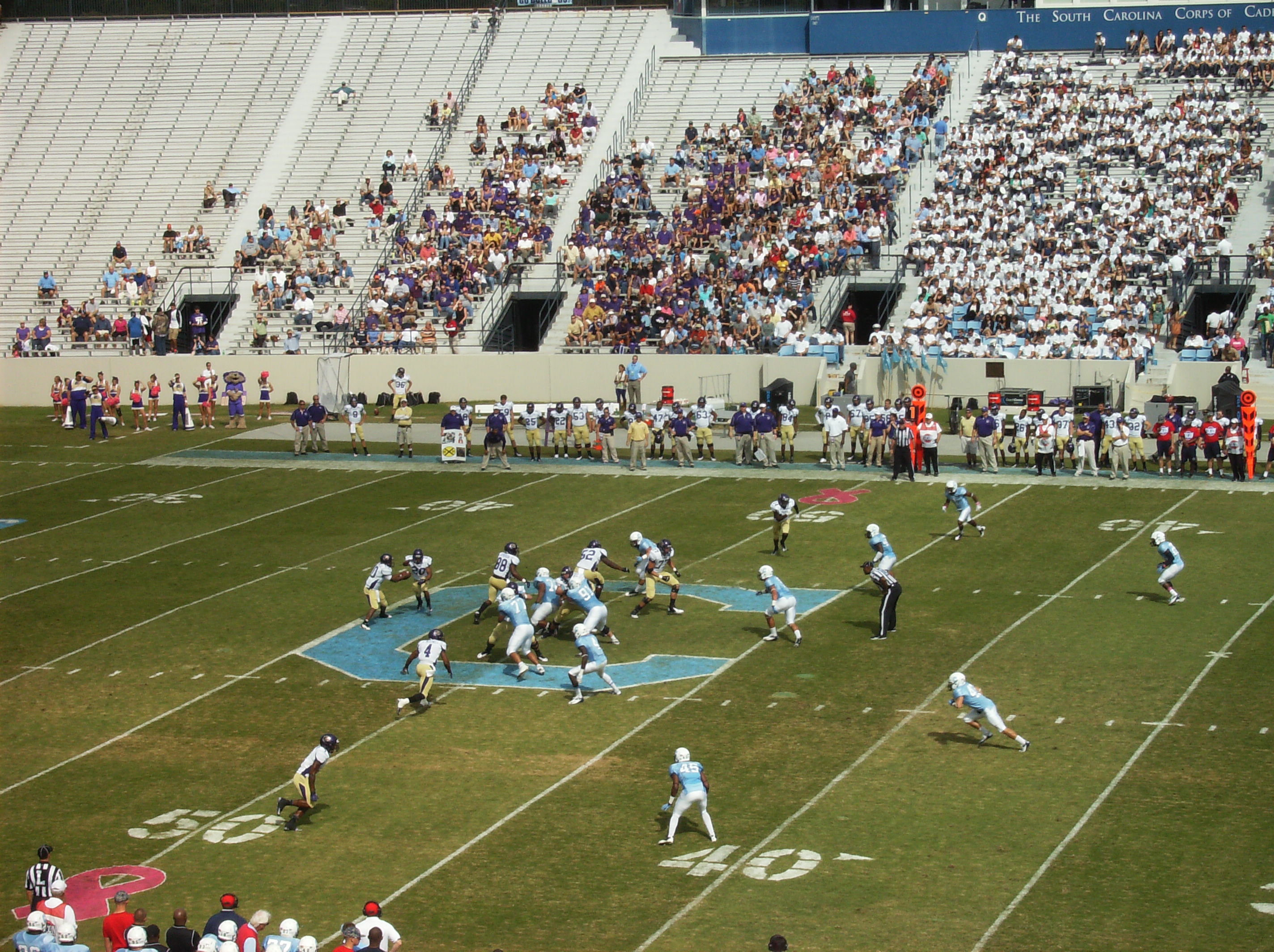
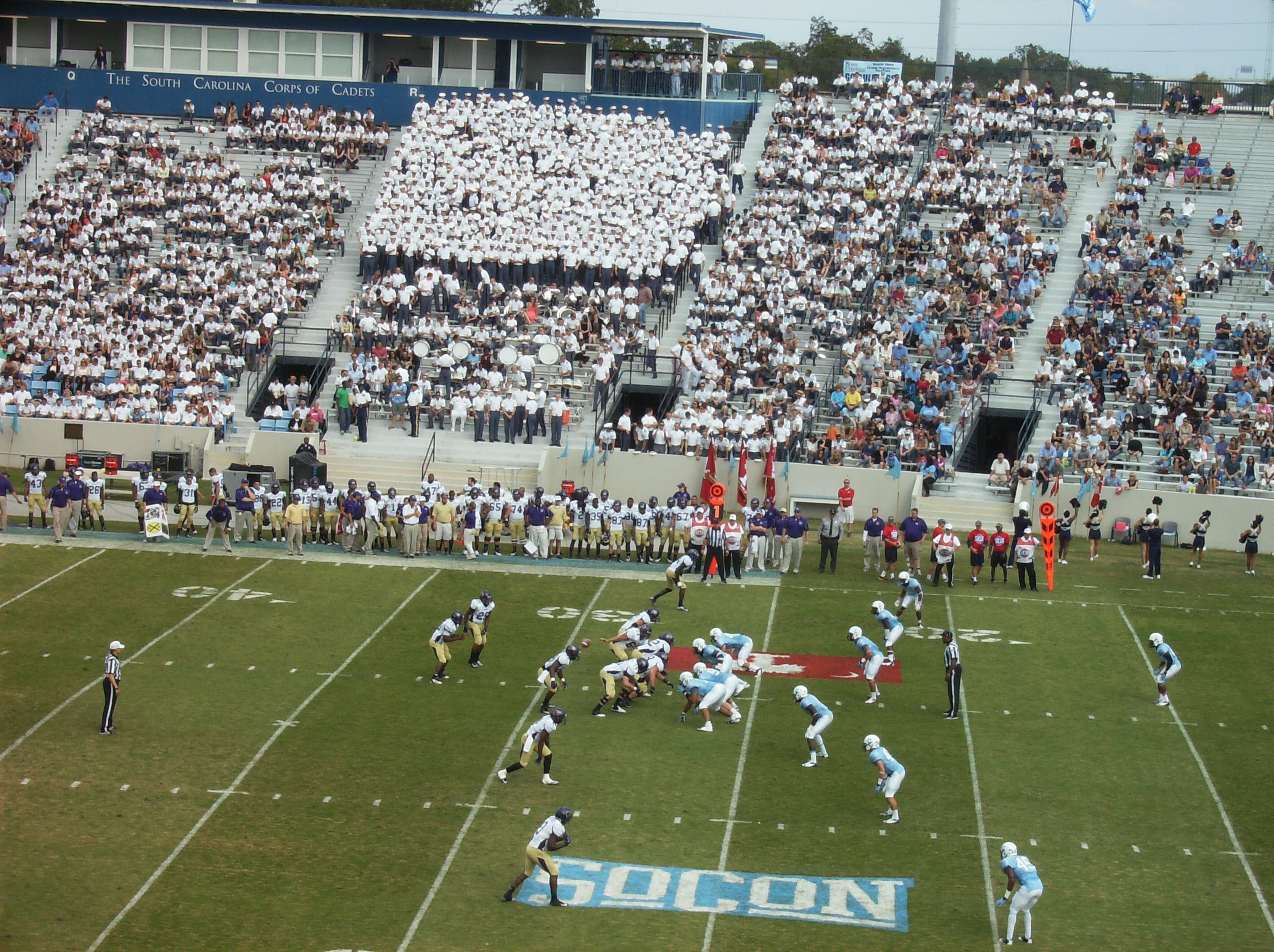
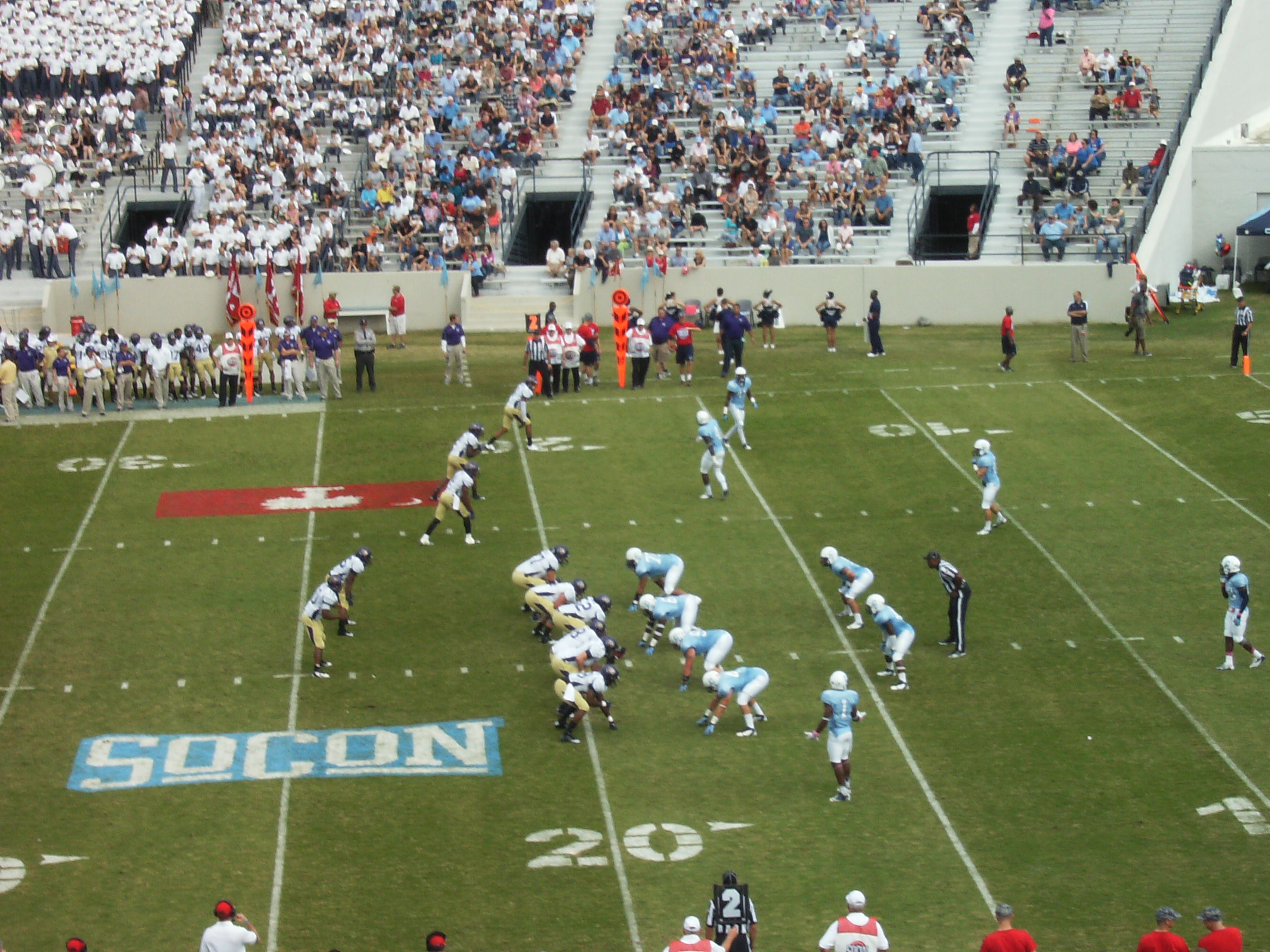
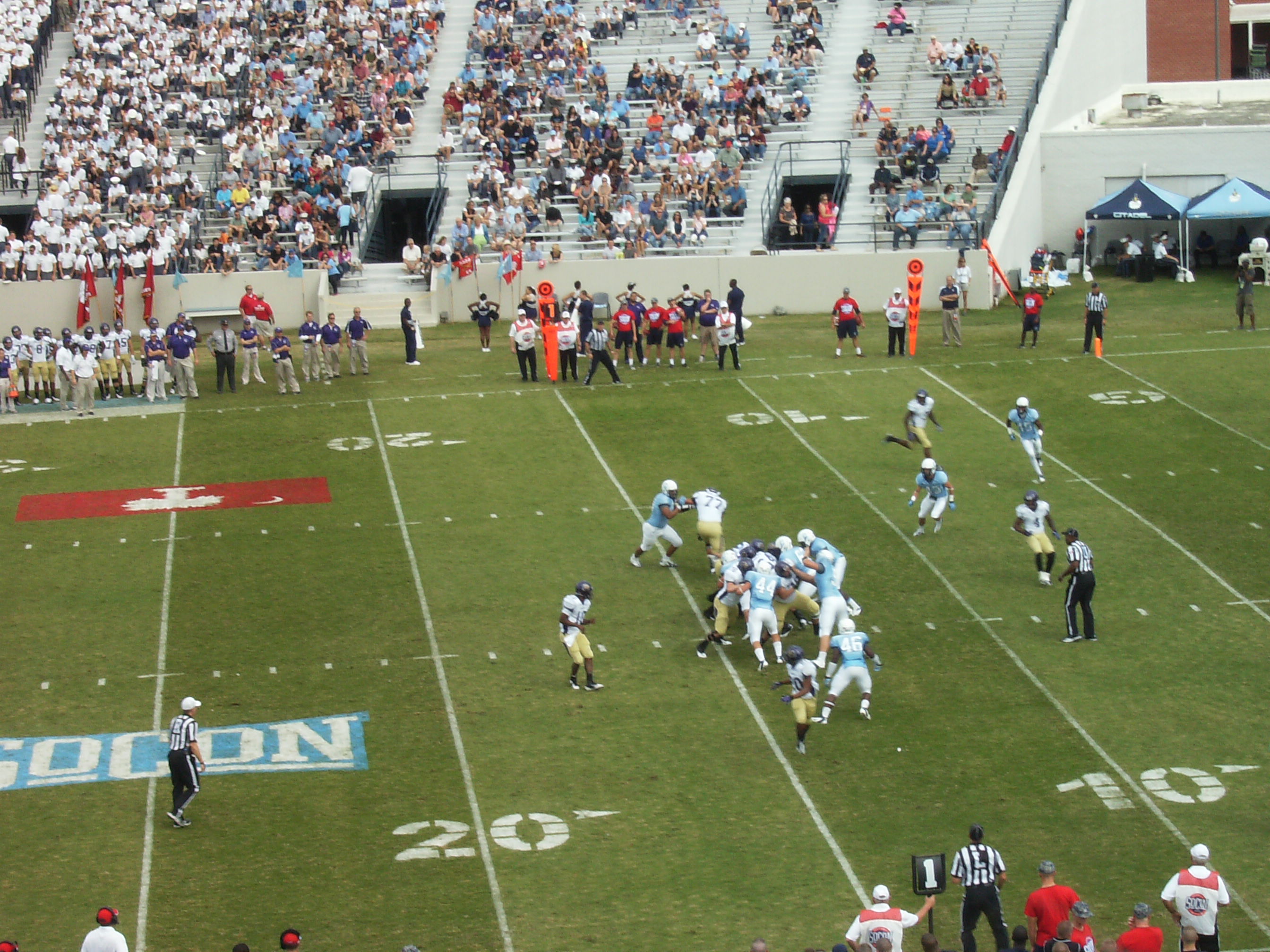
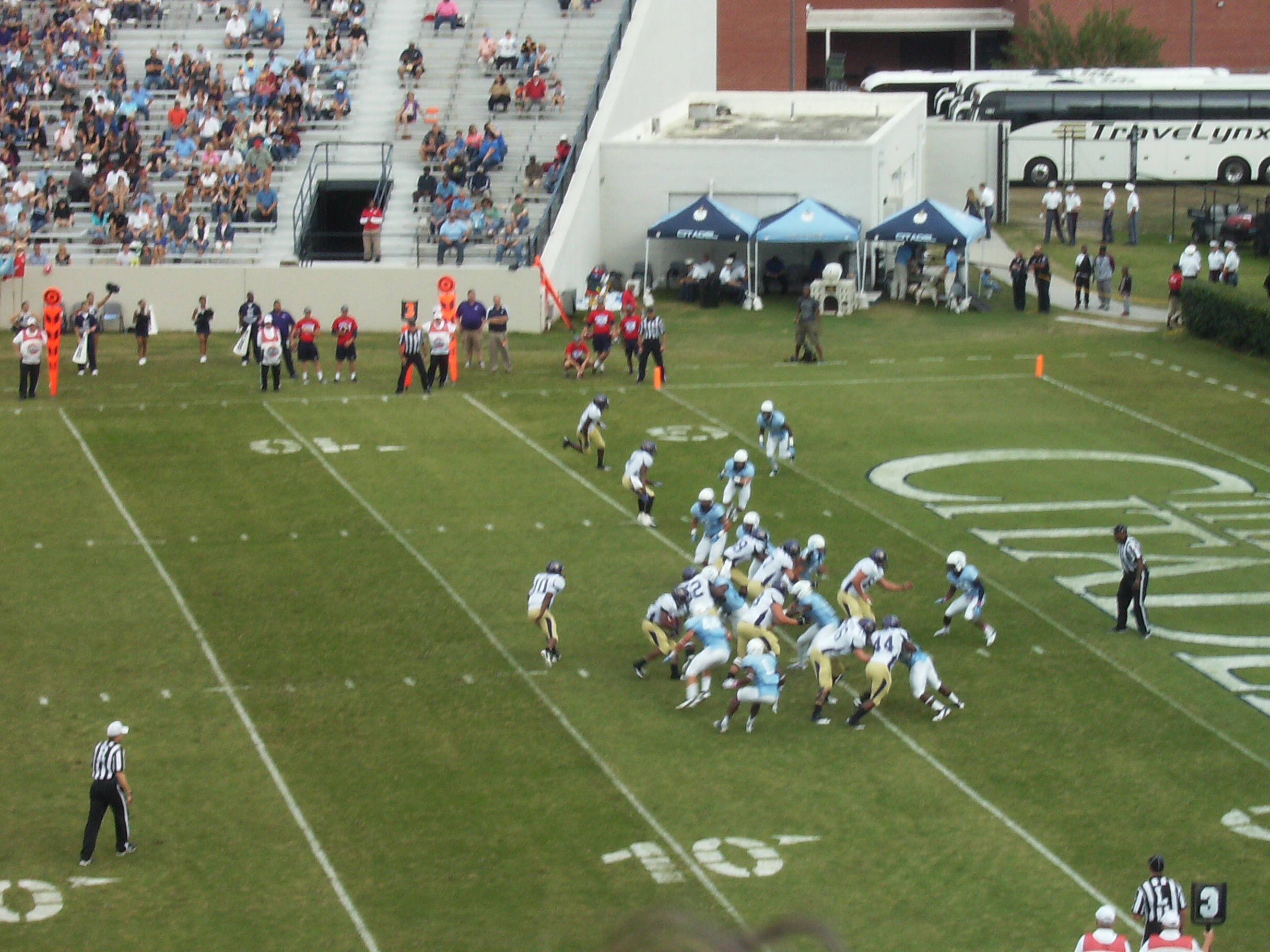
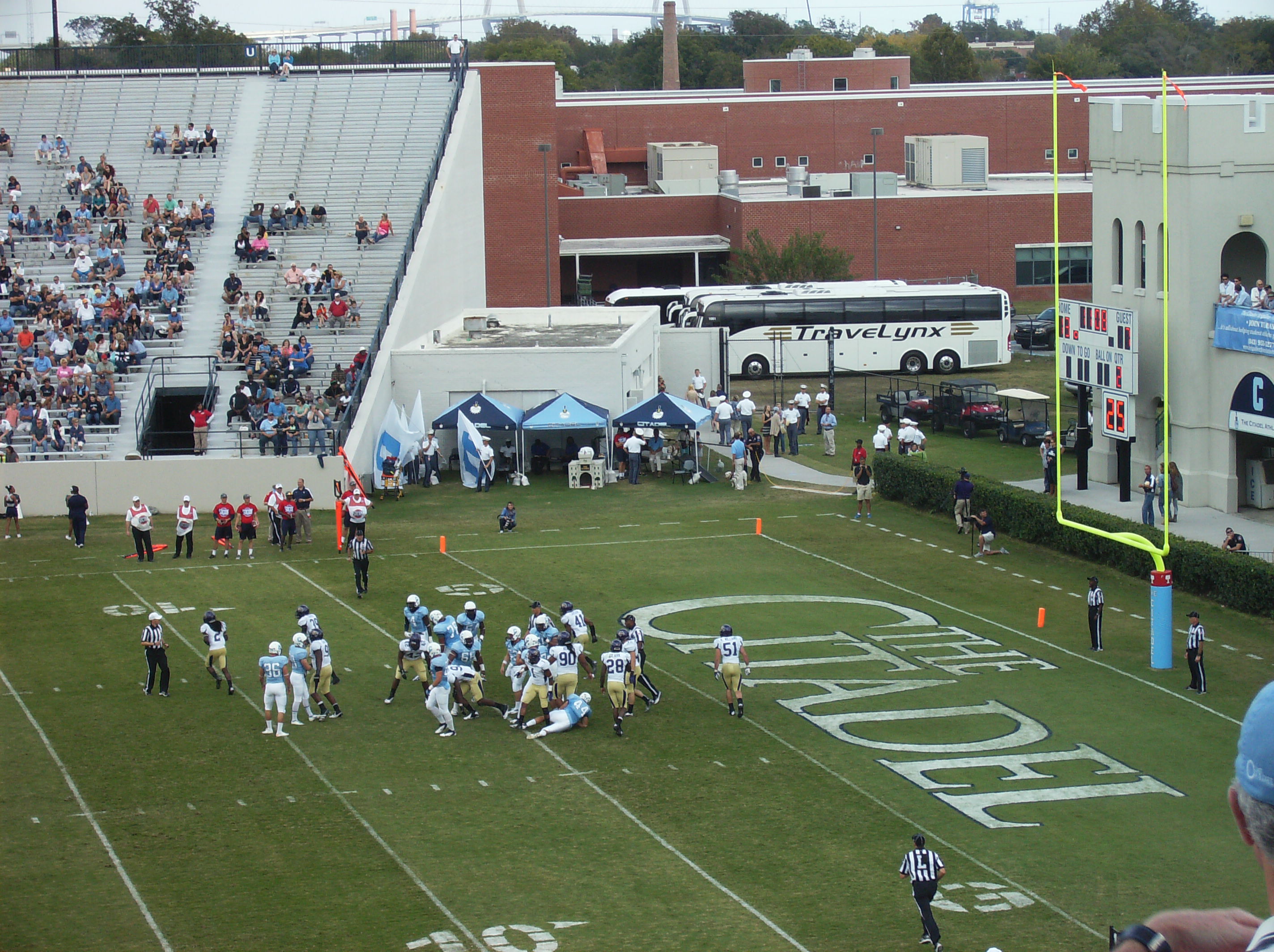
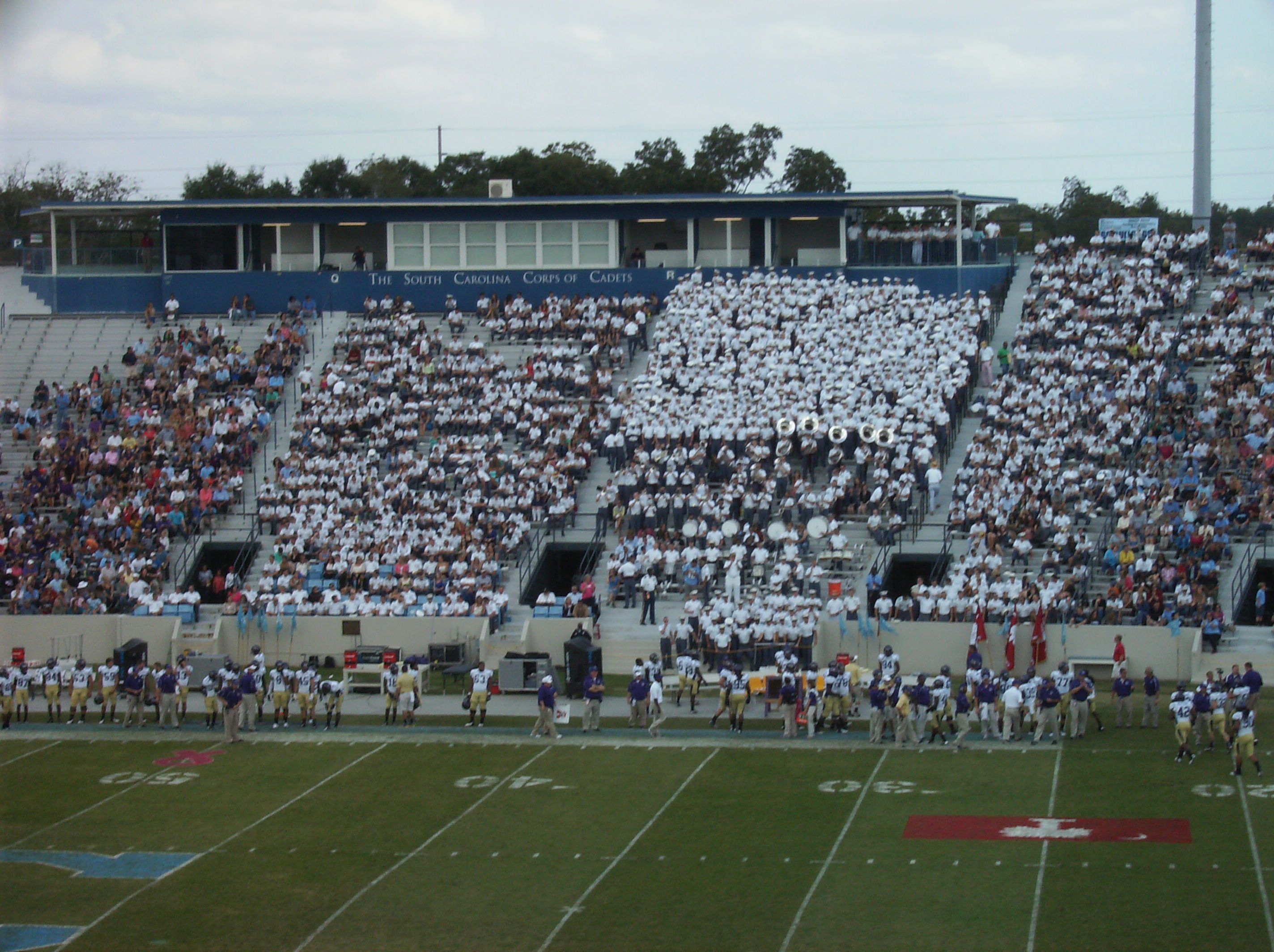
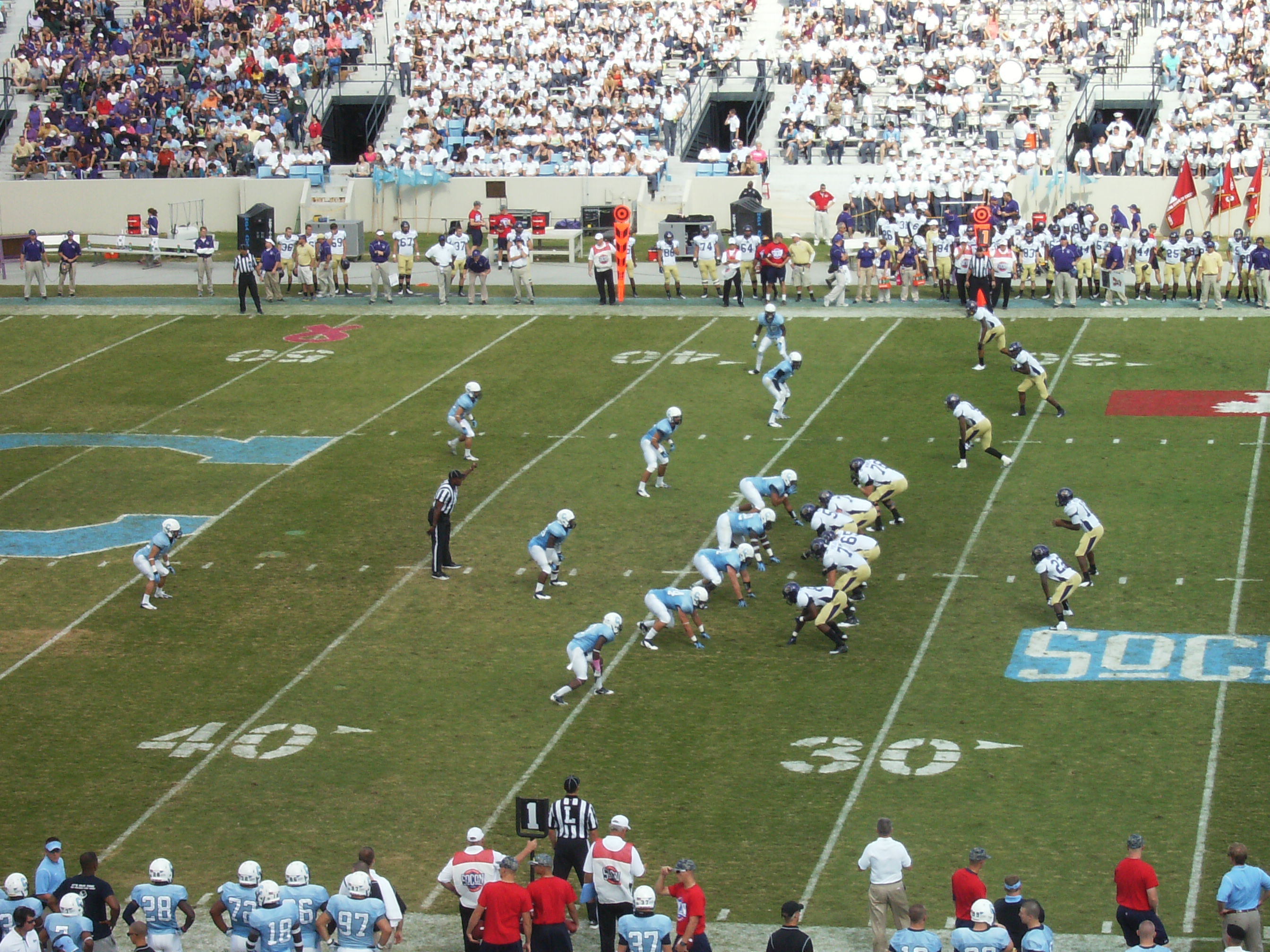
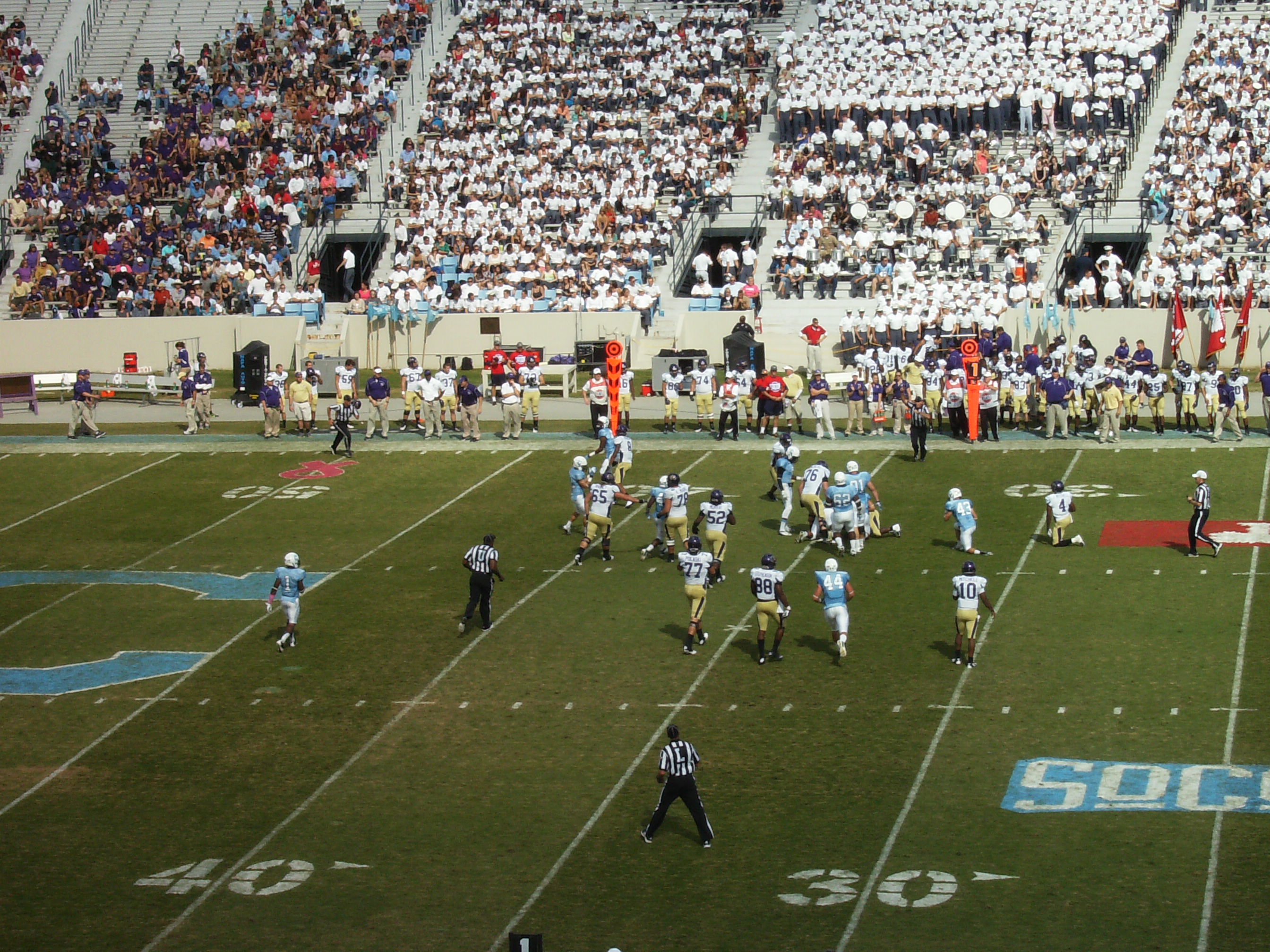
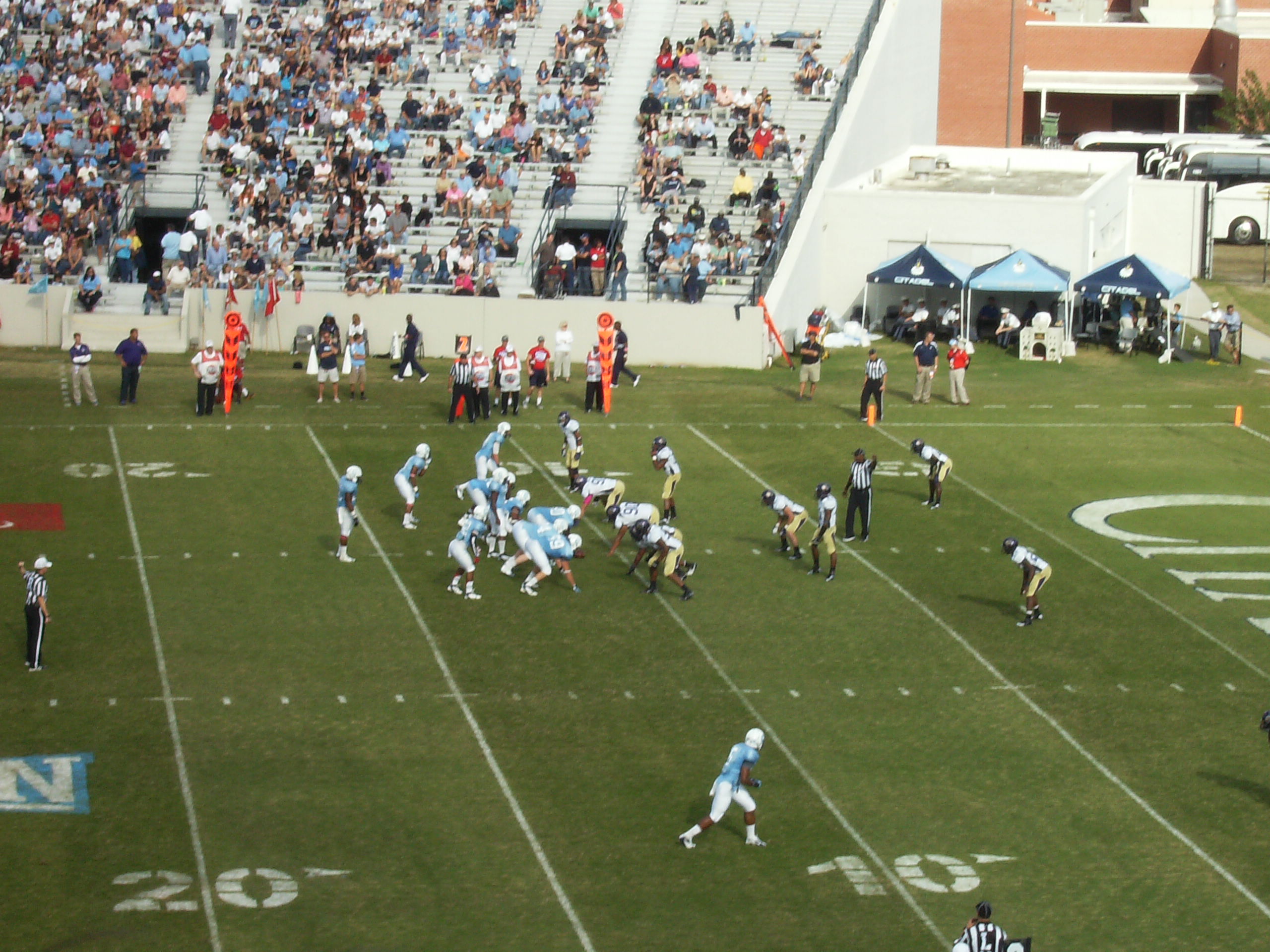
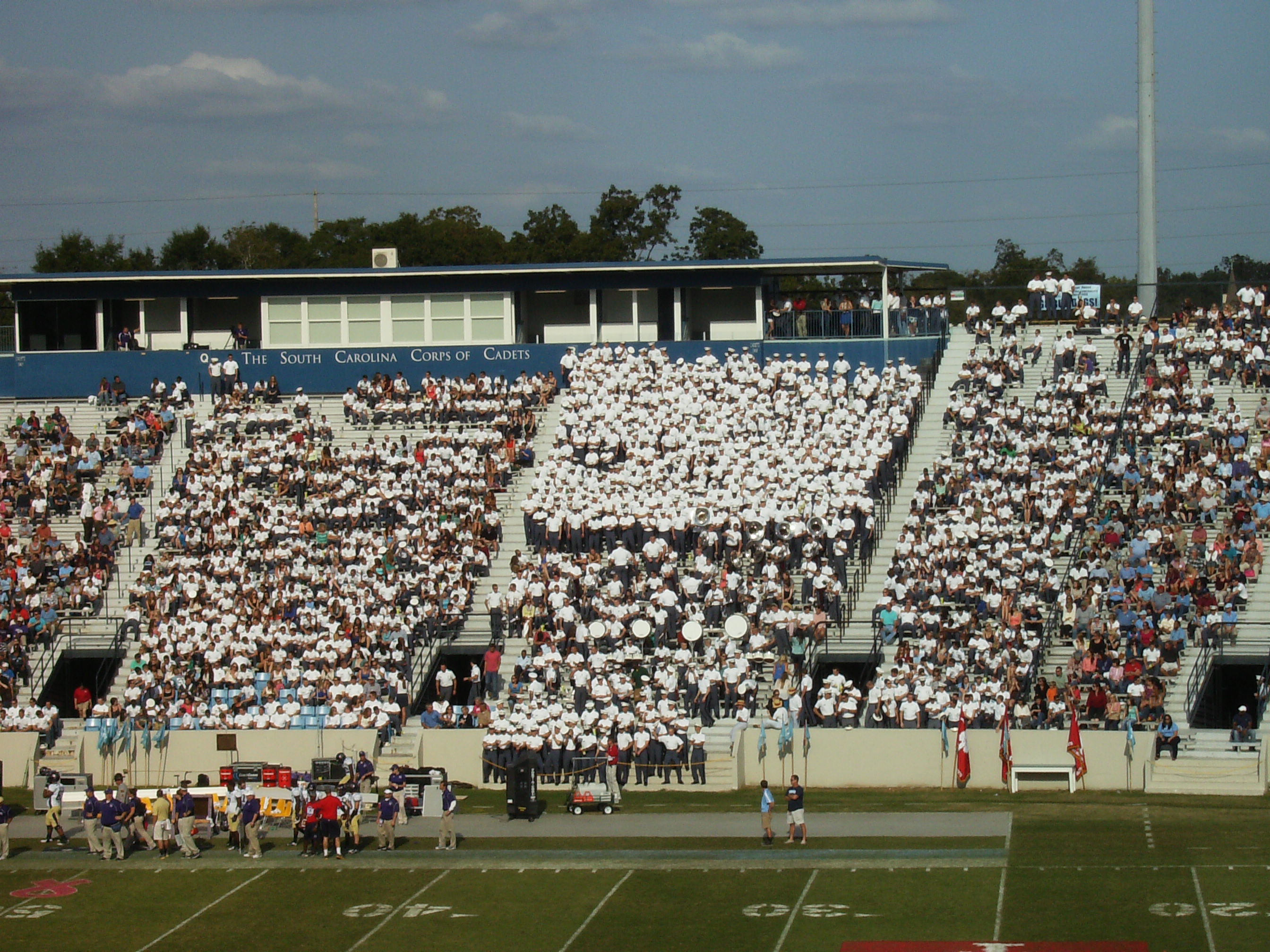
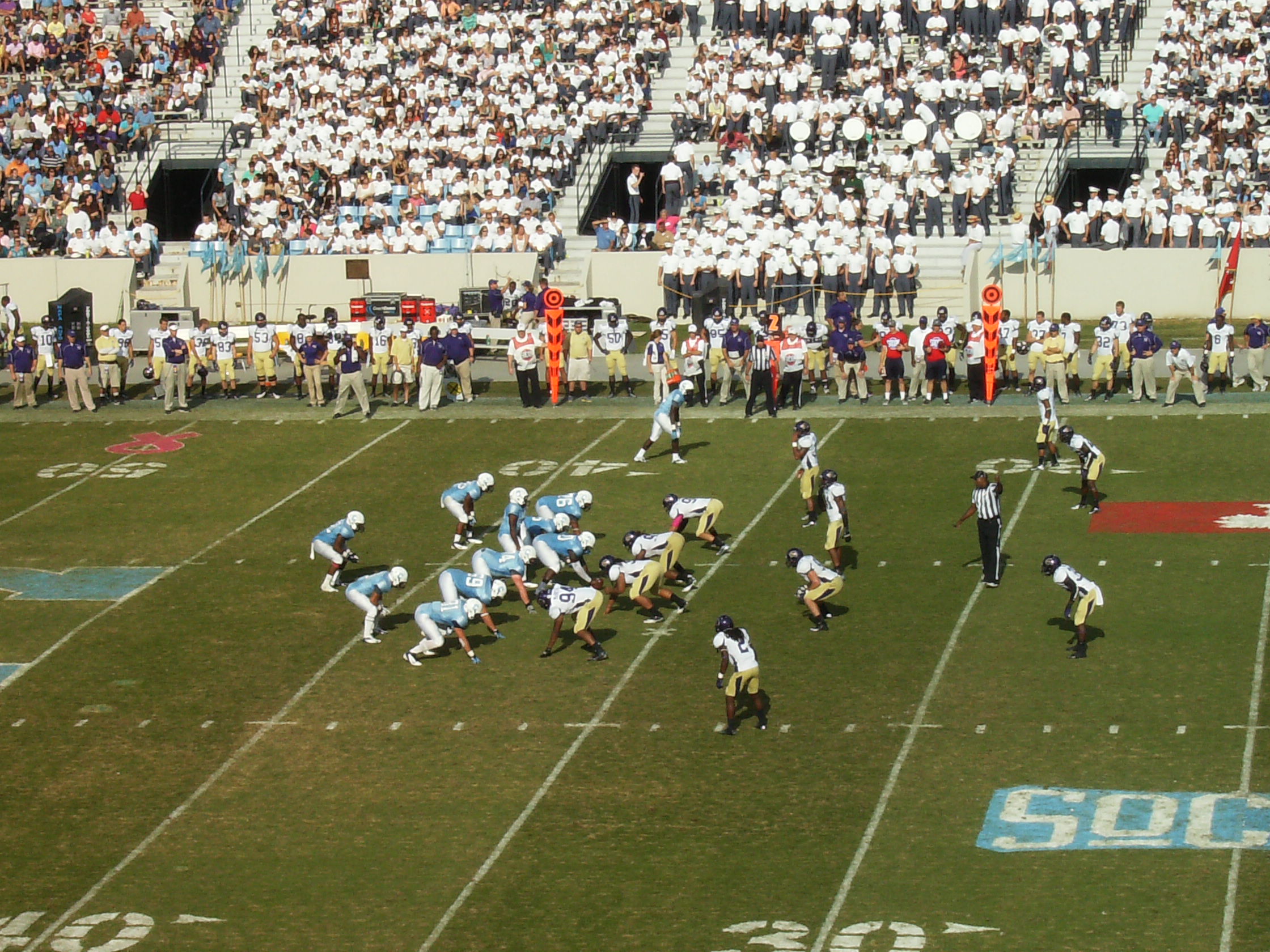
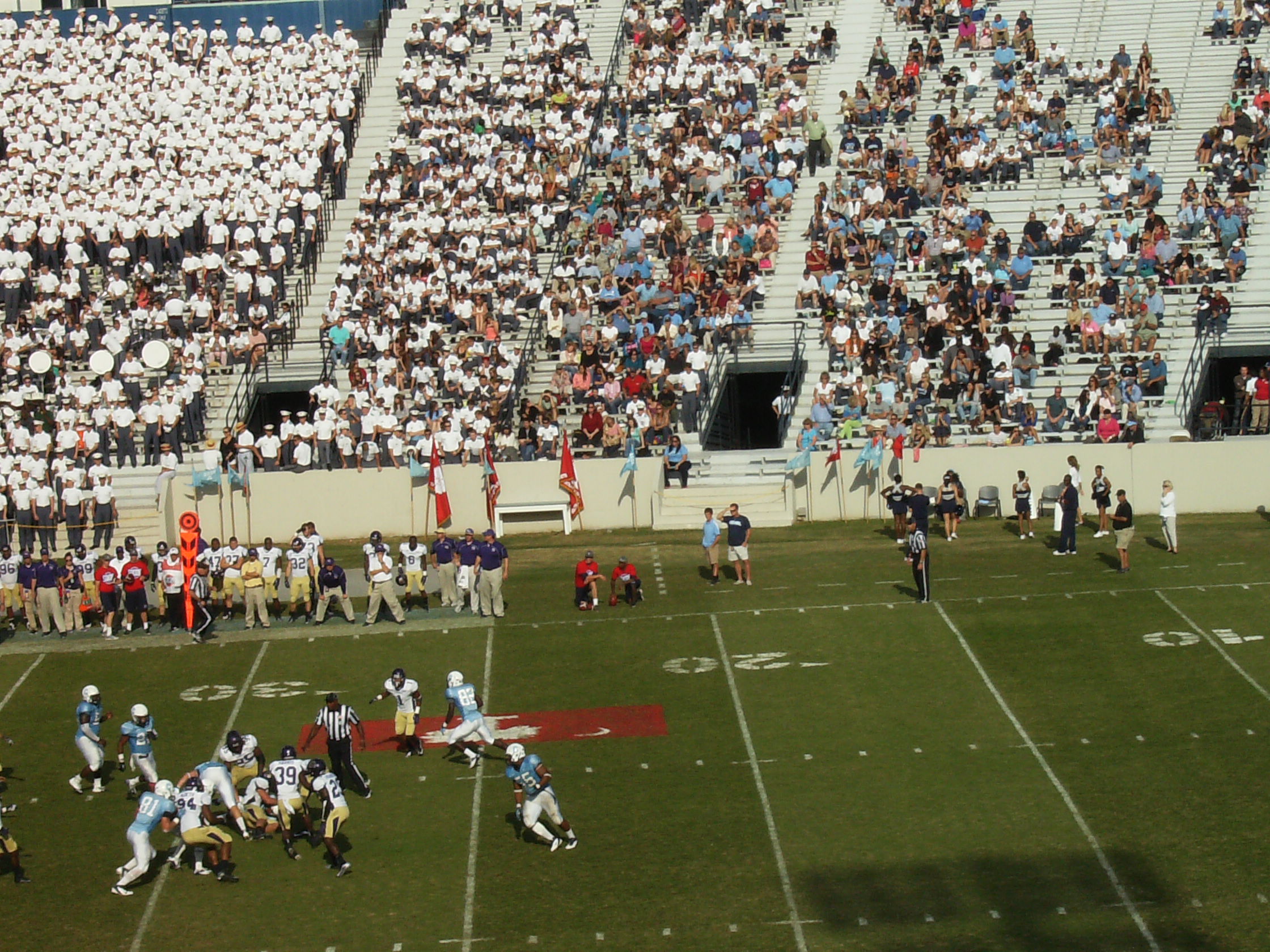
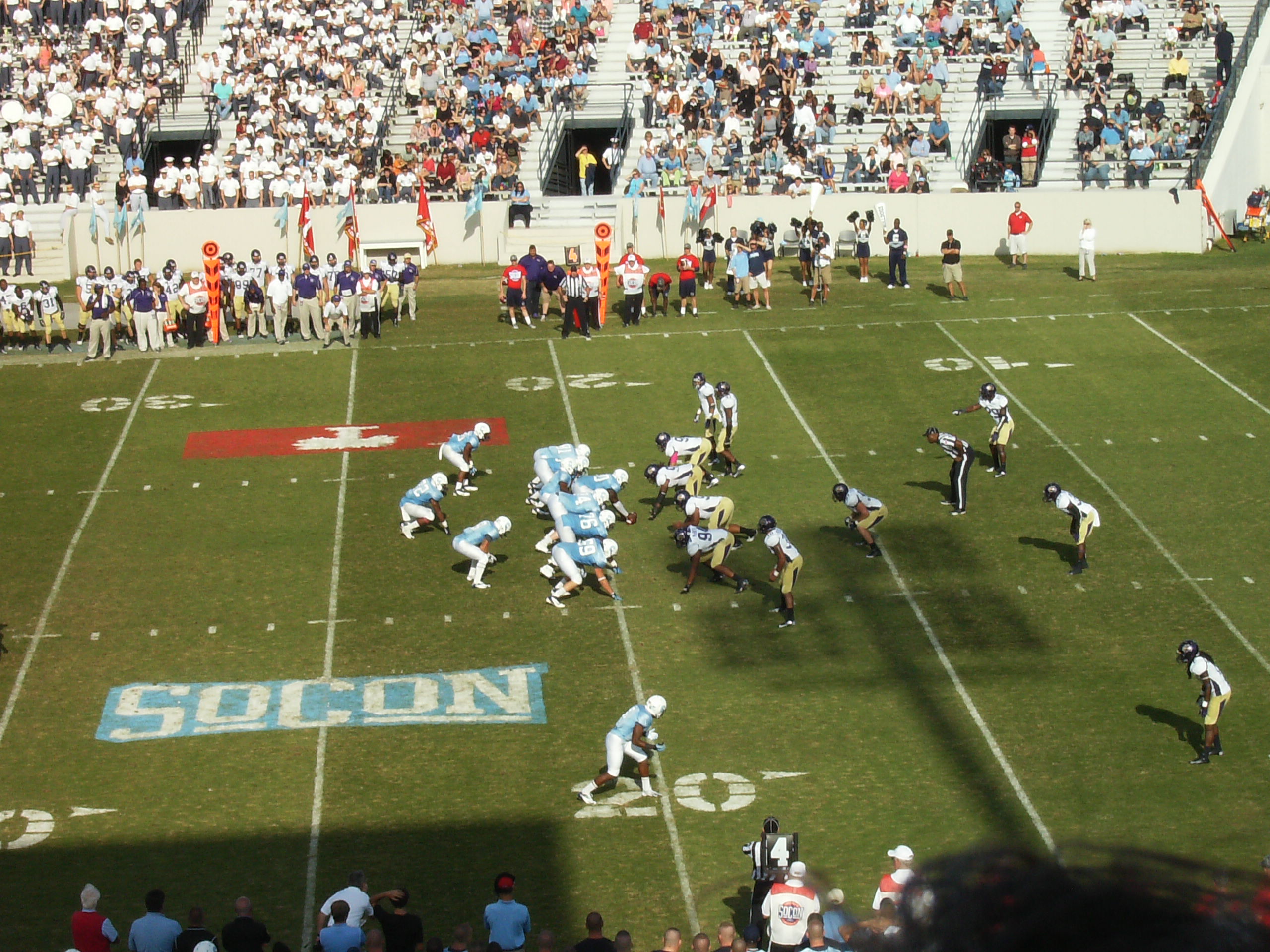
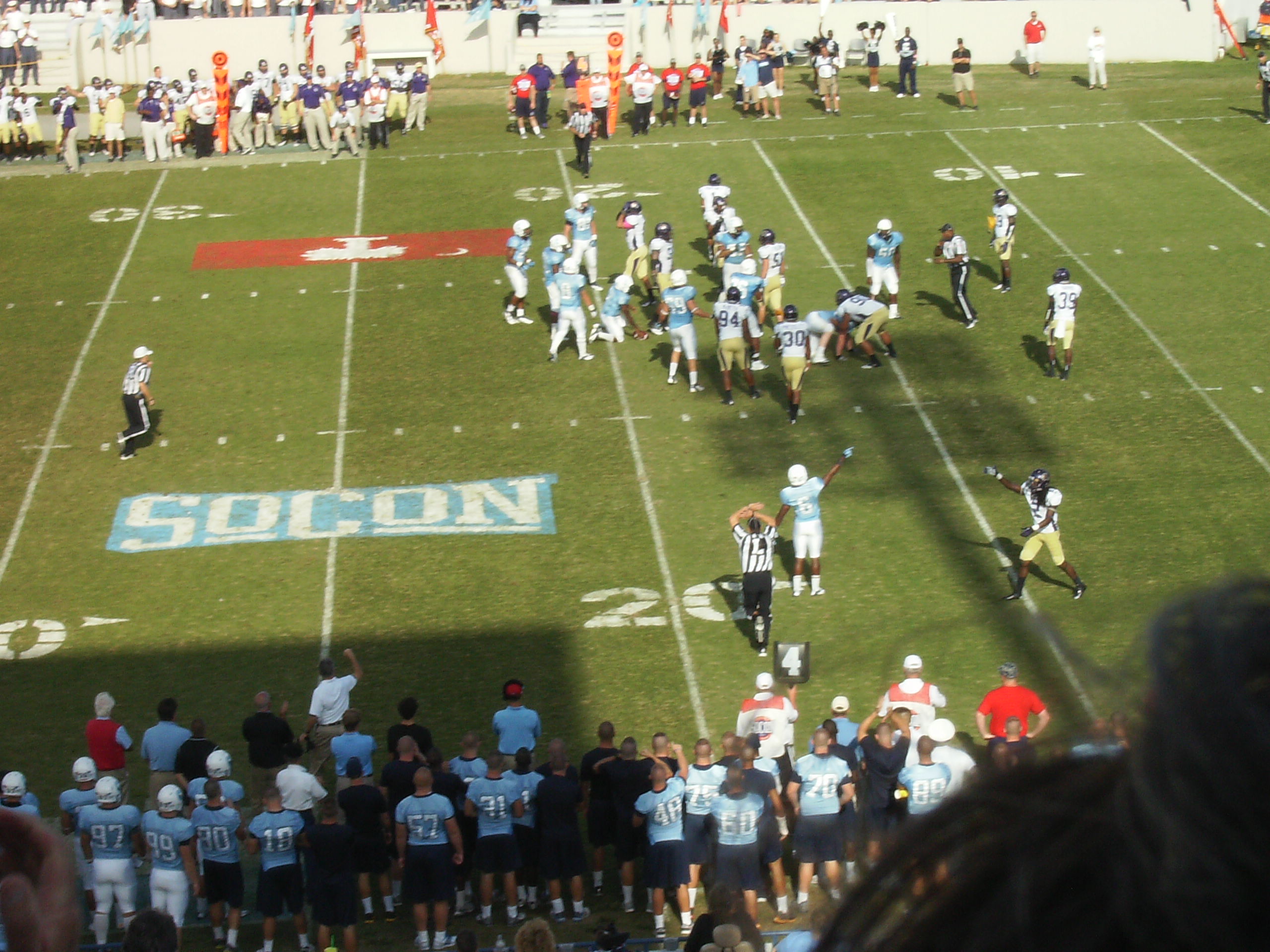
At the end of this post are some photos I took before and during the game. I’m including quite a few shots of the corps marching on to the field, more than usual.

As for the game shots, I tried to take more “action” shots this time, to go along with my standard pre-snap photos. As I’ve said many times, I’m not a good photographer, and my camera is just as limited as I am. Thus, the pictures can be hit-or-miss, with a lot more misses than hits.

Now for some random observations from the game, in no particular order.

The key play of the game, without any question, came with a little over nine minutes remaining in the third quarter:

Austin Jordan kickoff 54 yards to the WCU11, Shaun Warren return 8 yards to the WCU19 (Vinny Miller).

That is how the play was described in the box score play-by-play account. To say the description does not do Vinny Miller justice is a massive understatement.

Miller did not merely tackle the kick returner. HE BLEW HIM UP. There are balloons in the Macy’s Thanksgiving Day parade that aren’t blown up as much. The only reason the WCU player did not fumble the football is because the ball was basically pressed to his body in the same way a suction cup can be attached to a flat surface. Such was the force of the hit.

At the time, the game was tied at 24, and the crowd was, shall we say, apprehensive. After Miller’s hit, the atmosphere in the stadium markedly changed. The fans got wound up, and so did the defense, which to that point in the game had not forced a Western Carolina punt.

The sequence following Miller’s tackle went like this: defense forces three-and-out (including a sack by Cam Mobley, the Bulldogs’ first of the game), offense gets great field position, offense scores in four plays (helped by a 15-yard Catamount penalty), defense forces another three-and-out, offense drives 84 yards in 11 plays and scores to give The Citadel a two-touchdown lead.

The tackle was a huge, momentum-swinging event. I am not one who puts much stock in big hits meaning a whole lot over the course of a game, but this was an exception. I don’t think anyone who was at the game would disagree with me (and Kevin Higgins referenced it during his postgame interview with the press).

Listed above in the links section is WCSC’s video story for the game. The play leading to Miller’s tackle starts at around the 1:10 mark. To be honest, I’m not sure the video gives viewers a true understanding of the hit’s magnitude. I guess you had to be there. I am glad that I was.

For the most part, the offensive play calling was excellent for The Citadel against Western Carolina. However, I have to take issue with one particular call. I don’t criticize play calling too much, because I know full well I’m no expert, but in this case I feel compelled to point out what I think was a mistake.

I’m now going to criticize a play call by the Bulldogs that resulted in a touchdown for The Citadel…

The situation was this: fourth quarter, The Citadel clinging to a 38-31 lead. Western Carolina had just scored and attempted an onside kick, only for it to be collected by Domonic Jones. With 4:39 remaining, the Bulldogs began the drive on the WCU 46.

The Citadel picked up two first downs. Then, with less than two minutes to play, the Bulldogs faced third-and-four on the WCU 19. Ben Dupree rushed for six yards and a first down at the WCU 13. With just one timeout remaining and less than ninety seconds left in regulation, it was over for Western Carolina. The Citadel could go into “victory formation” and run out the clock.

Instead, the Bulldogs ran another play, a toss to Van Dyke Jones, who ran 13 yards for a touchdown.

Why?

If you take a knee (or two), the game is over. Why risk another play and a potential turnover — especially a pitch? I didn’t understand that at all.

Even the result (a touchdown) doesn’t end the argument, because The Citadel gave the ball back to Western Carolina with 1:16 to play. WCU was down by two scores, but at least had the ball and a chance (however remote) for a miracle. If the Bulldogs had taken a knee, the Catamounts wouldn’t have had that opportunity.

What if Western Carolina had run the kickoff back for a TD, then recovered an onside kick? The Catamounts would have had about a minute (and a timeout) to tie the game. Sure, it would have been a longshot, but if you’re WCU that is better than no shot.

Another issue is that The Citadel’s defense had to go back onto the field. It wound up being for only five plays, but those are five plays the defense really did not need. Admittedly, one of them resulted in an emphatic sack by Chris Billingslea, the video of which he can use as an audition tape for the WWE.

I just think when you have a chance to run out the clock and end the game, you should do so.

I was really glad to see the Bulldogs wearing light blue jerseys and white pants on Saturday. I wouldn’t mind seeing the same combination for Homecoming. It’s a good look. It’s also the right look.

Full credit must be given to Western Carolina’s Rock Williams, an indefatigable tackler. He had 24 stops (17 solo) against The Citadel. Williams also stole the ball from Ben Dupree when the Bulldogs were driving for an apparent score, which was just a ridiculous play by the Catamount linebacker. WCU needs a few more guys like Williams in its lineup.

After the game, I was happy the Bulldogs won, but more relieved than anything. Losing to Western Carolina in that situation would have had a lot of negative consequences.

I don’t know if the team would have completely lost confidence if it had lost the game, but I think a significant percentage of the fan base would have. It was only a few weeks ago that The Citadel was riding high at 3-0, but if the Bulldogs had followed up less-than-competitive losses to Chattanooga and Samford with a home loss to a woeful Western Carolina squad on Parents’ Day — well, the knives might have come out.

By winning, the Bulldogs avoided losing three games in four seasons to WCU, a program that has now lost 48 of its last 51 SoCon contests. The Citadel also snapped a five-game losing skid in “celebration games” (Parents’ Day and Homecoming), a streak which certainly wasn’t helping longterm attendance issues.

All in all, the second half was (in my opinion) pivotal for the tenure of Kevin Higgins. I’m glad the Bulldogs overcame serious defensive issues and made enough plays to get the victory.

The bye week comes at a good time. The Citadel has two weeks to figure things out on defense; the Bulldogs definitely need that time. Injured players will have a chance to heal, and the team can mentally prepare for the four-game finish.

Before the season started, I thought a winning season would be considered a successful year. The Citadel is 4-3, not exactly in the way its fans may have envisioned it being 4-3, but regardless the Bulldogs are still in a decent position to accomplish that goal. It won’t be easy, but it can (and should) be done.

It’s time to take a breath before the stretch run.

2012 Football, Game 7: The Citadel vs. Western Carolina

The Citadel vs. Western Carolina, to be played at historic Johnson Hagood Stadium, with kickoff at 2:00 pm ET on Saturday, October 13.  The game will not be televised, although it will be streamed on Bulldog Insider (subscription service) and can be heard on radio via the twelve affiliates of The Citadel Sports Network. Danny Reed (the “Voice of the Bulldogs”) will call the action alongside analyst Josh Baker, with Lee Glaze roaming the sidelines and Walt Nadzak providing pre-game, halftime, and post-game commentary. 

Links of interest:

The Citadel game notes

Western Carolina game notes

SoCon weekly release

The Kevin Higgins Show

Comments from Kevin Higgins at his weekly press conference

Mark Speir SoCon teleconference

Hey, read about The Citadel’s outstanding punter, Cass Couey. He likes to fish!

When The Citadel played Western Carolina last season, I wrote (among other things) the following:

The game against Western Carolina isn’t about a learning experience, or moving forward, or anything like that. There is only one goal for the matchup with the Catamounts, and only one acceptable outcome.  The Citadel must win this game.

That was true then, and it is true now, though the circumstances are not quite the same. The Citadel was 2-4 at this point last season, having lost two straight games, and played WCU on the road.

This year, the Bulldogs are 3-3, but have lost three consecutive contests, with the last two games being dispiriting affairs. The seventh game of 2012 will take place at Johnson Hagood Stadium, on Parents’ Day.

Last year, The Citadel took care of business against the Catamounts, winning 35-7. What about Saturday’s game?

First, let’s take a quick look back at last Saturday’s game against Samford. Yes, we have to do that…

I think at this point The Citadel is a known quantity on defense. It is a unit that has some limitations, including a lack of experience in key spots. To be fair, though, that was the concern heading into the season.

For example, I believe most people liked our starting linebackers but were worried about depth at that position. Now the Bulldogs have lost two of those three players for the season. That is a problem and will continue to be one for the rest of the campaign.

It doesn’t mean the defense is a lost cause; far from it. There is still talent on that side of the ball.

The main problem on D against Samford, in my view, was that the defensive line did not have a particularly good day, getting very little pressure on Samford quarterback Andy Summerlin, and not having much luck against the run either.

I think the d-line is better than that one game. That was certainly the case against Georgia Southern and Appalachian State. It is also true that against Samford, the defense didn’t get any help from the offense, and that took its toll in the second half.

The offense’s play was the really disappointing thing about the game in Birmingham. It wasn’t the first time The Citadel had struggled offensively against Samford, though.

In three games against Samford since moving to the triple option, The Citadel is a combined 6 for 39 on third-down conversions. That is…not good.

Samford’s “bear” front basically forces a team to go outside or over the top to beat it. A team that is successful in doing so can break a lot of big plays. Georgia Southern couldn’t convert on third down against Samford either (0 for 10), but had three long touchdown runs. In the last three games against Samford, The Citadel has only had four plays from the line of scrimmage that went for longer than 20 yards.

In his weekly press conference, Kevin Higgins referenced both issues. I felt a little better after hearing his comments. The game plan, to me, appears to have been a fairly good one:

Our goal going into the game was to be aggressive…We went for it on fourth-and-one because we wanted to send a message out to our guys that we wanted them to play aggressive. We were fortunate to get the first down. The very next play we had a play-action throw, as Ben Dupree hit Matt Thompson for a 48-yard strike and we got some momentum going there.

We had two legitimate shots for touchdowns that we just didn’t throw the ball real well or we dropped it. We ended with six dropped balls on the day. Several of those being real tough catches, but we needed to make those plays. Additionally in the second quarter Dupree threw an interception off a scramble and that hurt us [it certainly did, as it was returned for a TD].

Third down conversions were not good…We didn’t do a good job at continuing drives, as we ended up going 1-14 on third-down conversions. If we would have moved the ball better in the first half, it would have taken pressure off of our defense.

That comes close to summing up the offense’s afternoon.

Before moving on to the Western Carolina game, a special teams observation. The Citadel had a field goal blocked against Samford, never a good thing, but paid back that mishap with its own field goal block a short time later. It was yet another rejection for special teams stalwart Domonic Jones. He also got a hand on a second Samford field goal attempt that eventually sailed wide.

In his last 17 games, Jones has blocked six punts and two field goal attempts (not counting the deflection against Samford). He blocked two punts against Jacksonville in last year’s opener, and would later block a punt versus Elon and another in the VMI game (of course, you had to take a number to do that against the Keydets).

Jones has burned Appalachian State in consecutive seasons, blocking a punt for a TD in both the 2011 and 2012 games against the Mountaineers. His first career block of a field goal attempt came this year and was a critical play in the Bulldogs’ victory over Georgia Southern (and may have influenced the Eagles’ other FG attempt, a last-second miss).

Blocking a kick every other game is rather remarkable, and while Jones has drawn some recognition for his kick-blocking exploits, I’m not sure he has really received his just due. I think the SoCon needs to consider adding a place on its all-conference team for a special teams performer who isn’t a kicker or return man. Jones would be an obvious candidate to fill that spot.

Times have been tough for the Western Carolina football program in recent years. If you need confirmation of that, all you have to do is look at the WCU game notes. I’ve seen a lot of releases over the years, but the folks in Cullowhee have apparently made a commitment to stating brutal truths. No sugarcoating is allowed, I guess. The lowlights include:

– An 18-game losing streak in SoCon play, which is the longest current streak of futility for any FCS team in its own conference. The last time Western Carolina won a league game? Well, it was the last time WCU played at Johnson Hagood Stadium.

– That win over The Citadel in 2010 is also the last time the Catamounts defeated an NCAA Division I opponent, and the last time WCU won a road game.

– Western Carolina lost 20 SoCon games in a row from 2005-08.

– WCU has lost five straight games this season after winning its opener against Mars Hill.

– The Catamounts are 4-29 in their last 33 road contests, a stretch that dates back to 2005. WCU’s current road losing streak stands at 11 games, which is the sixth-longest such streak among FCS schools (Idaho State has lost a staggering 36 consecutive road games).

– WCU beat Mars Hill 42-14. The fourteen points allowed by the Catamounts marked the fewest points scored by an opponent since, you guessed it, the 2010 game against The Citadel (a 24-13 WCU victory).

– Western Carolina has lost 47 of its last 50 Southern Conference games. Two of the three victories have come against The Citadel.

On the bright side, most observers applauded Western Carolina’s selection of Mark Speir as its new head coach. Speir was a student assistant at Clemson during the latter part of the Danny Ford era in Tigertown. He then moved to Western Carolina for several years before three-year stops at Presbyterian and Elon. He had been on the Appalachian State coaching staff since 2003, and the recruiting coordinator for Jerry Moore since 2004.

Speir comes across (at least in the media teleconferences the SoCon puts out every week) as folksy, but not overly so. While listening to him this week, I was particularly impressed with a comment he made (basically unprompted) about this year’s Catamount squad:

I told [the WCU players] we are still here for this team, the 2012 team, to be a good football team, and we have five more opportunities to become a good football team…and our staff is not looking to next year, we’re looking [forward] to this week and the next four weeks…

That sounds like the opposite of, say, Charlie Weis. Being the opposite of Charlie Weis as a football coach strikes me as a good place to be (although Weis apparently has a great agent).

Speir clearly has his work cut out for him, though, especially this season. This year’s WCU outfit has been okay offensively, but on defense…not so much.

The aforementioned game notes actually include a paragraph entitled “Western Carolina’s Troubles With The Triple Option”. I couldn’t wait to read that section.

– Wofford rushed for 590 yards against the Catamounts, averaging over 8.5 yards per carry. Three Terriers rushed for over 100 yards.

– Georgia Southern rushed for 614 yards against WCU, averaging over 7.7 yards per carry. GSU had five different ballcarriers rush for at least 89 yards.

– You didn’t have to run the triple option to run on Western Carolina, though. Furman averaged 7.9 yards per carry in its victory over the Catamounts; the Paladins’ Jerodis Williams rushed for 239 yards on only 18 carries. Williams also added a 100-yard kickoff return for a TD.

– Samford running back Fabian Truss rushed for 180 yards against Western Carolina.

In that Samford game, though, Western Carolina actually had the lead in the fourth quarter before giving up 15 unanswered points and losing 25-21. Still, that level of competitiveness should get The Citadel’s attention.

WCU opened the scoring against Samford with a fumble recovery for a touchdown, one of three fumble returns for TDs the Catamounts have had this season. Maybe it isn’t the world’s greatest defense, but it appears WCU’s D is at least opportunistic at times.

Western Carolina runs a spread offense, not unlike that of Appalachian State. Eddie Sullivan has received the bulk of the snaps at quarterback, but Troy Mitchell will also see a lot of time. Against Georgia Southern, the two were interchanged for each other on almost every down, and occasionally were in the backfield together.

The Catamounts have several running backs; the two-deep’s listed starter, Michael Vaughn, has fewer rushing yards than three of the other RBs. Jacoby Mitchell is Western Carolina’s leading receiver, but keep an eye on 6’4″ freshman Spearman Robinson, a native of Greenwood.

There appears to be a bit of uncertainty on the left side of WCU’s offensive line, with both the LG and LT spots on the two-deep listed as an “or” situation. Josh Weinberg is a 260-lb. true freshman who will start at right tackle.

On defense, Western Carolina’s best player is linebacker/tackling machine Rock Williams, a preseason second-team All-SoCon selection. Randy Pressley isn’t listed as a starter at linebacker, but he made 16 tackles against Georgia Southern last week, including the Catamounts’ only tackle for loss.

WCU’s defensive line is not particularly large, as only two of the nine players on the depth chart weigh more than 265 lbs. and four of them weigh less than 250 lbs. The secondary is young; two of the starters are freshmen, and two others are sophomores.

Western Carolina punter Clark Sechrest is having a good year thus far. He presents a different challenge for Domonic Jones and company in that he is left-footed and can employ the “rugby style” of punting. He is also the backup placekicker. According to WCU’s website, he kicks field goals and PATs with his right foot.

The regular placekicker for WCU, Richard Sigmon, is 4 for 8 on FG attempts with a long of 45. He has had one kick blocked. Sigmon is also the kickoff specialist. Four of his 27 kickoffs have resulted in touchbacks.

Western Carolina’s punt return unit is not particularly strong. On kickoff returns, the long for the season for the Catamounts is 38 yards.

Tangent alert…

I need a ruling. Is Saturday’s game Parent’s Day (as noted on the school’s game preview) or Parents Day (on the website’s season schedule)? Actually, I think Parents’ Day would be more correct than either.

The press release from External Affairs refers to “Parents’ Weekend” throughout, except for (of course) the title of the release (“Parents Weekend”).

I’m going to go with Parents’ Day on this blog post. Yes, I know nobody cares.

What we really care about is the action on the field. The Citadel needs to win this game. It doesn’t really matter how, although I would personally be in favor of a blowout victory in which everyone gets to play a lot and the cadets all get overnights. Hey, I’m generous. Also, I remember Parents’ Day 1986 all too well. Not a good weekend.

There have been some good Parents’ Day games (the most famous being The Citadel’s 1950 victory over South Carolina), but lately things haven’t gone the home team’s way at what I call the “celebration” games — Parents’ Day and Homecoming. The Citadel has lost five consecutive celebration games.

Since 1953 (when the modern yearly Parents’ Day/Homecoming advanced schedule began), The Citadel has never lost six consecutive celebration games.

Incidentally, in none of those five losses did The Citadel wear its “traditional” uniform of light blue jerseys/white pants. Sure, that is just a coincidence. Still, perhaps Kevin Higgins’ Leadership Council can get together and appease some old alums while reversing a little karma. Just a suggestion.

I think the Bulldogs will win on Saturday, although I’m not overly confident. Nobody should be confident, given the results of the last two weeks. It is also worth pointing out that despite Western Carolina being a terrible football program for a number of years now, the Catamounts have won two of the last three games in this series.

WCU has players on its roster who know they can beat The Citadel. They will be more confident against the Bulldogs than any other SoCon team.

On the other hand, the stats don’t lie. League opponents have run the ball at will against Western Carolina. Saturday’s game is a good opportunity for Triple O’Higgins to put up some big numbers, and for the players to regain some lost confidence.

Perhaps the fans can regain some lost confidence as well.

Congratulations to all the seniors as they get their rings, with a gentle reminder that it isn’t over yet. There are still diplomas to be acquired.

Congratulations also to the freshmen who have made it to this benchmark. You still have a long way to travel, but you’ve survived the most stressful part of the trip.

I hope everyone has a good time this weekend. Let’s win this game.