The Phils of ’15

I was all set to make a long post about the 1915 World Series, in which the Phillies faced the Red Sox.  Then the Rays had to go out and win Game 7 of the ALCS last night…

Philadelphia did win the NL pennant, though, and since that doesn’t happen too often, it’s probably worth looking back to the ’15 Phils, which won the franchise’s first pennant.  In fact, Grover Cleveland Alexander’s victory in Game 1 of the 1915 World Series would be the only Series game won by the Phillies in the first 90 years of the club’s history.  (The only other pennant won by Philadelphia during that time period, in 1950, resulted in a four-game Series sweep at the hands of the Yankees.)

The Phillies hadn’t been that bad in the years preceding 1915; they hadn’t been that good, either, but they were not yet the notorious sad-sack outfit they were destined to become (that slide would begin in 1918).  In the five years before 1915, the Phils had finished second in the league once, fourth twice, fifth once, and sixth once.  The runner-up finish in 1913 was marred by the sudden death of Phillies majority owner William Locke, which happened when Philadelphia was still in first place.  The Phils would eventually finish second to the Giants by 12 1/2 games.  Locke was replaced as head of the ownership group by former NYC police commissioner William Baker (for whom the Phillies’ home park, Baker Bowl, was eventually named).

By this time the Phillies had managed to acquire some fine players, including Sherry Magee (who is on the Veterans Committee ballot for the Hall of Fame this year) and Gavy Cravath, one of the outstanding power hitters of his time.  Unfortunately for Cravath, his time happened to be the Deadball Era.  If Cravath had played during any other time in baseball history, and if he had not had such a relatively late start to his career, I have no doubt he would be in the Hall of Fame.

Magee was traded prior to the 1915 season for Possum Whitted (in a somewhat puzzling move that worked out for the Phils; Magee was disappointed he had not been named manager, which was one reason for the trade), and the club picked up some other players of note, including future Hall of Famer Dave Bancroft.

Cravath had a great year in 1915, leading the NL in OBP, slugging, runs scored, RBI, homers, and walks.  He also had 28 outfield assists, which led the league.  Cravath’s 24 homers were a 20th-century record at the time.  Playing in Baker Bowl certainly helped; the park’s dimensions in 1915 included 379 feet to the left-field power alley, 388 to straightaway center, 325 to right-center, and 273 feet to right field (which also had a 40-foot wall).

The Phillies had an excellent pitching staff, which included the young Eppa Rixey (also a future Hall of Famer; 1915 wasn’t one of his better years, however), and, most importantly, Alexander the Great.  Alexander won the pitching triple crown in 1915, with 31 wins, a 1.22 ERA, and 241 strikeouts (in 376 innings).  He also led the NL in shutouts, with 12.  The Phils won the pennant by 7 games over the defending champion Boston Braves, leading the league in pitching, defense, runs scored per game, and attendance (just under 450,000 fans).

All this happened under the watch of a new manager, Pat Moran, who had been a reserve catcher for the Phillies before taking charge of the club.  Moran is one of the more underappreciated managers in baseball history.  In nine seasons Moran won two pennants and one Series title, along with four second-place finishes, all for two franchises (Philadelphia and Cincinnati) that in the fifteen seasons following his untimely death in 1924 would combine for no pennants and one second-place finish (but would combine to finish last or next-to-last eighteen times in those fifteen seasons).  Moran had a serious drinking problem, which seems not to have affected his ability to manage, but after the 1923 season he apparently completely lost control, and showed up for spring training in 1924 essentially pickled.  He died in March of that year in an Orlando hospital.

In the Series the Phillies faced the Red Sox, managed by Bill “Rough” Carrigan and featuring a great pitching staff.  Because the Phillies were known to mash left-handed pitching, Carrigan elected not to start the youthful Babe Ruth at all and limited his lefty pitching usage to Dutch Leonard, a spitball pitcher for whom it didn’t seem to matter whether a batter was a lefty or a righty.  Leonard pitched in the pivotal Game 3, beating Alexander 2-1 when Duffy Lewis singled in the winning run with two outs in the bottom of the ninth.  The entire Series featured great pitching.  Alexander beat Ernie Shore 3-1 in Game 1, and then Boston proceeded to win three consecutive games by a 2-1 score.  The Red Sox clinched the world championship with a 5-4 victory in Game 5 when Rixey was unable to hold a 4-2 lead, giving up a two-run homer to Lewis and a solo shot (in the top of the ninth) to Harry Hooper when the ball bounced into temporary stands set up in Baker Bowl’s center field section; under the rules of the day, it was a homer and not a ground-rule double.

In the following season Philadelphia actually won one more game than it had in 1915, but the Dodgers passed them in the standings and took the pennant.  The Phillies would also finish second in 1917, but in the next 32 years would only finish above .500 one time (in 1932).  Baker was a key reason for this, as his cheapness led to the de facto selling of Alexander in 1918 (for $60,000) and the eventual departure of Moran (who was forced to manage without the benefit of a coach).  Baker would continue to run the club into the ground until his death in 1930.

Umpire gives Gamecocks QB the shiver

By now I would imagine there aren’t many sports fans in the country who haven’t seen the clip of SEC official Wilbur Hackett giving a forearm shiver to Gamecocks quarterback Stephen Garcia (video).  I think it was just an instinctive move by Hackett, but I have to say it could easily be interpreted as being intentional (and has been by a lot of message board posters).

I didn’t know the identity of the umpire, and so out of curiosity I looked him up.  It turns out that Hackett is a veteran SEC official, and he has an interesting personal history.  If you thought he looked like a linebacker on that play, well, maybe it’s because he was a linebacker — for Kentucky, in the 1960s.  Hackett was one of the first black football players in the SEC.

While researching this, I discovered an old article from the Los Angeles Times about the integration of the Kentucky football program.  It recounts a tragic death that I had never read about before, and includes comments from Hackett and longtime Atlanta Falcons center Jeff Van Note, as well as an anecdote illustrating the coolness of Archie Manning.  It’s worth a read:

Link

efense

That’s what The Citadel played Saturday.  There certainly was no discernible “D” to be seen, at least in blue and white…

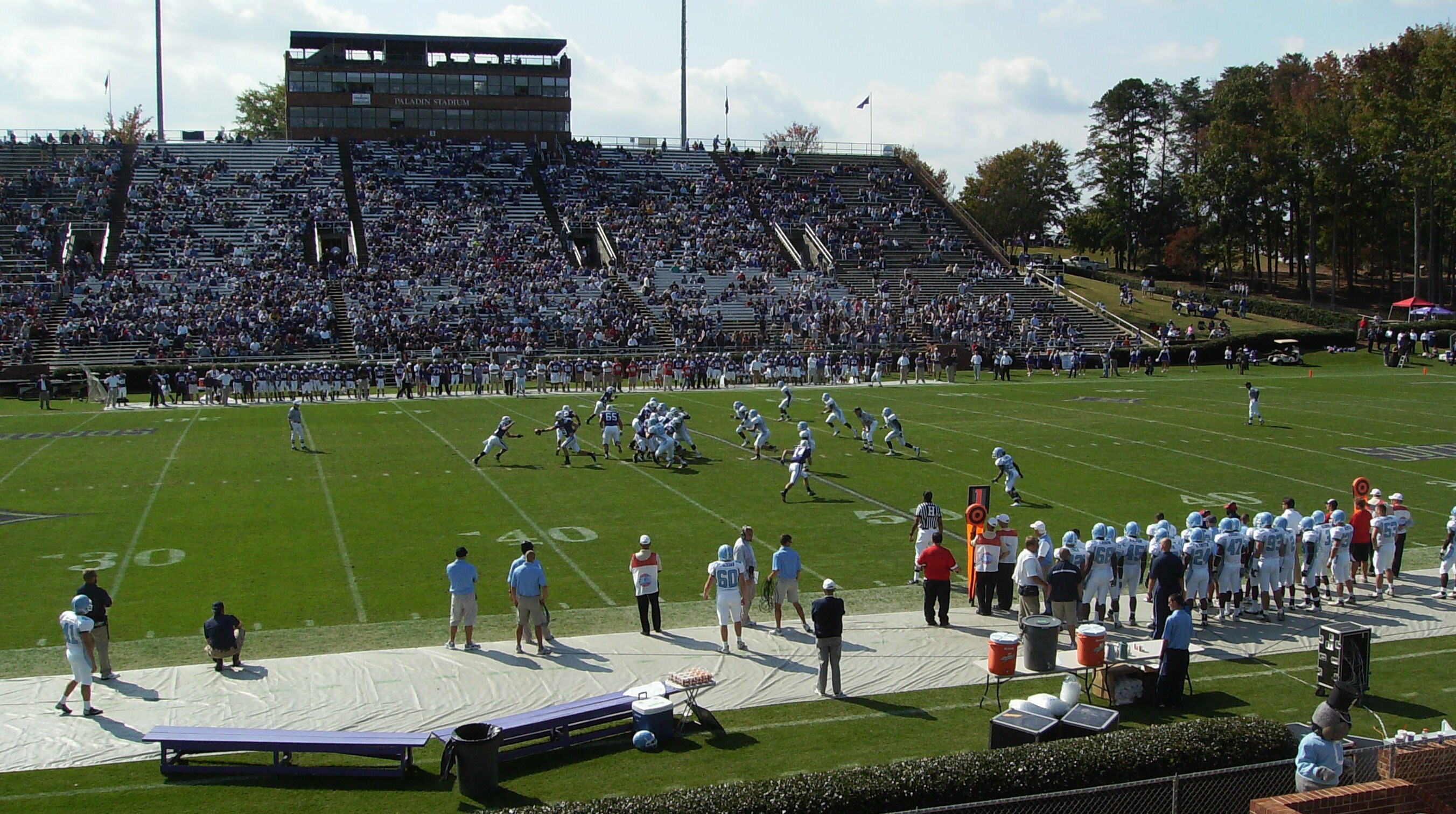
The final stats don’t really tell the story, because the Bulldogs made them (and the score) respectable in the 4th quarter, when the game was over.  The bottom line was The Citadel couldn’t get Furman’s offense off the field, especially in the second quarter (the Paladins had the ball for over 10 minutes in that frame alone).  Bart Blanchard didn’t have a good day, the offensive line didn’t have a good day, three different running backs dropped passes…and yet the biggest problem (by far) was the defense’s inability to make a stop, any stop.  Furman ran delayed handoffs and intermediate pass plays for good yardage all day long, the Bulldogs got no pressure on the QB…it was just ugly.

Some notes, then a few pictures (and no, my photography skills aren’t the best):

— For the people behind me who kept yelling that Scott Flanagan was open on every play…no, no he wasn’t.

— During the game, the fellow in front of me handed his binoculars to a fan sitting beside him.  The other fan had some trouble initially figuring out how they worked (understandably, if you had seen them).  The first guy explained, “I got these from the Iraqi army.  They’re a Russian make.”

I bet not every school has fans using binoculars like that.

— I have finally come around to the idea that we have to do something about our cheerleaders.  I was in favor of just ignoring the situation, but yesterday I watched a tubby little 10-year-old girl in the stands mock our cheerleaders for the better part of 10 minutes, without any provocation whatsoever.

— Furman’s announced attendance of 9,644 apparently included at least 1,500 invisible fans.  I think the folks at Furman have to be disappointed with the attendance, but I suspect it’s probably just a sign of the economic times.

— Furman’s players run through one of those blow-up helmets (pictured below).  I’ve always liked those.

— The guy riding Furman’s horse took off his helmet/mask before the game started and rode around bareheaded the rest of the time.  Why?  It ruins the gimmick.  He should wear the helmet the entire time he is in public view.  Instead of a knight riding his trusty steed, we got to see a decidedly nondescript bald dude riding a horse.


More HD, less people for CBS College Sports TV

Richard Sandomir of The New York Times wrote a short article about CBS College Sports TV (formerly CSTV) moving away from studio shows:

CBS College Sports said Thursday that it was laying off nearly one-quarter of its staff, or about 30 employees. The cutbacks signify the network’s shift from studio programs to increased high-definition event coverage.

I agree that it is better to have more HD programming than to have lame studio shows.  What would be better, though, would be to have more HD programming and actually good studio shows.  I guess that is a bit too high-concept, though…

Speaking of CBS College Sports TV, I am still trying to figure out what would be an appropriate acronym for the network.  When I post the weekly college football TV/announcers schedule on the Terp/Wake message boards, I have lately been employing “CCS” (standing for ‘CBS College Sports’).  I wish I could think of a better one.  “CBS-CS” doesn’t really work, at least for me.

Photo of the Day, Runner-Up

Mini-Manny?

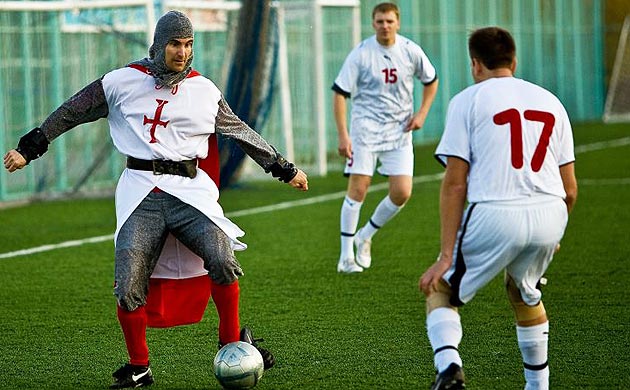
Photo of the Day

The player is obviously wearing a throwback English soccer uniform…

College baseball recruiting

I’m not a recruitnik when it comes to any sport.  I believe that when it comes to recruiting, you should trust your coaches.  Of course, this requires a wait-and-see attitude, and a lot of people don’t like waiting.  This was true before the internet age, by the way.  The veteran South Carolina radio host Phil Kornblut, to give one example, has made a living as a “guru” since the mid-1980s.  I used to regularly listen in the early evening as callers would phone in to ask Kornblut about some hot prospect (the sport in question was almost always football) who was considering South Carolina and/or Clemson.  Phil would rarely fail to put a positive spin on the chances of South Carolina and/or Clemson landing the player.  Kornblut had to be as diplomatic as possible if the choice was actually between the two schools.  (Of course, if the kid was actually good, he usually wound up at someplace like Florida State or Auburn.)

There are people who seem to care more about “winning” in recruiting than having success on the field or court.  It’s a little scary.

Having said that, I still peruse recruiting stories from time to time.  Today I took a look at Baseball America‘s list of college baseball’s Top 25 recruiting classes (accompanying story here; the Top 25 capsules are “premium content”).

I have to say that nothing jumped out at me as being really surprising.  I wasn’t really expecting to see a Top 25 recruiting class featuring, say, The Citadel (although that would have been cool).  Nevertheless, there were some things that interested me.

  • Louisville took advantage of its surprise CWS appearance from two years ago to sign the #20-rated class for this year.  The Cardinals brought in ten players (nine high schoolers and one JC transfer), including an intriguing 6’7″ lefthander from Massachusetts, Keith Landers, who reportedly throws 88-92 mph with a good breaking ball and has “composure” on the hill.  Landers was an 18th-round draft pick of the Orioles.  Also, my brother would want me to mention that Chris Lemonis is Louisville’s recruiting coordinator.

(Special Louisville factoid/cheap excuse for me to mention the ’90 CWS:  Cardinals head coach Dan McDonnell was the primary leadoff hitter for The Citadel in 1990, when the Bulldogs reached the College World Series.  McDonnell only hit .206 that year, but managed a .401 OBP thanks to 62 walks (in 60 games).  He was also hit by 7 pitches, stole 38 bases, and recorded 11 sacrifices.  McDonnell also managed to reach base at least three times after striking out on a wild pitch.  In short, he was as good a .206-batting college leadoff hitter as you will ever see.)

  • Duke has the #25-rated class, not bad for a school that hasn’t made an NCAA regional since 1961.  I’ve always thought Duke was an underachiever in college baseball (not UCLA-level of underachievement, of course).  In recent years, Duke has struggled to stay out of the ACC basement.
  • LSU, North Carolina, and South Carolina are not among the 11 SEC or ACC schools in the Top 25.
  • Defending national champ Fresno State brought in 23 players (six JC transfers), and that’s not even counting any potential tranfers from four-year schools.  I wonder how many of them expect to play right away…

One other thing:  North Carolina State (#23-rated class) signed two kids from The Hun School.  The school’s teams are known as the “Raiders”.  I was mildly disappointed when I found that out, as I was hoping for something unique, like “The Scourge”.

Testing post #2 — the self-portrait

Kicking the tires

This is my first post.  I’m just seeing how this thing works.