Next year’s football schedule: Who will The Citadel’s opponents play before they play the Bulldogs?

This is just a quick post on something I was looking at this past week. One thing that a triple option team sometimes has going for it is that its opponent doesn’t have time to prepare adequately for the offense, because it is so different from the “typical” offense. Of course, these days I’m not sure there really is a typical offense.

There is also something to be said about the quality of the opponent’s immediate prior opposition and how it affects its preparation, regardless of offensive or defensive setup.

The Citadel has announced its 2013 football schedule. Just for the record, here are the Bulldogs’ opponents’ opponents the week before they play The Citadel:

August 31: Charleston Southern — well, it’s the season opener

September 7: Wofford — the Terriers will travel to Florida State Baylor the week before playing The Citadel at Johnson Hagood Stadium. Advantage, Bulldogs.

Edit (2/25/13): Instead of Tallahassee, Wofford will head to Waco on 8/31, thanks to a late change in the Seminoles’ schedule.

Incidentally, Wofford’s game the next week is at home against Georgia Southern. That’s quite a stretch to begin the season.

September 14: at Western Carolina — the Catamounts are tentatively scheduled to play Virginia Tech in Blacksburg prior to facing The Citadel. Yikes. That’s after an opening game at Middle Tennessee State. Later in the year, WCU plays Auburn. Yes, three FBS programs in one season. Great for the financial bottom line, not so hot for trying to build a program.

September 21: at Old Dominion — the Monarchs host Howard on September 14. That follows consecutive games against FBS opposition (East Carolina and Maryland) for ODU, which is making the transition to FBS itself.

September 28: Furman — the Paladins are off the week of September 21. Rats.

October 5: Appalachian State — Edit (2/25/13): App State will host Charleston Southern on September 28. The Citadel will be the first of the SoCon’s three triple option teams that the Mountaineers will encounter during the 2013 season.

October 12: at Georgia Southern — the Eagles are at Samford the week before tangling with the Bulldogs in Statesboro. Will this be the last time The Citadel plays at GSU?

October 19: off week

October 26: at Chattanooga — the Mocs travel to Elon prior to facing The Citadel.

November 2: Samford — Pat Sullivan’s crew plays two straight games in South Carolina, traveling to Wofford before making an appearance at Johnson Hagood Stadium.

November 9: at Elon — November 2 will be an off week for the Phoenix. The matchup against The Citadel will also be Elon’s homecoming game.

November 16: VMI — the Keydets, like Samford, will venture to the Palmetto State in consecutive weeks, as they will journey to Presbyterian on November 9 to take on the Blue Hose.

November 23: Clemson — Edit (2/25/13): The Tigers will have two extra days off before playing The Citadel, as they will host Georgia Tech in an ESPN Thursday night game on November 14.

Clemson apparently tried to get out of the game against the Bulldogs. The Tigers have two FCS opponents in 2013 (The Citadel and South Carolina State) primarily as a result of the ACC waffling on having an eight- or nine-game league slate.

Just for comparison, last season’s opponents’ prior opponents:

Charleston Southern — season opener

Georgia Southern — the Eagles hosted Jacksonville

at Appalachian State — the Mountaineers hosted Montana

at North Carolina State — the Pack hosted South Alabama

Chattanooga — the Mocs hosted Appalachian State

at Samford — the Birmingham Bulldogs traveled to Georgia Southern

Western Carolina — the Catamounts hosted Georgia Southern

at Wofford — the Terriers traveled to Appalachian State

Elon — the Phoenix hosted Furman

at VMI — the Keydets traveled to Stony Brook

at Furman — the Paladins traveled to Appalachian State

Does it mean anything? Probably not. It won’t be in The Citadel’s favor that both Furman and Elon have a week off before playing the Bulldogs, but that’s the breaks. Another negative: Clemson will face fellow triple option team Georgia Tech immediately before playing The Citadel.

All this is, really, is something to pass the time while we wait for August 31 to roll around…

McAlister Musings: Time to start winning

Since my last post on The Citadel’s basketball team, the Bulldogs have played four games. One of them was a victory (!), which broke a 12-game losing streak. Alas, The Citadel has dropped two games since then.

This isn’t going to be a long post. I just have a few brief comments on the recent action.

Davidson 70, The Citadel 38

Okay, so Davidson is good and the Bulldogs are something less than good. Also, this game was at Davidson. Still, there is no excuse for any D-1 team not based in Lincoln Parish to average less than 0.6 points per possession for an entire game, as The Citadel did in this contest. 64 possessions, 38 points. Yeesh.

Davidson didn’t even shoot particularly well, and still won going away (and then some) thanks to 26 Bulldog turnovers, which when combined with 31% FG (3-11 from 3) resulted in an offensive debacle. The less said about this game, the better.

The Citadel 70, Georgia Southern 55

Georgia Southern is the most SoConnish of all SoCon hoops squads, as this game came immediately after the Eagles had beaten Davidson and the College of Charleston in back-to-back contests. GSU whipped the Wildcats by 13 points and held the Cougars to 34% FG, but could not stop The Citadel’s offense.

The Bulldogs followed up a 0.59 ppp performance with a 1.23 ppp effort against the Eagles (70 points on 57 possessions). The Citadel scored more than twice as many points per possession against GSU as it did against Davidson. That may be the biggest differential in consecutive D-1 games for any team in the country this season.

Mike Groselle and Matt Van Scyoc combined for 35 points on only 19 shots, and there were several other efficient individual offensive performances.

College of Charleston 69, The Citadel 54

The Bulldogs did not shoot the ball very well (37% FG, 22% 3FG), and when combined with being badly outrebounded (48-29), The Citadel didn’t stand much of a chance. Chuck Driesell mentioned the rebounding; I want to mention the foul disparity.

With less than three and a half minutes remaining in the game, Mike Groselle had the same number of fouls as the College of Charleston’s entire roster: 4. I’m not sure what to make of that.

Now for a commentary on a commentary…

Gene Sapakoff, writing in The Post and Courier:

Town tournament, anyone?

Simple format: Four teams, two days, two games per team.

The College of Charleston, The Citadel and Charleston Southern are locked in every year. S.C. State makes for a fine fourth, or rotate that spot with other state schools.

I vote no.

The Citadel is already committed to one in-season non-exempt tournament every year (the All-Military Classic). Playing in two of them would likely be problematic when trying to put together a manageable schedule. We’ve already seen how less-than-ideal scheduling can have a negative impact on a season (the all-road December slate).

Besides, The Citadel should be aiming for an exempt tournament (like the Charleston Classic), not one that just takes up two more games on the schedule. It seems pointless to hamstring the program for the benefit of a “local” tournament that may not appeal all that much to the locals anyway.

The Citadel can play the CofC and/or Charleston Southern every year if (and when) it wants to do so. It doesn’t need a tournament setting, with the resulting scheduling problems, to do that.

Elon 70, The Citadel 66

This game annoyed me.

I was annoyed that The Citadel could never tie or take the lead. I was annoyed that the Bulldogs missed a layup that would have tied the game midway through the second half, which was immediately followed by an Elon three-pointer. I was annoyed by Elon’s offense, which consisted of a lot of screens (some of which were legal) to set up three-point shots (32 of the Phoenix’s 59 field goal attempts were from beyond the arc).

I was annoyed by costly unforced turnovers, particularly late in the game. One of those turnovers was a pass where the ball eventually made its way to me. That was a problem, because I was in the stands and not on the roster. (Incidentally, our basketball of choice is ‘The Rock’.)

Most of all, though, I was annoyed by the Cub Scouts.

Yes, the Cub Scouts. There was a promotion for scouts and their families for this game. To be fair, most of them spent the afternoon goofing around with each other, eating large quantities of cotton candy.

During the second half, however, four little miscreants decided it would be fun to stand in the corner rafters and shriek at Bulldog players as they attempted free throws. I should say that it’s possible two of them were not scouts, as they weren’t in uniform (two of them were).

I thought about walking up there and suggesting that they could do something else with their time, but it was obvious nobody was going to get through to them, particularly the apparent ringleader — heavy-set, wearing a white t-shirt and sporting a Harpo Marx hairdo. At least Harpo had the grace to shut up in public.

“We’re frustrated that we’re not closing out games that we have a chance [to win].” — Chuck Driesell

The Bulldogs have been close in several of their losses (Elon, CofC at McAlister, Samford, Chattanooga). However, there is a big difference between being close and finishing the job, and that’s the step the team must now take. The Bulldogs face a stretch of winnable games: Wofford, at Furman, at UTC, at Samford, Georgia Southern.

Sure, some of those are on the road, but The Citadel’s win in Statesboro shows that the Bulldogs are more than capable of winning league games away from home.

I will be very disappointed if the Bulldogs don’t put something positive together over the next two weeks. It’s time to start winning.

Game Review, 2012: Elon

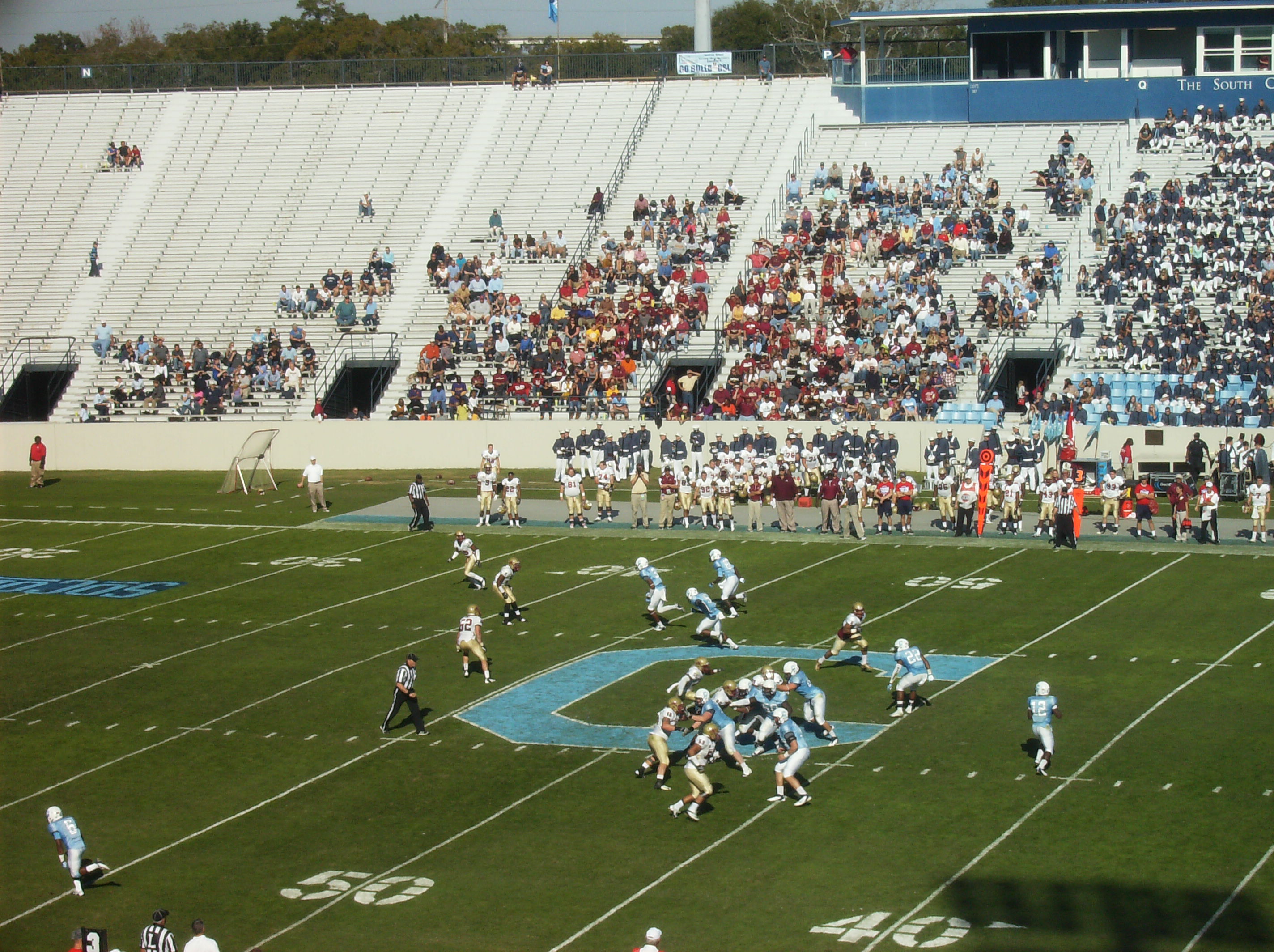
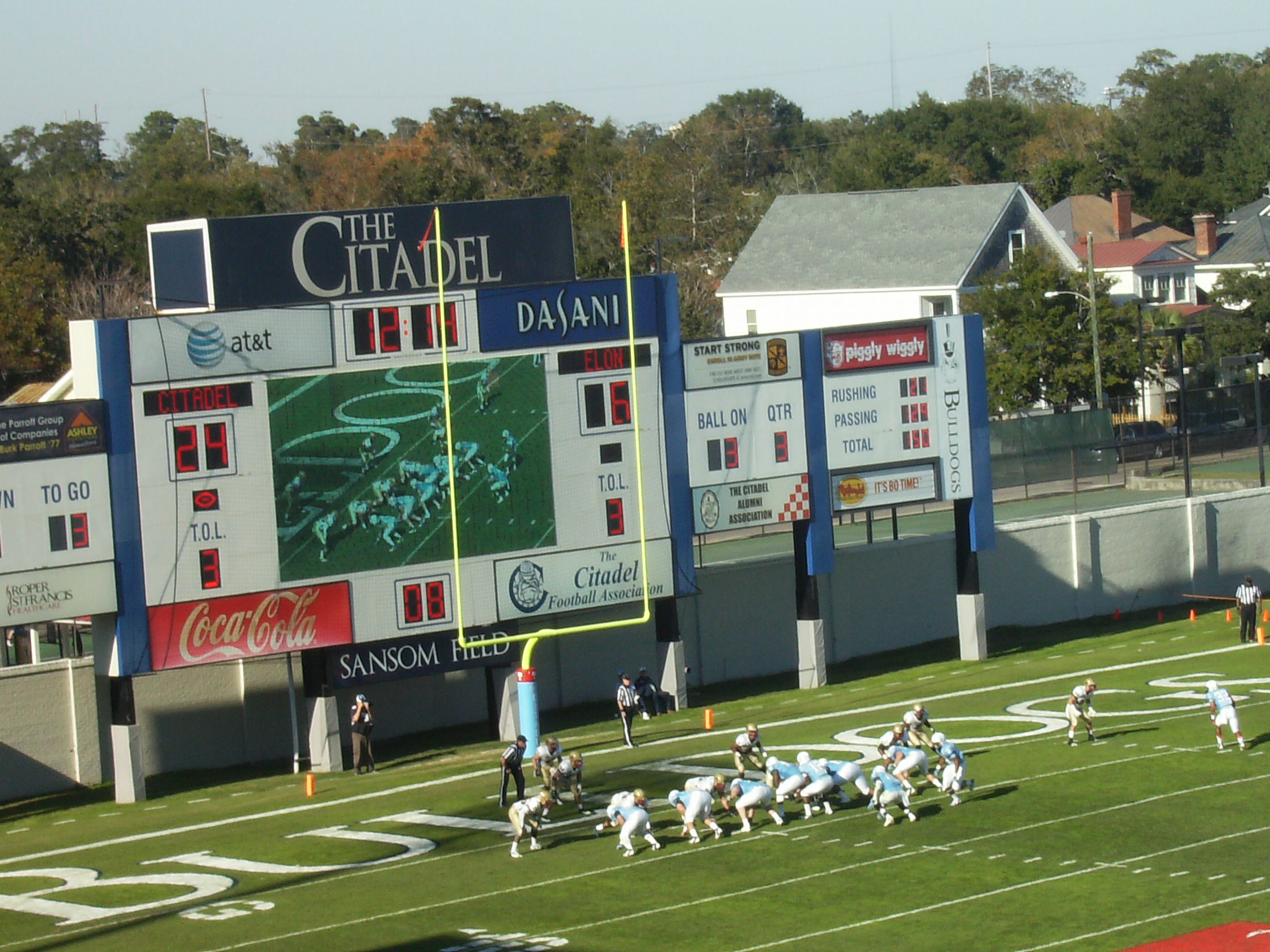
The Citadel 38, Elon 24.

Links of interest:

Game story, The Post and Courier

Notes, The Post and Courier

Game story, Burlington Times-News

Photo gallery, The Post and Courier

The Citadel’s release

Kevin Higgins’ postgame news conference (with Darien Robinson)

Postgame locker room speech

WCSC-TV story on the game (with video highlights)

Box score

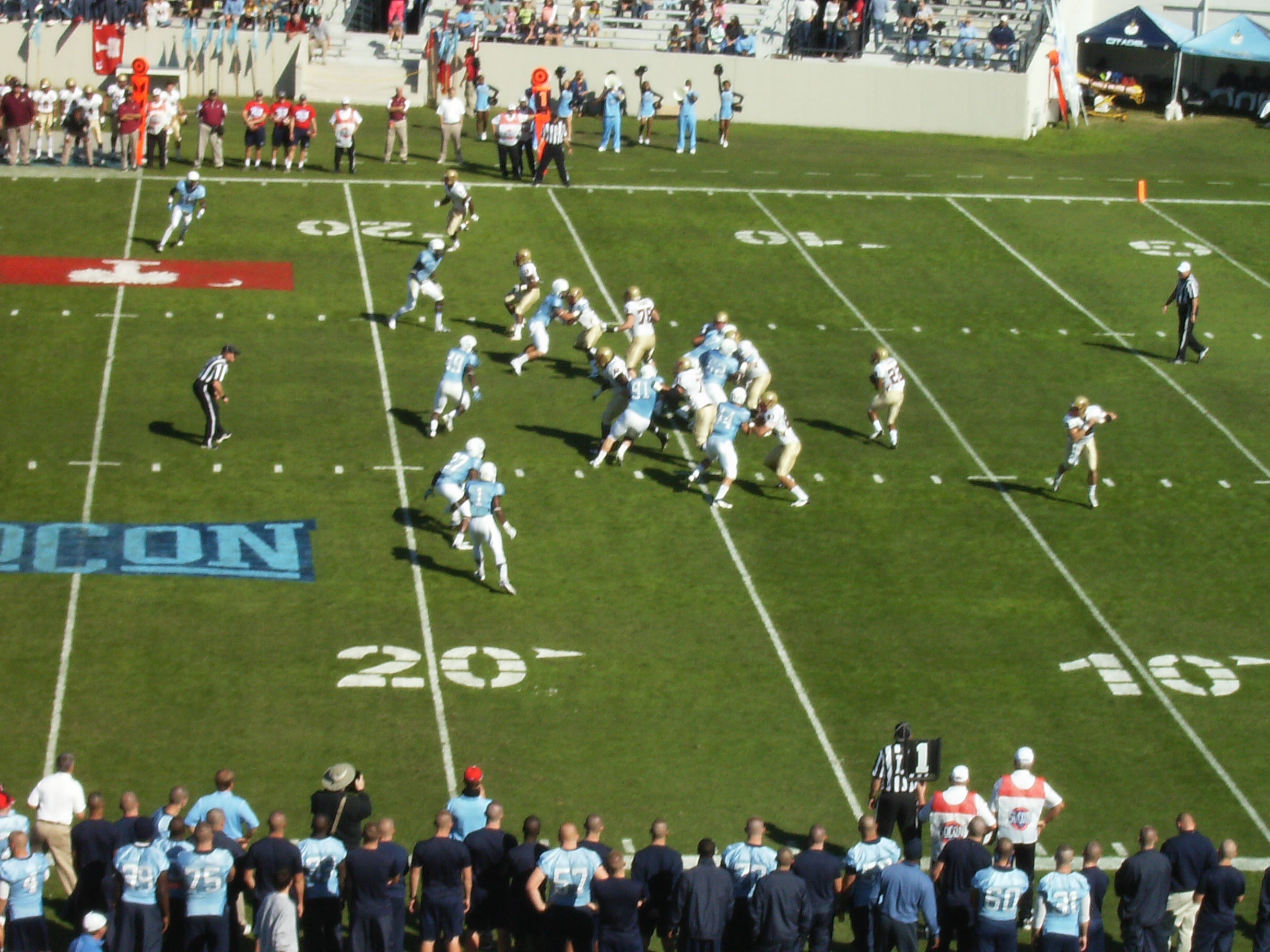
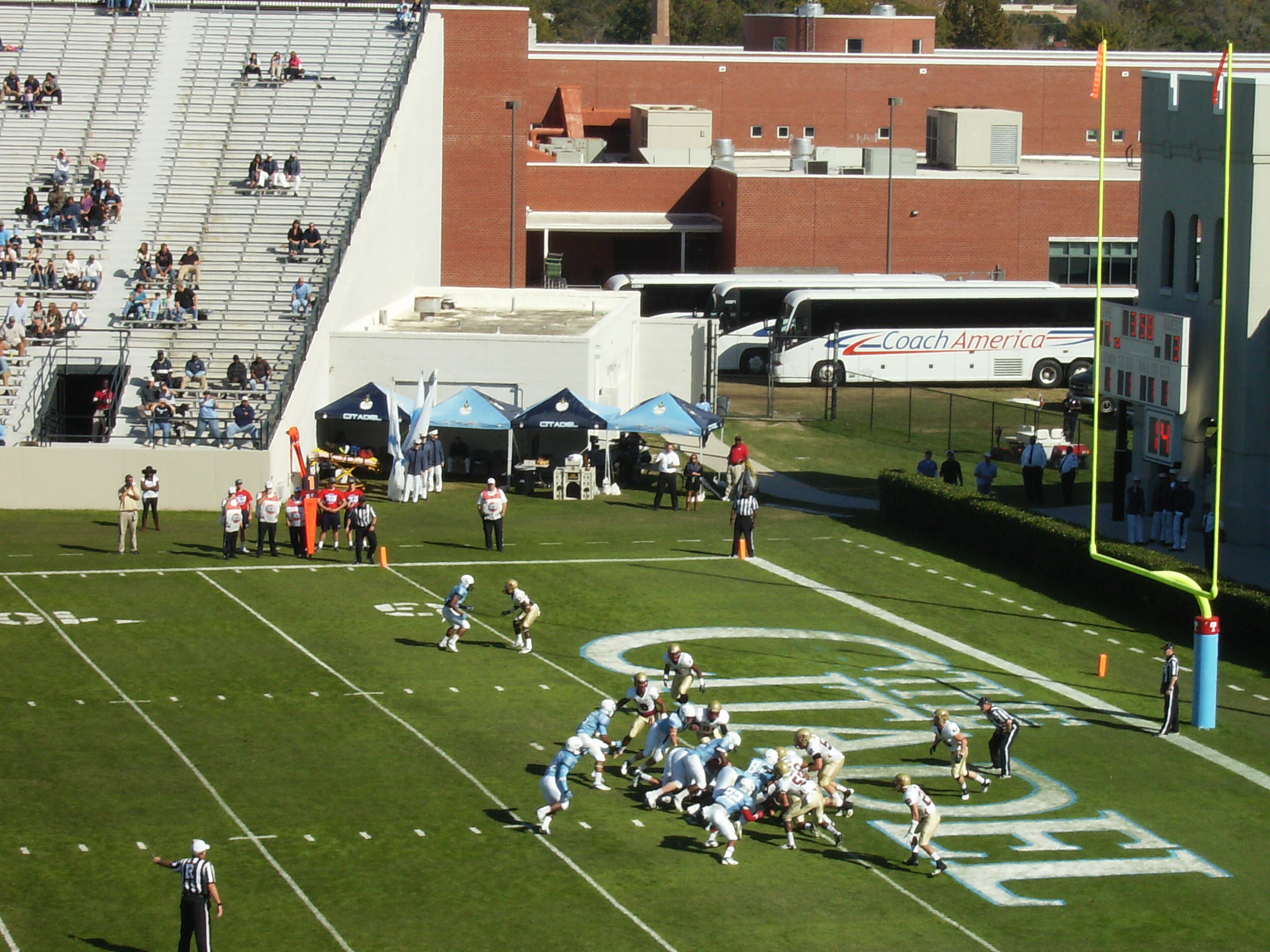
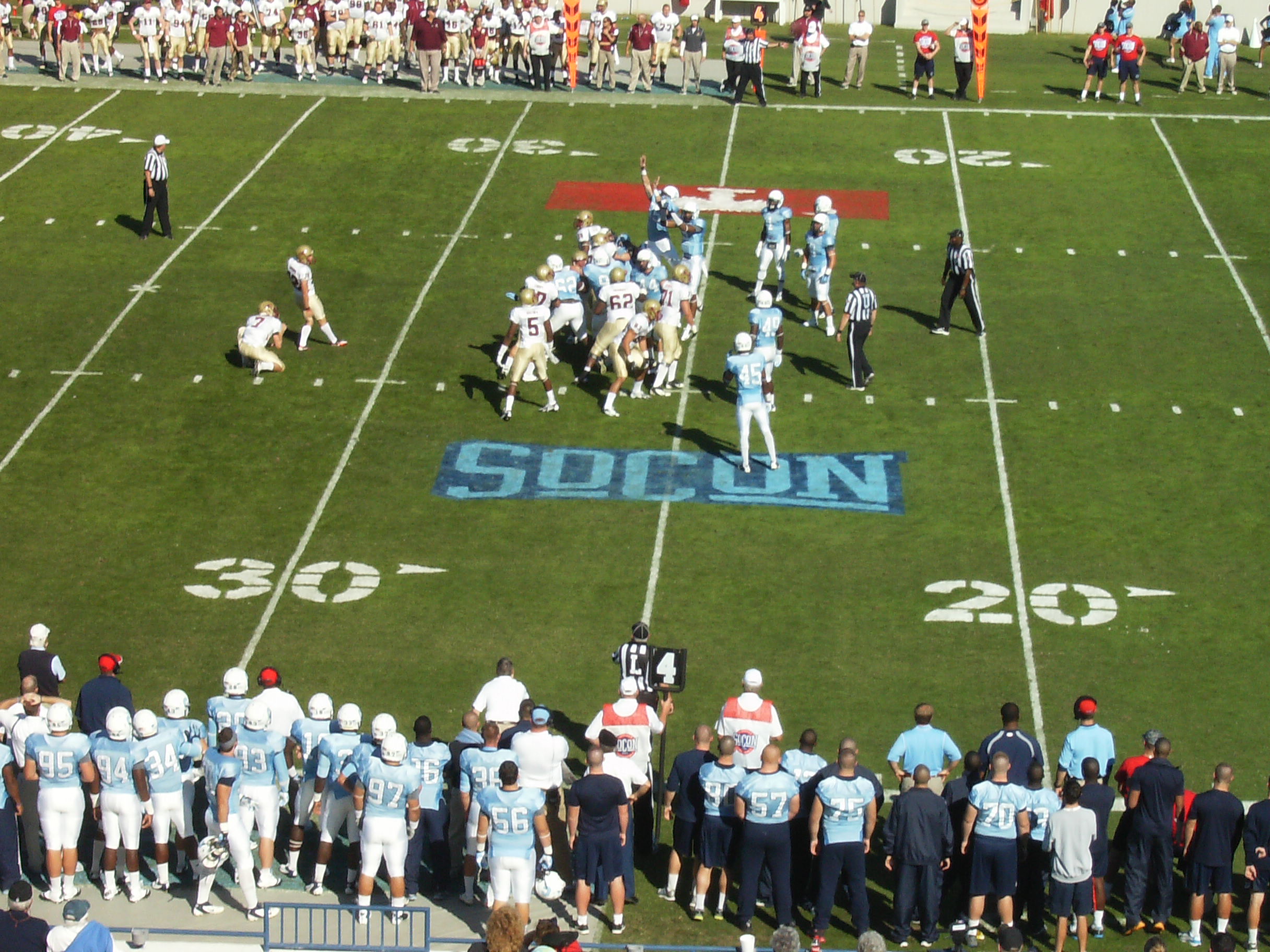
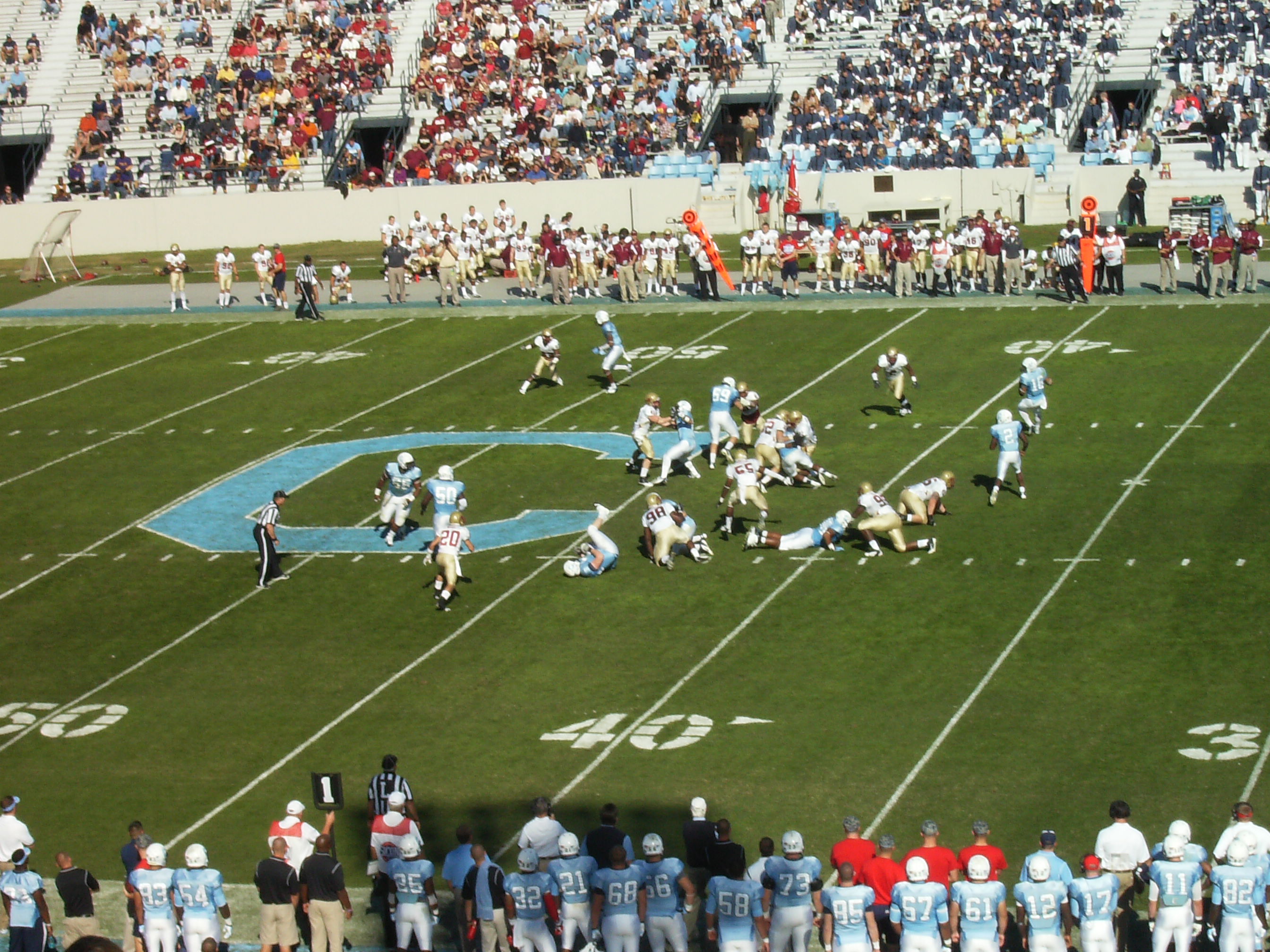
The weather was great, the atmosphere was festive, the tailgating was ridiculous, and the Bulldogs won on Homecoming. All in all, it was a very good day to be back at The Citadel.

Was I worried when Elon crawled back from a 25-point deficit to get within a touchdown? Sure. I definitely didn’t want to be in the stands to witness the biggest blown lead in The Citadel’s football history.

Fortunately, that didn’t happen, thanks to a 14-play drive that didn’t end until Darien Robinson crashed into the end zone with 2:33 remaining, essentially icing the game. Afterwards, Robinson described Kevin Higgins’ pep talk to the offense before the drive:

Coach got his message across in no uncertain terms. He let us know, we had to establish ourselves on that drive.

Heh…”in no uncertain terms.” Robinson certainly took the message to heart, carrying the ball nine times during the possession (which lasted over six minutes and featured nothing but running plays). He gained 54 of his 178 yards for the day on those nine rushes. Of the final ten plays on the drive, eight were runs by Robinson.

The offensive line came to play at the end, too, especially Mike Sellers, who was taking names on a consistent basis.

I was struck by how physical the game was, from both sides. It took its toll on some of the participants. Elon appeared to get the worst of things, most notably when Phoenix running back Karl Bostick was hurt on a rather brutal play in which he got bent over backwards while being tackled.

Bostick’s injury was to his ankle and may have been season-ending, according to Elon coach Jason Swepson. I was afraid that might be the case when it happened.

I think Elon’s players deserve some credit for not quitting after falling behind 31-6 early in the third quarter, especially after the way the first half ended. That had to have been as crushing a way to go into a locker room for the break as one could imagine.

Swepson made a mistake managing the clock at the end of the half, and the Bulldogs took full advantage. Kevin Higgins could have let the half end, and no one would have criticized him, but he elected to run a play and see what would happen. He made an intelligent call, the quarterback draw, and was rewarded. Three plays later, The Citadel would pull off a “Hail Mary”.

It’s the first time I’ve ever seen The Citadel connect on a Hail Mary in person. At least, I don’t recall another one. I do remember, however, seeing the Bulldogs score a touchdown on the final play of the first half at Johnson Hagood Stadium on one other occasion.

That would have been November 28, 1992. With seven seconds remaining in the first half, The Citadel led North Carolina A&T 13-0 in the first round of the I-AA playoffs. The Aggies had the ball and were inside the Bulldogs’ 30-yard-line, but Tracey Gamble sacked the A&T quarterback, who fumbled. Todd Lair picked up the loose pigskin and rumbled 65 yards for a TD.

As it happens, the 1992 team was honored at halftime of Saturday’s game. Perhaps there was a little magic left over from that ’92 squad…

I linked above to The Post and Courier‘s photo gallery of the game, but just in case anyone missed it, here is a nice shot of Matt Thompson making the reception on the Hail Mary: Link

Having the presence of mind to turn and leap into the end zone may have been more impressive than the catch itself — and the catch was great.

The crowd at Johnson Hagood was announced as 14,853. There was no official total to be had for the number of tailgaters, of course. I really don’t know how many people were tailgating who never entered the stadium. If I said at least 3,000, would that be an outrageous guess? Or would it be a conservative estimate?

Oh, and the flyover was outstanding.

Complaints dept.:

– The Citadel let Elon back into the game by unaccountably bogging down on offense in the second half. After scoring a TD on its opening drive of the stanza, the Bulldogs’ next four drives went like this: lost fumble, three-and-out, three-and-out, three-and-out. A better team may have made The Citadel pay for losing its offensive momentum.

– The defense played well in the first half, but was also a bit lucky. Thomas Wilson failed to connect with Bostick on what would have been a TD pass on the Phoenix’s first possession. Later in the half, the Bulldogs blew a coverage, but Wilson overthrew Aaron Mellette, missing out on a long TD pass.

– The Hail Mary disguised the fact that the rest of the Bulldogs’ passing game was suboptimal on Saturday. Aside from that one play, The Citadel was 1-9 passing for 15 yards.

– I thought the Bulldogs’ timing on pitches seemed a little off at times on Saturday. The Citadel lost a fumble on an errant pitch. Another semi-wayward toss was gathered in by Terrance Martin, who turned it into a rather nimble six-yard run.

Employees of the Week dept:

– Darien Robinson

– Mike Sellers

– Brandon McCladdie, for his outstanding coverage of Aaron Mellette, who had caught at least two touchdown passes in his previous six games. Mellette had no TDs on Saturday and had no truly big plays.

Best play I haven’t mentioned yet: Douglas German made a memorable special teams tackle on The Citadel’s final kickoff. I’m not sure what adjective to use to describe it. I think I’ll go with “sudden”.

Now the Bulldogs are just one win away from clinching a winning season, which was the baseline goal entering the 2012 campaign. The first chance to get win #6 comes next Saturday at VMI, as The Citadel looks to retain the coveted Silver Shako.

There is still a possibility the Bulldogs could sneak into the FCS playoffs with two more victories, although the other SoCon results from this weekend probably reduced the chances of that happening. At any rate, this is VMI week. There is no reason to concentrate on anything else.

Below are photos from Saturday. I seem to be getting worse every week taking pictures. Most of the game action shots are from the first half, as I didn’t have much luck with the camera after halftime.

2012 Football, Game 9: The Citadel vs. Elon

The Citadel vs. Elon, to be played at historic Johnson Hagood Stadium, with kickoff at 2:00 pm ET on Saturday, November 3.  The game will not be televised, although it will be streamed on Bulldog Insider (subscription service) and can be heard on radio via the twelve affiliates of The Citadel Sports Network. Danny Reed (the “Voice of the Bulldogs”) will call the action alongside analyst Josh Baker, with Lee Glaze roaming the sidelines and Walt Nadzak providing pre-game, halftime, and post-game commentary. 

Links of interest:

The Citadel game notes

Elon game notes

SoCon weekly release

The Kevin Higgins Show (10/30), Part 1 and Part 2

Comments from Kevin Higgins at his weekly press conference

Elon’s video highlights package from its game last week against Furman

Furman’s video highlights package from its game last week against Elon

Homecoming calendar of events

The Citadel really needs to win on Saturday against Elon. For one, it needs to break a few streaks:

— The Citadel has lost three straight Homecoming games

— The Citadel has lost four straight games to Elon (including Homecoming in 2010)

— The Citadel has lost four of its last five games

Of course, Elon has also lost four of its last five games, and is only 3-5 overall (1-4 in the SoCon). The Bulldogs will be a slight favorite to break the aforementioned streaks.

Elon’s most recent game was a 31-17 home loss to Furman. The biggest play in that game was a 95-yard fumble return for a TD by the Paladins when Elon was on the verge of tying the score. On the final drive of the game for the Phoenix, quarterback Thomas Wilson was sacked five times in a seven-play sequence. It is not often a team gets sacked five times on one drive.

Only 6,158 people attended the game — at least, that was the official count — leading Elon head coach Jason Swepson to say:

It felt like a coffin out there, and we didn’t help it. There was no one in the stands. We had to create our own energy, and we were flat.

I’m guessing Elon won’t be using “It felt like a coffin out there” as a tag line on next year’s season tickets brochure.

The Phoenix rank near the bottom of the Southern Conference in scoring defense (eighth of nine teams) and rush defense (seventh). Of course, The Citadel doesn’t rank highly in the league of either of those categories, either.

Elon allowed 342 yards rushing at Georgia Southern, similar to the 312 yards rushing the Eagles had versus The Citadel. However, the following week against Wofford, the Phoenix gave up 500 yards rushing (at home), with the Terriers’ Eric Breitenstein accounting for 321 of those yards.

That would seem to put a dent in the theory that it is easier for teams to defend the triple option after having recently faced another triple option squad.

Elon nosetackle Tony Thompson was a preseason second-team all-league selection. Lined up behind Thompson is MLB Jonathan Spann, who leads the team in tackles. The Bulldogs must neutralize both players on Saturday. Danny Reed is hoping that defensive tackle Olufemi Lamikanra doesn’t make many stops.

In his press conference on Monday, Kevin Higgins noted that Elon does “a lot defensively and they are all over the place…so there will be some opportunities for, hopefully, big plays, but at the same time they are going to kick you in the teeth a couple of times [because] they are very aggressive.”

Aaron Mellette is Elon’s best player, and he’ll be playing on Sundays next year. If the Bulldogs can keep him in check, they stand a good chance of holding down Elon’s entire passing game, as Mellette has accounted for 43% of the Phoenix’s receiving yardage this year.

Mellette is a 6’4″ wideout with very good speed. He has caught at least two touchdown passes in the Phoenix’s last six games, and has 13 or more receptions in three of Elon’s last four games, with no fewer than 154 yards receiving in any of those contests.

He has 15 catches this season of 20 yards or more. Mellette caught a 41-yard touchdown pass in last year’s game against The Citadel. The Bulldogs cannot afford to let him have a big game on Saturday.

The same goes for Elon quarterback Thomas Wilson, in his second full season as Elon’s starter. When Elon was The Citadel’s Homecoming opponent two years ago, Wilson made his first career start after longtime Phoenix QB/3B Scott “Chickenhawk” Riddle was unable to play after suffering an injury. Wilson did a fine job, leading Elon to a 27-16 victory.

Wilson has put up some big passing numbers this season, including 419 yards at Appalachian State (Mellette accounted for 237 of those yards), 412 yards versus Western Carolina, 322 yards against Wofford, and 302 yards at Georgia Southern. He is occasionally interception-prone (three picks against the Mountaineers), and the Bulldogs have to take advantage of any errant tosses.

Elon has thrown between 33 and 47 passes in each of its last five games. The Citadel’s secondary must be up to the challenge. It won’t be easy; not only does Elon throw the ball a lot, it is efficient in doing so (leading the league in that department).

The Phoenix are last in the SoCon in rushing offense, and by more than 40 yards per game. Elon is averaging just 2.8 yards per carry. The Bulldog D needs to force that trend to continue, and ensure that the Phoenix offense remains one-dimensional.

Elon has a fine placekicker in Adam Shreiner, who is 12 for 15 on field goal attempts this season. Shreiner was a key factor in the Phoenix’s win over the Bulldogs last season, as he made four field goals in that contest.

The Phoenix are last in the SoCon in net punting. and next-to-last in kickoff coverage.

Odds and ends:

— Each week, Elon’s coaches select an outstanding offensive and defensive scout team player of the week. Those two players lead the rest of the team onto the field for each game, carrying the flags of the United States and the State of North Carolina. It’s an interesting idea, although it’s a shame that the Phoenix are forced to carry a mediocre banner like North Carolina’s state flag.

South Carolina definitely has a huge edge on its neighbor state when it comes to flags. It’s just another reason North Carolina is often referred to as “South Carolina’s hat”.

— The Citadel continues to lead the nation in fewest penalties committed per game (3.13) and fewest penalty yards per game (21).

— The first question posed to Kevin Higgins at Monday’s press conference concerned the team’s uniforms. Higgins confirmed that the team would wear light blue and white for Homecoming. This obviously meets with my full approval.

— The Citadel is averaging 13,255 fans per home contest. Homecoming will likely improve that statistic.

— The Regimental Band and Pipes will perform at halftime. I hope the band is allowed to play more during the game, too. That has been an issue this season.

— Also in action on Saturday will be members of The Citadel’s wrestling team, competing in The Citadel Open. If you’re wandering around campus Saturday morning and looking for something to do, check out McAlister Field House, where the competition is being held.

The Citadel has a very promising group of wrestlers, including two defending league champions, and was a close second to Chattanooga in the SoCon’s preseason poll. Rob Hjerling’s squad is definitely one to watch.

Elon may only be 1-4 in the SoCon, but it has been in almost every league game. The Phoenix lost 26-23 at Georgia Southern, 35-23 at Appalachian State, and lost the Furman game in large part due to the long fumble return I mentioned earlier (essentially a 14-point swing in a game that was decided by 14 points).

This is not going to be an easy game for The Citadel. In Wilson and (especially) Mellette, Elon has the players to really put on a show at the home team’s expense. The Citadel needs to close down the Phoenix run game (which seems doable), prevent Mellette from making big plays (a challenge), and regularly stop Elon on third down (a must).

Offensively, The Citadel should have some opportunities, and I expect Triple O’Higgins to have a good day. As always, The Bulldogs need to avoid committing turnovers. The Citadel must also stay in manageable second- and third-down situations, something that didn’t happen late in last week’s game against Wofford. The loss of Keith Carter to a torn Achilles’ tendon is yet another injury setback that the Bulldogs are going to have to overcome.

I am looking forward to Saturday. The atmosphere will be festive, and the tailgating scene should be tremendous, but all those alums better make sure they make their way into Johnson Hagood Stadium by kickoff in order to cheer on the Bulldogs.

I’ll be there.

“Scanning the SoCon”: a brief explanation

Last season, I participated in something called “Scanning the SoCon”, a multiple-school blogging exercise on Southern Conference basketball run by Mocs Mania!, a blog devoted to UTC hoops. This year, it has been expanded to include participants from all twelve SoCon schools (even the CofC).

I’ll be providing a preview of The Citadel’s 2012-13 hoops campaign in about a week. What I’ll probably do is post it here as well have Mocs Mania! post it; I haven’t quite figured that out yet, to be honest. (I also haven’t figured out when I’m going to have the time to do it, but that’s my problem.)

All twelve schools will be previewed over the next couple of weeks, as the season draws closer. Here is a link to the “preview page”: Link

Also, if you were wondering where all these preview writers are from: Link

The first preview was posted today. It’s about Elon, and was written by a writer for that school’s student newspaper.

The Citadel’s first game on the hardwood is on November 10, which is right around the corner. The Bulldogs host VMI that day, and yes, it’s the same day the football team plays at VMI. As far as scheduling quirks go, it’s not the most ideal.

I just hope the Bulldogs go 2-0 that day…

Conference realignment, SoCon style: the College of Charleston is (probably) heading to the CAA

Update: Conference realignment, SoCon style: Is it nitty-gritty time?

I wrote about potential changes in Southern Conference membership over the summer. Now, something has actually happened…

After a somewhat contentious meeting, the College of Charleston’s Board of Trustees voted 12-5 “to begin negotiations with the Colonial Athletic Association”:

The board met for 90 minutes before passing a resolution to open official talks with the CAA. The resolution, which passed by a 12-5 vote, does not guarantee the Cougars will join the nine-member league. The College of Charleston has been in the Southern Conference since 1998.

The final vote is expected to come at the board’s next scheduled meeting in January, although a vote on the school’s athletic conference affiliation could come before the start of the new year, according to board members.

While it’s not guaranteed that the CofC is moving to the CAA, it’s all but assured, barring some unexpected problems in the negotiations.

The biggest immediate issue for those negotiations, it appears, is travel expenses. While some observers thought the estimate put forward by the school was too high, others within the college weren’t sure it was high enough.

I think the CofC’s move was “sold” to some of the BOT members as part of a larger migration from the SoCon to the CAA, a shift that would have created a “CAA South” division with Davidson and one or more of Appalachian State, Elon, and Furman.

When Davidson decided to stay in the Southern Conference, that scenario essentially ceased to be a possibility. As a result, the CofC had to recalibrate its travel expenses.

The move by the CofC, assuming it comes to pass, is being made almost exclusively for the benefit of the men’s basketball program, platitudes by the school’s president notwithstanding. For the school’s other varsity sports programs, it is basically a wash, with the notable exception of baseball, which will suffer greatly from the transition.

However, while none of those other programs really mattered in the decision, they did provide good drama. At the occasionally confusing BOT meeting, board member and baseball supporter Jeff Schilz had this to say:

This move is made assuming there’s more money in the CAA. This is a men’s basketball decision and they would have to reach goals they haven’t reached in a while.

Schilz wasn’t finished. He also opined that “our athletic programs have been ignored by the [CofC] administration” and questioned the stability of the CAA, at least as compared to the SoCon.

All of the above quotes came in the BOT meeting. The proceedings were “live-tweeted” by several different media members, a very 21st-century (and cool) development. One of the more interesting tweets came from WCIV-TV sportscaster Scott Eisberg:

Schilz says he knows 1 sport that will lose 4 recruits if they go. Audible to me,Natasha Adair says,’what abt teams that will gain recruits’

Adair is the new women’s basketball coach at the College of Charleston. I wouldn’t advise inviting her and Schilz to the same party.

I don’t know if the move will be a good one for the CofC. I tend to doubt it, but I could be wrong. At any rate, the school has every right to make a mistake. It’s the American way.

When you shake out all the pluses and minuses (exposure, travel, recruiting, etc.), it comes down to this: is the CAA really a multi-bid league? Because if it isn’t, the CofC leaving for basketball reasons but staying in a one-bid league is very hard to justify. I suspect that Davidson passed on joining the CAA at least partly because it wasn’t sure the CAA would regularly put two and three teams into the NCAA tournament.

Since 1987, there have only been three years in which the CAA received at-large bids: 2006, 2007, and 2011 (when it got two at-large bids). While that recent run does suggest upward mobility for the conference, two of the three schools largely responsible for that success have left (Virginia Commonwealth) or are leaving (Old Dominion) the league.

The other school that has carried most of the league’s water in hoops, George Mason, could easily bolt for the Atlantic 10 if that conference made an offer. (There have also been football-fueled rumors about James Madison and/or Delaware eventually leaving the CAA.)

Last season Drexel won the CAA regular season title (with a 16-2 conference record) and advanced to the league tourney final, but did not get an at-large bid to the NCAA tournament, thanks in large part to an unbalanced league schedule and a poor non-conference slate. If a 16-2 CAA team can’t get an at-large berth in the NCAAs (and that was with VCU and ODU in the conference), then it seems unlikely the Colonial will be a multi-bid nirvana going forward.

 —

Okay, so the CofC is (probably) gone. It’s just as well, too, given Joe Hull’s comments about the Southern Conference earlier last month. As soon as the diplomacy-averse Hull made his remarks, I believe every fan and journalist affiliated in some way with the league pointed out that the school hasn’t won the “invisible” SoCon in hoops this century.

What does the College of Charleston leaving mean for the SoCon…and what does it mean for The Citadel?

The league has three options: A) do nothing, B) add one school to replace the CofC, or C) add three more schools to get to 14.

Moving to 14 schools would be a way to solidify the SoCon in the short-term while protecting the league from the eventual departures of Appalachian State and Georgia Southern, assuming those schools get an invite from an FBS league in the near future.

I want what is best for The Citadel. Is what is best for The Citadel also what is best for the league? Maybe.

At this time, I don’t see why the league has to expand to 14 schools, although there are indications that is a possibility. I also don’t think it’s absolutely vital to immediately find a twelfth member. The league can afford to wait.

Appalachian State and Georgia Southern don’t have their FBS tickets punched yet, and may still have to wait a while (particularly GSU). I think league decisions should be made based on the general idea that both schools will be around for at least another year, but will leave in the next five years or so.

The SoCon’s biggest membership issue is that it is made up of several different groups of schools which have competing interests — from the smaller schools, to the larger ones, to the universities west of the Carolinas, to the institutions that don’t have scholarship football programs.

The league has historically always been a mishmash of schools, of course. However, trying to get everyone to agree on potential “adds” for the conference could prove especially problematic right now.

It has been suggested in various places around the internet that a “compromise” could be in the works, one that would be agreeable to the smaller school bloc (most of the private schools, plus The Citadel) and the larger schools (App State, GSU, etc.). This would result in the league moving to 14 schools by adding one private and possibly two larger public schools, in an effort to appease the bigger schools and also the institutions west of the Carolinas (which want company on their side of the league).

I don’t think that would be in the best interests of The Citadel. Depending on the schools involved, it also would be close to anathema for Furman and Davidson. I find it hard to believe Davidson would have elected to remain in the SoCon knowing there was a good chance the conference would be adding multiple schools with significantly different institutional profiles.

As for the other schools in the league, I am less certain. For example, take the North Carolina universities. Elon is a bit of a wild card; I’m not going to even try to guess what its decision-makers may be thinking. UNCG is a non-football school with limited history in the league. Western Carolina is a smaller public school (as compared to Appalachian State and Georgia Southern) in a relatively remote location.

I’ve seen all kinds of schools mentioned as possible new SoCon members. Some of them may have little to no interest in joining the league; some of them would name all their incoming freshmen after John Iamarino in order to get in the club. Below are my comments, opinions, etc., about a few of these schools. Remember, I’m doing this with a bias. I want what is best for The Citadel.

Do I have insider knowledge on any of this? Nope. If you read something on the internet from someone who claims to have insider knowledge on any of this, should you believe that person? Nope.

Let’s start with the favorite to be the next school to join the SoCon.

– Mercer: mentioned by an actual media person, Adam Smith, who seems to have a decent handle on SoCon info. Would make sense on a lot of levels. Mercer is just starting its football program, which will begin as a non-scholarship entity. Still, a natural replacement for the football-free CofC.

Negatives: no scholarship football (yet). Could be blocked by larger schools that want the aforementioned compromise so as to jam two or three big public universities into the league.

After Mercer, there are no obvious picks.

– Virginia Military Institute: left the league a decade ago. Would probably like to come back. I could see all the privates plus The Citadel favoring VMI’s return.

Negatives: league currently has nine football schools, and a nine-game SoCon schedule could be tough to implement. The alternative is to not have a round-robin.

Another consideration is that VMI has been terrible in football for 30 years. That counts (and is why it left the league in the first place). I could see VMI making a return to the SoCon when App State and/or Georgia Southern depart. If the league went to 14, I am not sure VMI would be one of the three additions.

– Coastal Carolina: ah, here comes controversy…

This is the school many of the larger state schools want in the league (at least, their fans do). So which schools are not so crazy about CCU joining the SoCon? That would be Furman, The Citadel, and Davidson. I am not as sure about Wofford, although I would think it would be in the same group.

From the perspective of The Citadel and Furman, adding another, larger South Carolina school with a different mission and budget is a complete non-starter (and another Palmetto State school also may not sit well with Samford and Chattanooga). It doesn’t benefit either S.C. school. I also suspect longtime SoCon types look at Coastal Carolina and think “Marshall II”, and one Marshall was enough for a lot of people.  That may be unfair to CCU, but it’s reality.

Also, I don’t think Appalachian State’s and Georgia Southern’s wishes (in terms of new members) should even be considered by the other schools. App and GSU have stated they want to leave, and they eventually will, which is fine. However, why should the schools remaining in the conference make a decision on league membership for the benefit of schools that aren’t going to be in the SoCon much longer? That would be stupid.

– Kennesaw State: reportedly discussed in the league’s meeting in June. From an April article in the Marietta Daily Journal:

One of the big challenges for Kennesaw State’s athletic programs will be to find a conference before the football team kicks off its inaugural season since the Owls’ current conference, the Atlantic Sun, does not sponsor football. [New Kennesaw State AD Vaughn] Williams said he has had some preliminary conversations with representatives from the Southern Conference and the Ohio Valley Conference about joining their leagues in the future.

I could see Chattanooga and the other state schools in favor of Kennesaw State, which I suppose would be part of a three-school add-on, with Mercer and some other institution. KSU won’t start its football program until 2014. It would basically be like adding UNC Charlotte to the league.

Would adding such a school to the SoCon be in the best interests of The Citadel? Not really. Could it happen? Sure. Trying to get into the Atlanta market would be the major justification for inviting Kennesaw State.

– South Carolina State: allegedly was also discussed at the (surely infamous) June league meeting. It is hard to imagine the league seriously considering SCSU, which has a host of institutional problems, including serious financial issues. SC State has had more school presidents in the last five years than Western Carolina has had league victories in football.

I also have my doubts that it would be in South Carolina State’s best interests to leave the MEAC in the first place.

– Tennessee Tech: located in Cookeville, Tennessee. Public, but on the small side (around 10,000 undergraduate students). Would appeal to Western Carolina, Chattanooga, and probably Samford. Whether or not the conference wants to venture any further from its current geographic footprint is open to question.

As far as The Citadel is concerned, it is probably a more palatable option than any of the above-mentioned schools save Mercer and VMI. Tennessee Tech is in the OVC and I am not sure why it would want to leave that league.

– William & Mary: would be a great get, but is not happening unless the CAA implodes, and even then W&M’s first choice would likely be the Patriot League.

– Richmond: would only join the SoCon as a football-only member if the CAA dropped football sponsorship, as UR is happy to have its hoops program in the A-10.

I don’t see any school joining the SoCon as a football-only member. I saw a report suggesting Kennesaw State might be interested in this option. That should not happen, and I don’t think it will.

– Presbyterian: another Palmetto State school, which is PC’s biggest problem. Furman and Wofford aren’t interested in “elevating” the Blue Hose.

– Jacksonville: I wrote about JU in September of 2011, when I previewed The Citadel’s football season opener against the Dolphins that year. JU has potential (and a good market), but it’s another non-scholarship football program.

– Jacksonville State: wants to go FBS, like App and GSU. I don’t see the point of adding a member school like that. I doubt JSU does either.

– Liberty: see the entry for Jacksonville State.

– East Tennessee State: dropped football, dropped out of the SoCon. Now may want back in, though it still doesn’t have football. I’m not sure how serious a possibility ETSU is as things currently stand. Would not be the first choice for any of the current league members with the possible exception of Chattanooga.

A few other schools have been mentioned in passing, including Gardner-Webb, High Point, Murray State, Winthrop, Eastern Kentucky, North Alabama, and West Georgia. I don’t see any of them as realistic options for the SoCon (though I could be wrong).

A slightly different question: is the College of Charleston leaving the SoCon good or bad for The Citadel?

The real answer to that question is “to be determined”. Ultimately, though, it will depend on two things:

1) Which (if any) schools replace the CofC in the league

2) What (if anything) The Citadel does to take advantage of the CofC leaving

The Citadel has something to say about the first item, and everything to say about the second.

If the school(s) that replace the College of Charleston in the SoCon are from The Citadel’s perspective “like” institutions (smaller schools, good academics, etc.), then the CofC leaving will present the military college with an opportunity. That opportunity is greatly lessened if the new member schools do not fit that profile.

With the College of Charleston’s departure, The Citadel takes complete control of the Charleston market for the SoCon, and that’s a good thing. The Charleston area will, in my opinion, more easily identify with a football conference that has a long history, and that has “familiar” schools (like Furman and Wofford). The Palmetto State is, ultimately, a football state.

The Charleston market has also already proven over time to be supportive of SoCon baseball (with its long tenure as the league tourney host). That reminds me: it’s time for John Iamarino to step up and give the Low Country a long-term contract to host the tourney again.

Speaking of baseball, it’s possible that Monte Lee’s loss will be Fred Jordan’s gain in terms of recruiting for their respective programs.  I think Coastal Carolina may also benefit from the CofC joining a lower-tier baseball conference (and Charleston Southern will have something to say about it as well), but it won’t hurt The Citadel at all to pick up impact local recruits who want to play against quality opposition closer to home.

I also wouldn’t be surprised if a few other varsity sports at The Citadel benefit from the “only local school in the local league” phenomenon.

What The Citadel needs to do is get the message out to the local populace that the Bulldogs are the hometown team of choice, especially in a football-crazy state that also loves its baseball. It should be, to steal a term from college basketball officiating, a “point of emphasis”. I know that is already happening, but now more than ever it is a strategy that needs to be pushed.

I just named three sports in consecutive sentences. That means it is time to wrap this up…

The next few months are going to be very interesting for fans of the Southern Conference. Few other leagues have the potential for divisiveness quite like the SoCon, thanks to its disparate membership. For The Citadel, it is important that the school’s administration looks out for the school’s best interests, even if they are not in line with what league officials may propose.

This is not the time to “go along to get along”. Earlier, I mentioned three SoCon options. One of them was to do nothing and stay at eleven schools. There is nothing bad about that option right now. If the alternative is something that is not optimal for The Citadel, then the school should not be afraid to be intransigent.

We’re good at that.

CAA vs. SoCon: another conference realignment update

In the week following my last post on the CAA’s ostensible attempt to “raid” the SoCon, there has been a meager amount of actual news, and a lot of rumor-mongering. A great example of how an internet rumor can get started came after a series of tweets by Burlington Times-News reporter Adam Smith. The tweet that ultimately initiated a cyber-roar:

Davidson, College of Charleston and App State – yes, App State – formally have been contacted by the #CAA.

Notice that he didn’t say the schools had been invited to join the CAA, or anything like that. He just said the three institutions “formally had been contacted”, which was simply Smith’s way of stating that CAA commissioner Tom Yeager had called his opposite number at the Southern Conference, John Iamarino, to let him know he was approaching those schools.

The fact Yeager was calling SoCon school officials wasn’t really that big a deal, as it had been reported a month ago. However, Smith’s scoop that Appalachian State had been one of the schools singled out by Yeager was quite newsworthy, and a bit of a surprise.

Smith’s tweet was apparently picked up by the folks who run GoBlueRidge.net, but that site put a different spin on the information, running with a report that the CAA had “made a formal invitation to Davidson, College of Charleston and Appalachian State—yes, ASU, to become league members.”

There is a major distinction between contact and an invitation, to say the least, but it was that part about the alleged invite that got things stirred up on various messageboards, not to mention Twitter. It took a while before people began to figure out that the schools in question had not yet been formally invited to switch leagues.

Smith followed up with an article in which he noted that Furman had not been in contact with the CAA (“per multiple sources”) and that the administration at Elon wasn’t saying anything. The news about Furman seemed to dampen various reports/rumors of the Paladins being part of a larger migration of SoCon schools to the CAA.

The story also pointed out why many observers (including me) are skeptical of Appalachian State jumping to the CAA:

Appalachian State, if it were to join the CAA, would be expected to abandon its well-known pursuit of climbing from the Football Championship Subdivision to the top tier Football Bowl Subdivision, because the CAA competes on the FCS level.

Such a concession from Appalachian State appears highly unlikely, given the investment the Mountaineers have made in growing football, already their flagship sports program.

There would be some angry Mountaineer fans if the Appy administration punted on its very public FBS ambitions to make an arguably lateral move to another FCS conference. Such a jump would cost the school $600,000, as that is the exit fee required for leaving the SoCon. In addition, Appalachian State would have to pay a $1 million exit fee to the CAA if it were to abandon that league after joining.

Shortly after the Burlington Times-News story was released, the Watauga Democrat posted a quote from Appalachian State spokesman Mike Flynn:

There are no new developments in Appalachian’s ongoing pursuit of a conference that sponsors FBS football.

So there (I guess).

One additional piece of information came the next day, when UNC-Wilmington chancellor Gary Miller had this to say about a timeframe for CAA expansion:

Christmas is a realistic goal. It’s a difficult question to answer, because the schools we want to talk to have time constraints, they’re in conferences already, they have exit strategies. We would like to see some things happen quickly – and definitely by next year.

Miller may be thinking about a holiday down the road, but SoCon commissioner Iamarino has his eye on a more immediate day of celebration, as he reportedly wants the institutions in his league to finalize their decisions by July 4.

I think Iamarino may get his wish. I’m not sure waiting is going to change anything as far as the Southern Conference schools are concerned.

One other piece of information was revealed on Tuesday that could be suggestive. The Atlantic Sun conference announced that Furman and Elon would be joining that league for women’s lacrosse. Both schools are starting lacrosse programs, and the league release stated the two would “debut their programs as affiliate members of the [Atlantic Sun] as early as 2014.”

Furman and Elon needed another league besides the SoCon to place their brand-new lacrosse programs because the Southern Conference does not sponsor the sport. However, the CAA does. It strikes me that if Furman and Elon were seriously considering a move to the CAA, they wouldn’t have been so quick to come to an arrangement with another conference for their lacrosse teams.

I believe there will probably be a resolution to the CAA/SoCon tug-o’-war in the next few weeks. I hope so, anyway. It’s almost time for football season.

Examining the conference realignment rumor mill: is the CAA going to decimate the SoCon?

Let’s take a quick look at the latest wild speculation in the never-ending game of conference musical chairs…

Andy Katz of ESPN had this to say in a blog post on June 18:

CAA commissioner Tom Yeager is actively looking at expansion and, according to Davidson coach Bob McKillop, was on the Charlotte-area campus. But no formal offer was given, and it’s unclear if Davidson would accept since it is comfortable in the Southern Conference. The CAA is also looking at Charleston and, according to sources, Furman and Elon are on a lengthy list. However, Stony Brook makes the most sense if it wants to link up its northern teams with Hofstra.

That’s right, Furman and Elon have now joined the College of Charleston and Davidson as schools being connected to a move to the CAA (along with Stony Brook of the America East). This Katzian nugget in itself wouldn’t have started a Twitter fire, but it was followed a couple of hours later by this tweet:

CAA fans shouldn’t be surprised if Stony Brook, Elon, Charleston, Davidson & Furman ALL join the CAA, per sources

The tweet’s author runs the site CollegeSportsInfo.com; I am not sure how good his sources would be, although I don’t think he’s exactly in the same league with Brett McMurphy. (Then again, who is?)

Nevertheless, the tweet got a lot of play in the world of Twitter and on message boards everywhere.

One thing I want to note in passing, however, is the rather strong “we’re in the America East to stay” vibe coming from Stony Brook’s AD in the Katz story. Of course, it’s not like he’s going to say that Stony Brook can’t wait to ditch its current league for the CAA, but it’s not a non-committal stance, either.

If Furman, Davidson, Elon, and the CofC all left the SoCon, the conference would look like this:

Appalachian State
Georgia Southern
The Citadel
Western Carolina
Chattanooga
Samford
Wofford
UNC-Greensboro (no football)

Considering that both Appalachian State and Georgia Southern want to move to an FBS conference in the near future, it’s obvious that losing all four of those schools (particularly the three private schools, which play football) would seriously hurt the league.

Assuming that any of these rumors have any validity is dangerous, but I can see why CAA commissioner Tom Yeager might be trying to make such a bold play. His problem, from my perspective, is that while the CAA may have a certain appeal to the College of Charleston, one of his two believed main target schools, the current CAA lineup doesn’t appear to  impress Davidson, the other school most observers think is on the primary CAA wishlist.

I wrote about much of that a month ago. I didn’t account for the possibility that the CAA might employ a different kind of strategy — namely, flush out Davidson from the Southern Conference by attempting to decimate that league by inviting other SoCon schools, which would also make the CAA more palatable to Davidson (and to current Colonial member UNC-Wilmington).

Such a grandstand play by the CAA, if successful, would be bad news for The Citadel, which would find itself in a hollowed-out shell of a SoCon, and one that would be difficult to reconstruct in a manner that would be acceptable for the military college. It would be so unsatisfactory that I think The Citadel would have to hope for a (perhaps unlikely) CAA invite of its own, even though that league includes schools as far away as Northeastern (980 miles from Charleston), Hofstra (793 miles), and Drexel (680 miles).

In addition, those schools are much larger than The Citadel (or Furman or Davidson). Drexel has well over 20,000 students (as does fellow CAA member Towson and possible invitee Stony Brook). Northeastern and Hofstra are also bigger, urban schools. None of them have any historic ties to The Citadel.

They don’t have any to Furman, Davidson, or Elon, either — which begs the question, is it really worth it for any/all of those three schools to make such a leap of faith?

Honestly, I don’t think it is, and for that reason I’m just a bit skeptical that such a major move is going to happen.

The CAA does have things that the SoCon currently does not — some immediate cash on hand, a modest TV contract with NBC Sports, and the promise of a new digital network. The last of those might be the most important thing of all in the long run, and is something the Southern Conference needs to develop if it wants to remain relevant.

On the other hand, familiarity matters. So does geography, despite what you may read. Sure, the BCS conferences have occasionally pulled off moves that made little geographic sense, but they made those moves despite that, not because of it. There was enough money being thrown around to overcome such issues.

At the mid-major (or low-major) level, however, that’s not the case. Creating an FCS league that stretches for the better part of 1000 miles would be foolhardy, in my opinion. I could be wrong about that. I’ve been wrong before. It just seems nonsensical, though.

In reading a variety of messageboards, just seeing what ideas/rumors/silliness were out there, a couple of things about Furman were mentioned that interested me, and seemed believable. One suggestion is that FU is institutionally concerned about what would happen to the SoCon if the CofC/Appy/Georgia Southern move. The folks in Greenville want to make sure any replacement school(s) would be acceptable to Furman.

That leads to the second point, which is that Furman wants to be in a league with “like-minded” schools. I am not sure the CAA can offer that to the Paladin faithful. I tend to think that if Furman waits for a couple of years, though, the SoCon may start to more fully resemble that school”s ideal.

All of this discussion may be for nothing, but if there is something to it, Gen. Rosa and Larry Leckonby must be out in front of any potential major movement within the league. This type of conference upheaval could affect athletics at The Citadel for many years to come. Standing pat is not the way to go.

Waiting on college football season…hurry up already!

This is a post featuring meaningless gridiron musings, and it’s not even June yet.

I saw this chart on Phil Steele’s site a couple of days ago. It’s an interesting look at the percentage of lettermen returning for each FBS team, although perhaps not really indicative of how a team may do this season. For example, I suspect that Southern California, next-to-last in the category, is still going to be really good.

North Carolina State, which will play The Citadel in late September, is also near the bottom of the list, with a lettermen return rate of 59.6%. That got me thinking, what’s The Citadel’s return rate? It turns out to be not much higher (62.9%).

I compiled a similar list of The Citadel’s opponents this year in a chart. Well, not all the opponents, for the simple reason that I couldn’t find readily available numbers. I found practically no information about Charleston Southern’s returnees, to name just one school, although I would imagine that since the Buccaneers were 0-11 last season there are going to be some changes.

I have return/loss statistics for eight of the eleven schools playing the Bulldogs. As I get more information for the others, I’ll add those numbers to the chart.

Anyway, this is what I came up with for eight opponents, plus The Citadel (excuse the less-than-stellar presentation):

Team     2011 L’men     Lost         Returning   % Returning

Appy           55                22                 33       60.0%

GSU             80                24                 56       70.0%

NCSU          52                 21                 31       59.6%

Wofford      64                 17                 44       68.8%

WCU           63                 21                42       66.7%

UTC            65                 20                 45       69.2%

Furman        62                 17                 45       72.6%

VMI          54                   19                    35       64.8%

The Citadel  62                 23                 39       62.9%

Among returning offensive and defensive starters, Chattanooga returns 16 of 22 (8 offensive/8 defensive); Georgia Southern, 15 of 22 (8/7); Appalachian State, 14 of 22 (5/9); North Carolina State, 14 of 22 (7/7); Western Carolina, 14 of 22 (8/6); VMI, 11 of 22 (5/6); and Furman, 14 of 22 (6/8).

Some links, if you’re interested or bored or both:

Appalachian State 2012 Preseason Prospectus

Georgia Southern 2012 Quick Facts

A report from Charleston Southern’s spring game

Wofford 2012 Quick Facts

Chattanooga 2012 Spring Notes

Furman 2012 Quick Facts

VMI 2012 Quick Facts, Newspaper report on VMI spring football, school report on final spring scrimmage

Western Carolina 2012 Quick Facts and A report from Western Carolina’s spring game

Samford 2012 Prospectus

A report from Elon’s spring game

North Carolina State 2012 Spring Prospectus

Phil Steele’s team page for The Citadel

Jeff Hartsell’s writeup of The Citadel’s spring game (over two months ago, sure, but in case you missed it)

Less than 100 days to go…

Why The Citadel needs to sponsor more varsity sports (and a few other things)

The Citadel needs to sponsor more varsity sports. Yes, roll those eyes. I know the money isn’t there right now. It’s also true that some of our existing varsity sports could stand improvement, both on the field/court and in terms of resource allocation.

Before I get started on this ramble of a post, I want to issue a caveat bigger than the new Ring Statue, especially for people who might have accidentally wandered into the path of this little blog for the first time. There are things I know a little bit about, and can opine on with some confidence. I know that Chal Port was a great baseball coach. I can discuss how Rabbit Maranville, famous in his day, is now underappreciated. The Citadel defeated South Carolina in football in 1950; I have a fairly good grasp of the enormity of that upset. The “hold” statistic in baseball is flawed, and I can tell you why.

There are other things I don’t understand quite as well. Lots of things. It has become apparent to me in recent days that higher education is one of those things, particularly in regards to my alma mater. I remember when I was a cadet that there always seemed to be a lot going on around campus that I didn’t really understand, and never would. The same is true today.

That makes this post a bit different from my usual efforts, which I like to think are fairly precise in terms of information and analysis. Because the subject is important, though, I decided to press forward. I apologize in advance for anything outlandishly stupid. I don’t apologize for anything that is simply outlandish, though — this is something of a big-picture essay, more conceptual than specific.

Please keep that in mind. I’m not really crazy. At least, I don’t think I am…

Quick tangent before I go into blogging overdrive: speaking of resource allocation, The Citadel has the top college rifle range in the nation. This is a sport in which the school could conceivably win an NCAA title. However, The Citadel currently only offers 1.5 scholarships in rifle, while the NCAA maximum is 3.6 schollies.

I know I’m spending money that’s not mine (I’m going to be doing that throughout this post), but it seems to me that with such a great facility, and being a military school that might naturally attract people who like shooting things, it wouldn’t be a bad idea to maximize schollies — especially when that would only take a little over two more scholarships.

If The Citadel won an NCAA title, I would shortly thereafter go to the South Carolina Statehouse and take a picture of the top of the building. Since the state legislature has set a precedent with a Gamecocks flag flying atop the Statehouse following South Carolina’s CWS titles, I would very much enjoy seeing “Big Red” waving proudly above the dome.

The reasoning behind my suggestion that The Citadel needs more varsity sport options goes to the heart of where the military college is now as an institution, and where it will be in the future. I suspect some will disagree (perhaps strongly so) with my point of view, in terms of what the school is and could be. That’s okay. It’s the discussion that is most important. What follows may be a flight of fancy. Just humor me.

I have been thinking about this topic for a long time, but while a lot of this isn’t necessarily about college athletics, what actually inspired me to finally sit down and do some typing (and a fair amount of research) were two recent sports stories:

Furman received a $5 million contribution to establish men’s lacrosse and women’s lacrosse as varsity sports

VMI’s women’s water polo team played its first match ever, wearing swimsuits with supersized logos

With the addition of the two new lacrosse programs, Furman will have 20 varsity sports. VMI’s addition of women’s water polo brings its total to 17 varsity sports. The Citadel, despite having about six hundred more undergraduate students than VMI, has only 15 varsity sports.

Note: I am counting rifle as one sport, not two, as it is a co-ed sport in NCAA competition. Indoor and outdoor track are counted as separate sports, and that is the case for both the men’s and women’s teams.

Of course, you can’t directly compare the scope of a school’s varsity sports offerings simply by number of teams. Some of those sports may be fully funded, some may not. Still, it is apparent that The Citadel does not have nearly as diverse a collection of varsity sports as some of its peer institutions. A partial list:

The Citadel – 15
Elon – 17 (once women’s lacrosse is added, with possibly more to come)
VMI – 17
Samford – 17
Wofford – 18
Richmond – 19
Furman – 20 (when lacrosse programs are added)
Davidson – 21 (non-scholarship football)
Lafayette – 22 (non-scholarship football)
William & Mary – 23
Lehigh – 25 (non-scholarship football)
Colgate – 25 (non-scholarship football)
Bucknell – 27 (non-scholarship football)

While Lafayette, Lehigh, Colgate, and Bucknell currently field teams that play FCS football without offerering athletic scholarships, that will change beginning in 2013, as the Patriot League schools move to athletic financial aid awards in football. That decision has a number of ramifications, a couple of which may directly affect The Citadel.

As one of those links points out, northern schools will shortly have more options when scheduling FCS schools. A few years ago, The Citadel played Pittsburgh in a “money game”, but going forward Pittsburgh could schedule Bucknell or Lehigh instead and count the game toward its win total for bowl eligibility, something that couldn’t happen if those schools remained non-scholarship for football.

[Edit, 3/26/12: Actually, it was possible for a Patriot League school to be a “counter” in the past, depending on whether or not it averaged 56.7 or more football “equivalencies” (athletic need-based aid) over a rolling two-year period. Thanks to the first commenter for spotting that error.]

It is also true that the Patriot League schools will be able to offer athletic grants in a way they could not before, and as a result will be able to compete that much more with other colleges for recruits. Kevin Higgins is just one of many coaches who likes to recruit the Mid-Atlantic region (he is on record as preferring to bring in at least one Pennsylvania recruit in each class, for example). This will presumably be more difficult in the future.

While competing with those schools for football players is one thing, what I think is even more important to realize is that going forward, The Citadel might be competing with those institutions for other students as well. Therein lies the point of much of this post, and why I listed four private schools located north of the Mason-Dixon line as “peer institutions”.

From the November 1, 2011 minutes of a meeting of The Citadel Board of Visitors:

Chair Snyder called the meeting to order and updated the Board on The Citadel Foundation’s recent board meeting.  He reported that the Foundation anticipated falling short of its fundraising goal for the year. They expect to raise around $17 million against a “stretch” goal of $24 million.  The Foundation is finalizing its strategic plan and is working closely with the college administration to formalize plans for the next capital campaign…

…Chair Snyder expressed concern that many people external to the college are thinking that the college is looking at going private.  This is not the case, however, in light of reduced state funding we must move towards the private college fundraising model to ensure our financial sustainability.

Col. Snyder (assuming that he is the person who specifically made the comment in bold) is surely correct. Despite being a state school, this is the path the college is going to have to take in order to maintain excellence.

This is not recent news, but it is a fact that in 1994, the State of South Carolina funded 40% of The Citadel’s budget. As of FY12, state appropriations had dropped to 8.8% of the school’s $89 million budget.

Whatever your opinion is on how the Palmetto State funds higher education, the bottom line is that The Citadel cannot expect to go back to the days of 1994. It is not completely out of the question that the state will someday supply no funding at all to the military college. The school must plan with that possibility in mind.

I’m sure what I’m going to say now will have some people shaking their heads, but here goes…

If The Citadel is truly intent on moving to a “private college fundraising model”, then it has to act in ways that a private college or university might. It has to offer things that private schools offer, and provide other things that private schools don’t have. It has to compete directly with those private schools for students and for donors.

That means The Citadel will have to continue to grow as an institution. That growth won’t come cheaply. The school is operating right now on an annual budget of roughly $90 million. As a comparison, Furman’s budget in 2009 was $133 million. Furman has a slightly larger student body than The Citadel currently does, of course, but I think it’s a reasonable example — a benchmark, perhaps.

A fundraising model developed with the idea of supporting the college with a yearly budget (inflation-adjusted) of $90 million may work in the short term, but over the long run I’m not sure it’s a good idea. I think the school should prepare to raise funds as if its anticipated yearly budget going forward will be around $120 million, if not more.

You don’t have to tell me, “we don’t have the money.” I know we don’t have the money. I also know how impossibly difficult raising such an amount would be.

I just think that fresh investment in the college is likely to be achieved by expanding the scope of the college in a manner that would appeal to new donors. The school will be competing against private institutions for this type of support, and I suspect that what the military college needs to be marketing is something new and tangible — i.e. endowed faculty chairs, cutting-edge library technologies, a varsity sports program or two. On the other hand, I am not sure there is someone out there who wants a plaque in return for paying off The Citadel’s deferred maintenance costs.

(Though if there is someone out there who wants to do so, he or she could get a lot more than a plaque. In fact, I am sure a bronze bust inside Bond Hall could be arranged.)

Also, while a lot of what I’m suggesting may seem almost impossible, something not dissimilar is currently taking place at another school in the Southern Conference. I’ve written about Elon’s amazing transformation on a couple of occasions before (while previewing upcoming football games, of course; priorities and all that). Elon undoubtedly has some advantages over The Citadel when it comes to raising money, including being able to do exactly what it wants with its money, but it is still a good example of what can be done with foresight, hard work, and (probably) some luck.

That isn’t to say The Citadel can’t sell people on what it has now, of course. As an example of this, the list of marketing and community partnerships the school has with various corporate entities is impressive. It includes Under Armour, Google, and Boeing, among others.

The crux of the issue for The Citadel is that the college has to act and react in ways similar to private schools while remaining a public institution. It has needs similar to those of private schools, and standards similar to (and often greater than) private schools, but doesn’t have resources many of those schools have (such as large endowments). It also has obligations as a state institution, regardless of how much money the state actually provides the college. Chief among those is providing an education to qualified South Carolina high school graduates who want to attend The Citadel.

A further complication is that, thanks in part to the Ashley River, The Citadel can’t just raise some quick cash by dramatically expanding the size of the corps and raking in additional tuition dollars. That doesn’t mean undergraduate enrollment can’t increase, because it has in recent years, as the school administration has made strides in maximizing the physical capacity of the campus. Apparently that is continuing, with an additional new cadet company reportedly in the works for the 2012-13 school year.

I don’t know what the new “ideal” corps size is going to be. The upcoming Blueprint (the strategy planning focus for the college) will probably have more information on that front. The Office of External Affairs informed me that the Board of Visitors is scheduled to approve the next phase of the Blueprint in June. (That was one of several questions I recently asked OEA; I appreciate the staff’s patience with what must have seemed rather eccentric queries.)

I will say that I wouldn’t like the corps of cadets to get significantly larger than it is now; I think the small size of the school is part of its essence, and also helps alums continue to identify with their alma mater. I’m not sure what the tipping point for that is (maybe 2500 cadets?). Having said that, if The Citadel has to increase the size of the corps in order to remain viable in the future, then that’s what it should do.

As The Citadel moves into mega-fundraising mode (which it will regardless of its actual budgetary goals), I believe it is important for the college to expand its potential donor base. Fresh blood, if you will. Part of that expansion should be geographic in nature. I think the school should bring in as many out-of-state students as possible, much like many private institutions, such as Furman (69% of its student body being from out of state), Samford (61%), Elon (75%), Bucknell (76%), and Richmond (78%).

This is a subject not without some controversy, but before I address some specifics for the 21st century, I want to briefly note some of The Citadel’s past enrollment trends. History can be a guide.

Tough times around the nation. The Citadel in something of a financial crisis, with a state legislature more inclined to take money away from the school’s allocated budget than add to it.

I’m not talking about 2012, though. I’m talking about 1932…

By 1932 the country was in the throes of the Great Depression, and The Citadel was far from immune from its effects. In 1928, there were 722 cadets enrolled at the college, but by 1933 that number had dropped to 637 (these numbers and those in the next three paragraphs are from this book).

At that point in time, 71% of the corps hailed from South Carolina. However, the school began to attract more out-of-state students, and gradually the percentage of Palmetto State natives declined, although the raw numbers of South Carolinians were not reduced — rather, the corps increased in size primarily due to the influx of out-of-state cadets. By 1943, there were 1,980 cadets enrolled. From 1933-1943, the number of cadets at The Citadel more than tripled.

Students from outside South Carolina first outnumbered their Palmetto State counterparts in 1940, when 50.3% of the corps were out-of-state residents. It was a significant transformation in the student body’s geographic diversity that occurred over an eight-year period.

World War II had a deleterious effect on student enrollment, but once the size of the corps began to approach pre-war levels, the greater number of cadets continued to come from outside of South Carolina. Between 1955 and 1965, that majority hovered around 60%. After a while, a few politicians began to complain about this.

The bell cow for the issue in 1965 (and for much of the 1960s) was Dillon County state representative A.W. “Red” Bethea, who introduced an appropriations amendment that would have limited the number of out-of-staters at The Citadel to just 12% of the corps, which seems ludicrous today, and was probably considered ludicrous then. That said, the vote to kill his amendment was only 64-21, so 25% of his fellow House members were willing to go along with him.

Bethea was a self-styled populist (just one way to describe him). Among other things, he also campaigned against Clemson College changing its name to Clemson University. Bethea either did not understand or chose to ignore the fact that The Citadel was not exactly turning away large numbers of Palmetto State students. According to the linked article, 90% of South Carolina applicants were being accepted at the time.

Various members of the state legislature have over the years periodically echoed Bethea’s concerns over admissions policies as related to in-state vs. out-of-state students. That is understandable, as they are trying to represent their constituents. On this issue I tend to agree with the comments made by Kenneth Wingate (Chairman of the South Carolina Commission on Higher Education) and Charleston state representative Chip Limehouse in this article.

However, I am not impressed with threatening schools with enrollment caps, particularly after making large cuts in their annual appropriations. That strikes me as counter-productive, and not in the overall best interests of the state (to say nothing of the respective schools, as noted in some of the responses to this question-and-answer piece).

There is an occasionally overlooked part of The Citadel that should be considered when discussing the issue of opportunities for in-state students, namely The Citadel Graduate College. As Jeff Perez of the Office of External Affairs stated in the above-linked Q-and-A:

The CGC is deeply tied to the Lowcountry as it provides advanced education for those looking to advance their careers and contribute to the future of the region.

Another consideration is that admitting more out-of-state students may actually help in-state students in at least one respect:

[Coastal Carolina president David] DeCenzo and other college officials say there is another benefit to the influx of out-of-state students – students paying much higher out-of-state tuition rates help keep tuition from skyrocketing for in-state students.

I think that is a very good point. It used to be the case that with a little pluck and luck, a local could “shoestring” his way through The Citadel. That’s not really possible anymore, and the rise in tuition rates has made things even more difficult for South Carolina residents.  Ultimately, everyone wants qualified in-state residents from families of all income categories to have an opportunity to receive an education at The Citadel.

I believe it is important for the school to maintain its relationship with the citizens of the state. For the record, my point of view on that issue comes naturally. I was born and raised in South Carolina, graduated from The Military College of South Carolina, and have spent much of my adult life in South Carolina. The same was true for my father. I’m a Sandlapper through and through.

As far as The Citadel is concerned, every qualified South Carolina resident who applies is accepted to the military college. Some years, there are more in-state applicants than in others, leading to an occasional “yo-yo” effect in terms of in-state vs. out-of-state enrollment, as the “balance” is conditioned by the number of enrolling in-state students (again, thanks to OEA for explaining this to me). For example, in August 2010, 378 South Carolinians reported as part of the Class of 2014, the “largest S.C. population in 46 years”.

Tangent: I am wondering if that could have actually been 45 years between milestone classes, not 46. If it were 45 years, it would have been the summer after Red Bethea’s proposal was defeated and in line with the “substantial increase in Palmetto State freshmen” referenced in the 1965 newspaper article I linked earlier in the post. That would make it the entering class of 1969.

Other recent classes have had a larger percentage of out-of-state students, generally around 56% (the Class of 2011’s 60% out-of-state contingent being the highest over the past decade). However, early returns suggest the class of 2016 may be more evenly distributed. From the BOV minutes for 12/2/2011:

  • Projected enrollment is estimated to be higher than budgeted
  • In-state vs. out-of-state ratio will be approximately 50-50; we originally budgeted 46% in-state vs. 54% out-of-state.

One thing I haven’t mentioned yet is that The Citadel’s out-of-state student cohort is, by and large, southern. This is not an accident. The Citadel long had an acknowledged “five state recruiting area” of the Carolinas, Georgia, Florida, and Virginia, and that region continues to produce students for the military college. For the fall 2011 semester, 70.2% of the corps was made up of cadets from those five states. Taking out the South Carolinians, 24.3% of the corps is from either North Carolina, Georgia, Virginia, or Florida.

The numbers are similar throughout at least recent history (the link above states that 68% of incoming freshmen for the class of 1999 were from that five-state radius). When I looked at some recent enrollment figures, though, I was struck by something else — namely, a recent decline in cadets from the Mid-Atlantic and Northeast regions of the United States.

In 2006, there were 2037 cadets. Of that number, 286 (14% of the overall corps) were from the states of Maryland, Pennsylvania, Delaware, New Jersey, New York, Connecticut, Rhode Island, Massachusetts, Vermont, New Hampshire, and Maine.

In the fall of 2011, there were 2128 cadets. However, despite the increased size of the corps, only 229 students hailed from that same eleven-state grouping, which meant the percentage of cadets from that region fell to 10.8% of the overall corps.

States that dropped noticeably in enrollment totals included Maryland (from 59 cadets to 46), Massachusetts (28 to 17), and especially Pennsylvania (63 to 43). They weren’t the only states nationally to produce fewer cadets over that time span (Texas went from 73 cadets to 48), but to have an entire region decline in enrollment in a relatively short amount of time struck me as surprising. It’s not a large sample size (and it’s always possible 2006 was the high-water mark for those states), but something to think about nonetheless.

By now, if you’re still reading (and if you are, you are very patient), you know that I think The Citadel should be expanding its offerings. This should happen in a number of different areas, of course, but for the remainder of this post I’m going to focus on varsity sports. Why? Well, because this is a sports blog.

While I am postulating that The Citadel should be adding to its varsity sports portfolio, I think it’s only fair to take a quick look at some of the current issues affecting the department of athletics and The Citadel Brigadier Foundation.

In 2003 The Citadel cut two sports (men’s soccer and men’s golf) in an effort to save a little under $300,000 per year. At the time BOV member Glenn Addison (a former soccer player himself) observed:

Even though it makes sense from the standpoint of budget issues now, I think maybe stepping back is not the right thing to do.

Addison is still a BOV member (he is now the vice-chair). I would imagine that he may feel even more strongly that cutting those two sports was “not the right thing to do”. Even at the time, it struck some observers as penny-wise and pound-foolish. In my opinion, the move ultimately did little to relieve pressure on the athletics budget, even in the short term.

From the BOV minutes for 6/11/11:

Colonel Addison, Chair of the Athletics Committee, presented the following committee motions:

“That The Citadel Board of Visitors approves a 2012 Athletics operating budget of $10,201,702.”

Following discussion, the motion passed unanimously.

“That The Citadel Board of Visitors approves a budget of $350,000 from The Citadel Trust for the 2012 Athletics budget.”

Following discussion, the motion passed unanimously.

Some perspective: in 2007-08, The Citadel Trust provided almost $1.5 million to cover the remaining costs for the department. The FY2012 number reflects well on Larry Leckonby and his staff. Leckonby had a tough budget situation when he assumed the role of Director of Athletics. So far he seems to have done a good job getting costs under control. It should be noted, though, that the renovation of Johnson Hagood Stadium was still a factor in the budget boondoggle of 2007-08.

From the Blueprint, Strategic Initiative Three:

Athletic programs are an integral component of educating principled leaders, fostering institutional loyalty and spirit, and maintaining a vibrant campus community. The institution will institute the following actions designed to strengthen the athletics program specifically, and the College generally, during the next three years:

  • Create an Athletics Excellence Fund
  • Increase membership in The Citadel Brigadier Foundation (athletic foundation)

Key Performance Indicators:

  • Increase membership in The Citadel Brigadier Foundation 35% by 2012
  • Increase gifts to the Athletics Program to reach $250,000 by 2012

From the Blueprint annual report for 2011:

Goal: Increase membership in The Citadel Brigadier Foundation by 35% by 2012.

Result: 24% Progress (Behind Schedule)

When Jerry Baker was named Executive Director of The Citadel Brigadier Foundation in December of 2008, he stated that “our immediate goal is to get membership up.” Following his appointment, the TCBF had some initial success in doing just that. There were 1,599 members in 2009; that number increased to 1,729 in 2010. The meter barely moved in 2011, though (1,734 members). The TCBF appeared to hit a wall.

It may be an indication that a more expansive approach is needed. From the BOV minutes for 9/10/11:

…The Citadel Brigadier Foundation has raised $2.4 million over the past year; the memorial fund is at $9.1 million…

…Mr. Larry W. Leckonby, Athletics Director, commented that the Brigadier Foundation has changed its philosophy and is moving away from being a booster club and becoming a viable fundraising entity.

If The Citadel’s administration were to decide to add certain varsity sports, as part of an all-encompassing push to broaden the school’s profile and attract a new (or renewed) base of students/families, where would it start?

There is little doubt in my mind as to the answer. To its existing lineup, The Citadel should add men’s and women’s lacrosse.

I say that as someone who doesn’t even understand all the rules of lacrosse. I know it’s a fast-paced, exciting game in which players wield large sticks. Honestly, that sounds made-to-order for The Citadel, doesn’t it?

Actually, lacrosse is a sport the administration should take a hard look at adding very soon, even if the school’s immediate goals are more modest than what I’ve espoused here. The demographics of lacrosse are close to ideal for what The Citadel needs right now, and the timing could not be more perfect.

For the most part, the largest high school talent pools in lacrosse can be found in Maryland, New York, New Jersey, Pennsylvania, Connecticut, and Massachusetts. Many D-1 prospects play at outstanding parochial and preparatory schools; others play at quality public schools. The Citadel wants to attract students from these schools, along with drawing support from their families and associates. Combine this with the decline in cadets from that part of the country over the last few years, and you have a no-brainer in terms of recruitment strategy. Lacrosse fits the bill.

When competing for students from these schools, The Citadel actually has many advantages, from location (Charleston — it’s actually warm down here!), academics (including the well-regarded undergraduate engineering program), the cachet of the school itself and, yes, the military component. Sometimes I fall into the trap of viewing the military aspect of The Citadel as a detriment to recruiting future students, but in fact it is often viewed as a positive by recruits and their families.

The gradual increase in interest in the sport over the last two decades, particularly in the south, also means that two issues that would have come into play two decades ago are no longer problematic. First, there are enough high school lacrosse teams in South Carolina that a school like The Citadel doesn’t have to worry about total numbers within the program. The South Carolina High School League began holding championships in both boys’ and girls’ lacrosse in 2010 (in what may bode well for the sport’s future at that level in South Carolina, the first two years featured different champions for both the boys’ and girls’ divisions).

The other past issue would have been scheduling. Twenty years ago, it was rare to find a D-1 lacrosse program (like UNC) south of the state of Virginia. That is no longer the case.

Schools that have or will shortly have men’s and/or women’s lacrosse programs include Furman, Elon, Winthrop, High Point, Presbyterian, Mercer, and Jacksonville. There are also a number of Division II lacrosse programs in the Carolinas.

Jacksonville is a good example of why these schools are now offering lacrosse. JU is a relatively “young” school; I wrote about its history during my preview of The Citadel’s football game against the Dolphins last September. Jacksonville is clearly using lacrosse in an attempt to appeal to potential students outside its region. While the football program only had six players from outside the state of Florida, its lacrosse roster includes players from all across the eastern seaboard (including Canada), with just five Floridians.

The Citadel already has a vibrant men’s lacrosse club program, which would make a transition to NCAA Division I more manageable. The start-up costs would be alleviated to a degree by The Citadel already having an appropriate facility (Johnson Hagood Stadium).

I don’t believe the school needs $6 million, the total Michigan allocated toward its two new lacrosse programs. As a Big 10 school, Michigan’s department of athletics is presumably printing money; I wouldn’t be all that surprised if the Wolverines’ lacrosse sticks were gold-plated. The Citadel can have a much more modest approach and still get the job done.

What I would suggest, though, is that a decision is made fairly quickly. The Citadel has a chance to establish itself as a major player in this market, but time might be short to capitalize on that opportunity. The school probably needs to become D-1 by no later than 2015 in order to fully realize the potential of the two programs.

Oh, and make no mistake: The Citadel would in fact be starting two lacrosse programs, men’s and women’s teams.

The school doesn’t have an enrollment goal for female cadets (yet another question I had for OEA); rather, the Blueprint suggests a more general standard of “Expand[ing] student diversity by 4% each year, 12% by 2012”. Nevertheless, I am guessing that the administration would like to see a rise in qualified female applicants.

As of fall 2011 there were 141 female cadets in the corps, or 6.5% of the total. When I first looked at the numbers, I was struck by the lack of junior female cadets when compared to the other three classes (32 seniors, 22 juniors, 39 sophomores, and 48 freshmen).

Comparing The Citadel’s numbers to those of the service academies is not an apples-to-apples situation, not least because those schools have been admitting women for more than 35 years, but it is worth noting that 17% of the U.S.M.A.’s class of 2015 were women.

All of that is a long-winded way of saying that The Citadel is definitely interested in recruiting outstanding students of both genders from those generally excellent (and lacrosse-mad) high schools.

While lacrosse should be on the front burner when it comes to expanding the department of athletics, there are other sports that could prove beneficial in terms of providing more opportunities for potential recruits. In an ideal world, men’s soccer and men’s golf (the latter having been played at The Citadel for almost 70 years before it was eliminated) would return. Women’s tennis is another possibility.

Along with men’s and women’s lacrosse, though, the next varsity sport at The Citadel probably should be women’s sand volleyball, even if it is only to serve as a natural complement to the current volleyball program.  In early March the College of Charleston announced that it will be starting an NCAA sand volleyball team, and The Citadel might be well served to follow suit.

There are arguments to be made for other sports, of course. I read with interest an article about local college club teams, particularly The Citadel’s ice hockey team. The school may not be quite ready yet for a D-1 hockey program. Among other issues, scheduling could be a problem. You never know, though. There is a lot of passion for that program, and the uniforms can be distinctive.

As for why The Citadel doesn’t have a women’s basketball team, I’ll let Les Robinson speak to that:

What I’ve told the Southern Conference is that it would be an injustice for us to start basketball before we get all the other sports going. Until we get volleyball competitive and soccer. Right now, if we try to have women’s basketball it would be a disaster for the conference. It would pull down the conference RPI [Ratings Percentage Index]. It would hurt the conference in the long run as far as getting teams in the women’s NCAA Tournament and women’s NIT.

That was in 2008. Since then, the soccer program has made a remarkable turnaround and has been competitive for the past three seasons. The volleyball team continues to struggle for victories.

I suspect that given the landscape for Division I women’s basketball, which is arguably the most “mature” of D-1 women’s team sports, The Citadel needs to have a larger group of female cadets in the corps before it can seriously consider adding women’s hoops. I don’t know what that number is, but I know it isn’t less than 200. I think a more realistic “base” to draw from may be 500 cadets. It is debatable, to be sure.

One potential benefit to having an increased number of varsity athletes roaming the campus: just having more of them around might help the overall support of the school’s sports programs by the corps as a whole, an occasionally sore subject among alums (and some current cadets). Having a significant percentage of varsity athletes among the total student body would give off something of a Division III vibe, but at the Division I level, which could be rather cool.

Speaking of Division I, it is important for The Citadel to play its NCAA sports at the highest level possible, in order to attract top-quality cadets. The school wants those elite students, and many of them aspire to play at that level. That may seem obvious, but it’s a point that from time to time needs to be re-emphasized. It is the kind of issue that resonates with schools all over the country as they recruit prospective students; for example, it is one component of the U.S. Naval Academy’s decision to join the Big East for football.

Finally, I want to mention conference affiliation, which has been a regular feature of sports news for over a year now, and will continue to be as long as schools chase big money (which means it will be a regular feature of sports news for as long as college sports exist). The Citadel is a long-standing member of the Southern Conference, a league that has had schools come and go for nine decades.

With Appalachian State looking for (allegedly) greener pastures and Georgia Southern possibly not too far behind the Mountaineers in seeking FBS glory, the SoCon will be turning its membership over again, as will other FCS leagues such as the Colonial. It’s possible that The Citadel will be in a very different-looking conference in the not-too-distant future. Having a good variety of sports offerings will only help the military college become part of a league with like-minded schools that have numerous varsity teams. A potential “Cypress League” might look something like this:

The Citadel
Furman
Wofford
Davidson
Elon
VMI
William & Mary
Richmond

The odds are long that a conference will eventually form with that exact makeup of schools, but in my opinion a league with a similar grouping of schools is very possible.

I could go on, but I think this post is more than long enough. A quick wrap-up:

It takes a leap of faith to support what amounts to an institutional expansion during an era when contraction seems to be the trendy thing to do. My principal argument is based on two assumptions: that things will get better nationally over time, at least in terms of the economy, and that The Citadel is a great school that can become even greater. There may not be a lot of evidence right now in favor of that first assumption, but I have to believe that. Everyone has to believe that.

As for that second point: The Citadel has to move forward. That involves a certain element of risk. However, it’s 2012, and not trying to move forward doesn’t  have an end result of standing still. It has an end result of going in reverse.

The Citadel has never really been known for retreating…