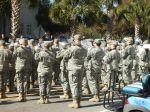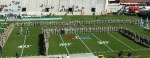
2014 Football, Game 12: The Citadel vs. VMI

The Citadel vs. VMI, to be played on Alumni Memorial Field at Foster Stadium in Lexington, Virginia, with kickoff at 1:30 pm ET on Saturday, November 15. The game will not be televised, but will be streamed on ESPN3.com, with Pete Yanity providing play-by-play and Will Merritt supplying the analysis.

Note: the contest will not be streamed on the SoCon Digital Network.

The game can be heard on radio via the various affiliates of The Citadel Sports Network. Mike Legg (the “Voice of the Bulldogs”) will call the action alongside analyst Lee Glaze. It is also possible to listen to the action with a smartphone, using a TuneIn Radio application.

WQNT-1450 AM [audio link], originating in Charleston, will be the flagship station for The Citadel Sports Network. The pregame show and game broadcast will be produced by Jay Harper, who will also provide updates on other college football action.

Links of interest:

Game notes for The Citadel and VMI

SoCon weekly release

Mike Houston’s 11/18 press conference

Mike Houston on the SoCon media teleconference

Sparky Woods on the SoCon media teleconference

WCSC-TV interviews Mike Houston about The Citadel-VMI

The Citadel’s football team has a “ticked off, mad as fire attitude”

It’s too bad Aaron Miller can’t play another season for the Bulldogs

Does Sparky Woods need to win on Saturday to keep his job?

The former Clemson radio tandem of Pete Yanity and Will Merritt will be handling play-by-play and analysis for ESPN3.com’s streaming coverage of the game. Yanity and Merritt have worked two other ESPN3.com productions involving SoCon teams this season, earlier calling Samford-Furman and Wofford-Chattanooga.

A few weeks ago, I wrote an essay about VMI’s football history and its re-entry into the Southern Conference for the premier Navy football blog, The Birddog (the Midshipmen were playing the Keydets that week). In lieu of me detailing the program’s recent history on the gridiron, as I tend to do in this space, you can read that piece here: Link

One thing I wrote about VMI for The Birddog last month that did not come to fruition:

Every coach VMI has had since 1953 has suffered through at least one winless or 1-win campaign, with the exception of current head coach Sparky Woods…Woods has yet to suffer through a winless or 1-loss season, but he has had four 2-win campaigns. This year, there is a chance VMI’s victory over Davidson in its home opener may be the only win the Keydets enjoy all season.

Of course, VMI defeated Furman three weeks ago, giving the Keydets their second victory of the 2014 campaign. Sparky Woods remains the only VMI coach of the past 60 years to never have a winless or one-win season while in charge of the Keydets.

VMI opened its season at Bucknell, losing 42-38 in a game the Keydets never led (but tied on four separate occasions). Bucknell’s winning score came on a punt return TD.

Al Cobb’s debut at quarterback for the Keydets was a good one, as the redshirt freshman threw for 308 yards and four touchdown passes. Running back Deon Watts ran for 97 yards.

Incidentally, Bucknell has gone on to have a fine season, as the Bison are 8-2 and have an outside shot at an at-large bid to the FCS playoffs.

In its second game, VMI was whipped 48-7 by Bowling Green. The Falcons became the second team in as many weeks to return a punt for a touchdown against the Keydets, and added a blocked-punt TD for good measure.

Bowling Green would go on to upset Indiana the following week and would eventually win the MAC West division title, clinching a berth in that league’s championship game.

VMI played its home opener against a much easier opponent, Davidson, and crushed the Wildcats 52-24. The Keydets finished with 597 yards of total offense.

Aaron Sanders had ten receptions for 215 yards, and Jabari Turner had three TD runs. VMI also picked up a punt-block TD of its own, courtesy of Chris Copeland.

Of some concern for the Keydets, however, was Davidson rolling up 531 yards of offense. The two teams combined for 1,128 yards of total offense; both teams had over 200 rushing yards.

The next week, VMI made the long trip to Birmingham to face Samford. The Keydets suffered through a nightmarish first half, allowing a touchdown on the second play of the game and committing four turnovers. Samford led 49-0 at the break, going on to win 63-21.

A different kind of frustration would come for VMI in its next game, a tough 27-24 home loss to Mercer. A potential game-winning drive in the last two minutes of the game was ended by a Mercer interception. Cobb was 30-44 for 324 yards, but threw two costly picks.

In its next two games, VMI was manhandled 55-7 at Chattanooga and 51-14 at Navy. Against the Mocs, the Keydets only put up 165 yards of total offense.

VMI recovered a fumble for a touchdown against the Midshipmen, but allowed Navy to run for 352 yards on 49 carries (7.2 yards per attempt). I suspect The Citadel’s coaches have watched a lot of video from that particular game.

The Keydets returned home and suffered a double-overtime loss to Gardner-Webb, 47-41. That game featured the largest attendance for a game at Foster Stadium (6,624) since VMI hosted The Citadel two years ago (when 7,863 fans, a fair number clad in blue, were on hand for The Military Classic of the South).

Cobb was 34-53 passing for 351 yards and six touchdowns, each to a different receiver, as VMI made a stirring comeback after being down 18 points in the fourth quarter. It just wasn’t quite enough for the victory.

Wofford then thumped the Keydets 38-3 in a game played in Spartanburg. VMI was outrushed by the Terriers 374-58.

Back at Foster Stadium the following Saturday, VMI would get its first SoCon victory of the season, beating Furman 31-15 in a game not really as close as the score might indicate. The Keydets had lost 21 straight games to the Paladins, but raced out to a 17-0 halftime lead and then forced three Furman turnovers in the second half.

The Keydets had a 14-minute edge in time of possession, helped by converting 12 of 19 third-down attempts. Greg Sanders intercepted a pass for VMI, the third consecutive game he had done so.

After a bye, VMI lost last week at Western Carolina, 42-27. The game featured 1,111 yards of total offense, including 640 by the Catamounts. WCU had over 300 yards rushing and passing, which isn’t something you see every day.

The next three sections include statistical team/conference comparisons for SoCon games only (unless otherwise indicated). Both VMI and The Citadel have played six league contests, obviously against the same teams.

The Keydets’ offense has thrown the ball (or been sacked attempting to pass) 57.5% of the time, the highest percentage in the conference. Passing yardage accounts for 67.7% of VMI’s total offense, also the league high by percentage.

VMI is last in total offense (4.9 yards per play), scoring offense (18.8 points per game), and rushing offense (3.5 yards per carry). The Citadel is next-to-last in total defense, with a league-worst 6.9 yards allowed per play.

The Bulldogs are also next-to-last in rushing defense, but are actually middle-of-the-pack in scoring D (allowing 21.5 points per game in league action).

VMI is fourth in passing offense, but next-to-last in offensive pass efficiency, with the latter ranking being affected by the Keydets’ league-worst ten interceptions. VMI is averaging 35.3 pass attempts per game in SoCon play, the most in the conference.

The Citadel is sixth in pass defense, but dead last in defensive pass efficiency, allowing 9.1 yards per attempt. The Bulldogs’ D is tied for the league low in interceptions, with three.

When both conference and non-conference games are counted, the Keydets are 28th nationally in passing offense (out of 121 FCS teams), while the Bulldogs are 83rd in passing yardage allowed.

VMI is fourth in offensive third down conversion rate, at 43.5%, while The Citadel is third in the league in defensive third down conversion rate (42.3%). VMI has only attempted five 4th-down plays in conference action, the fewest in the league.

The Keydets have an offensive red zone touchdown rate of 78.6%, the best mark in the conference, though VMI has been in the red zone fewer times than any other team in SoCon play. The Citadel has a defensive red zone TD rate of 50% (11-22), which is third-best in the league.

VMI is last in the league in scoring defense (allowing 40.0 points per game), total defense, and rushing defense (giving up 6.2 yards per carry). The Citadel is fifth in scoring offense (21.5 points per contest) and third in total offense. The Bulldogs lead the league in rushing offense (5.2 yards per attempt).

Including all games, VMI is next-to-last in FCS football in rushing defense (ahead of only winless Nicholls State), while The Citadel is second nationally in rushing offense (trailing only Cal Poly of the Big Sky).

The Citadel is next-to-last in passing offense and sixth in offensive pass efficiency (having only thrown one interception in league play). VMI is fifth in passing defense but next-to-last in defensive pass efficiency.

The Bulldogs are second in the conference in offensive third down conversion rate (46.9%), while VMI is sixth in defensive third down conversion rate, at 48.8%. The Citadel is tied for the most fourth-down attempts in the conference, with 18.

VMI has allowed 19 touchdowns in 23 trips by its opponents inside the 20-yard line (82.6%), the worst defensive red zone TD rate in the league. The Citadel has an offensive red zone touchdown rate of 66.7%, fourth-best in the SoCon.

The Citadel is +1 in turnover margin in conference play, while VMI is -7 (worst in the conference). VMI has actually forced more defensive turnovers than the Bulldogs (11-8), but the Keydets have 18 offensive turnovers, by far the most in SoCon action.

VMI is sixth in the league in time of possession (28:53), while The Citadel is second (32:28).

The Citadel has run 455 offensive plays in its six SoCon games (75.8 per contest), while VMI’s offense has run 388 plays from the line of scrimmage (64.7 per game). In terms of pace, The Citadel runs its plays faster (2.34 snaps per minute) than does VMI (2.23).

The Bulldogs have committed the second-fewest penalties in the league, while VMI is tied for fifth in that category. However, the Keydets’ opponents have committed more penalties than any other team’s opponents. The Citadel is next-to-last in having flags thrown on its behalf, a season-long issue with officiating that has been a constant source of frustration for its fans.

Al Cobb (6’3″, 190 lbs.) is a native of Pulaski, Tennessee who redshirted last season for the Keydets. In his first season as VMI’s quarterback, he is completing 61.3% of his passes, averaging 6.5 yards per attempt, with eighteen touchdowns and ten interceptions.

Cobb has completed eight passes this season of more than 35 yards, including two 44-yard completions in his most recent game against Western Carolina.

VMI lists three tailbacks on its two-deep; all three have started at least one game this season for the Keydets. Deon Watts (5’11”, 197 lbs.) is VMI’s leading rusher, with 450 yards (and the senior has also caught 34 passes out of the backfield). Fellow tailback Jabari Turner has seven rushing touchdowns to lead the team.

Aaron Sanders (6’2″, 185 lbs.) is Cobb’s top receiving target, with 51 catches (including a 60-yarder against Davidson). The sophomore hauled in three passes for the Keydets in last season’s game versus The Citadel.

Redshirt senior Doug Burton leads VMI in receiving touchdowns, with four. VMI uses a three-receiver, one-back offense with a tight end, though starting TE Andrew Lewis only has five receptions all season.

Average size of the projected starters on VMI’s offensive line: 6’4″, 294 lbs. Redshirt freshman center Patrick Doucette and redshirt senior right tackle Andy Marcotte have started every game this season for the Keydets.

Marcotte, at 6’8″, 325 lbs., is the biggest VMI player on the roster, and was a preseason second-team All-SoCon selection. He set a team record in the weight room with a 635-lb. squat.

VMI operates out of a 3-4 defense when not facing the triple option. When it does, in recent years the Keydets have featured a five-man front.

Nosetackle Joe Nelson (6’3″, 265 lbs.) is one of three Keydets on defense to start every game. The redshirt sophomore has five tackles for loss, including two sacks, and also blocked a PAT against Mercer.

The Keydets’ four starting linebackers rank 1-4 in the team in tackles. Miller Williams, a 6’1″, 220 lb. senior, leads the way with 66 tackles.

Redshirt freshman Ryan Francis (6’1″, 200 lbs.) has three sacks, most on the squad. He is also tied for the lead in tackles for loss, with 6.5.

Francis shares that team lead in tackles for loss with 6’1″, 241 lb. redshirt senior Logan Staib, who has been a mainstay for VMI over the past four seasons. Staib has saved some of his best football for games against The Citadel, having made 14 tackles against the Bulldogs in both 2011 and 2013.

From his position as one of the Keydets’ starting cornerbacks, redshirt sophomore Damien Jones (6’1″, 190 lbs.) has two interceptions and leads the team in passes defensed, with ten. He also recovered a fumble in the end zone for a touchdown against Navy.

The other starting cornerback, James Fruehan (5’10”, 187 lbs.) is a senior who has appeared in 44 games for VMI over the course of his career. He is sixth on the team in tackles.

Strong safety Alijah Robinson, a 6’0″, 185 lb. sophomore, is fifth on the squad in tackles. His backup, Greg Sanders, leads the Keydets in interceptions with three.

VMI placekicker Dillon Christopher, a sophomore from Newport News, Virginia, is 7 for 13 on field goal tries this season, with a long of 49 against Mercer. He kicked a 45-yarder against Western Carolina.

Christopher is 32-33 on PAT attempts. He is also the Keydets’ kickoff specialist, with 18 touchbacks in 53 kickoffs.

Punter Hayden Alford is averaging 37.0 yards per punt, with a long of 69. He has had 17 of his 53 punts downed inside the 20.

VMI has allowed three punt return TDs this season and ranks in the bottom 10 nationally in punt return defense, allowing an average of almost 14 yards per return.

The Keydets’ primary punt returner is wideout Dana Forlines, who is averaging 3.9 yards per return. Taylor Stout and Greg Sanders have returned almost all kickoffs for VMI; each has a kick return average of 19.2 yards.

Odds and ends:

– This week in the Capital One Mascot Challenge, Spike The Bulldog faces Cocky, the overexposed mascot for South Carolina. It’s a quarterfinal playoff matchup in the Challenge.

Vote for Spike!

– Tickets go on sale this Saturday for the Medal of Honor Bowl, the all-star game being held at Johnson Hagood Stadium on January 10, 2015: Link

– As pointed out in The Citadel’s game notes, The Citadel is 4-0 when it gains more than 500 yards of total offense. When it doesn’t, the Bulldogs are 0-7.

– Per one source that deals in such matters, The Citadel is a 12-point favorite on Saturday. The over/under is 63.

– VMI has two players on its team from South Carolina. Not surprisingly, most of the Keydets are from Virginia (53). Other states represented on the VMI roster: Tennessee (10), Pennsylvania (7), Georgia and North Carolina (4 each), Alabama (3), Maryland (2), and one each from Texas, California, Ohio, West Virginia, and Washington, DC.

I’ve said this before, but if you are a graduate of The Citadel, a trip to VMI should be on your personal “bucket list”. It’s interesting to compare and contrast the two military schools.

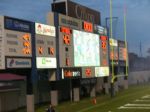
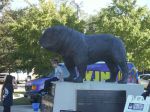
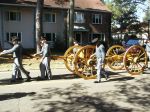
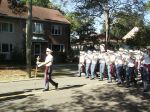
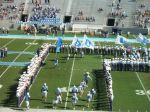
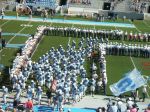
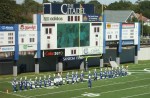
Every alum should travel to Virginia at least once to see the campus, watch a parade, and check out the gameday experience:

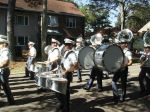
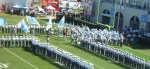
The VMI Corps of Cadets marches from barracks onto the field as The Regimental Band plays “Shenandoah”. The Corps welcomes the team onto the field, as “Little John,” a ceremonial cannon, joins the cheers with a thundering boom. The Rats come out of the stands with every Keydet score, and do a pushup for every point on the VMI side of the scoreboard. The familiar strain of “The Spirit” plays to stir the hearts of the Keydet faithful.

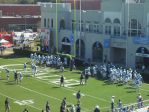
Completed in 1962 at a cost of approximately $250,000 through funds allocated by the General Assembly of Virginia and the VMI Alumni Association, the stadium contains 54 rows, is 173 feet high (not including the press box) and has a seating capacity of 10,000. Fiberglass seats were installed in 1974 and refurbished in 1985.

A new Brute Bermuda grass playing surface was initially installed during the summer of 1998, and the crown on the field was elevated to improve drainage.

I was there two years ago to watch The Citadel (barely) clinch a winning season. I won’t be able to make it this Saturday, alas.

I anticipate Saturday’s game will be fairly high-scoring (and judging from the over/under, so does the gambling community). In VMI, you have a passing team that can’t stop the run. The Citadel, meanwhile, is a running team that has struggled against the pass.

Al Cobb is averaging over 35 pass attempts in SoCon play, and I would be surprised if he doesn’t throw at least 40 passes against the Bulldogs. The best way for The Citadel to prevent that is for its offense to control the game on the ground and completely dominate time of possession.

In his press conference on Tuesday, Mike Houston mentioned that the Bulldogs have not had “great, consistent starting field position” this season. That affects the offense’s ability to regularly mount scoring drives, because there is that much further for it to go.

The game last week versus Samford was a good example of this. One of The Citadel’s drives lasted for 17 plays but produced no points; it was one of two possessions for the Bulldogs that lasted for more than five minutes but did not lead to a score.

Special teams can make a difference in that aspect of the game, but so can the defense. One thing the Bulldogs’ D has not done this season is consistently force turnovers. As I mentioned earlier, The Citadel has only forced eight turnovers in six league games.

If the Bulldogs are to retain the coveted Silver Shako on Saturday, forcing multiple turnovers is almost a must for the defense. To do that, The Citadel likely has to get more pressure on the quarterback.

VMI has come close to winning this matchup in recent years, leading at halftime last season and falling just short of a comeback victory the last time the Bulldogs made an appearance at Foster Stadium. The Keydets’ record is not particularly meaningful when The Citadel is the opponent (the reverse is also true).

Several of VMI’s games this season should give fans of the Bulldogs pause, particularly its convincing victory over Furman. The Keydets’ competitive losses to Mercer, Western Carolina, Gardner-Webb, and Bucknell are also noteworthy.

There are several positives to take from this season for The Citadel. It has been an instructive (and often entertaining) year, as a new head coach has begun to put his stamp on the program.

The biggest positive of all would be to keep the greatest trophy in all of sports in Charleston, where it belongs.

Game review, 2014: Samford

Links of interest:

Game story, The Post and Courier

Game story, The Birmingham News

Box score

I don’t really have a lot to say about this game, to be honest. Just a few observations:

– In my opinion, it was a well-played game. There were no turnovers, and an absence of really dumb plays. It was a little lower-scoring than I would have expected.

Ultimately, The Citadel needed to make one more play to win the game. It didn’t make that play, though.

– This was arguably the best performance of the season by The Citadel’s defense. It was helped by the offense maintaining possession throughout the game, even when a drive didn’t result in a score (the Bulldogs were 7-19 converting third downs and had a time of possession edge of over 15 minutes).

Samford was 4-13 on third down. Six of the SU’s eleven possessions resulted in short drives (6 or fewer plays, 21 or fewer yards).

– While The Citadel’s offense controlled possession for major portions of the game, it didn’t make that ball control count enough. The Bulldogs had four different drives of seven or more plays that ended with no points being scored (including one that lasted 17 plays).

– I have a great deal of sympathy for Vinny Miller, who is apparently the official whipping boy for SoCon officials. I seriously believe a number change is in order, so the men in stripes aren’t so quick to throw their flags in his direction.

Imagine the pregame conversation Mike Houston could have with a certain SoCon referee:

Ref: “Coach, where’s #16?”

Houston: “Uh, he’s not playing. We’ve got, uh, another guy playing slotback today, #32.”

Ref: “Oh, okay, that’s good. Just between you and me, I thought #16 was acting like a jackass.”

Houston: “Yes, I know. You told the entire Homecoming crowd that during the Furman game.”

– Speaking of Houston, I have a suggestion. The Citadel’s head coach is intense and emotional, which plays very well with the Bulldogs’ fan base (and rightly so).

However, he probably needs a “cool down” period immediately following a game. I think the postgame radio interview can wait a few minutes.

This would have the added benefit of making it easier for fans to hear the coach’s thoughts. They need time to get back to their cars/tailgates after the alma mater is played.

– It was cold. Cold Cold Cold.

Cold.

That partly explained the less-than-sellout conditions at Johnson Hagood Stadium. The attendance could have been worse, however, what with Clemson and South Carolina both in action at the same time.

Samford brought very few fans, though that was perfectly understandable. Birmingham to Charleston is not a short trip.

Now it’s time to get ready for the final game of the season. The coveted Silver Shako is at stake.

The team better be ready. VMI will be, especially in Lexington.

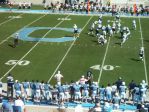
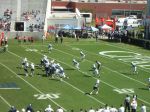
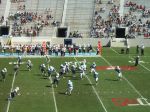
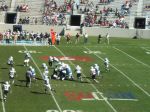
The pictures are…well, they’re in color.

I didn’t have time to annotate them this week, though they are in sequential order. If you want to look for a specific play, it shouldn’t be too hard to find (assuming I took a picture of the play in question). The statistical play-by-play would be a good guide to use.

As usual, I took some pregame shots as well.


2014 Football, Game 11: The Citadel vs. Samford

The Citadel vs. Samford, to be played at historic Johnson Hagood Stadium, with kickoff at 1:00 pm ET on Saturday, November 15. The game will not be televised.

The contest will be streamed for free on the SoCon Digital Network, the league’s new streaming platform.

The game can be heard on radio via the various affiliates of The Citadel Sports Network. Mike Legg (the new “Voice of the Bulldogs”) will call the action alongside analyst Lee Glaze. It is also possible to listen to the action with a smartphone, using a TuneIn Radio application.

WQNT-1450 AM [audio link], originating in Charleston, will be the flagship station for The Citadel Sports Network. WQNT will have a two-hour pregame show prior to each home football game that will be hosted by Ted Byrne. The pregame show and game broadcast will be produced by Jay Harper, who will also provide updates on other college football action.

—

Links of interest:

Game notes for The Citadel and Samford

SoCon weekly release

Mike Houston 11/11 press conference

Mike Houston on the SoCon media teleconference

Samford defensive coordinator Bill D’Ottavio on the SoCon media teleconference

Aaron Miller is the SoCon Offensive Player of the Week

Homecoming highlights

Jaquiski Tartt will be Samford’s first-ever Senior Bowl representative

My preview of The Citadel’s upcoming basketball season

Also, a hoops season preview article from The Post and Courier

As this is a Bulldogs vs. Bulldogs matchup, I have to define some terms:

In this post, “Bulldogs” refers to The Citadel, while “Birmingham Bulldogs”, “SU”, or “Baptist Tigers” will serve as references to Samford.

It is possible that this is Pat Sullivan’s last year coaching at Samford. Sullivan has had serious health problems in recent years, and missed the first three games of last season while recuperating from back surgery.

This year, Sullivan missed the season opener at TCU (where he was once the head coach) as he recovered from cervical fusion surgery; he coached Samford’s league opener against VMI from the press box. Most of the coach’s health issues can be traced from chemotherapy and radiation treatments he received after being diagnosed with throat cancer in 2003.

Defensive coordinator Bill D’Ottavio was the acting head coach against TCU and has handled a considerable amount of media obligations on Sullivan’s behalf throughout much of the season.

If this is Sullivan’s final season (and I have no idea if it is), he’s having another solid campaign. The Birmingham Bulldogs are 6-3 and have clinched the program’s fourth consecutive winning season. Samford won’t win a piece of the SoCon title this year as it did in 2013, but it could finish as high as second.

Last week’s victory over Western Carolina was Sullivan’s 46th win in his eight years at Samford. That made him the school’s alltime winningest football coach. The school’s field house will be named in his honor.

Samford has not played a “like” non-conference opponent. Besides TCU, the Birmingham Bulldogs have played two small Alabama schools, Stillman (which competes in Division II) and Concordia (which isn’t an NCAA or NAIA member; it plays in the USCAA).

After it plays The Citadel, Samford will finish its season by playing at Auburn, Pat Sullivan’s alma mater (and where as a quarterback he led the team to three bowl games and won the Heisman Trophy in 1971).

Samford beat the two Alabama colleges by a combined score of 107-0; it lost to a powerful TCU squad 48-14. As far as evaluating SU is concerned, then, it’s best to simply focus on its games in SoCon play.

The first conference opponent Samford faced was VMI, in the third game of the season. SU destroyed the Keydets 63-21. SU led 49-0 at halftime, delighting the partisan home crowd, and rolled up 525 yards of total offense (including 180 yards rushing for Denzel Williams).

Samford’s next game was a 38-24 loss at Chattanooga. Starting quarterback Michael Eubank threw for 244 yards and two touchdowns, but was also intercepted three times and sacked four times.

One week after averaging 7.5 yards per play, SU was held to 4.7 yards per play by the Mocs (despite 129 yards receiving for Karel Hamilton). Samford also allowed a punt return TD in the contest.

The Birmingham Bulldogs rebounded with a 21-18 home victory over Mercer. Samford led the entire game, and was up by 11 points with less than a minute to play when Mercer’s Chandler Curtis returned a punt 99 yards for a touchdown. SU recovered the ensuing onside kick to preserve the victory. Hamilton had 10 catches and 101 receiving yards, while Jaquiski Tartt had eight tackles and also intercepted a pass.

After a bye week, Samford lost at home to Wofford 24-20. The Terriers took the lead with less than five minutes in the game, then stopped SU on 4th-and-1 from the Wofford 24, gaining possession and the win.

Samford’s D held Wofford to 3.8 yards per play (and under 200 total rushing yards, though Terriers fullback Lorenzo Long did rush for 128 yards on 20 carries). Michael Eubank passed for 305 yards and a TD (he also threw a pick). Samford was 3-13 on third down conversions and only rushed for 49 yards, which contributed to Wofford’s edge in time of possession (over seven minutes).

The following week, SU destroyed Furman in Greenville 45-0. Samford led 14-0 after less than three minutes, having only run one offensive play. A blocked punt for a TD opened the scoring for the Birmingham Bulldogs, and they never looked back. Denzel Williams rushed for 101 yards and two touchdowns, while Eubank had another 300-yard passing day. Karel Hamilton had 206 yards receiving (on nine catches).

In beating Western Carolina 34-20 last week, Williams rushed for 156 yards and two more TDs, while Hamilton had another 100-yard receiving day. Justin Cooper had 14 tackles to lead a defense that intercepted two WCU passes.

The next three sections include statistical team/conference comparisons for SoCon games only (unless otherwise indicated). Samford has played six league games, facing every conference team except The Citadel.

The Bulldogs have played all but two SoCon teams, Samford and VMI.

In those six conference matchups, Samford’s offense has thrown the ball (or been sacked attempting to pass) 46.3% of the time. Passing yardage accounts for 57.8% of SU’s total offense.

Samford is second in scoring offense (34.5 ppg) and total offense, and also second in the league in yards per play (5.9). The Citadel is next-to-last in total defense and is allowing 7.2 yards per play, but is actually fifth in scoring defense (28.2 ppg).

SU leads the league in passing offense, averaging 252.7 yards per game in conference action. Samford is third in the SoCon in passing efficiency, with nine touchdowns and four interceptions. SU quarterbacks have been sacked twelve times, tied with Mercer for the most allowed in league play.

The Birmingham Bulldogs have averaged 32.2 pass attempts per game, which is more than every league team except Furman and VMI.

Samford is averaging 7.9 yards per pass attempt, which is fourth in the SoCon. The Citadel is sixth in pass defense, but dead last in defensive pass efficiency, allowing 9.5 yards per pass attempt. In five league games, the Cadets only have five sacks and three interceptions.

The Birmingham Bulldogs are fourth in rushing offense (4.4 yards per carry), averaging 185 yards per game. Samford’s 17 rushing touchdowns are second in the conference, behind Chattanooga.

The Citadel is next-to-last in rushing defense, and is allowing a league-worst 6.2 yards per rush.

Samford is fourth in offensive third down conversion rate (42.5%). The Citadel is fifth in defensive third down conversion rate (44.8%).

SU has a red zone TD rate of 60%, second-worst in the league (but well ahead of Furman’s abysmal 28.6%). The Citadel’s red zone D has been solid, with a TD rate of 47.3%, second-best in the league (behind only Western Carolina).

Samford is third in scoring defense, allowing 20.2 points per game. SU is also third in total defense (4.5 yards allowed per play) and rushing defense (3.9).

The Citadel is third in total offense (averaging 5.5 yards per play) and leads the league in rushing offense (a category in which the Bulldogs rank second nationally, trailing only Cal Poly). The Bulldogs are next-to-last in passing (averaging only 6.4 yards per attempt), but are actually fifth in passing efficiency.

Samford leads the league in passing defense, allowing 141 yards per game (which is third nationally). SU is also first in the SoCon in pass efficiency defense, and leads the conference in interceptions (9).

At 49.4%, The Citadel is second in the SoCon in offensive third down conversion rate, behind only UTC. Samford is second in defensive third down conversion rate (32.3%), so this will definitely be something to watch on Saturday.

The Citadel has an offensive TD rate of 66.7%, tied for third-best in the league. Samford’s red zone defensive TD rate is 76.5%, sixth-best in the conference.

Samford is +2 in turnover margin in league action, while The Citadel is +1.

As far as time of possession is concerned, The Citadel has held the ball for an average of 31:25, second-highest in the conference. Samford is next-to-last in that category (28:39).

That hasn’t prevented the Birmingham Bulldogs from leading the league in offensive plays. Samford’s hurry-up style has led to it averaging 2.58 plays per minute in SoCon games when on offense. Conversely, The Citadel runs 2.33 plays per minute when it is on offense.

Interestingly, the two teams have run almost the exact same number of offensive plays per game (73.8 for Samford, 73.4 for The Citadel).

The Citadel is tied for the second-fewest penalties per game in SoCon play, while Samford has the second-most. On the other side of the coin, SU opponents commit more penalties per game than all but one team in the league (VMI). As its fans know all too well, The Citadel does not get the benefit of having a lot of flags thrown on opposing teams in SoCon contests; only Wofford has seen fewer in this category.

Samford quarterback Michael Eubank (6’6″, 246 lbs.) is a native of California who was the No. 8 high school dual-threat QB in the nation in 2011, per Rivals.com. He would up attending Arizona State for three years, redshirting his freshman year and then playing in 20 games over the next two seasons, rushing for seven touchdowns and throwing for four more.

In January of 2014, Eubank transferred to Samford. This season, he is completing 64.7% of his passes, averaging 7.7 yards per attempt, with ten touchdowns and six interceptions. Eubank also has five rushing touchdowns.

Denzel Williams (5’10”, 191 lbs.) is the workhorse running back in Samford’s spread offense. The redshirt sophomore has 157 of the team’s 392 rushing attempts this season; Eubank is the only other player with more than 37.

For the season, Williams is averaging 87.8 yards per game and 5.0 yards per carry; with 15 rushing touchdowns, he also leads the SoCon in scoring. Williams had 180 yards rushing against VMI, and also had 100-yard efforts against Furman and Western Carolina.

Karel Hamilton (6’1″, 190 lbs.) is far and away the leader in receptions for Samford, with 45. The sophomore is averaging a sterling 16.4 yards per catch, with six TDs. As mentioned earlier, Hamilton had 206 yards receiving against Furman; he also had 115 yards receiving versus Western Carolina, 101 yards against Mercer, and 129 yards versus Chattanooga.

Tight end Tony Philpot (6’2″, 243 lbs.) was a second-team all-league selection in the preseason.

Average size of the starters on Samford’s offensive line: 6’4″, 299 lbs. Right tackle Gunnar Bromelow, a preseason first-season All-SoCon selection, is the biggest of the group; the redshirt junior checks in at 6’6″, 305 lbs. Right guard C.H. Scruggs was a second-team All-SoCon preseason choice.

Four of the five o-line starters are in their fourth or fifth year in the program.

In my opinion, free safety Jaquiski Tartt (6’1″, 218 lbs.) is one of the two best defensive players in the league (along with Chattanooga’s Davis Tull). He had a pick-6 against The Citadel in 2012. Tartt is second on the team in tackles, with 57.

Tartt was one of two Samford defensive backs to get a first-team preseason All-Conference nod. James Bradberry, a 6’1″, 205 lb. cornerback, was the other. Bradberry spent one year at Arkansas State before joining the Birmingham Bulldogs’ program.

Strong safety Jamerson Blount (6’1″, 190 lbs.) leads the team in passes defensed and is also third in tackles. He is one of 22 players from Florida on the SU roster.

Samford’s leading tackler is middle linebacker Justin Cooper, a 6’2″, 230 lb. redshirt junior who began his college career at Texas Tech. Cooper has 5.5 tackles for loss this season (69 overall) and is the reigning SoCon Defensive Player of the Week.

Fellow linebacker Josh Killett (6’2″, 220 lbs.) has six tackles for loss as part of his 40 overall tackles.

Along the defensive line, Samford is quite imposing. There are a lot of players in the rotation (including three noseguards on the two-deep), and plenty of individual size and skill.

Michael Pierce, a 6’0″, 309 lb. defensive tackle who spent his first two years in college at Tulane before transferring to Samford last year, was a first-team All-SoCon preseason selection. He has 33 tackles this year, including five tackles for loss.

Mike Houston called Pierce “one of the better d-linemen in the league” in his weekly press conference. Pierce’s younger brother Myles is a freshman linebacker at The Citadel who had a tackle last week against Furman.

One of three players listed on the depth chart at the “stud” position, Roosevelt Donaldson (6’2″, 258 lbs.), leads the team in tackles for loss, with seven. He also has the most sacks (four).

For Samford, both kicker Warren Handrahan and punter Greg Peranich were first-team preseason picks for the All-SoCon team.

Peranich is averaging 43.1 yards per punt, with 14 of his 41 kicks downed inside the 20 (against four touchbacks). However, two of his punts this season have been returned for TDs. Samford is in the bottom five nationally in average punt return allowed (17.77 yards).

Handrahan is 5-9 on field goal attempts this season, with a long of 47. Last season he was 19-24 on field goal attempts, with a long of 48. That included two field goals against The Citadel (including a 44-yarder).

He did not kick in Samford’s victory over Western Carolina last week. Backup placekicker Reece Everett was 2-2 on field goal tries (and is 4-5 for the season). Everett is listed as this week’s starter on the two-deep.

Samford’s kickoff specialist is Michael O’Neal. Almost 25% of O’Neal’s kickoffs have resulted in touchbacks; he has only kicked the ball out of bounds once this year.

Nationally, SU is 43rd in kickoff return average (21.0 yards/return) and 61st in kickoff return defense (19.8 yards/return).

Robert Clark, a 5’9″, 173 lb. wide receiver, is Samford’s primary kickoff and punt returner. His longest kick return this season was for 45 yards.

From 2010-2012, The Citadel’s offense only scored a combined total of 34 points in three games against Samford’s “Bear” front. In those three games, the Bulldogs faced third down on 39 occasions, converting only six of them for first downs.

Last season’s game was different. The Citadel was 8-17 on third down and scored four rushing touchdowns while rolling up a respectable 338 yards rushing. The Bulldogs overcame a 17-0 deficit to win 28-26, with Vinny Miller rushing for 95 yards.

The Citadel only passed for 55 yards in that contest, however (on 16 attempts). If the Bulldogs hope to win on Saturday, they will likely have to throw for more yardage than that, and more effectively as well.

Odds and ends:

– The Citadel’s game notes mentioned the initial encounter between Samford and The Citadel on the gridiron, the 1989 contest. It was arguably the most memorable game between the two teams. It was the first game played at Johnson Hagood Stadium following the devastation caused by Hurricane Hugo. The Citadel won the game, 35-16. Three brief comments on that matchup:

  • The Citadel only attempted two passes, completing one of them. I’ll bet you thought Jack Douglas threw that completed pass, but nope: it was Speizio Stowers with a 16-yard pass to Cornell Caldwell.
  • Douglas threw the other Bulldog pass in that game, which fell incomplete, but we’ll cut him some slack, since he rushed for 105 yards and a touchdown while directing an attack that finished with 402 yards rushing. Tom Frooman had 113 of those yards and three TDs, while Raymond Mazyck added 92 yards on the ground and a score. Also prominent in the statbook that day: Kingstree’s own Alfred Williams, with 55 yards rushing on 11 carries.
  • Care to guess what the attendance was? Remember, Charleston was still in major recovery mode from the hurricane (you could say the same about Johnson Hagood Stadium). Okay, the answer: 15,214. Think about that, especially when compared to recent attendance at The Citadel (and elsewhere, for that matter).

– Speaking of the game notes, I didn’t realize Jake Stenson became the first Bulldog since Andre Roberts in 2008 to score a rushing and receiving touchdown in the same game. Kudos to him.

– The 22 positions on offense and defense for The Citadel have been started by a total of 32 players — 18 on offense, and only 14 on defense. Eleven Bulldogs have started every game, including seven on defense.

– The Citadel Athletic Hall of Fame will enshrine six new members this week. Two baseball players, 1990 CWS hero Hank Kraft and Rodney Hancock (the scourge of Furman) will be inducted. All-American wrestler Dan Thompson will be enshrined, as will football lineman Mike Davitt, a mainstay during the Red Parker era. Charleston mayor Joe Riley and basketball player/cookbook author Pat Conroy will be recognized as “honorary” members.

– The 1:00 pm ET start time will be the fourth different start time for a game at Johnson Hagood Stadium in 2014. Other start times: Noon, 2pm, and 6pm.

– Only one player on Samford’s roster, reserve defensive lineman Cole Malphrus, is from South Carolina. The junior is from Hilton Head.

There are 28 natives of Alabama playing for SU, along with 22 each from Georgia and Florida. Tennessee is represented by seven players, while four hail from Mississippi, three from California, and two from North Carolina. There is even one Alaskan playing for the Baptist Tigers (freshman defensive back C.J. Toomer).

– This week in the Capital One Mascot Challenge, Spike The Bulldog faces Aubie The Tiger, the mascot for Auburn.

Vote for Spike!

This is a tough matchup for The Citadel. It’s an opponent with a defense that has a history of success against the triple option (last year notwithstanding) and an offense that would be expected to do well against the Bulldogs’ pass D.

The key to the game for The Citadel is to keep Samford’s offense off the field as much as possible. The SU defense has been good at stopping teams on third down this season; the Bulldogs have to reverse that trend on Saturday.

Samford has had some results that might give The Citadel some confidence, including its games against Wofford and Mercer. On the other hand, the Birmingham Bulldogs drilled Furman (which took The Citadel to overtime just last week) and handled Western Carolina with relative ease.

The Citadel can win this game, but it will probably take the Bulldogs’ best performance of the season. That includes a team effort from not only the offense and defense, but also the special teams, which were subpar against the Paladins (to say the least).

I am a little worried about the atmosphere on Saturday. After the big Homecoming win over Furman, this game might be anticlimactic to some.

It shouldn’t be that way for the team, however. There are still goals to pursue for these Bulldogs, including a third straight victory and a chance to finish the year with a winning season in conference play.

I’m looking forward to this contest. It’s a home game, after all. There aren’t that many of them in a given season.

You have to treasure them all, especially when there won’t be another one until next September.

Game review, 2014: Furman

Members of The Citadel’s 1990 College World Series team were honored at halftime of the football game on Saturday. This reminded me of a comment from the late great Chal Port after that squad defeated Cal State-Fullerton in the College World Series:

I thought that was one great game. It was not great baseball, but my God that was exciting.

If you substitute “football” for baseball, Port’s comment could easily have applied to the gridiron battle between Furman and The Citadel at Johnson Hagood Stadium. It wasn’t necessarily the most elegant of contests, but it kept the fans guessing for over three hours.

Against Cal State-Fullerton, The Citadel’s baseball team won despite committing seven errors. The football Bulldogs had to overcome a similar number of mistakes against the Paladins to prevail — and, like that 1990 baseball game, regulation wasn’t enough to decide matters.

Links of interest:

Game story, The Post and Courier

“Notes” column, The Post and Courier

Game story, The Greenville News

Game report, WCSC-TV; also, additional comments from Mike Houston

Game report, WCIV-TV

Box score

When it comes to Southern Conference officiating, “open mic night” takes on a whole new meaning…

Late in the fourth quarter, just prior to The Citadel scoring the game-tying touchdown, the game referee had a conversation with Vinny Miller. The running back had been called for three highly dubious holding penalties during the game and was clearly upset (justifiably so), particularly with the last call. What the referee did not know was that his microphone was still on.

After the talk with Miller (whose comments were inaudible), the referee chatted with the umpire and had this to say:

He came to apologize…16 [Miller] came to apologize for being a jackass…why is he staring at me over there, Warren?…The head coach…

Well, I would guess that Mike Houston was staring at you because you had just announced to over 11,000 people that (in your opinion, and your opinion only) one of his players had been acting like a farm animal.

Shortly afterwards, still unaware his microphone had not been turned off, he remarked:

I like excitement. I just don’t like to be involved in the excitement, you know what I mean?

Unfortunately for the players and coaches on both teams (and their increasingly frustrated fans), the officials were all too involved in the excitement of Saturday’s game.

I’m not going to list all the questionable and simply bad calls and non-calls. I’ll just say it wasn’t a good day for the men in stripes.

Despite the officiating, the team that won the game deserved to win it. Some Furman fans may not feel that way, and I understand their misgivings.

However, Furman has now lost eight straight games, and the last half of the fourth quarter (plus overtime) was a partial demonstration of why the Paladins are on their current losing skid. With two golden opportunities to all but ice the game, Furman fumbled the ball away on The Citadel’s 1-yard line, and missed a relatively easy field goal. Teams that do those kinds of things late in close games generally don’t win those games.

Conversely, The Citadel made the big play late in the game when it had to do so, and dominated the OT session on both sides of the ball.

Random thoughts and observations:

– The two teams combined for 509 yards of total offense in the first half.

Furman entered the game last in the SoCon in total offense, averaging just over 305 yards per game. In the first half, though, the Paladins had 212 yards of total offense. Starting QB P.J. Blazejowski accounted for 194 of those yards (including 124 through the air).

– I’ve never seen fewer Furman fans at Johnson Hagood Stadium for a game. It was a bit startling, to be honest. I guess the long string of losses during the season has taken a toll on the fan base.

Those Paladin fans probably wondered about a few of their coaches’ offensive playcalls during the game, including operating out of the shotgun on 4th down and less than a yard; the play near midfield in the third quarter where Blazejowski threw a weird third-and-short pass to no one in particular; and the abandonment of the running game during the overtime period.

– There was some discussion in the stands about the number of fullback carries the Bulldogs had on Saturday. Indeed, Tyler Renew and Isiaha Smith combined for 38 rushes.

That’s a lot. It was almost half of The Citadel’s 78 rushing attempts.

However, it’s also true that those carries by Renew and Smith were good for an average of 4.55 yards per rush. Both backs were consistently getting yardage that put the Bulldogs in manageable down-and-distance situations, a key factor in the 30-18 edge The Citadel had in first downs.

I also wondered if the coaches wanted to avoid overusing the slotbacks, given how thin the Bulldogs currently are at that position. At any rate, all the fullback action set things up nicely on the outside, as the trio of Jake Stenson/Vinny Miller/Jonathan Dorogy averaged 6.9 yards per carry.

Overall, the offensive efficiency was excellent.

– The special teams for the Bulldogs were not very special on Saturday. To review, The Citadel fumbled the opening kickoff, botched a PAT, gave the Paladins great field position with a bad punt, allowed a long kickoff return to open the second half, missed a field goal, and committed two penalties on returns.

Without all those miscues in the kicking game, the Bulldogs probably would have won the game with a little room to spare. As it was, the mistakes in the kicking game made things a lot more difficult for The Citadel.

– On Aaron Miller’s 32-yard touchdown run in the first quarter, it appeared that Miller was running diagonally through a maze. I noticed on the replay that wideout Jorian Jordan essentially blocked two Paladins on the play, which gave Miller his final lane to the end zone.

– There were several outstanding receptions by The Citadel. The first was Brandon Eakins’ sideline grab in the first quarter, which may have been lost in the shuffle. It was an important catch, though, because it came on third down and kept the Bulldogs’ initial drive alive.

Then there was Alex Glover’s acrobatic snag of a 40-yard pass on 3rd-and-3 in the second quarter. He showed a great deal of athleticism in making that play.

Jonathan Dorogy’s late-game catch was particularly impressive given the fact he was interfered with (though it wasn’t called) and caught the ball anyway. It was also Dorogy’s first career reception. Everyone should clap their hands in appreciation.

That said, I think Jake Stenson’s catch-and-run for a TD was the play of the day, and maybe the best individual play by a Bulldog I’ve seen all season. It had a little bit of everything.

He showed good hands in making the grab near ankle level, shrugged off one would-be tackler, met another defender head-on and bowled him over, and then had the presence of mind (and understanding of the situation) to leap for the goal line, showing great field awareness in the process. It was a very impressive effort.

– Aaron Miller completed only eight passes in the game, but they went to six different receivers. He has options, and he uses them.

– The Bulldogs tried to convert a two-point PAT out of their standard unbalanced formation, and failed spectacularly. It was the third time The Citadel had tried to get two points on that setup, and the first time it hadn’t worked.

Of course, the Bulldogs lost both games in which they successfully converted the two-point trick play, and won on Saturday when they didn’t make it. What does that mean? Nothing.

– I wasn’t a huge fan of going for two at the end of the first half. I felt that was a little too early to begin chasing points, especially when the two teams had combined for eight touchdowns in two quarters of action. It worked out for The Citadel, though.

– The Citadel did not commit a false start penalty in the game. In fact, none of the Bulldogs’ offensive linemen were called for a single infraction. The o-line had a fine day at the office, and the statistics reflect that.

– The kicking contest at the end of the third quarter featured not one, but two cadet kickers. Both of them made their field goal attempts, much to the glee of the Homecoming crowd.

– The regimental band/pipes performance at halftime was excellent. The band needs to be more of a presence during the game, of course. I’ve mentioned this before, and I know the powers that be are working on it.

The crowd at Johnson Hagood Stadium got what it wanted, which was a fun football game that ended with the home team celebrating. What was gratifying (and a little surprising) to me was how many people stayed throughout the contest.

Usually at Homecoming games, there is even more action than usual going on outside the stadium. While there were plenty of parties in full swing on Saturday (I can attest to that), the west stands remained mostly full and engaged.

In overtime, the atmosphere was tremendous. I remember looking around at one point and thinking, “This is great.”

I wish it were always that way. It can be. It’s going to take a little time, though — and a few more victories for the Bulldogs.

Homecoming was a lot of fun. I got a chance to reconnect with a lot of old friends. We told a few stories, most of them funny, and counted our blessings.

The new overhead video scoreboard at McAlister Field House is a pleasure to see in person. It’s fantastic. Well done, Class of 1964.

After viewing the scoreboard, I wandered over to the parade ground and watched the Joe Riley announcement. After he leaves office as Charleston’s mayor in January 2016, Riley will be teaching at The Citadel as the first professor in an endowed chair named in his honor, which is outstanding.

I watched the twilight parade, and then went to a reunion party. There, I learned that having multiple food trucks available for sampling at one’s leisure is a very fine thing indeed.

Tailgating on Saturday was quite enjoyable, too.

It was a great weekend. The win over Furman was just the icing on the cake.

Very tasty icing.

This week’s pictures range from surprisingly decent to incredibly bad. It’s a diverse mix, to be sure.

The collection starts with some non-football photos. It was Homecoming, after all…


2014 Football, Game 10: The Citadel vs. Furman

The Citadel vs. Furman, to be played at historic Johnson Hagood Stadium, with kickoff at 2:00 pm ET on Saturday, November 8. The game will not be televised.

The contest will be streamed for free on the SoCon Digital Network, the league’s new streaming platform.

The game can be heard on radio via the various affiliates of The Citadel Sports Network. Mike Legg (the new “Voice of the Bulldogs”) will call the action alongside analyst Lee Glaze. It is also possible to listen to the action with a smartphone, using a TuneIn Radio application.

WQNT-1450 AM [audio link], originating in Charleston, will be the flagship station for The Citadel Sports Network. WQNT will have a two-hour pregame show prior to each home football game that will be hosted by Ted Byrne. The pregame show and game broadcast will be produced by Jay Harper, who will also provide updates on other college football action.

—

Links of interest:

Game notes for The Citadel and Furman

SoCon weekly release

Mike Houston 11/4 press conference

Mike Houston on the SoCon media teleconference

Bruce Fowler on the SoCon media teleconference

DeVonta Delaney is the SoCon Defensive Player of the Week

The Citadel looks to finish strong

Furman is still seeking an offensive identity

As a reminder that basketball season is right around the corner, my preview of the Bulldogs’ upcoming campaign:

Getting ready for The Citadel’s 2014-15 hoops season

Revisiting last Saturday’s victory over Mercer:

– I’ll take that first-half performance by The Citadel’s offense every week, preferably for both halves. Five possessions, four touchdowns. They were good, long drives (of 71, 70, 82, and 53 yards).

All four of those scoring drives featured nothing but running plays. The other first-half possession, which resulted in the Bulldogs’ first punt, was short-circuited by a sack on The Citadel’s first would-be pass attempt of the game. That drive also featured the Bulldogs’ only penalty of the entire half (a false start).

– Then there was the second half. In the words of Mike Houston at the SoCon media teleconference:

We always seem to find a way to make it interesting.

Houston added that on the bright side, prevailing in close games helps the players’ mental toughness going forward. I’m not sure the same can be said for the fan base.

The six possessions of the second half resulted in two punts, a missed field goal, a failed fourth down conversion attempt, a lost fumble, and the final drive of the game, when three first downs (including a big 22-yard run by Aaron Miller on 3rd-and-4) clinched the victory for The Citadel.

The Bulldogs were their worst enemy during the latter half. Besides the fumble and the inability to convert on 4th-and-3 from the Mercer 35 (which was about the only time all day Mercer successfully defended on the outside), there were the by now all-too-familiar rash of penalties — six of them.

Now, one of those six penalties was a bit dubious, as I thought the unsportsmanlike conduct infraction called on Mitchell Jeter was weak. It kept Mercer’s final scoring drive alive, too.

However, the Bulldogs also had two false start penalties in the second half. One of them came prior to the opening play from scrimmage for The Citadel’s offense in the third quarter. The other forced the Bulldogs into a 3rd-and-7 that one play later became the aforementioned 4th-and-3 which The Citadel was unable to convert.

There was also an offensive holding penalty (which came right before the fumble — amazing how that works out), a facemask on defense (just a bad break), and a flag thrown on a kick return.

The Bulldogs have to stop committing those penalties.

– The Citadel’s defense did a fine job bottling up Alex Lakes, who came into the game as the SoCon’s leading rusher, at 102 yards per game. He is still the league’s top ground gainer (Aaron Miller is currently second in that category), but on Saturday, the Bulldogs’ D held him to 58 yards on 22 carries, with a long of 11 yards.

Mercer quarterback John Russ had more success running the ball, gaining 96 yards on 14 carries (and that includes lost yardage from two sacks). His 31-yard scamper in the first quarter set up the Bears’ first touchdown.

While I thought The Citadel’s defense for the most part was solid, those rushing yards by Russ are a reminder that the Bulldogs still have issues at times dealing with a QB who can pass or run.

This week, The Citadel will again face a dual-threat quarterback…

– Mercer head coach Bobby Lamb might want a do-over on the Bears’ two-point try. It wound up being a receiver pass to the quarterback, a tricky play that was expertly broken up by The Citadel’s DeVonta Delaney.

In that situation, I thought Mercer would have been better off with either Russ or Lakes trying to make a play, as is usually the case for the Bears. They are the primary ballhandlers for Mercer; a potential game-deciding play probably needs to go through one of them.

– After Aaron Miller picked up a first down on 3rd-and-4 with two minutes remaining (and Miller staying inbounds on the play), Mercer was down to one timeout and thus was not able to prevent the Bulldogs from running out the clock. I was a little surprised The Citadel ran two more “regular” plays (both Miller runs).

Maybe those runs were the Bulldogs’ version of “victory formation”, but I was worried about the chance of a fumble. In that situation, there was no need for The Citadel to risk a Mercer player becoming the college version of Herm Edwards.

Furman is 2-7 overall, 1-3 in the SoCon (with its league record matching The Citadel’s). The Paladins opened the season with a 13-3 home victory over Gardner-Webb, but it proved costly.

After passing for 221 yards, Furman quarterback Reese Hannon broke his left ankle in the third quarter. Just like that, the Paladins had lost their starting QB for the season.

The next week, Furman won its conference opener at Mercer, 25-20. The key play in the game was an interception return for a touchdown by Paladins defensive end Gary Wilkins.

Since defeating the Bears, Furman has lost seven consecutive games, its longest losing streak since 1972, a year in which FU lost its last seven games of the season.

Furman only scored seven points in each of the two games following the Mercer game, a 10-7 loss in Clinton to Presbyterian (the Blue Hose’s first victory over the Paladins since 1979) and a 17-7 defeat to South Carolina State (a team Furman had beaten in the first round of the FCS playoffs last season).

Western Carolina then defeated the Paladins in Greenville, 35-17, the first victory for the Catamounts at Furman in twenty years. WCU converted three Paladin turnovers into 21 points.

The following week saw Furman play arguably one of its better games of the season, eventually losing at home to Coastal Carolina 37-31 in double overtime. Furman had a chance to win the game in the first OT, but a wide receiver pass attempt went awry.

After a bye, the Paladins traveled to Columbia and played respectably in a 41-10 loss to the Gamecocks. Running back Hank McCloud rushed for 106 yards in the contest, including a 60-yard TD run.

The games of the last two weeks, however, could not be described as “respectable” by any fan of the Paladins.

Furman was shut out by Samford, 45-0, a result made worse by the fact it was the Paladins’ Homecoming game. After only one offensive play from scrimmage, Samford led Furman 14-0. It was that kind of day for the Paladins.

It was the worst conference loss for Furman since losing to Davidson 77-14 in 1969, and the first shutout loss to a SoCon opponent since The Citadel blanked Furman in Greenville 24-0 in 1974 (Andrew Johnson rushed for 149 yards in that contest, one of eight 100-yard efforts for Johnson that season).

Last week, the Paladins lost 31-15 at VMI, breaking a 21-game winning streak against the Keydets. VMI took a 24-0 lead in the third quarter and coasted to victory.

Furman only managed 82 yards rushing (on 20 attempts) against VMI. That may have been a more startling statistic than the final score, given that the Keydets had allowed an average of 349.5 rushing yards to their four previous league opponents.

Injuries have been a major theme of Furman’s season. Bruce Fowler didn’t want to go into full-alibi mode at the SoCon media teleconference when asked about it by The Post and Courier‘s Jeff Hartsell:

We’ve had a bunch of them, but I don’t like to harp on that. That’s part of [football]. We’ve got some young players who are getting some experience. They’ve been in several games now, some of them, and they’re getting better…

Fowler also mentioned that some of the positions on the roster had been disproportionately affected by injuries.

Exhibit A for that would be at safety. Apparently, being a safety at Furman is the equivalent of being the drummer for Spinal Tap.

Five different Paladins have started at free safety or strong safety in 2014; a sixth (Adekunle Olusanya) is listed as the starter at strong safety for this week’s game against The Citadel. Injuries suffered by Furman safeties include a sprained ankle (three different players), a concussion, a fractured arm (two different guys), a hamstring problem, and mononucleosis. That’s just the safeties, mind you.

Carl Rider, an all-conference pick last season at middle linebacker, tore his labrum. Offensive tackle Charles Emert, who had started 36 games for the Paladins, will miss this week’s contest after suffering a concussion.

There was also Hannon’s injury, of course, along with several others. Even Hank McCloud, who is second among active SoCon players in number of rushes (471), missed a game after dislocating his elbow in a car accident during the summer.

Furman has also been without the services this season of the Robinson brothers, Gary (who had 133 receiving yards versus The Citadel last year) and Terry (who scored two touchdowns against the Bulldogs as a “wildcat” QB). Both suffered injuries last season and have been unable to play this year.

Long snapper Danny LaMontagne fractured his ankle against South Carolina. He had been the regular for 31 games; his backup would normally have been Rider.

That led to this:

…the Paladins turned to the student body [after the South Carolina game] and found senior Andrew Smith.

Smith, who had not worn football pads since playing snapper at Brentwood (Tennessee) Academy in high school, did a solid job [against Samford] but decided not to return this week.

“He’s just got a lot going on as a senior,” said Fowler. “He’s working really hard in school and has some job stuff he’s doing.”

Furman is now using sophomore placekicker Hunter Townes as its long snapper, and offensive lineman Matthew Schmidt as its “short snapper”.

The Paladins have also had some off-field issues, dismissing impact defensive back Jairus Hollman and starting center Eric Thoni during the summer. Then just last week, Furman announced the dismissals of Shawn Boone (a fifth-year player, and a regular in the defensive end rotation) and reserve offensive lineman Aaron Black.

Time for some statistical team/conference comparisons. This week, these will mostly be for SoCon games only.

Furman and The Citadel have each played four league contests. Both have played Mercer and Western Carolina. The Bulldogs have also faced Chattanooga and Wofford, while the Paladins have played VMI and Samford.

If you’ve managed to get this far in my preview, you won’t be surprised to learn that Furman is last in the league in scoring offense (14.2 points per game). The Paladins are next-to-last in total offense and rushing offense.

The Paladins are actually second in passing offense, but in terms of passing efficiency, FU is next-to-last.

The Citadel’s defense is middle-of-the-pack in scoring defense (26.5 points allowed per contest) despite being next-to-last in total defense. The Bulldogs are also firmly in the middle of the standings in pass defense, but are next-to-last in defensive pass efficiency.

As for rushing defense…well, The Citadel is last in that category, trailing even VMI (thanks in part to the Keydets’ wonderful day against the Paladins last week).

One reason both teams don’t fare well in their respective pass efficiency categories: Furman has been intercepted eight times, tied for most in conference play, while The Citadel only has three interceptions (though all three have come in the last two weeks).

Furman’s offense has been in the red zone ten times in four league games. Only twice on those ten occasions have the Paladins scored touchdowns, by far the worst percentage in the SoCon. Counting all games, both league and non-conference, Furman’s red zone offensive TD rate is only 27.2%, so that inability to get into the end zone in league play is not a fluke.

The Citadel’s red zone defense has allowed seven TDs in fifteen attempts (46.7%).

The Paladins are last in the SoCon in third-down conversion rate (32.2%). That may be good news for the Bulldogs, owners of the league’s second-worst third-down defensive conversion rate (48.9%).

Of course, The Citadel’s third-down stats on D may be good news for Furman. Your mileage may vary.

Furman is next-to-last in scoring defense (32.8 points per game), though it is fifth in total defense and fourth in rushing defense. The Paladins are next-to-last in pass defense and last in defensive pass efficiency, though that may not matter much against The Citadel.

If it does matter, that would presumably be good for the Bulldogs.

The Citadel leads the league in rushing offense (and is second nationally), but is only fourth in total offense and sixth in scoring offense (17.5 points per game).

The Bulldogs are second in the league in third-down conversion rate (49.1%), while Furman is last in defensive third-down conversion rate (51.9%). That will be something to watch on Saturday.

As for red zone offense, The Citadel’s TD rate in SoCon play is only 58.3%. Its red zone TD rate in all games is considerably higher (73.5%), so sample size may be an issue when evaluating the conference numbers.

The Paladins have allowed touchdowns thirteen out of seventeen times a SoCon opponent has been in the red zone (76.4%). That number drops slightly (66.7%) when all games are taken into account.

Furman is third in the league in kickoff return average, while The Citadel is fourth in the SoCon (though only seventh when non-conference games are included).

One thing the Bulldogs did very well in Macon was prevent long returns. The Citadel’s kickoff coverage unit was outstanding against Mercer.

Among league teams, Furman is more or less average at returning punts. The Bulldogs rank last in the league in that category.

In conference games, Furman is -3 in turnover margin, while The Citadel is +2. Overall, the Paladins are -6 and the Bulldogs are -1.

The Citadel has held the ball slightly longer than its opponents in SoCon action (30:26); that number rises to 31:30 for all games. Furman is last in the league in time of possession (28:46), but has had the ball longer when all contests are included (30:20).

In conference games, The Citadel has committed nine fewer penalties than Furman, but overall the Paladins have been whistled for eight fewer infractions than the Bulldogs.

The Citadel continues to trail all league teams in the number of penalties called against their opponents. Fans of the Bulldogs are not surprised.

For the season, Furman’s offense has thrown the ball (or been sacked attempting to pass) 48.3% of the time. Passing yardage accounts for 57.1% of the Paladins’ total offense.

P.J. Blazejowski (6’0″, 182 lbs.), a freshman from St. Augustine, Florida, was probably a redshirt candidate at the beginning of the season, but once Reese Hannon was injured he became the backup quarterback for the Paladins. He has now started the last four games for Furman.

Blazejowski is completing 52.1% of his passes, averaging 5.4 yards per attempt, with four touchdowns and six interceptions. He is also Furman’s second-leading rusher, averaging 4.5 yards per carry (a number that includes sacks).

Hank McCloud is another Floridian; the redshirt senior is from Tampa. McCloud rushed for 1,092 yards last season, averaging 78 yards per game. He just about hit his average last season against The Citadel, when he ran for 77 yards.

In the 2012 game against the Bulldogs, McCloud rushed for 92 yards on only 12 carries (splitting carries with Jerodis Williams). He has been an excellent player for Furman over his career.

That 2012 contest reminded me of something I noticed from last week’s game against VMI. In both games, Furman got behind and abandoned the run game early. I thought it was a mistake to do so against The Citadel two years ago, and I have to wonder if that was true last Saturday as well.

Furman only rushed the ball 20 times against VMI (and one of those was a sack). Again, VMI entered that contest having allowed 349.5 yards per game on the ground in conference play.

The Paladins’ offensive line has been in a state of flux. Only veteran right guard Joe Turner (6’3″, 275 lbs.) has started every game. Left guard Tank Phillips (6’2″, 307 lbs.) has 24 career starts, so he also has considerable experience.

The loss of Charles Emert to a concussion was a blow for Furman, as he was versatile enough to play anywhere on the line.

Average height/weight of the projected starters on the o-line: 6’3″, 291 lbs. The heaviest of the group is 317 lb. right tackle Terrell Bush, a true freshman from Tuscaloosa, Alabama.

Last year, Duncan Fletcher was a quarterback for the Paladins. He was 3-3 passing for 61 yards against The Citadel, as he relieved an injured Reese Hannon in that contest. He would eventually start two games at QB.

This season, Fletcher (6’4″, 222 lbs.) is Furman’s starting tight end. He has a 28-yard touchdown reception against VMI (one of two TD catches for him this year), and leads the Paladins in receptions with 33.

Starting flanker Andrej Suttles (5’10”, 182 lbs.) has 30 receptions. Suttles caught 50 passes last season, including four against The Citadel (for 58 yards). He is also Furman’s primary punt returner, and had a 42-yard return against Western Carolina.

Jordan Snellings, the split end, is a taller receiver (6’2″, 190 lbs.), something that occasionally has been a problem for Bulldog defenders. He has 32 receptions this year, and is averaging 13.3 yards per catch. Snellings had 112 yards receiving against Western Carolina, and 111 versus Mercer.

Furman operates out of a base 4-3 defense. That may fluctuate a bit on Saturday, depending on how the Paladins line up against The Citadel’s triple option attack.

Despite all the injuries throughout the team, Furman has had a stable front seven for most of the season.

The defensive line is anchored by Gary Wilkins (6’3″, 240 lbs.), an outstanding defensive end who was the SoCon defensive player of the month for September. The fifth-year senior has made 38 career starts (he was formerly a linebacker).

Wilkins was a preseason all-conference selection, and leads the Paladins in tackles for loss (10.5) and sacks (6).

There is plenty of experience on the line with Wilkins. Defensive end Ira McCune and defensive tackle John Mackey have combined to make 46 career starts, including every game this season. The other starting defensive tackle is 6’1″, 290 lb. Jordan Hawkins, a sophomore who has already started 18 games for the Paladins.

Middle linebacker T.J. Warren had three tackles for loss (including a sack) against The Citadel last season. Fellow linebacker Cory Magwood leads Furman in tackles with 93; no other Paladin has more than 53.

Marcus McMorris, a redshirt senior from Newberry, had an 89-yard interception return against Samford for a TD last season. This year, he has two interceptions, the only Paladin with multiple picks.

Jamarri Milliken and Reggie Thomas have started every game at the two cornerback positions for Furman. Thomas, at 6’0″, is the taller of the two players.

Nick Miller, a 5’9″, 167 lb. sophomore from Kennesaw, Georgia, is listed as this week’s starting free safety on Furman’s two-deep. Miller is also listed as the backup at both cornerback spots and at nickelback.

As mentioned earlier, Adekunle Olusanya is slated to start at strong safety. He is a redshirt freshman from Tampa.

Jon Croft Hollingsworth is the punter and regular placekicker for the Paladins. He is eight for fifteen on field goal attempts. While erratic, he does have a strong leg, having made a 51-yarder against Western Carolina and a 50-yarder versus Mercer (one of four field goals he made in that game).

Hollingsworth, a freshman from Greenwood, is averaging 39.9 yards per punt, with fifteen of his fifty kicks landing inside the 20-yard line. He had a punt blocked against Samford that was returned for a touchdown.

Nick Miller is one of Furman’s two kick returners. The other is Logan McCarter, a reserve wide receiver who appears to be something of a big-play threat; the redshirt freshman only has three receptions this season, but they went for 27, 36, and 34 yards (with the 36-yarder a TD catch against South Carolina State).

While discussing Furman’s injury troubles above, I referenced the personnel issues the Paladins have had when it comes to longsnapping. It is possible that could be a factor this Saturday.

The Citadel may be more inclined to put pressure on the punter (or placekicker). It is also conceivable that Furman will be more likely in certain situations to go for it on fourth down rather than punt or attempt a field goal.

Odds and ends:

– Furman has 17 players on its team from South Carolina. As is fairly typical, there are more Paladins from Georgia (32) than any other state.

Three other states have double-digit representation on the Furman football roster: Florida (15), North Carolina (12), and Tennessee (10).

– Per one source that deals in such matters, The Citadel is a 9-point favorite on Saturday. The over/under is 41.

Keep in mind that The Citadel has only covered the spread twice this season, against Gardner-Webb and…Florida State.

– Members of The Citadel’s basketball team will sign autographs and distribute schedule cards and posters at Johnson Hagood Stadium the hour prior to kickoff.

Also: “the team will also be handing out the 2014 adidas Citadel Homecoming t-shirts.”

– It was announced during Tuesday’s press conference that the 1990 College World Series team will be recognized at halftime on Saturday. (My thanks to WCSC-TV sportscaster Andy Pruitt for mentioning that on Twitter.)

– The honorary captain for the game will be Bill Sansom, Class of 1964.

– This week in the Capital One Mascot Challenge, Spike The Bulldog faces Wilma T. Wildcat, the mascot for Arizona.

Vote for Spike!

– This is Homecoming weekend at The Citadel. As always, there is a lot going on.

Watch out for extra traffic and parking issues on Friday, as Joe Riley is apparently making a special announcement of some sort on the parade ground at 1:00 pm ET. The longtime Charleston mayor is a member of the Class of 1964, which is celebrating the 50th anniversary of its graduation.

There are other major reunion events taking place. Rumor has it that at least one of them, that of the Class of 1989, will be particularly over-the-top (even by the standards of The Citadel).

This is not one of Furman’s better teams, to say the least, but it is a dangerous squad nonetheless, one more than capable of disappointing the home crowd on Saturday.

Last year the Paladins held The Citadel to just 132 yards rushing, and many of the players who were on the field for Furman in that game are back. While the offense has had major problems, the Paladins’ defense has mostly held up this season.

In addition, The Citadel is facing yet another dual-threat QB operating out of a spread offense. Furman has talent at the skill positions and some experience on its offensive line. It will not be an easy matchup for the Bulldogs’ D.

That said, Saturday’s game is an opportunity for The Citadel. This is a winnable game.

If the Bulldogs play like they did in the first half last week against Mercer, The Citadel will likely win. If they repeat the inconsistent and mistake-prone play of the second half of that game, however, they will almost certainly lose.

I would highly recommend the Bulldogs repeat that first-half performance.

McAlister Musings: Getting ready for The Citadel’s 2014-15 hoops season

Note: this season, I am again participating in a cross-blog/forum exercise known as “Scanning the SoCon”. As part of this, there will be a preview for each league school. I am writing the preview for The Citadel, which you can read below (it is being posted on ‘Mocs Mania!’ as well). Previews for the other conference schools can be found here: Link

  • The Citadel’s 2013-14 record: 7-26, 2-14 in the SoCon (last)
  • Chuck Driesell’s record at The Citadel (four seasons): 31-94 overall, 16-54  in the SoCon
  • Biggest positive from the 2013-14 campaign: the Bulldogs won three of their last four games, including a rare SoCon tournament victory
  • Negatives from 2013-14: a school-record 17-game losing streak, the nation’s fourth-worst defense, an offense that ranked in the bottom 60 nationally, and an incredible ability to give up buzzer-beating shots

It’s hard to identify the low point of The Citadel’s 2013-14 basketball season, a campaign in which the Bulldogs lost 17 games in a row, did not win a league game until February 24, failed to beat any team in the RPI top 300, and finished with no road victories.

Was it the loss to Division II West Alabama, a contest the Bulldogs trailed by 23 at halftime? That’s not a bad candidate, but I think I would vote for the 82-53 loss to Georgia Southern on January 30, a game in which the Bulldogs were at one point outscored 29-0 over 12 minutes of game action.

Some might argue the season nadir was Chuck Driesell’s comment that he needed “to coach up optimism” after an 18-point home setback to Western Carolina. The next game for the Bulldogs was the above-mentioned Georgia Southern debacle, so apparently coaching players in the art of being more hopeful is not a quick fix.

Let’s be honest: when it comes to optimism for The Citadel’s basketball program, it’s in short supply, at least for the fan base. It’s not just about last year, either.

The Bulldogs have had double-digit losing streaks in each of the last three seasons. The Citadel has won fewer than 23% of its conference games over the last four years, and it’s not like the SoCon is on the same level with the ACC.

I hope the players and coaches have a positive outlook for 2014-15. For longtime supporters, though, it’s probably going to be a “show me” kind of season.

Note: the statistics in the next two sections do not include the four games The Citadel played last season against non-D1 opponents. Unless otherwise stated, statistics are per kenpom.com.

I mentioned earlier that The Citadel had one of the country’s least-defensive defenses. The Bulldogs were 348th out of 351 Division I teams in adjusted defensive efficiency, ahead of only Maryland-Eastern Shore, Cornell, and Grambling State.

Those three squads combined to win 13 games. The team immediately above the Bulldogs in the defensive ratings, Presbyterian, won six games — but lost to The Citadel.

The Bulldogs did not force many turnovers (bottom 10 nationally in that category) and struggled mightily to keep opponents off the offensive boards (bottom 50 nationally). Opponents shot two-point shots against The Citadel at a 51.1% clip, significantly higher than the D-1 average (48.5%).

The opposition did not go to the foul line that often against the Bulldogs; indeed, The Citadel was actually in the top 100 in preventing free throw attempts. Of course, that could be a double-edged sword, as it arguably suggests a lack of defensive aggression.

For The Citadel to have any chance of success this season, the Bulldogs must get much better on defense. While the team obviously needs to force more turnovers, what I would most like to see is an improvement on the defensive glass.

That has been a constant problem for the past two seasons, and if it isn’t solved, the defense will continue to be well below average. The Citadel simply has to assert itself on the boards.

The Bulldogs were largely ineffective on offense. The numbers weren’t as bad in conference play, but they still weren’t good enough.

Rebounding was a negative (as it was defensively), and The Citadel also couldn’t get to the foul line. The Bulldogs were in the bottom 50 nationally in both offensive rebounding percentage and free throw rate.

The Citadel did improve its offensive turnover rate, which had been an enormous bugaboo over the previous two seasons. While its overall numbers merely suggest a modest step up in that department, the league statistics were actually solid, as the Bulldogs had the second-best offensive turnover rate in conference play.

As far as three-point shooting went, The Citadel was respectable from beyond the arc (its 37.2% shooting from 3-land was third-best in SoCon play). There was a decided lack of efficiency in and around the paint, however, as the Bulldogs’ overall 2-point shooting rate was only 45.1%.

All the above numbers are indicative of a lack of productivity from interior players, and that was in fact a major issue (if not the major issue) for The Citadel in 2013-14. Injuries decimated the frontcourt, leaving Driesell bereft of experienced big men (player attrition from previous seasons did not help). The freshmen tried hard, but they weren’t quite ready.

This year, there are four returning post players with significant experience. If they can stay healthy, the Bulldogs should improve their rebounding and defensive work in the paint.

Four players from last year’s team did not return.

Nate Bowser, a 6’9″ forward/center, appeared in twelve games his freshman season for a total of 81 minutes. He only played in one contest after January 2. Bowser is no longer enrolled at The Citadel, and is currently a student at Oklahoma.

– After playing in 19 games during his freshman campaign, 6’3″ guard Raemond Robinson appeared in 26 games last season for the Bulldogs. He shot 35% from three-point range in 2013-14 while averaging 2.9 points per game. This summer, Robinson announced that he was transferring to Charleston Southern.

Dylen Setzekorn graduated from The Citadel in May with two years of hoops eligibility remaining. Setzekorn, a 6’7″ guard/forward, played in 42 games for the Bulldogs over two seasons. He is now playing at North Georgia, where he is in graduate school.

Matt Van Scyoc averaged 14.3 points per game for The Citadel in 2013-14, which led the team. The 6’6″ sophomore swingman transferred to Indiana State after the season.

Van Scyoc shot 43.5% from the field, 36.5% from beyond the arc, and 86% from the charity stripe. His offensive production will be sorely missed. Someone will have to replace his scoring punch — perhaps multiple someones.

The Citadel does have three seniors (and a redshirt junior) returning for this season, along with several other players who will be key contributors.

– Marshall Harris III is a 6’1″ pass-first senior point guard, with an assist rate of 29.8% and a 2-to-1 assist/turnover ratio last year. Harris had a 28.9% turnover rate, which was too high. He was also bothered by foot problems during the season.

His overall shooting percentages were decent, though in SoCon play he did not fare as well from beyond the arc. He wasn’t a volume shooter by any means, but Harris took his fair share of free throws, with the highest FT rate on the team.

– Ashton Moore was named to the ten-man preseason All-SoCon team by the league’s coaches. The 6’0″ senior averaged 14.1 points and 3.6 assists per game last season, both marks second-best on the team. He led the squad in minutes played.

Moore can be a streaky offensive player. He was excellent down the stretch for the Bulldogs last year, scoring 22+ points in five of the last seven games. That included a 35-point effort against Davidson (on just 19 shots) and outstanding performances versus Samford and UNC-Greensboro.

He only averaged 2.4 fouls per 40 minutes last season. That was actually a higher percentage of fouls than Moore had committed the previous year, when he had the sixth-fewest fouls per 40 minutes in the country.

– At 6’3″, sophomore Warren Sledge is a bigger guard than Harris and Moore, which could be helpful from a defensive perspective. Sledge was injured at the beginning of last season, but showed some promise when he started playing for the Bulldogs.

He needs to cut down on turnovers, and Sledge only averaged one steal every 77 minutes of play; he should do a little better than that. His assist rate was solid, and his shooting from beyond the arc, while limited, was good.

Quinton Marshall is a 6’5″ guard/forward who is one of the better athletes in the SoCon, as Samford found out late in the year. To become a better offensive performer, the junior needs to limit his turnovers and improve his free throw shooting (only 52% last season).

He averaged just over five rebounds per 40 minutes of play. Ideally, Marshall would be more of a force on the boards.

Last season, The Citadel entered the season without P.J. Horgan or C.J. Bray. For the Bulldogs to be successful in 2014-15, both must be healthy and ready to play from the opening tip.

– Bray is a 6’7″ product of James Island High School. When not hampered by ankle or shoulder problems, the redshirt junior is a post player with an interesting skill set.

He has a nice touch from outside, and enough strength to hold his own in the paint (Bray was a fine high school football player).

As a freshman, Bray was a dependable presence on the defensive glass. That was three years and several injuries ago. If he can return to that form, it will be a big lift for the Bulldogs.

– Now a senior, Horgan was believed to be through with basketball after suffering a lower back injury. In fact, it was announced in October of 2013 that his career was over.

However, the 6’9″ forward/center returned to the team and by January of 2014, he was playing. It was a bit rough at times (in his first game, he fouled out after 15 minutes of action).

By February, he was healthy enough to log 35 minutes in a lopsided loss to Davidson. He had 10 points and 9 rebounds in a late-season victory over Georgia Southern.

With Horgan and Bray out of action (or not ready to contribute major minutes), the frontcourt was primarily left to two freshmen, Brian White and Tom Koopman. That wasn’t really fair to either one of them, but at least they got a lot of experience.

– White actually had an fine freshman campaign for The Citadel. He impressed many observers with his efficient play and made the SoCon’s all-freshman team.

He had the best eFG rate (53.6%) on the team, blocked a shot every now and then, and had a respectable turnover rate. White (now listed at 6’8″) can improve in some facets of his game; he had just one double-digit rebounding game against a Division I team, and had only ten assists all season.

Regardless, White was clearly a bright spot for the Bulldogs last year, and is expected to be even better in 2014-15.

– Koopman is a 6’8″ native of the Netherlands who was overwhelmed at times last year (according to Blue Ribbon, he also suffered significant weight loss during the campaign). He did show flashes of what he could become, though, including solid performances against Nebraska and (later in the season) Georgia Southern.

With more help in the frontcourt, and having completed his freshman year at The Citadel, there is a reasonable chance Koopman could be The Citadel’s most improved player this season.

Four freshmen join the Bulldogs this year.

Jake Wright is a 6’4″ guard from Hopkins, Minnesota. He may be the freshman most ready to contribute for The Citadel, assuming he brings his shooting touch from high school to McAlister Field House.

Wright played at a high school that includes among its alums current NBA player Kris Humphries. Thus, there are only three degrees of separation between Wright and Kanye West.

Brandon Thompson, like Wright, is also a shooting guard. One difference between the two: Thompson is only 5’11”.

Thompson is from Gaithersburg, Maryland. He played at Covenant Life School, a small private school that is a member of the Potomac Valley Athletic Conference, and averaged 18.3 points per game his senior season.

Tim Broom is also a guard, but he is more of a lead guard than a pure shooter. The 6’2″ Jacksonville native was a high school football safety, too.

Some of the adjectives used to describe Broom in print include “rugged” and “sturdily built”. If that translates into being a quality defender, he could see action early and often.

– Nadi Beceri is a 6’7″ post player who went to Bergen Catholic High School in Maywood, New Jersey. He could get some minutes in the frontcourt rotation, with the amount possibly dependent on how much Horgan and Bray are able to play.

Chuck Driesell called Beceri “a blue-collar player” who is “not afraid to mix it up”.

The Citadel’s non-conference slate includes games against three power conference schools, as the Bulldogs will face Florida State, Virginia Tech, and Michigan State (all on the road). The Bulldogs also play at College of Charleston.

As has been the case for the past three seasons, The Citadel will compete in the All-Military Classic, which is being held this year in West Point, New York. The Bulldogs open that tournament against VMI (which will be a non-conference game) and play either Air Force or Army the next day.

At home, The Citadel plays Navy and Bethune-Cookman, along with three non-Division I schools — Toccoa Falls, Bob Jones University, and Warren Wilson College.

Last year, the Bulldogs played four non-D1 squads, so three is a minor improvement. Ideally, the military college would not play more than two, but filling out a home schedule can be difficult for a low-major.

The conference as a whole has 20 scheduled matchups with non-Division I schools, which is down from last season’s 32. It’s not an exact comparison, of course, due to the turnover in SoCon schools over the past year.

Incidentally, The Citadel eschewed exhibition games this year in favor of two so-called “secret scrimmages” against Stetson and North Florida.

The Citadel was picked to finish last in the SoCon by the league media vote and next-to-last by the coaches. NBC Sports also predicted the Bulldogs will finish next-to-last, as did The Sports Network, while SB Nation thinks The Citadel will be the worst team in the league.

Considering the team’s record last season, and the fact the Bulldogs lost their leading scorer from that squad, those are understandable placements.

In all honesty, I would have ranked the Bulldogs a little higher. Blue Ribbon had The Citadel in seventh, and I think that’s about right in terms of a preseason projection. There are other schools in the league that had many more personnel defections (hello, Samford) and weren’t exactly dominating on the hardwood in the first place.

It appears that The Citadel’s new director of athletics, Jim Senter, is interested in improving the gameday atmosphere at McAlister Field House, and is taking steps along those lines. Such action is most welcome, as it is long overdue.

I generally do not make predictions about how a season will turn out. I won’t this time, either. However, I do have expectations.

For this season to be considered a success, the team must finish with an overall winning record, and a winning record in conference play. Nothing less will be acceptable.

That may seem unrealistic for a program that has lost 94 games in the last four seasons, never winning more than ten games during any of those years. It doesn’t matter.

This is Chuck Driesell’s fifth year as the head basketball coach of The Citadel, and it’s time to see some positive results. Otherwise, the school should (and likely will) move in a different direction.

I’m ready for the season to start. I’m also ready to celebrate a bunch of victories.

2014 Football, Game 9: The Citadel vs. Mercer

The Citadel vs. Mercer, to be played to be played in Macon, Georgia, at Mercer University Stadium, with kickoff at 4:00 pm ET on Saturday, November 1. The game will not be televised. It will be streamed on ESPN3.com, with Dan Mathews providing play-by-play, D.J. Shockley supplying the analysis, and Hannah Chalker reporting from the sidelines.

Note: this game will NOT be streamed on the SoCon Digital Network.

The game can be heard on radio via the various affiliates of The Citadel Sports Network. Mike Legg (the new “Voice of the Bulldogs”) will call the action alongside analyst Lee Glaze. It is also possible to listen to the action with a smartphone, using a TuneIn Radio application.

WQNT-1450 AM [audio link], originating in Charleston, will be the flagship station for The Citadel Sports Network. WQNT will have a two-hour pregame show prior to each home football game that will be hosted by Ted Byrne. The pregame show and game broadcast will be produced by Jay Harper, who will also provide updates on other college football action.

—

Links of interest:

Game notes from The Citadel and Mercer

SoCon weekly release

Mike Houston at his 10/28 press conference

Mike Houston on the SoCon teleconference

Bobby Lamb on the SoCon teleconference

Bulldogs plagued by self-inflicted mistakes

Mercer gears up for The Citadel

Mike Houston (in that above-linked “plagued by self-inflicted mistakes” article):

Saturday’s game was frustrating, because it goes back to what I said at the beginning of the season. And that is that we can win our share of games as long as we do what good football teams do.

Late in the year, good football teams take care of the football, don’t have penalties on critical downs and play good, fundamentally sound defense. And although we did some good things Saturday, we didn’t do those things that we needed to.

This is especially true when there is less margin for error, as is normally the case for varsity teams at The Citadel. When the Bulldogs turn the ball over three times in their opponents’ territory, and commit two false-start penalties when preparing to go for it on 4th down — well, they aren’t going to win many games, particularly on the road.

Frustrating is a good word for The Citadel’s performance against Western Carolina. The Bulldogs were ready to play last Saturday against the Catamounts. The effort was there. The execution was not.

In my game preview I wrote that I wanted to see “crisp play on both sides of the ball”. It wasn’t quite present in Cullowhee, at least from the Bulldogs’ perspective, and so the result was another loss.

The offense had the aforementioned turnover and penalty issues. As for the defense, one statistic sums up the day: Western Carolina averaged 9.6 yards per play.

The Citadel has to get better if it wants to record another victory this season. That’s the bottom line.

What is now Mercer University was founded in 1833. The school was originally located in Penfield, Georgia, a small town between Atlanta and Augusta. The campus relocated to Macon in 1871.

The institution is named for Jesse Mercer, a Baptist leader who was the first chairman of the school’s Board of Trustees. The college was originally established by Baptists, but no longer has an affiliation with the denomination.

MU has about 4,400 undergraduate students and almost 4,000 graduate/professional students. They are enrolled at twelve different colleges located in Macon (the primary campus), Savannah, and Atlanta.

Mercer has over 68,000 alumni. Its most notorious graduate is probably Nancy Grace.

Obviously, Mercer is new to the SoCon, so just to quickly recap some varsity athletics particulars:

– The school fields teams in 17 of the league’s 20 sports. The exceptions are men’s track and field (both indoor and outdoor) and wrestling.

– Mercer also has varsity squads in two sports that are not sponsored by the SoCon: women’s lacrosse and sand volleyball.

In ’92, Mercer played its first college football game.

That would be 1892. In January of that year, the Bears played Georgia in Athens, losing 50-0.

Mercer may have lost the game, but it acquired a nickname/mascot. Well, allegedly:

The choice of the bear as Mercer’s mascot is said to have been prompted by a University of Georgia football player. In that first football game between the two schools, one of the Georgia players saw a Mercer player burst through the line of scrimmage and exclaimed, “Whence cometh that bear?”

If you really believe that a football player at Georgia said “Whence cometh” while a play was in progress, I have a washed-out bridge in Adams Run to sell you. It strikes me as a latter-day explanation provided by the sports information director of a bygone era, someone inspired by Epicurus or the Bible.

Two months after the Georgia game, Mercer played the Savannah Catholic Library Association, losing 20-2.

The Bears’ first victory came in November of 1892, when they defeated Georgia Tech 12-6. The contest (which was Tech’s first-ever football game) was played in a local Macon park.

Mercer played once in 1893, losing 10-6 in a rematch with Georgia Tech played in Atlanta. The coach of the Bears for that game was George Tweedy Stallings, who had recently finished his regular job for the year, that of a professional baseball player. Stallings also served as the Bears’ baseball coach during this period.

He would play only seven major league games, but still managed to carve out his place in baseball history. Stallings managed the 1914 “Miracle Braves” of Boston, a team that was in last place in the National League on Independence Day before surging to the NL pennant. The Braves then swept the heavily-favored Philadelphia A’s in four straight games to win the World Series.

For that accomplishment, Stallings was known for the rest of his life as “The Miracle Man”.

Incidentally, Stallings is not the most famous baseball coach in Mercer history. Cy Young coached at Mercer from 1903-1905.

(One more note on Stallings: some references list him as a graduate of VMI. However, there is apparently no evidence Stallings ever attended that school.)

Mercer started playing football games on a regular basis in 1906, when it joined the Southern Intercollegiate Athletic Association. The football program would move to the Dixie Conference in 1930.

That victory over Georgia Tech in 1892 would be the only one Mercer ever recorded against the Yellow Jackets, as the Bears lost 15 of the other 16 games in the series (one matchup ended in a tie). Mercer was 0-22 versus Georgia.

The Bears were more competitive against another bunch of Bulldogs, winning four of eleven games against The Citadel (with one tie). The teams played six times in a seven-year period between 1925-31, meeting in several different locations (Charleston, Macon, Augusta, and Savannah).

That 1931 game would prove to be the last between the two programs until this season. Mercer would disband its football program following the 1941 campaign, never restarting the sport after World War II — not until last year, that is.

On November 19, 2010, Mercer’s Board of Trustees voted to reinstate varsity football, though not as a scholarship sport. The school hired former Furman head coach Bobby Lamb to lead the program two months later.

Lamb signed his first class of recruits in February of 2012, with an eye on competing in the Pioneer League (which had accepted Mercer as a member). However, when the school announced in May of 2013 that it was joining the SoCon (beginning with the 2014-15 school year), it also stated that it would transition to scholarship football. Lamb thus did not sign a full class of scholarship recruits until February 2014.

Mercer also built a new football/lacrosse complex. The 10,000-seat Mercer University Stadium opened for gridiron activity in 2013 with more fans in the stands than seats, as 12,171 supporters watched the Bears defeated Reinhardt 40-37 in the school’s first football game since 1941.

The Bears would finish last season with a 10-2 record, winning their first four contests before losing at San Diego. Mercer’s other loss last season came on the road against another Pioneer League opponent, Marist.

Not coincidentally, USD and Marist were two of the three best teams in the Pioneer League in 2013 (along with Butler). Arguably the best win of the season for Mercer was its victory over Drake.

Mercer opened this season with a back-and-forth, who-has-the-ball-last kind of game, a 45-42 home triumph over Reinhardt (which is an NAIA school in Georgia). There were ten lead changes in the contest.

The following week, the Bears lost 25-20 to Furman, the Paladins’ first game after losing starting quarterback Reese Hannon to a season-ending injury. The key play in the game was a pick-six by Furman in the fourth quarter.

MU rolled in its next two games, winning at Stetson 49-0 and pummeling Ave Maria of the NAIA 42-21 (the Bears led the Gyrenes 42-7 at halftime). Mercer then won its first SoCon game, a 27-24 triumph at VMI in which a last-minute interception near the goal line preserved the victory.

Mercer has lost three of its last four games, all conference matchups. The lone victory in that stretch was a 49-21 walloping of Austin Peay.

Samford defeated the Bears 21-18. The score was 21-10 with a minute remaining when Chandler Curtis (more on him later) returned a punt 99 yards for a touchdown. A subsequent onside kick was recovered by the homestanding Birmingham Bulldogs.

Turnovers and penalties doomed Mercer against Western Carolina (sound familiar?). The Catamounts won in Macon, 35-21.

Last week, the Bears lost at Chattanooga 38-31. Mercer trailed 35-14 before mounting a comeback, but couldn’t quite reel in the Mocs.

General statistics for consideration, Mercer’s offense/The Citadel’s defense:

Mercer has passed (or been sacked on passing plays) 39% of the time. Passing yardage accounts for just over 50% of the Bears’ total offense.

MU leads the SoCon in offensive pass efficiency and total offense. It is second in scoring offense, and third in rushing offense.

One caveat: While Mercer is averaging 33.6 points per game overall, that number drops to 23.4 points per game in league play.

Mercer is averaging 5.1 yards per rush and a SoCon-high 8.9 yards per pass attempt, which combined have resulted in a league-leading 6.5 yards per play.

The Citadel ranks next-to-last in the league in scoring, rushing, and total defense, and last in passing defense  and pass efficiency defense. The Bulldogs are allowing 5.3 yards per rush and 8.4 yards per pass attempt, which adds up to 6.6 yards per play.

The 63-56 2OT game against Charlotte skews those numbers slightly, but the Bulldogs have not played well on defense in the two games following the matchup with the 49ers either. The statistics bear that out.

Despite the fact that the Bears lead the conference in first downs per game (20.4), Mercer has not been all that successful on third down. Its conversion rate of 35.4% ranks behind every other SoCon team except Furman. Saturday’s matchup may be a case of the stoppable force versus the movable object, however, as The Citadel’s defense ranks last in opponents’ third-down conversion rate (an unsightly 49.2%).

MU’s offense has a red zone touchdown rate of 69%, while the Bulldogs are second-best in the SoCon with a defensive red zone TD rate of 51%.

Mercer is +3 for the season in turnover margin, a number that is mostly to the credit of the Bears’ defense. Only two SoCon offenses have turned the ball over more often than Mercer.

The Citadel’s defense did intercept its first two passes of the campaign last week, but the Bulldogs still rank last in the conference in turnovers forced.

General statistics for consideration, Mercer’s defense/The Citadel’s offense:

Mercer is fifth in the league in scoring defense, sixth in total defense and pass defense, fourth in rushing defense, and third in defensive pass efficiency. The differential between passing defense and defensive pass efficiency can be partly explained by the Bears’ league-leading nine interceptions.

MU is allowing 4.4 yards per rush and 7.1 yards per pass attempt, resulting in a 5.7 yards/play average.

The Citadel leads the league in rushing offense and is fourth in total offense. The Bulldogs are just sixth in scoring offense, however, and are next-to-last in passing offense (and last in offensive pass efficiency).

From a per-play perspective, The Citadel is last in the league in passing yards per attempt (5.8) and second in yards per rush (5.3). Overall, the Bulldogs are tied for fifth in yards per play (5.4).

The Citadel leads the SoCon in third-down conversion rate, at 49.2%. Mercer’s D is middle-of-the-pack in that category (39.9%).

The Bulldogs are scoring touchdowns 71% of the time when they enter the red zone. Conversely, MU’s defense is allowing TDs at a 60% clip once an opponent advances inside the 20-yard line.

Mercer is tied for the league lead in forced turnovers, with 18 (including the aforementioned nine interceptions). The Citadel’s offense is tied with Wofford for fewest turnovers committed (nine).

The odds that Mercer’s D records a sack in this game are probably not good. The Citadel’s offense has only given up a sack twice this season, while the Bears are tied for last in defensive sacks.

General statistics for consideration, special teams and miscellaneous-but-interesting:

Mercer leads the conference in punt return average, with a ludicrous 20.7 yards per return (which also ranks third nationally). The Bears have three punt return touchdowns (and also a kickoff return TD).

The Citadel is last in kick return average.

The Bulldogs have made seven of their eight field goal attempts, while Mercer is only five for ten on FG tries.

Mercer is apparently adept at drawing penalties, as opponents have committed 75 infractions while playing the Bears this season, a number that leads the SoCon. The Citadel is the exact opposite, as it ranks last in the league in opponents’ penalty yardage (and next-to-last in total opponent penalties).

The Citadel leads the conference in time of possession. The Bears are next-to-last in that category.

Mercer has a young roster, which is what happens when you’re only playing your second year of football since 1941. Mike Houston made a good point in his weekly press conference, however.

He noted this is Mercer’s third year (in terms of signing classes) and that more than 50% of the roster is the same age as Bulldog regulars like Mitchell Jeter and Nick Willis.

One example: free safety Lendell Arnold (who Houston recruited while coaching at Lenoir-Rhyne) originally attended Air Force’s preparatory school. He is a now a sophomore who will turn 22 in two weeks.

Bobby Lamb mentioned during the SoCon teleconference that Mercer currently has about 38 total scholarships in its program (presumably made up of full and partial offers, though he didn’t specify that).

John Russ (6’0″, 199 lbs.) leads the Southern Conference in passing touchdowns, with sixteen (he has been intercepted eight times). A native of Buford, Georgia, Russ leads the SoCon in pass efficiency as well.

He is completing 58% of his throws, averaging 9.3 yards per attempt. In his second year as a starter, Russ has developed a reputation as a fine downfield passer. Mercer is averaging 15.5 yards per pass completion, fifth-highest in all of FCS.

Running back Alex Lakes leads the conference in rushing at 102.6 yards per game, and is also tied for the SoCon lead in rushing touchdowns with twelve. He is averaging an impressive 6.2 yards per carry, and was named the SoCon Player of the Month for September.

Lakes is from Newnan, Georgia. He spent one semester at AFA’s prep school, then wound up at West Georgia the following spring, playing defense.

When Mercer announced it was going to play scholarship football, Lakes moved to the Macon school (where he had made a previous visit) to play running back, redshirting during his first year on campus.

Mercer has another big-play running back in 5’10”, 186 lb. freshman Tee Mitchell, who played high school football at The Bolles School in Jacksonville. Mitchell had an 80-yard touchdown reception against Austin Peay and a 74-yard TD catch versus Chattanooga. He also had a 41-yard run against VMI.

Chandler Curtis (5’10”, 186 lbs.) isn’t listed as a starting wideout on the Bears’ depth chart, but don’t let that fool you. He is an impact player of a very high order.

The freshman has twenty receptions, two rushes, nine punt returns, and twelve kick returns. Ten of those forty-three “touches” have resulted in touchdowns.

He leads all of FCS in return TDs with four, including a 99-yard punt return against Samford. When is the last time you saw a guy return a punt 99 yards?

Quite a few of Curtis’ big plays have come against Mercer’s non-conference opponents, but he is not just bullying outclassed teams. Curtis has four 40+ yard receptions in league play.

Mercer got some bad news earlier this week, when it was revealed that leading receiver J.T. Palmer would miss the rest of the season with a hand injury. The junior had 39 catches (five for TDs).

Tight end Robert Brown has had his share of injury problems as well, but had 49- and 35-yard receptions last week against Chattanooga. The product of Nashville is not the largest TE in the world (6’1″, 218 lbs.), but he has a habit of making big plays (averaging 18.6 yards per catch).

Brown’s primary backup, Derek Owings, is a bigger tight end (6’3″, 248 lbs.) who has started three games this season. He spent two years at Eastern Michigan before heading south to Macon.

Mercer’s offensive line has been largely unchanged through most of the season. Average height and weight of the starters: 6’2″, 288 lbs.

Right tackle A.M. Posey is the biggest of the group, at 6’6″, 321 lbs. He began his collegiate career at Tennessee. Kirby Southard has started at center for every game over the past two seasons.

Mercer usually lines up in a 3-4 on defense. As always, things may be different when a team faces a triple option offense.

Defensive end Tunde Ayinla is second on the squad in tackles for loss, with 4.5. He also shares the team lead in sacks with two.

Nosetackle Bret Niederreither is one of two players on the Bears’ roster who played high school football north of the Mason-Dixon line (Derek Owings is the other). The 6’3″, 290 lb. Pennsylvania native transferred to Mercer from Temple.

“Bandit” linebacker Kyle Williams leads the team in tackles for loss, with six. Like several Mercer players, he spent a year at the Air Force Academy Preparatory School.

Devin Davidson is third on the team in tackles. He’s a 6’1″, 218 lb. sophomore linebacker from Suwanee, Georgia.

Middle linebacker Tyler Ward (6’1″, 231 lbs.) is a hometown kid, having played at Tattnall Square Academy in Macon. He has been the Bears’ MLB since day 1 and currently leads the team in tackles by an enormous margin (he has 82; the second-highest total is 48).

That 48-tackle total belongs to Alex Avant (5’8″, 170 lbs.), a cornerback who (like Ward) has started every game for Mercer over the last two seasons. He played one season at Tuskegee before moving to Mercer. Avant has 14 pass breakups and three interceptions this season.

Strong safety Mike Gray is from Jacksonville. He is another player who has started every game for Bobby Lamb at Mercer.

Three different placekickers have attempted field goals for Mercer this season; each has a 50% success rate.

Jagger Lieb is listed as the starter this Saturday. He has a season long of 42 yards, and is 3 for 6 overall in field goal tries.

Tyler Zielenske is the starting punter, though Rob East (who also holds on placekicks) has the most punts for the Bears in 2013. He’s listed as the backup punter this week.

Will Roper, who handles the kickoffs, is the only senior on the Mercer roster. For the past three seasons, Roper served as the kickoff specialist at South Carolina State.

I mentioned Chandler Curtis’ return heroics earlier in the post. The regular lead kick returner for the Bears is Payton Usher, a 5’7″, 173 lb. backup running back. In limited time, Usher is averaging 8.0 yards per carry.

Odds and ends:

– The second annual Medal of Honor bowl, an all-star game played at Johnson Hagood Stadium, will be nationally televised this year by NBC Sports Network (NBCSN). That should give the game a welcome boost; for one thing, it will likely attract more quality players as a result.

– Mercer has 63 players on its roster from Georgia, 14 from Florida, 6 from Tennessee, 3 from Alabama, 2 from North Carolina, and one each from Michigan and Pennsylvania — but none from South Carolina.

– For the second week in a row, The Citadel will be a school’s Homecoming opponent.

Bobby Lamb expects an electric atmosphere.

“There’s nothing like coming home,” Lamb said about this week’s game. “From what I’m hearing, the homecoming numbers are off the charts and people being back on campus. There’s lot of excitement, and I think we’re going to have great weather.

“This late in the season, we need this, and we need the support to try to finish this season on a positive note.”

– Per one source that deals in such matters, The Citadel is a 4-point favorite on Saturday. The over/under is 56.

– This week in the Capital One Mascot Challenge, Spike The Bulldog faces Benny Beaver, the mascot for Oregon State University.

Vote for Spike!

For the fourth week in a row, the Bulldogs face a team with a dual-threat quarterback who has a lot of options at the skill positions. The defense has not fared well against the previous three squads.

Anyone less than certain about Mercer’s offensive chops should check out the statistics from the Bears’ game last week against Chattanooga. Mercer rolled up 440 yards in total offense against the Mocs, averaging a very healthy 6.7 yards per play.

On offense, I think there will be opportunities for The Citadel. Mercer struggled against Reinhardt’s wing-T offense, allowing 270 rush yards and 469 total yards. That strikes me as promising from the Bulldogs’ perspective.

Ultimately, I’m not confident in The Citadel’s chances on Saturday. The offense has to prove that besides moving the ball, it can hold on to the pigskin. It also has to avoid the killer penalties that have derailed so many potential scoring drives this season.

The defense has to get pressure on the quarterback, and get off the field on third down. Winning the turnover battle would also come in handy.

If The Citadel plays at the level it did against Western Carolina, taking into account all factors (consistency/penalties/turnovers/big plays), the Bulldogs will probably lose. If the team plays like it did against Chattanooga, the Bulldogs will lose badly.

Here is hoping that the team can get better. If it does, the Bulldogs will win this Saturday.

Improve or worsen. There are no other options.

2014 Football, Game 8: The Citadel vs. Western Carolina

The Citadel vs. Western Carolina, to be played to be played in Cullowhee, North Carolina, on the grounds of Bob Waters Field at E.J. Whitmire Stadium, with kickoff at 2:00 pm ET on Saturday, October 25. The game will not be televised. 

The contest will be streamed for free on the SoCon Digital Network, the league’s new streaming platform.

The game can be heard on radio via the various affiliates of The Citadel Sports Network. Mike Legg (the new “Voice of the Bulldogs”) will call the action alongside analyst Lee Glaze. It is also possible to listen to the action with a smartphone, using a TuneIn Radio application.

WQNT-1450 AM [audio link], originating in Charleston, will be the flagship station for The Citadel Sports Network. The pregame show and game broadcast will be produced by Jay Harper, who will also provide updates on other college football action.

—

Links of interest:

Game notes from The Citadel and Western Carolina

SoCon weekly release

Mike Houston at his 10/21 press conference

Mike Houston on the SoCon teleconference

Mark Speir on the SoCon teleconference

Great starts key great start for WCU football

Carson Smith was reinstated by the SoCon on Wednesday, following an appeal by The Citadel to the league’s executive committee. This will allow Smith to participate in Saturday’s game against Western Carolina.

I’m glad the executive committee made the right decision. Obviously, it would have been nice if the call on the field had not been botched in the first place, but you can’t have everything. Smith will presumably be more than ready to go against the Catamounts after missing almost the entire Chattanooga contest following the errant ejection.

The league’s press release was rather perfunctory, consisting of only eight sentences. It wouldn’t have been a bad idea for the SoCon to include an explanation from the committee as to why it overturned the suspension, but to be honest I wasn’t expecting an angry screed from the conference about the injustice of the situation.

That’s my job.

You may recall that last year, Western Carolina played what I called “Division I’s most absurd schedule”, as it faced three FBS squads (Middle Tennessee State, Virginia Tech, and Auburn) and two transitional FBS schools (Appalachian State and Georgia Southern), all on the road. This, after having not beaten a Division I team of any kind (FBS or FCS) since September of 2010.

That was last year. WCU eventually did pick up that elusive D1 victory later in 2013 (beating Elon in OT at Homecoming), but finished with a 2-10 record.

In 2014, things have changed. Western Carolina is still loading up on FBS opponents, with two this season (South Florida in the opener, Alabama in the finale), but the Catamounts currently sport a 5-2 record that includes three SoCon victories, including two straight.

That 3-0 SoCon record is a very big deal for WCU, given that the Catamounts entered this season having only won four league games since 2006. Western Carolina had lost 29 of its last 30 conference matchups prior to 2014.

WCU hasn’t been 3-0 in the league since 1994. If the Catamounts win on Saturday, they will match their best-ever league start.

It has taken time, but Mark Speir appears to have things moving in the right direction in Cullowhee. A competitive WCU program is good for the league, in my opinion.

The Citadel has won eight of its last ten meetings with the Catamounts, but clearly is going to have to get better going forward to continue having the upper hand in this series. That’s okay, though; the military college has to get better on the gridiron anyway.

While there is no question that Western Carolina has improved, I’m a little uncertain as to the level of improvement. WCU has defeated two non-D1 schools (Brevard and Catawba), a team with QB injury problems (Furman), and a conference debutant (Mercer).

However, the Catamounts can also claim a 26-14 home victory over Wofford. In that game, WCU ran back the opening kickoff for a touchdown, blocked a 24-yard field goal attempt, forced a fumble when the Terriers had 2nd-and-goal on the 1, and picked up a safety on another Wofford miscue.

Western Carolina actually had fewer total yards than the Terriers. On the other hand, Wofford had averaged 430 rushing yards in its previous eight games against the Catamounts, but was held to 270 yards on the ground this time. Wofford also had no aerial attack in that contest, completing just one pass for three yards.

That is an impressive defensive performance.

WCU’s season opener was a loss to South Florida in which the Catamounts led at halftime and only lost by five points (36-31). Western Carolina quarterback Troy Mitchell was 46-66 (not a typo) passing for 374 yards against the Bulls.

Mark Speir had a notable quote after that game, which after all was a very solid effort against an FBS program:

There will be no more moral victories in Cullowhee. You either win or you lose. We lost.

The Catamounts’ other defeat came at Presbyterian by a 19-14 score. PC won that game thanks mostly to a pair of pick-sixes, including one in the last two minutes of the game. Western Carolina outgained the Blue Hose 359-222, but couldn’t overcome five turnovers (including four interceptions).

The dynamics of the reshuffled SoCon and the loss to Presbyterian combine to make it difficult to assess just how good Western Carolina is this year. In all fairness, though, PC is 3-1 against FCS opposition so far this season. The Blue Hose spoiled Charleston Southern’s homecoming last week, suggesting Harold Nichols has turned the corner in Clinton.

Some general statistics for consideration:

Western Carolina has passed (or been sacked attempting to throw the ball) on 42.9% of its plays. It should be noted, though, that 53.5% of WCU’s total offense has come via the air; the Catamounts are second in the SoCon in offensive pass efficiency.

WCU is third in the SoCon in scoring offense and (perhaps more surprisingly) second in the league in scoring defense. Western Carolina is third in both total offense and defense in the conference.

The Catamounts are averaging 4.5 yards per rush and 7.4 yards per pass attempt; those numbers combine for  a 5.7 yards/play average. As a comparison, The Citadel’s offense has a 5.4 yards/play average, while the Bulldogs’ D is allowing 6.1 yards per snap.

WCU’s defense leads the league in defensive pass efficiency, but is only sixth-best in rush D. The Catamounts are allowing 4.5 yards per rush, a higher average than any SoCon squad except VMI and (sigh) The Citadel.

Western Carolina leads the SoCon in kickoff return average and is second in interceptions (conversely, The Citadel’s defense has yet to pick off a pass in 2014). WCU’s kickoff coverage unit isn’t nearly as good as its return team, as it’s next-to-last in the league.

WCU is the second-most penalized team in the league. However, The Citadel is last in the league in opponents’ penalty yardage.

The Bulldogs simply don’t force the opposition to make mistakes that result in penalties. Either that, or officials are simply less inclined to flag teams playing The Citadel; you be the judge.*

The Citadel and Western Carolina are 1-2 in the conference in third-down conversion rate (47.5% for the Bulldogs, 44.9% for the Catamounts). While Western Carolina’s D is middle-of-the-pack in third-down conversion rate against (39.6%), The Citadel is dead last in that category (a very poor 49.5%).

The Catamounts have dominated fourth down in 2014, converting 8 of 11 tries on offense and only allowing 4 of 12 conversions on defense. Both marks lead the conference.

Western Carolina’s offensive red zone touchdown rate is 73.9%, tied for the second-highest mark in the league (The Citadel’s offensive RZ TD rate: 72.4%). Defensively, WCU has a red zone TD rate of 52.4%; The Citadel’s 50% defensive TD rate in the red zone is the SoCon’s best.

*I threw that last line in for the commish.

Troy Mitchell is the starting quarterback for the Catamounts, and the key to WCU’s offense. He has been playing hurt in recent weeks, but Mark Speir downplayed that in the SoCon media teleconference:

“He’s a lot better. He threw the ball well last week, had the zip back on his passes. He gets a little bit sore, but is having no pain. I would say he was about 90-to-95-percent last week. With our athletic trainers, he’s done a great job in rehabbing. He’s back to 100-percent, Troy’s at full speed.”

Mitchell (6’0″, 205 lbs.) is a dual-threat quarterback, especially against The Citadel. The native of Houston has two career 100-yard rushing games; both have come versus the Bulldogs. In last season’s game, Mitchell was also 16-22 passing against The Citadel for 136 yards and a TD (with one interception).

This season, he is completing 65.4% of his passes, averaging 7.3 yards per attempt. Mitchell has thrown eleven touchdown passes while only being intercepted three times.

His rushing numbers in 2014 are relatively modest, averaging 4.0 yards per attempt, and 43 rush yards per game. That’s still the third-highest rush yardage total for the Catamounts.

Backup QB Garrett Brown has appeared in all seven games thus far for Western Carolina, and will likely see action on Saturday as well. Brown has changed roles a couple of times during his career in Cullowhee, having played running back and receiver as well as quarterback. As a freshman in 2011, he caught a 61-yard TD pass against The Citadel (and like this week’s contest, that was WCU’s homecoming game).

Darius Ramsey is the primary running back for WCU. Like Mitchell, Ramsey is a junior, one of many third-year players who have “grown up” in Mark Speir’s program. Also like Mitchell, Ramsey has two 100-yard rushing games on his rĂ©sumé against The Citadel, having run for 118 yards in 2012 versus the Bulldogs and 102 yards in last season’s matchup (scoring two touchdowns).

Western Carolina has experience and productivity at the wide receiver position. Spearman Robinson (6’4″, 215 lbs.) has eight touchdown receptions this season. He had 120 yards receiving and two touchdowns against Furman, and added three more scores (and 102 receiving yards) last week versus Mercer. He’s a major threat.

Spearman Robinson (who is from Greenwood, SC) is one of two wideouts named Robinson who start for WCU, with sophomore Terryon Robinson being the other. Terryon Robinson and Spearman Robinson (not related) both have 28 receptions for the Catamounts so far this season.

Despite not having the surname Robinson, Karnorris Benson is still allowed to start at wide receiver for Western Carolina. That’s probably because Benson caught 12 touchdown passes last season, tying a school record. He’s missed some time this season, but was back for the Mercer game, catching his first TD pass of the campaign.

Western Carolina’s starting offensive line averages 6’2″, 281 lbs. It is made up primarily of third- and fourth-year players, though left guard Ethan James is a sophomore.

Right tackle Josh Wineberg is the tallest of the group, at 6’6″. He was a preseason second-team All-SoCon selection. Starting center Jake Thornton is the grandson of former Buffalo Bills guard Billy Shaw, a Pro Football Hall of Famer.

Tangent: Billy Shaw is the only player in the Hall to have never played in the NFL, having spent his entire career (1960-1969) in the AFL.

Western Carolina’s defense normally operates out of the 4-3, though as always that is subject to change given The Citadel’s triple option attack.

Defensive end Caleb Hawkins (6’3″ 255 lbs.) leads the team in tackles for loss, with 6 1/2. Rapidly improving defensive tackle Helva Matungulu (6’5″, 280 lbs.) is a native of Kenya who played Rugby 7s before trying American football at Western Carolina.

Noseguard Ezavian Dunn is a 6’2″ 315 lb. true freshman who has started three games this season for the Catamounts, including the last two. He blocked a field goal attempt against Wofford.

Linebacker Christon Gill has 63 tackles, most on the squad. He also leads WCU in sacks with three (two of which came versus Mercer last week).

Daniel Riddle is the Catamounts’ second-leading tackler. The linebacker is a question mark for the game on Saturday after suffering a shoulder injury against Mercer (though he is listed on WCU’s depth chart as a potential starter).

Sertonuse Harris was a safety in 2013; this year, he’s an impact linebacker. So far this season, Harris has six tackles for loss, two sacks, an interception, three pass breakups, and two fumble recoveries.

The Catamounts have a fine secondary, led by sophomore cornerback Trey Morgan (who has four interceptions to lead the conference). Morgan is from North Augusta, and is one of seven South Carolinians on Western Carolina’s roster.

Strong safety Ace Clark has good size (6’3″, 220 lbs.) and athleticism (he blocked a field goal attempt against The Citadel last year). Clark was a second-team all-SoCon pick by the league’s coaches following last season.

Sophomore safety Bryson Jordan is the son of former Falcon/Brave Brian Jordan.

Placekicker Richard Sigmon has only attempted three field goals this season, making all three (with a long of 33). He is also perfect on PATs. Last season, Sigmon was 10-13 on field goal attempts, and did not miss from inside 39 yards (8-8).

Sigmon has shared kickoff duties this season with Mark Powell.

Destry Barnwell is a true freshman from Charlotte who has done all the punting for Western Carolina this season. Barnwell is averaging 40.0 yards per punt, with eight of his thirty-three punts landing inside the 20-yard line (he also has four touchbacks).

Backup running back Detrez Newsome is the primary kick returner, and he’s a good one. He is averaging over 30 yards per return and took one back 100 yards for a TD to open the game against Wofford.

Terryon Robinson or Garrett Brown will serve as WCU’s punt returner on Saturday, as regular return man C.J. Goodman is out.

Odds and ends:

– Next season, Western Carolina will again play multiple FBS opponents. WCU will square off against Texas A&M and Tennessee in 2015.

– The game against The Citadel on Saturday will be Western Carolina’s Homecoming. The Catamounts and Bulldogs have met six times during Homecoming in Cullowhee; The Citadel is 5-1 in those games, with WCU’s sole victory coming in 2009.

Western Carolina was 0-5 entering that 2009 game, but defeated the Bulldogs 14-10 in one of the more inept offensive performances of the Kevin Higgins era.

– The Citadel also lost to WCU the following season, in 2010, which was the last time the Catamounts had beaten a Division I program until last year’s game against Elon.

– Bob Waters Field is an artificial surface. The most recent change in the field came in 2008, with the installation of Desso Challenge Pro 2 turf, a “nylon-like, woven base interlaced with synthetic ‘blades of grass’ that are approximately two inches in length.”

– Western Carolina’s nickname (“Catamounts”) was chosen in 1933. The second choice was “Mountain Boomers”. How great a nickname would “Mountain Boomers” have been? Oh, WCU, you missed a chance there.

Before adopting the “Catamounts” moniker, Western Carolina’s teams were known as the “Teachers” and also (according to some reports) the “Yodelers”.

– Per one source that deals in such matters, WCU is a 7-point favorite over The Citadel on Saturday. The over/under is 56.

– Spike The Bulldog is 6-2 so far in the Capital One Mascot Challenge. This week, his opponent is Boise State’s Buster Bronco.

Vote for Spike!

This is going to be a tough game for the Bulldogs. Western Carolina’s program has been imbued with a confidence that hasn’t really existed in Cullowhee in about a decade.

The players expect to win, and so does the fan base. My understanding is that Whitmire Stadium will be filled close to capacity on Saturday, so the atmosphere should be excellent.

I expect a fair number of blue-clad fans will be in attendance on what promises to be a beautiful day in the mountains. I can’t be among them this week, alas.

That’s okay, though. What is much more important is that the team comes ready to play.

When I watch the game on the SoCon Digital Network (hopefully figuring out a way to “simulcast” it with Mike Legg and Lee Glaze on the radio call), I expect to see spirit and commitment, things that appeared to be absent during the Chattanooga game. That is imperative.

I also want to see crisp play on both sides of the ball. For each and every game, I expect to see improvement in the team’s play. That obviously didn’t happen last week.

If things don’t get better, the Bulldogs won’t have much of a chance. However, I suspect The Citadel will rebound this week. If it does, I think there is an opportunity to pull off a road victory on Saturday.

Go Dogs!

Game review, 2014: Chattanooga

Links of interest:

Game story, The Post and Courier

“Notes” section, The Post and Courier

Box score

This isn’t going to be lengthy, because it doesn’t have to be…

I do not understand why a team is not ready to play a football game. There aren’t that many of them in a season. Shouldn’t players have the required intensity for each and every game?

The lack of fire in the Bulldogs on Saturday was striking, and deeply disappointing. I’ve seen The Citadel lose many games over the years, but rarely have I been as disgusted in the team’s play.

This egg-laying type of performance happened occasionally in Kevin Higgins’ tenure, too, and it was just as infuriating when it happened then. I was hoping that with a new coaching staff, there would never be a question as to the Bulldogs’ effort, or desire.

When the game story in the local newspaper uses the words “sleep-walking” and “drowsy” to describe the home team (and the URL for the webpage includes “sluggish”), you know the team didn’t go about its business in an enthusiastic manner. Spirit and passion are mandatory for players when The Citadel plays a football game. Those qualities did not appear to be present on Saturday.

The lack of sharpness was most evident in the number of missed tackles by The Citadel’s defense. I’m not sure I’ve ever seen so many missed tackles by the Bulldogs’ D in a game.

Chattanooga ran 67 offensive plays from scrimmage. Based on that, I would guesstimate the Bulldogs missed about 100 tackles, as they seemed to miss 1 or 2 tackles on every play.

The Mocs averaged 7.13 yards per play. There is no telling how many extra yards UTC running backs and receivers picked up after the initial hit.

The entire contest, from The Citadel’s perspective, was bad. Offense, defense, special teams — everything. The missed tackles, though, stood out.

The best on-field performance by a member of the corps on Saturday didn’t come from one of the football players, but by a cadet who was invited to compete in a contest after the third quarter. Cadet Patton (I think that was his name) successfully threw a 25-yard pass through the goalposts, winning $100. Congratulations to him. (Nice toss, too. Good, tight spiral.)

It’s been a tough year for Mike Houston and The Citadel when it comes to officiating, and Saturday’s game brought more of the same.

(Just to make myself clear: officiating had nothing to do with the outcome of the game in any way.)

Carson Smith was ejected from the contest against Chattanooga with a little over nine minutes remaining in the first quarter. He was dismissed for throwing a punch. It was not a good call.

I’ve watched the video numerous times. I have no idea why the umpire (who threw the flag) thought Smith was throwing a punch. It was rather obviously a “football play”, to use a trite (but true) phrase. I would hate to think how many players would be ejected from games for making similar plays during a typical contest.

I’m not even sure Smith could have been called for unnecessary roughness (or a late hit), because I don’t think the whistle had blown and ended the play while he was attempting to punch the ball out of the running back’s hands. Maybe you could argue that.

I doubt anyone is going to claim that an ejection was the correct course of action on that play, because it wasn’t.

Smith, a junior, was hit with an unsportsmanlike conduct penalty on the Mocs’ second possession of the game. That resulted in an ejection, which means Smith will have to sit out all of next week’s game at Western Carolina.

Smith appeared to be trying to punch the ball away from Mocs running back Richardre Bagley when he was penalized.

“The deal with Carson really bothers me,” Houston said. “He was trying to strip the ball out, trying to punch it out and everybody in the stadium could see that. That’s deemed a punch at a player and an ejection? I don’t know … I don’t know.”

SoCon commissioner John Iamarino, on hand for the game, said there’s no review of the call unless the officials mistakenly ejected the wrong player.

Houston and SoCon coordinator of officials Jack Childress had a lengthy conversation after the Wofford game. I’m guessing any conversation the two men had on Monday would have been much shorter. There isn’t a whole lot Childress can say.

If you are an official, you have to be very, very sure of what you’ve seen to throw a player out of a game. It’s not the same as calling holding or a false start.

John Iamarino stated that there is no review of the play. I’m assuming he meant during the game itself, which is true. Targeting penalties can be reviewed at halftime in FCS football, and possibly overturned, but that’s a recent NCAA rule change and there is no provision for other kinds of ejections.

However, the additional one-game suspension is not an NCAA stipulation, from what I understand. That’s a league rule.

As such, I see no reason why the league can’t acknowledge an error by a game official and waive the additional one-game penalty. It strikes me as the fair thing to do. Otherwise, Carson Smith will miss almost two full games because an official made a mistake.

We’ll see what the conference does as the game against Western Carolina draws nearer.

This week’s pictures, taken by a bad (and glum) photographer:


2014 Football, Game 7: The Citadel vs. Chattanooga

The Citadel vs. Chattanooga, to be played at historic Johnson Hagood Stadium, with kickoff at 12:00 pm ET on Saturday, October 18. The game will be televised by the American Sports Network (affiliate list), with Darren Goldwater providing play-by-play and Corey Miller supplying analysis.

The contest will not be streamed on the SoCon Digital Network, the league’s new streaming platform. It will also not be available on ESPN3.com.

The game can be heard on radio via the various affiliates of The Citadel Sports Network. Mike Legg (the new “Voice of the Bulldogs”) will call the action alongside analyst Lee Glaze. It is also possible to listen to the action with a smartphone, using a TuneIn Radio application.

WQNT-1450 AM [audio link], originating in Charleston, will be the flagship station for The Citadel Sports Network. WQNT will have a two-hour pregame show that will be hosted by Ted Byrne. The pregame show and game broadcast will be produced by Jay Harper, who will also provide updates on other college football action.

Links of interest:

Game notes for The Citadel and Chattanooga

SoCon weekly release

Mike Houston 10/14 press conference

Mike Houston on the SoCon media teleconference

Russ Huesman 10/14 press conference

Russ Huesman on the SoCon media teleconference

Aaron Miller is the SoCon Offensive Player of the Week

Cam Jackson is the SoCon and (nationally) TSN Freshman of the Week

Brandon Eakins is WCIV-TV’s Athlete of the Week

Mid-season progress report for the Bulldogs

Mocs wary of The Citadel, especially its run game

Let’s talk about television coverage…

Chattanooga-The Citadel will be televised by the American Sports Network. What is the American Sports Network?

A total of 18 live SoCon events, including six football games, are scheduled for carriage by a network of regional Sinclair stations under the banner of the newly formed American Sports Network (ASN).

Sinclair Broadcast Group owns a bunch of stations around the country, including several in South Carolina. Most of the Sinclair stations are located in the southern and midwestern part of the United States.

In terms of the game on Saturday, this is what we’ve got:

– The game will not be streamed on the SoCon Digital Network (which is a fairly standard practice when a game is televised on “linear” TV).

– It’s not on ESPN3.com, either (unlike the Wofford game earlier or the matchup with VMI later in the season).

– It may be on a station near you. Or it may not.

For satellite TV subscribers, probably the best bet for seeing the game is Altitude Sports, which is carrying UTC-The Citadel for the Rocky Mountain region. Altitude is available as part of DirecTV’s Sports Pack; the game is listed in the guide as appearing on channel 681-1 (an alternate feed for Altitude). Dish Network should also have Altitude Sports.

There is always a possibility the game could be “blacked out” in one or more regions, but at this point I tend to doubt it. I think it will be televised nationwide on Altitude.

For cable subscribers, things may be a little trickier if Altitude Sports is not available. A lot of the local affiliates getting the game are actually carrying it on digital subchannels; for example, in Washington, DC, it will be on WJLA’s “MeTV” subchannel (D-2).

There are also certain areas within the SoCon footprint where the game will not be televised by a local affiliate, notably Columbia and Charlotte. It’s rather disappointing no station in either of those markets is getting Chattanooga-The Citadel.

At the same time the action in Johnson Hagood Stadium begins, Western Kentucky-Florida Atlantic will kick off in Boca Raton. That game is also part of the ASN package, and it’s being televised in Charlotte — but the SoCon matchup is not.

I am frankly puzzled that UTC-The Citadel is not being televised in Columbia, especially since Western Carolina-Furman was carried by Sinclair’s Columbia affiliate (WACH) earlier this year.

Obviously, there are a lot of graduates of The Citadel who live in Columbia and Charlotte. They are not going to be very happy about the way this game has been distributed.

It’s a double whammy for them, in the sense that not only is the game not on TV in their area, but they can’t watch it on the SoCon Digital Network either. Some of The Citadel’s far-flung alumni will have the same problem (the same is true for Chattanooga fans, of course).

I understand what the SoCon was trying to do with this arrangement, and I’m not inclined to be overly critical about it. However, at this point I suspect most fans would rather not have the ASN package at all, and simply take their chances with the SoCon Digital Network.

The good news, from The Citadel’s perspective, is that Saturday’s contest will be the only football game involving the Bulldogs carried by ASN this season.

Update, 10/17/2014: The game will also be televised by MASN, a regional network based in the Baltimore/Washington DC area.

Over the years, I’ve written about Chattanooga (a/k/a UT-Chattanooga, a/k/a University of Tennessee at Chattanooga, a/k/a UTC) and its branding difficulties. The school has a webpage on its varsity athletics website devoted to one essential question: What is a Moc?

 The term “Moc” is short for “Mockingbird.” Mockingbirds are fiercely territorial creatures which protect their homes with courage, determination and skill.

In the past, “Moc” was short for “Moccasin”, and referred to a snake, or a shoe, or an Indian (two of them, actually — Chief Chattamoc and, later, Chief Moccanooga). Now it’s a bird.

Chattanooga is similar to The Citadel’s most recent opponent, Charlotte, in that it has been striving for a number of years to establish a “standard” name for its sports teams, i.e. Chattanooga. In this post, I’ll refer to “Chattanooga”, “UTC”, and “Mocs” when discussing its football program.

I’ve mentioned this before, but I see no harm in repeating it. A lot of people think The Citadel is a private school, though it is not and has never been.

UTC, on the other hand, was a private college for much of its history (the school was founded in 1886). It did not become a public institution until 1969, when it merged with the University of Tennessee.

Last week, Chattanooga lost 45-10 to Tennessee. For playing the Vols in Knoxville, UTC’s department of athletics received $450,000.

It was the second time this season the Mocs had played an FBS opponent, as Chattanooga had opened the season with a 20-16 loss at Central Michigan, a game for which UTC got a check for $350,000. Chattanooga coach Russ Huesman agreed to play a second FBS school this season in part because most of the money received for playing CMU is going to help pay for a new athletics and training center, which has an estimated total price tag of $12-$14 million.

Although still in the planning stages, the new facility, which will be 50,000-60,000 square feet, will include a large team meeting room, academic lounge, expanded offices for the football staff, a state-of-the-art training room and locker room that would be a dramatic upgrade from the team’s current cramped facility.

“The one thing that will allow Chattanooga athletics to take the next step forward, like a Georgia Southern or Appalachian State or North Dakota State, is if we can get an athletics facility built,” [Mocs AD David] Blackburn said. “Given our city and geographical footprint, that’s the only thing we lack. The biggest benefit of having that new facility built is recruiting. This would help us sell the program to the type recruits our staff needs to take that next step.

Of course, Georgia Southern and Appalachian State have made the move to FBS. There is no indication that Chattanooga is in a hurry to join those two schools, though last year it was revealed that UTC was on a list of institutions that were “candidates” for Sun Belt expansion.

One of the results of Chattanooga playing two FBS opponents this season is that the Mocs only have five home games. It does help UTC a little that four of them are league contests (against three road conference matchups).

Next year, the Mocs will play Florida State.

Last year, Chattanooga came oh-so-close to finally making the FCS postseason party, a feat the football program has not accomplished since 1984, when UTC made the playoffs for the only time in school history.

That year (1984) was also the last time the Mocs had won the SoCon until last season, when they tied for the title with Furman and Samford. The Paladins received the league’s automatic bid to the playoffs by winning a tiebreaker, while Samford garnered the conference’s sole at-large berth.

Chattanooga was left home with an 8-4 record (the most wins for the program since 1980). The critical loss was probably an overtime setback at Samford late in the season.

The SoCon’s major postseason awards were split last season, with the media and coaches differing on most of their selections. The Mocs swept the coach’s honors, however, with Russ Huesman (Coach of the Year), Jacob Huesman (Offensive Player of the Year), and Davis Tull (Defensive Player of the Year) all collecting trophies.

Jacob Huesman and Tull both return this year, along with several other fine players from last season’s UTC squad. Given that, along with the upheaval in conference membership, it was no surprise when Chattanooga was picked to win the league by 29 of 30 voting media members.

Chattanooga is 3-3 so far this season. The Mocs opened the year with the aforementioned game at Central Michigan, a contest UTC led 16-0 late in the first half before the Chippewas made a comeback.

In its next game, the home opener, Chattanooga dropped a 26-23 overtime decision to Jacksonville State (which is currently ranked 8th in FCS). UTC didn’t score an offensive touchdown in that game; both of its TDs came on interception returns. The Mocs were held to 111 yards of total offense.

UTC picked up its first victory of the season at Austin Peay, soundly defeating the OVC school 42-6. After a bye week, the Mocs defeated Samford 38-24, winning the turnover battle 3-0 and also returning a punt for a touchdown.

Chattanooga then crushed VMI 55-7, with the Keydets avoiding a shutout by scoring with 36 seconds remaining in the game. In the loss to Tennessee on Saturday, the Mocs turned the ball over three times.

UTC employs a run-oriented offense, having passed the ball (or been sacked attempting to do so) on 37.3% of its plays. However, 46.2% of Chattanooga’s total offense has come via the air.

The Mocs are currently last in the SoCon in total offense, though that is often a misleading statistic. Obviously, UTC’s non-league schedule has included two FBS squads and a top-10 FCS opponent as well, though that is balanced somewhat by games against Austin Peay and new conference member VMI.

Perhaps of more concern to UTC fans is its 4.9 yards per offensive play, the second-lowest average in the SoCon (ahead of only Furman). The Mocs are averaging 4.1 yards per rush and 6.4 yards per pass attempt (Chattanooga is second in the league in offensive pass efficiency).

UTC is converting 35.7% of its third-down attempts, not a particularly good percentage (The Citadel leads the conference in that category, at 49.4%). Chattanooga’s red zone offense has been effective, however, with a TD rate of 70.6%.

The Citadel’s offensive red zone TD rate is 70.3%, a stat buoyed by last week’s performance against Charlotte, when the Bulldogs scored nine touchdowns in nine red zone trips. Samford’s 78.9% TD rate leads the league; Furman’s ghastly 35.3% TD rate is last.

Jacob Huesman is the coach’s son, but he’s not starting because of nepotism. He’s a fine dual-threat quarterback. Earlier this season against VMI, Huesman passed two different career milestones — 2,000 yards rushing, and 4,000 yards passing. He became the first player in program history to attain both marks.

In 2014, the junior signal-caller has completed 62.5% of his passes, averaging 6.38 yards per attempt, with eight touchdowns against five interceptions. Huesman threw a 70-yard touchdown pass against Central Michigan. Against VMI, he tossed four TDs in the first half, ran for another, then opened the third quarter with a 44-yard touchdown run.

Huesman has been sacked eight times this season, with four of those coming against Jacksonville State.

Running back Keon Williams was a preseason All-SoCon selection. He missed last week’s game versus Tennessee with a wrist injury, but is expected to play against The Citadel. In last year’s matchup against the Bulldogs, Williams was injured on the opening kickoff and did not play for the rest of the game.

Williams rushed for 131 yards (on 21 carries) against Samford, his one dominant performance so far this season.

Tangent: in the SoCon weekly release’s “superlatives” section, Williams is credited with 131 yards *receiving* against Samford. That’s a mistake, as all of his yardage in that game came on the ground.

Tommy Hudson has missed the last two games with a turf toe problem, but should be back this week. Mike Houston described him as a “playmaker”, and no wonder.

Hudson is a wideout who also returns punts, and when he returns a punt, he has a tendency to go a long way. He has two punt return TDs already this season (a third TD was called back due to a penalty) and is averaging 32.8 yards per return, albeit on only four attempts.

As a receiver, he is averaging 14 yards per catch, with three touchdowns. He was on the receiving end of that 70-yard TD against Central Michigan thrown by Huesman.

C.J. Board, a 6’2″ sophomore, leads the Mocs with 16 receptions. He is averaging 11.75 yards per catch. The other starting wideout for the Mocs, Xavier Borishade, caught a 33-yard TD pass against the Bulldogs last season.

Faysal Shafaat, UTC’s starting tight end, is a 6’5″, 250 lb. handful. He caught a touchdown pass against The Citadel last year, part of an all-conference campaign (and also scored against the Bulldogs in 2012). This year, the native of Orlando has been hampered by a shoulder injury, but Shafaat has been healthy for the last two weeks, and had three receptions against Tennessee last Saturday.

UTC’s offensive line suffered a blow prior to its opening game when preseason all-conference pick Synjen Herren injured his knee and was lost for the season. Herren has now been replaced at left guard by Corey Levin (who had been the left tackle), one of several moves on the line.

The o-line is fairly big (two-deep average size: 6’3″, 287 lbs.). Starting right guard Chris Mayes, who began his collegiate career at Navy, is a senior who was moved from the defensive line in the spring.

Hunter Townson is a redshirt freshman who has started the last three games at left tackle for the Mocs. Starting center Jacob Revis is also a redshirt freshman, while right tackle Brandon Morgan has made 27 career starts.

While UTC may be last in the SoCon in total offense, it leads the league in total and rush defense, and its average yards/play allowed of 4.2 is the best mark in the conference.

Chattanooga is only allowing opponents an average of 3.1 yards per rush. The Citadel will have to do much better than that if the Bulldogs are to have a chance at winning this week.

The Mocs have 17 sacks on the season, which leads the league. In second place are the Bulldogs with 15, though 10 of those came in one game (versus Gardner-Webb).

Chattanooga opponents have only converted 36.1% of their third-down attempts. UTC’s defense has given up TDs 55% of the time in the red zone; the league leader in that category happens to be The Citadel, at 51.7%.

UTC has forced 12 turnovers, second-best in the SoCon, and has a turnover margin of +3, also second-best in the league. Chattanooga has recovered six opponents’ fumbles and intercepted six passes, returning two of those errant tosses for TDs (both against Jacksonville State, as mentioned earlier).

Against The Citadel’s triple option attack, the Mocs will likely not deviate from their standard front of four down linemen.

Defensive end Davis Tull is the active FCS leader in sacks, with 32.5. He already has six sacks so far this season, with eleven total tackles for loss. Four of those tackles for loss (and two sacks) came against Samford, a game in which Tull also forced a fumble.

UTC has two quality players at the nosetackle position. Daniel Ring is a transfer from Navy who has started 17 consecutive games, while Derrick Lott is a major roadblock for any offense. Lott, who started his career at Georgia, is a 6’4″, 303 lb. wrecking ball with four sacks this year, his sixth as a collegian (he was injured for most of last season and did not play against The Citadel).

Josh Freeman has two sacks this season, and they came last week against Tennessee. The other starter on the d-line is end Zack Rayl. His backup at right end, Keionta Davis, has three sacks and two forced fumbles this year.

Middle linebacker Muhasabi Wakeel leads the team in tackles, with 49. Last year against The Citadel, he was named SoCon Defensive Player of the Week after a 17-tackle performance.

Nakevion Leslie had 17 tackles versus Central Michigan and has 36 stops on the season. Strong safety Cedric Nettles is averaging 6.8 tackles per game.

Redshirt freshman Lucas Webb is the starting free safety. He has three interceptions, two against Samford and a pick-six versus Jacksonville State.

The other player to return an interception for a TD against JSU, cornerback Dee Virgin, is a 5’10” sophomore from Donalsonville, Georgia. He is second in the SoCon in passes defended, with eight.

The other starter at cornerback for the Mocs, Jeremiah Hay, is also 5’10”, and the first junior college transfer to play for UTC since Russ Huesman became the head coach. Hay is a native of Miami who began his collegiate career at Mississippi before transferring to Pasadena (CA) City College.

Chattanooga has excellent special teams across the board. Hudson is clearly a threat to take any punt back to the house. The Mocs also have an outstanding kick coverage unit.

Placekicker Henrique Ribeiro is a native of Brazil who went to high school in Chattanooga, where he discovered football. He is 6-6 this season kicking field goals (with a long of 47), which means this game will feature two kickers yet to miss a FG this season (as The Citadel’s Eric Goins has made all seven of his field goal attempts).

Nick Pollard handles both the punting and kickoff duties for the Mocs. He is averaging 42.2 yards per punt, with no touchbacks. Eleven of his thirty-nine punts have been downed inside the 20-yard line.

Odds and ends:

– Last season, Chattanooga defeated The Citadel 28-24. I guess UTC was lucky that the final margin was four points, since the Mocs have lost 10 straight games decided by three points or less.

– Chattanooga has no players from South Carolina on its roster. The Mocs do have one Palmetto State connection, as linebackers coach Rusty Wright is from Petticoat Junction, SC.

– Aaron Miller’s 197 rushing yards against Charlotte were the most by any SoCon player so far this season. The 553 rushing yards the Bulldogs had as a team in that game were the most for any FCS squad in 2014.

– Per one source that deals in such matters, Chattanooga is a 7 1/2 point favorite over The Citadel. The over/under is 49 1/2.

– Earlier this week, The Citadel’s game next season against South Carolina was confirmed. The game will be played on November 21, 2015, and will be the final regular-season matchup that season for the military college.

The Bulldogs will play seven league games next season (four at home) and four non-conference contests (remember, next year the regular-season schedule reverts back to 11 games). The four games The Citadel will play outside the SoCon: at South Carolina, at Georgia Southern (provisionally scheduled for September 19), home against Charleston Southern (on September 26), home against Davidson (the season opener in 2015, on September 5).

This week, The Citadel’s defense will face an offense with a dual-threat quarterback, a quality running back, a big-play threat at wide receiver, and a fairly large offensive line. The Bulldogs encountered a similar cast of characters against Charlotte, and the result was not pretty. As an unwanted bonus, UTC also features a talented tight end who is a serious matchup problem.

The Bulldogs’ D has a major challenge on Saturday. It’s not an impossible one, but it’s difficult.

On the other side of the ball, The Citadel’s offensive line must win the battle up front with an outstanding defensive line, one with multiple playmakers. That will not be easy.

Chattanooga’s special teams units also tend to have the upper hand in most of its games. The Bulldogs must be very sharp in the kicking game on Saturday.

All that said, The Citadel can win this game. It’s an opportunity for the Bulldogs, a chance to make an impact on the conference title race.

It should be a nice, sunny day in Charleston on Saturday. I’m looking forward to an early kickoff at Johnson Hagood Stadium and an exciting, competitive game.

It will be even more exciting if it ends in a Bulldog victory.