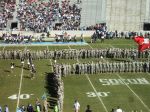
2016 Football, Game 10: The Citadel vs. VMI

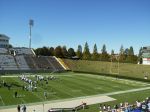
The Citadel vs. VMI, to be played on Alumni Memorial Field at Foster Stadium in Lexington, Virginia, with kickoff at 1:30 pm ET on Saturday, November 12. The game will not be televised.

The contest will be streamed on ESPN3.com, with Wade Branner providing play-by-play and Dave Harding supplying the analysis.

The game can be heard on radio via the various affiliates of The Citadel Sports Network. WQNT-1450 AM [audio link], originating in Charleston, will be the flagship station. 

Mike Legg (the “Voice of the Bulldogs”) will call the action alongside analyst Lee Glaze.

It is also possible to listen to the action with a smartphone, using a TuneIn Radio application.

Links of interest:

– Game notes for The Citadel and VMI

– SoCon weekly release

– Brent Thompson’s 11/8 press conference, including comments from Cody Clark and Tyler Renew (video)

– Brent Thompson’s 11/9 radio show (video)

– FCS Coaches’ Poll

– STATS FCS Poll

– NCAA FCS selection committee rankings for November 10

– Sure, we can relive that Cam Jackson run again

– VMI’s new starting quarterback tries to lead Keydets to an upset of the Bulldogs

– Highlights of VMI’s game against Bucknell (video)

– Get well, Mike Groshon

The second week of preliminary rankings by the FCS selection committee resulted in a few changes, but by and large those adjustments did not really affect The Citadel.

Week 2  Rank School Previous (Week 1)
1 Jacksonville State 1
2 Eastern Washington 3
3 North Dakota State 4
4 James Madison 5
5 Sam Houston State 2
6 The Citadel 6
7 Chattanooga 8
8 Richmond 7
9 Central Arkansas 10
10 North Dakota NR

The biggest news was Sam Houston State dropping from #2 to #5. The Bearkats are one of two undefeated FCS teams, with The Citadel being the other. However, SHSU’s strength of schedule is weak when compared to all but one of the other top eight teams (we’ll get to the exception in a moment).

Last week, North Dakota State fans (and media members) complained vociferously after Sam Houston State was ranked ahead of the Bison. They had a point.

It is impossible to know whether or not certain members of the selection committee were influenced by the noise emanating from Fargo. I could make a good guess, though.

Of course, NDSU didn’t get everything it wanted. North Dakota State is still ranked behind Eastern Washington and Jacksonville State. The latter school’s #1 ranking continues to be a bit puzzling.

Schedule strength of the top 10 teams through last week’s games (incidentally, Samford is 2nd overall in this category):

  • Jacksonville State (schedule strength of 101st out of 124 FCS teams)
  • Eastern Washington (tied for 12th)
  • North Dakota State (3rd)
  • James Madison (35th)
  • Sam Houston State (89th)
  • The Citadel (tied for 12th)
  • Chattanooga (34th)
  • Richmond (37th)
  • Central Arkansas (82nd)
  • North Dakota (38th)

Jacksonville State is 8-1. The one defeat came at LSU, so nobody is saying that JSU should be penalized severely for its loss. However, the Gamecocks don’t play in a very strong league, and don’t have the non-conference schedule heft to match that of Eastern Washington and North Dakota State — and both of those schools also play in tougher conferences while maintaining identical 8-1 records.

Of course, some observers would note that one difference between the three schools is that Jacksonville State’s director of athletics is on the selection committee.

The Citadel is undefeated, has a significantly better strength of schedule, and also has a win over another team in the top 10 of the rankings. However, not only are the Bulldogs behind Jacksonville State, they are ranked below Sam Houston State as well. There is no legitimate reason for that to be the case.

In my opinion, The Citadel should currently be ranked in the top 4. Eastern Washington and North Dakota State should be 1-2 in some order, followed by James Madison and The Citadel in the 3-4 spots. However, unless JSU and SHSU lose, the Bulldogs are not likely to pass either one of them (particularly Jacksonville State).

This effectively means The Citadel’s seeding “ceiling” is probably #5. The difference between being seeded #5 instead of #4 could be the difference between playing at home or on the road in a potential quarterfinal game.

That would be unfortunate for The Citadel.

Earlier this week, SB Nation’s “Football Study Hall” site posted a report on tempo at the FBS level. It’s a very interesting and well-considered piece.

After I read it, I decided to take a look at pace of play in FCS. Basically, I took stats from 122 teams (for practical reasons, I didn’t include “transitional” schools Abilene Christian and Incarnate Word), and determined how quickly FCS teams have run offensive plays so far in 2016. Here are the top 20 squads:

Team (Conference) Time between plays (seconds)
Stephen F. Austin (Southland) 19.49872
Eastern Kentucky (OVC) 19.68576
Samford (Southern) 20.29769
South Dakota (MVFC) 20.86083
Sam Houston State (Southland) 21.5656
Murray State (OVC) 21.80123
Eastern Washington (Big Sky) 22.09565
Southern Utah (Big Sky) 22.11938
Southern Illinois (MVFC) 22.12278
Indiana State (MVFC) 22.34259
Dartmouth (Ivy League) 22.52891
Western Carolina (Southern) 22.53821
Eastern Illinois (OVC) 22.7168
Sacramento State (Big Sky) 22.78134
Morehead State (Pioneer) 23.02286
Montana (Big Sky) 23.18182
Marist (Pioneer) 23.25649
Princeton (Ivy League) 23.31231
Columbia (Ivy League) 23.37113
VMI (Southern) 23.48567

Stephen F. Austin’s pace is faster than all but three teams in FBS: Missouri (which is absurdly fast), Baylor, and California.

These are the 20 “slowest” teams, with Wofford taking more time between plays than any other team in FCS (only Stanford and Georgia Tech are slower at the FBS level):

Team (conference) Time between plays (seconds)
Florida A&M (Mid-Eastern) 28.66306
Youngstown State (MVFC) 28.76508
Jacksonville (Pioneer) 28.82095
Mississippi Valley St. (Southwestern) 28.88979
Robert Morris (Northeast) 29.07609
North Dakota (Big Sky) 29.10984
Presbyterian (Big South) 29.31664
San Diego (Pioneer) 29.42857
Albany (NY) (Colonial) 29.43738
Stony Brook (Colonial) 29.46168
Chattanooga (Southern) 29.56397
Tennessee Tech (OVC) 29.77833
Texas Southern (Southwestern) 30.02473
Tennessee State (OVC) 30.05179
Charleston Southern (Big South) 30.076
North Dakota State (MVFC) 30.33216
Saint Francis (PA) (Northeast) 30.35612
Delaware (Colonial) 30.87125
Wofford (Southern) 30.90445


In my FCS Playoffs primer, I mentioned this comment from the chairman of the selection committee, Brian Hutchinson, when asked by an interviewer about “Sam Houston State’s value to the committee”:

The value of Sam Houston State is that they are an 8-0 team right now [that] is averaging close to 60 points per game and close to 600 yards of [total] offense. That’s the value that people see.

As I said in that post, I hope no committee members will actually use total offense as a criterion of any real significance. Part of my concern has to do with schedule strength, of course, but style of play is also a factor.

Sam Houston State leads FCS in total offense. As you can see above, SHSU is also the 5th-fastest offense in the division, in terms of pace of play.

I think it would be more than a little ridiculous to use total offense as a marker for comparing the Bearkats to teams like Chattanooga (19th in total offense, but the 9th “slowest” team) or The Citadel (23rd in total offense, and in the bottom third in pace of play, at 27.33 seconds between plays). The latter two teams shouldn’t have their style of play held against them by a committee member who is overly impressed by raw statistics.

While I’ve got this information handy, here are pace of play rankings for the nine SoCon squads, plus a few other teams:

  • Stephen F. Austin (1st out of 122)
  • Samford (3rd)
  • Sam Houston State (5th)
  • Eastern Washington (7th)
  • Western Carolina (12th)
  • VMI (20th)
  • Mercer (27th)
  • James Madison (37th)
  • Lehigh (41st)
  • Harvard (44th)
  • Liberty (47th)
  • Kennesaw State (71st)
  • The Citadel (84th)
  • Gardner-Webb (87th)
  • East Tennessee State (91st)
  • Furman (95th)
  • Presbyterian (110th)
  • Chattanooga (114th)
  • Charleston Southern (118th)
  • North Dakota State (119th)
  • St. Francis [PA] (120th)
  • Delaware (121st)
  • Wofford (122nd)

Friday is Founders Day at VMI:

The VMI Corps of Cadets will commemorate Founders Day this Friday with a parade featuring a 17-gun salute executed by the Cadet Battery to honor VMI’s founders and the nation’s veterans.

The anniversary, which marks 177 years since 23 VMI cadets relieved the state militia and converted the state arsenal into the Institute, will also see the dedication of the recently renovated Cormack and Cocke halls at 10 and 11 a.m., respectively.

There will also be a parade at 10:30 am on Saturday.

If you’re going to the game, be sure you’re up to speed on the parking situation.

Scott Wachenheim is in his second year as VMI’s head coach. His team is 3-6 this season, 1-5 in SoCon play. That qualifies as improvement for the Keydets’ football program, given that VMI had won two games in each of the last five years.

The Keydets opened the 2016 season by dropping a 47-24 decision at Akron. VMI’s defense allowed 576 yards of total offense, but the Keydets stayed in the game, putting together two drives of 90+ yards to pull within two points as the third quarter ended.

Akron scored 21 fourth-quarter points to ice the contest. However, it was a very respectable showing by VMI against an FBS opponent.

VMI’s next game was a 17-13 victory at Morehead State. While the Keydets’ loss to Akron was encouraging, the win over the Eagles (which play football in the non-scholarship Pioneer League) was not. VMI’s offense was sluggish, but the defense kept Morehead State at bay, allowing the fewest points to a Keydets opponent in four seasons.

A third straight road game resulted in a triple overtime victory, 23-17 over Bucknell. The Keydets did not give up any points in the three OT sessions.

It was the first time VMI had won back-to-back games since 2005, and (unbelievably) the first time the program had won consecutive road games since the last game of the 1981 season and the first game of the 1982 campaign.

Back in Lexington, another overtime affair did not go the Keydets’ way. Mercer edged VMI 33-30 in a game reportedly marred by poor SoCon officiating (very surprising, I know). VMI trailed 21-7 at halftime before making a comeback, taking the lead with just 32 seconds remaining in regulation. The Keydets could not hold the lead, and then lost in OT.

VMI rebounded from that setback with a 37-7 home victory over East Tennessee State. Al Cobb threw three TD passes, and the Keydets rushed for 233 yards.

Since that game, VMI has lost four straight contests. The first of those defeats was a 55-21 loss at Samford. SU quarterback Devlin Hodges threw for 435 yards and 5 TDs, and VMI also got victimized by a pick-6.

Chattanooga then beat the Keydets 30-13. UTC rushed for 297 yards despite Derrick Craine missing the game with an injury. One of VMI’s two TDs was a 79-yard bomb from Al Cobb to Javeon Lara.

VMI returned home, but was beaten in Lexington 24-10 by Furman. The loss was a costly one for the Keydets, as Cobb suffered a shoulder injury.

Last week, VMI lost 32-29 at Western Carolina. The Keydets should have won the game, but basically handed the victory to the Catamounts with a series of miscues. Among other things:

  • VMI fumbled the opening kickoff, which was returned by WCU for a touchdown
  • The Keydets had four kicks blocked (two field goal attempts, two PATs)
  • VMI threw three interceptions
  • Western Carolina scored with 54 seconds to play on a 53-yard pass

Statistics of note for VMI:

VMI Opp
Points/game 22.7 28.7
Rushing yardage 1056 1487
Yards/rush 3.2 4.3
Rush TDs 16 10
Passing yardage 2266 2501
Comp-Att-Int 208-330-12 210-334-6
Average/pass att 6.9 7.5
Passing TDs 11 22
Total offense 3322 3988
Total plays 663 682
Yards/play 5.0 5.8
Fumbles/lost 7/3 11/6
Penalties-pen yds 35-318 75-681
Pen yards/game 35.3 75.7
Net punt average 34.6 34.3
Time of poss/game 28:50 31:10
3rd-down conv 47/143 48/138
3rd-down conv % 32.9% 34.8%
Sacks by-yards 13-91 23-122
Red Zone TD% (22-35) 63% (23-36) 64%
  • VMI is 2nd nationally in fewest penalties per game
  • The Keydets are 84th in FCS in scoring defense and 63rd in rushing defense
  • VMI is 29th in defensive third down conversion rate
  • The Keydets are 85th in time of possession
  • VMI is 28th in passing offense

Statistics of consequence for The Citadel:

The Citadel Opp
Points/game 30.8 18.7
Rushing yardage 3366 1129
Yards/rush 5.6 4.1
Rush TDs 29 12
Passing yardage 540 1645
Comp-Att-Int 33-82-2 140-246-8
Average/pass att 6.6 6.7
Passing TDs 4 8
Total offense 3906 2774
Total plays 685 524
Yards/play 5.7 5.3
Fumbles/lost 15/6 12/7
Penalties-pen yds 43-449 38-358
Pen yards/game 49.9 39.8
Net punt average 37.3 36.6
Time of poss/game 34:37:00 25:22:00
3rd-down conv 75/151 35/110
3rd-down conv % 49.7% 31.8%
Sacks by-yards 25-165 0-0
Red Zone TD% (22-39) 56% (12-20) 60%
  • The Citadel leads the nation in rushing offense (374.0 yards/game) and is seventh in average yards/rush
  • The Bulldogs are 9th in offensive third down conversion rate
  • The Citadel is third nationally in time of possession
  • The Bulldogs are 13th in fewest penalties per game
  • The Citadel is 21st in the country in turnover margin
  • The Bulldogs are 15th nationally in defensive third down conversion rate

VMI throws the ball on 49.8% of its offensive plays from scrimmage, with 68.2% of the Keydets’ total yards coming via the air. The Keydets operate out of the spread.

Al Cobb was the preseason choice as the SoCon’s all-conference quarterback. Cobb was injured against Furman and did not play last week versus Western Carolina.

Will he play on Saturday? Cobb is not listed on the two-deep. According to an article in The Roanoke Times, he may be available.

The starter, though, will be redshirt freshman Austin Coulling (6’4″, 200 lbs.). Coulling, a native of Salem, Virginia, has played in five games this season, starting against WCU last Saturday.

For the season, he is completing 56.9% of his passes, averaging 7.5 yards per attempt, with two touchdown passes and six interceptions.

Coulling does not lack for confidence:

After hours of watching video, Coulling said he thinks there are some areas in The Citadel defense that the offense can exploit.

“There are opportunities there for us to take,” Coulling said. “As a team, if we come out with the same energy we came out with last week and execute more efficiently than we did last week and have the same running game as we had last week, I mean, anything can happen. … We can come out on top.”

Daz Palmer (5’10”, 175 lbs.) is a freshman from Norfolk who is leading the Keydets in rushing. He is averaging 4.5 yards per carry, with 3 rushing TDs. Palmer also has 12 receptions this season.

Wide receiver Aaron Sanders (6’2″, 190 lbs.) was a preseason all-league pick. He has 62 receptions so far this year, with two TDs. Sanders had 7 catches last year versus The Citadel; in fact, Sanders has had 7 receptions in each of his last two games against the Bulldogs (including a 165-yard receiving performance in 2014).

Fellow wideout Dane Forlines (5’10”, 190 lbs.) made the all-conference team last year as a return specialist. Forlines is a dangerous punt returner, averaging 12.9 yards last season and 9.3 yards this year in that discipline. He is second on the team in receptions, with 47 catches and one TD.

Starting tight end Ryan Swingle (6’3″, 232 lbs.) has 30 receptions and four touchdown catches this season. The former quarterback is also the holder on placekicks, and VMI is not afraid to take advantage of his versatility. He threw a 50-yard pass on a trick play against Mercer.

VMI’s projected starting offensive line averages 6’3″, 279 lbs. According to the two-deep, the offensive tackles will be flipped for the game against The Citadel.

Fifth-year senior Iyan Roseborough (6’3″, 335 lbs.) has played right tackle this season for the Keydets, but is listed as the left tackle on this week’s depth chart. Roseborough is a native of Jenkinsville, South Carolina, and graduated from Fairfield Central High School.

Redshirt freshman Cole Brummit (6’4″, 250 lbs.) made his first career start against Western Carolina at left tackle. He is listed as the right tackle this week.

VMI’s defense normally lines up in a 3-4. In last season’s contest, the Keydets were generally effective at bottling up The Citadel’s triple option attack. After Cam Jackson broke loose for a 68-yard TD on the Bulldogs’ fourth play from scrimmage, VMI did not allow another offensive TD.

The Keydets’ D is led by two active inside linebackers. Ryan Francis (6’1″, 205 lbs.) is a redshirt junior from Knoxville who had 15 tackles versus The Citadel in last year’s matchup. Allan Cratsenberg (6’3″, 220 lbs.) is a junior from Natrona, Pennsylvania; he had 11 stops against the Bulldogs in last season’s game.

The two are currently tied for the team lead in tackles, with 94 each. They have combined for 21 tackles for loss, including eight sacks.

Francis is the main pass rusher, with six of those sacks; he also has two fumble recoveries. Against Mercer, Francis also threw a pass out of a fake punt formation; it was intercepted.

Another linebacker, Alijah Robinson (6’0″, 205 lbs.) is third on the team in tackes, with 58. Robinson also has two sacks.

Cornerback Riuq Trotman (5’9″ 155 lbs.) is a sophomore from Virginia Beach who leads the Keydets in interceptions, with three.

Dillon Christopher (6’2″, 200 lbs.) is in his fourth year as a placekicker for the Keydets. He has shared kicking duties with freshman Reed King (5’9″, 150 lbs.).

Regardless of the kicker, VMI has had major problems in the kicking game this season, with nine blocked kicks — five field goal attempts, and four PAT tries.

Christopher does have a strong leg, which he employs on kickoffs.

VMI’s punter is redshirt sophomore Bill Hogan (6’1″, 225 lbs.), who can also play linebacker. He has had one punt blocked this season. Hogan was the punter for VMI when the Keydets played The Citadel last season, and did a solid job.

Jake Keith (5’10”, 190 lbs.), a freshman from Blacksburg, is the long snapper.

Odds and ends:

– The weather forecast for Saturday in Lexington, Virginia, per the National Weather Service: sunny, with a high of 52 degrees. The projected low on Saturday night is 27 degrees.

– Per one source that deals in such matters, The Citadel is an 18-point favorite over VMI, with an over/under of 47.5.

– Other lines involving SoCon teams: Chattanooga is a 7.5-point favorite over Wofford; Samford is a 15.5-point favorite against Mercer; Furman is a 6.5-point favorite over Western Carolina; and East Tennessee State is a 24-point favorite against Cumberland.

Gardner-Webb (now 4-6) is off this week, presumably celebrating its stunning victory at Charleston Southern last Saturday. North Carolina (7-3) was upset by Duke 28-27 on Thursday night.

– Massey Ratings: The Citadel is ranked 4th in FCS (moving up one spot from last week, the second consecutive week the Bulldogs have crept up one position). VMI is ranked 69th.

Massey projects The Citadel to have a 93% chance of winning, with a predicted final score of The Citadel 34, VMI 13.

Other FCS rankings in Massey of note: Chattanooga (8th), Samford (12th), Wofford (19th), Mercer (41st), Gardner-Webb (46th), Furman (47th), Western Carolina (64th), East Tennessee State (82nd).

The top ten in Massey’s rankings, in order: North Dakota State, Eastern Washington, Jacksonville State, The Citadel, Central Arkansas, South Dakota State, Youngstown State, Chattanooga, Sam Houston State, and Northern Iowa.

– VMI’s game notes roster includes 69 natives of Virginia. Other states represented on the squad: Tennessee (9), North Carolina (4), Pennsylvania (4), Georgia (3), Alabama (2), and one each from West Virginia, Louisiana, New York, Michigan, Texas, Maryland, and South Carolina.

– The Citadel’s geographic roster breakdown (per the school’s website) is as follows: South Carolina (47 players), Georgia (23), Florida (9), North Carolina (7), Alabama (4), Pennsylvania (4), Texas (4), and one each from Louisiana, Maryland, Kansas, Oklahoma, Nevada, and West Virginia.

– VMI concludes its season next week at Wofford.

– FBS opponents for VMI in future seasons include Toledo and Old Dominion in 2018; Army in 2019; and North Carolina State in 2023.

– On The Citadel’s two-deep this week, Evan McField is listed as the #2 B-back, with Isiaha Smith not listed on the depth chart. That is the only change from last week’s two-deep.

– Game notes factoid of the week: The Citadel has rushed for at least 400 yards in five games this season, tying the school’s single-season record. Those five games: North Greenville (559 yards, the most by an FCS school in a game so far in 2016), Western Carolina (513), Samford (463), East Tennessee State (427), and Gardner-Webb (419).

– With its victory over Samford on Saturday, The Citadel won its fifth consecutive Homecoming game. The Bulldogs won their fifth straight Parents’ Day game earlier in the season when they defeated Chattanooga.

The ten consecutive “celebration” victories are a modern-day school record. The Citadel had never won eight straight such games prior to the current run.

– The original cost of the Silver Shako (which was created in 1976) was $532.72.

– More than 40 players (and a few coaches) from VMI’s 1981 team will be honored at halftime of Saturday’s game. That Keydets squad beat Army and Virginia Tech, finishing with a 6-3-1 record. VMI has not had a winning season since that year.

On his radio show, Brent Thompson was asked about resting starters, trying to avoid injuries, etc., given that The Citadel has clinched a playoff spot. Thompson’s response:

It’s a loser’s mentality, there’s no doubt about that. You don’t go out there worrying about which guys are going to get hurt and who’s going to do this, and who’s going to do that. We’re going to go out there and play the game, and play the game to win. There’s a game on our schedule, it’s assigned to us, and we’re going to…go out there and give it our best. It doesn’t really matter who it is, whether it’s this week or next week…we’re going to try to play it, and try to play it to win it. If there are injuries…that’s part of the game and we can’t concern ourselves with that.

Thompson also noted that the offense did not play well against VMI last season, and wants to see improvement this year.

The coach also mentioned the importance of getting a bye for the FCS playoffs. If the Bulldogs want to seriously contend for the national title, they almost certainly need to be a seeded team, and receive the bye that goes with that designation.

A loss to VMI would almost certainly end The Citadel’s chance at a bye. Conversely, the game against North Carolina in two weeks will probably not be a factor in The Citadel’s postseason placement, unless the Bulldogs perform well in that contest.

The Citadel has been a member of the Southern Conference since 1936. In all that time, the football team has never finished undefeated in league play.

Along with the outright SoCon title, and a tenth straight victory, the opportunity to finish undefeated in the conference would be reason enough for the Bulldogs to want this game very badly. They don’t really need another reason, however.

This is the Military Classic of the South.

It will be a fierce contest. VMI will come ready to play on Saturday. The Citadel must respond in kind, and with even greater ferocity.

The coveted Silver Shako is at stake, the greatest trophy in all of sports.

The Bulldogs have to do whatever it takes to keep it, and bring it back to Charleston, where it belongs.

College Football TV Listings 2016, Week 11

This is a list of every game played during week 11 of the 2016 college football season involving at least one FBS or FCS school. All games are listed, televised or not. For the televised games (only live broadcasts are listed), I include the announcers and sideline reporters (where applicable). I put all of it on a Google Documents spreadsheet that can be accessed at the following link:

College Football TV Listings 2016, Week 11

Additional notes:

– I include games streamed by ESPN3.com and Fox Sports Go; they are denoted as “ESPN3″ and “FS-Go”, respectively.

– I also list digital network feeds provided by various conferences, but only when they are free of charge. For some of these feeds, the audio will be a simulcast of the home team’s radio broadcast. Other online platforms have their own announcers.

For now, the digital networks I am including in the listings are those for the ACC, Big Sky, Big South, CAA, Mountain West, NEC, OVC, Patriot League, and SoCon.

Occasionally individual schools (almost always at the FCS level) provide video feeds free of charge. When that is the case, I list those as well.

– I also do not include PPV telecasts, regardless of whether or not the matchup in question features FBS or FCS schools.

– The local affiliates for the ACC Network “national” game of the week can be found on a link in the document, and here: North Carolina State-Syracuse

– The regional sports networks carrying the ACC Network “regional” game of the week can be found on a link in the document, and here: Miami (FL)-Virginia

– Local affiliates for American Sports Network games are linked in the document, and here: William & Mary-Towson, Presbyterian-Kennesaw State, Southern Mississippi-Old Dominion, Nicholls-Central Arkansas, Middle Tennessee State-Marshall [link when available]

– ABC/ESPN2 coverage maps for the noon ET games: Baylor-Oklahoma and Penn State-Indiana

– ESPN3/ACC Digital Network/College Extra blackout maps: North Carolina State-Syracuse, Miami (FL)-Virginia, Idaho-Texas State, UTSA-Louisiana Tech

– BTN “gamefinder”:  Link

– SEC Network “gamefinder”: Link

– AP Poll (FBS):  Link

– FCS Coaches’ Poll:  Link

—

A lot of the information I used in putting this together came courtesy of Matt Sarzyniak’s incredibly comprehensive and truly indispensable site College Sports on TV, a must-bookmark for any fan of college sports.

Also to be credited, as always, are the indefatigable information collectors (and in some cases sports-TV savants) at the506.com. I am also assisted on occasion by helpful athletic media relations officials at various schools and conferences.

The FCS playoffs — a primer

The purpose of this post is to explain some of the ins and outs of the FCS playoffs, particularly for people who may not be familiar with the basics of postseason play. I’m also going to delve into a few other aspects of the playoffs (including the way the teams are selected, seeded, and bracketed), some of which I believe are problematic.

The tournament has expanded over the years, from a four-team setup in 1978 to today’s 24-team field. The current format has been in place since 2013.

Of the 24 teams that make the field, 10 will be conference champions that automatically qualify for the tournament. As of November 7, two teams have already qualified for the 2016 tourney — Lehigh (from the Patriot League) and The Citadel (from the Southern Conference).

While there are 10 automatic qualifiers, there are actually 13 FCS conferences. Three of those leagues do not have auto-bids to the FCS playoffs.

The Ivy League does not participate in the playoffs, so none of its schools will send a team to the tournament.

The other two conferences without automatic bids are the Southwestern Athletic Conference (SWAC) and Mid-Eastern Athletic Conference (MEAC). Those two leagues send their respective champions to the “Celebration Bowl”, a separate post-season event.

However, SWAC and MEAC schools are eligible to receive at-large bids. In other words, if a team that does not win one of those leagues is deemed by the selection committee to be one of the 14 best at-large candidates, it may compete in the FCS playoffs. While that scenario would normally be unlikely, this season might provide just such a situation, thanks to two teams in the MEAC that are each having fine seasons.

North Carolina A&T is currently ranked 9th in the FCS Coaches’ Poll, with a record of 8-1 that includes a victory over an FBS opponent (Kent State). The Aggies’ only loss so far this season was to Tulsa.

Meanwhile, North Carolina Central is 7-2, with both losses to FBS schools. The two schools will play in two weeks for the MEAC title. I don’t believe North Carolina Central would receive an at-large bid at 8-3, but if North Carolina A&T were to lose to the Eagles, a 9-2 Aggies squad could be a viable at-large candidate.

The leagues that send automatic qualifiers to the playoffs:

  • Big Sky Conference
  • Big South Conference
  • Colonial Athletic Association (CAA)
  • Missouri Valley Football Conference (MVFC)
  • Northeast Conference (NEC)
  • Ohio Valley Conference (OVC)
  • Patriot League
  • Pioneer Football League
  • Southern Conference (SoCon)
  • Southland Conference

Here is this year’s tournament schedule:

  • Bracket announcement: Sunday, November 20, 2016 at 11:00 am (televised on ESPNU)
  • First round: Saturday, November 26, 2016 — eight games at campus sites (this is the Saturday after Thanksgiving)
  • Second round: Saturday, December 3, 2016 — eight games at campus sites (seeded teams will host in this round after getting a bye in the first round)
  • Quarterfinals: Friday, December 9, 2016 or Saturday, December 10, 2016 — four games at campus sites (higher-seeded team hosts)
  • Semifinals: Friday, December 16, 2016 or Saturday, December 17, 2016 — two games at campus sites (higher-seeded team hosts)
  • National Championship: Saturday, January 7, 2017 at Toyota Stadium in Frisco, Texas (kickoff at noon EST)

The FCS selection committee selects the 14 best at-large teams to join the 10 automatic qualifiers, and then ranks the top 8 teams.

The teams ranked in the top 8 are seeded, and also receive first-round byes. The remaining 16 teams are then bracketed and play first-round games.

It is important to understand that, unlike the NCAA basketball tournament, not every team is seeded. In fact, two-thirds of the field is not seeded. That is done on purpose, in order to allow the committee to make pairings “according to geographical proximity“.

Historically, that has resulted in the committee putting together what might be called a bracket of convenience, routinely pairing teams in first- and second-round matchups that have already played each other during the regular season, and/or in recent tourneys. This has been a source of frustration for many fans over the years, because the event is supposed to be a national tournament; after all, it is referred to by the NCAA as the Division I “National Championship”. However, it is rarely treated like one by the powers that be.

A good example of the “regionalization” of the FCS playoffs came last year. For the 2015 tournament, the selection committee set up multiple potential second-round regular-season rematches. When the dust had cleared from the first-round games, five of the eight second-round matchups wound up being regular-season rematches (two of those were matchups between teams in the same league).

Most inexcusably, the committee set up a first-round regular-season rematch between Colgate and New Hampshire.

Five teams from the MVFC made the field last season (four at-large picks and the automatic qualifier, North Dakota State). All five were slotted on one side of the bracket. That did not sit well with the MVFC league commissioner:

Missouri Valley Football Conference commissioner Patty Viverito said she believes the Football Championship Subdivision playoff committee made “a conscious decision” to put five Valley teams in the same bracket…

Viverito said: “It seems to me the committee has enough latitude in how they break the quadrants up that they’d be able to put teams on opposite sides of the bracket fairly easily. I wasn’t in the room. I don’t know what challenges the committee faced when they came up with this. I can’t imagine it was just a horrible oversight and they didn’t realize they’d done it until the bracket was announced. I think it was a conscious decision. I just don’t know what went into the decision-making process.”

…Viverito called the committee’s pairings “the good, the bad and the ugly.” She said her league getting five teams in the playoff field “good.” She said the formulating of the bracket and the regionalization of it “bad.” And she [called] placing five Valley teams in the same bracket “ugly.”

The complaints from the MVFC led to a change for this year:

…the NCAA approved two FCS bracketing policies that should help spread out teams from the same conferences and also avoid rematches in the early rounds. The playoff committee will now be allowed to add a flight in the first or second rounds to avoid placing four or more teams from one conference in the same side of the bracket. The committee also has the license to avoid matchups in the first round for teams that played during the regular season in a non-conference game, providing that change doesn’t result in an additional charter flight.

That won’t change a lot, but it’s better than nothing. It primarily benefits larger leagues that regularly have three or more teams make the tournament (like the MVFC, CAA, and Big Sky).

For the SoCon and Big South, however, there is no mechanism to prevent the committee from doing what it seems to like doing most — namely, pairing two teams from each conference in a first-round matchup, with the winner playing a seeded team from one of the two leagues.

This year, the FCS selection committee decided to do something that I’m guessing a few of the committee members will wind up regretting.

The NCAA Division I Football Championship Committee will reveal the top-10 teams in rank order three times during the month of November.

The committee will be releasing the top-10 teams for the first time in history. The rankings will be announced as part of College Football Daily on ESPNU Nov. 3 and 10 at 4 p.m. (ET).

The final release will take place Nov. 15 at 10 p.m. (ET) on the ESPNU Championship Drive: Power Hour.

This move was officially made for reasons of transparency. However, if part of the idea for releasing a preliminary list was also to help promote the FCS playoffs, the first reveal (November 3) on “College Football Daily” was not a success.

Show anchor Brendan Fitzgerald and analyst Jason Sehorn knew next to nothing about the FCS (including how many teams actually make the playoffs). The entire segment lasted less than two minutes; the producer did not even bother to use recent video clips for a highlights package that accompanied the release of the rankings.

Clearly, the committee is taking a page from the College Football Playoff (CFP) and its weekly rankings. When it comes to the CFP, though, the weekly rankings release may not be the best thing to emulate.

Ten people make up the FCS selection committee. All are directors of athletics, representing schools from each of the ten leagues with automatic bids:

  • Brian Hutchinson, Morehead State — Pioneer League [chairman]
  • Chuck Burch, Gardner-Webb — Big South
  • Richard Johnson, Wofford — SoCon
  • Kyle Moats, Missouri State — MVFC
  • Nathan Pine, Holy Cross — Patriot League
  • Marty Scarano, New Hampshire — CAA
  • Paul Schlickmann, Central Connecticut State — NEC
  • Greg Seitz, Jacksonville State — OVC
  • Brad Teague, Central Arkansas — Southland
  • Jeff Tingey, Idaho State — Big Sky

One of the things I noticed about the committee is the dual-league nature of its chairman, Brian Hutchinson. Morehead State competes in football in the Pioneer League, which is the league he represents on this committee. However, in other sports Morehead State is a member of the OVC.

To me, that leads to a potential “optics” issue, namely the possible impression (almost certainly unfair, but still) that the OVC has two representatives on the committee — Hutchinson and Greg Seitz, the director of athletics at Jacksonville State.

When the first set of preliminary playoff rankings were released last week, the top-ranked team was, somewhat controversially…Jacksonville State.

Week 1 rankings:

Rank School
1 Jacksonville State
2 Sam Houston State
3 Eastern Washington
4 North Dakota State
5 James Madison
6 The Citadel
7 Richmond
8 Chattanooga
9 Charleston Southern
10 Central Arkansas

This will look a little different in Week 2. Charleston Southern will fall out of the top 10 after losing at home to Gardner-Webb, and so could Richmond (which lost at home to James Madison). However, how much change in the rankings is really possible? Is the committee already hamstringing itself on that front?

Brian Hutchinson gave two radio interviews after the rankings were released last week, both to stations in North Dakota. He should get some credit for agreeing to the interviews, because he is in the difficult position of having to speak for a committee. He may not even agree with all of the committee’s decisions, but he has to defend them anyway.

A few thoughts on his comments:

  • I got the distinct impression that the committee members weren’t prepared for a public rankings release
  • It’s conceivable that the rankings will wind up being close to valueless when it comes to the actual selection and seeding
  • Somewhat surprisingly, there is no established order of criteria when evaluating teams

Hutchinson was asked about the difference in seeding between two currently undefeated teams, Sam Houston State and The Citadel. One of the interviewers compared the two squads and noted that The Citadel had a better strength of schedule, including a win over another top-10 team (Chattanooga).

When asked about the “value of Sam Houston State to the committee”, Hutchinson said:

The value of Sam Houston State is that they are an 8-0 team right now [that] is averaging close to 60 points per game and close to 600 yards of [total] offense. That’s the value that people see.

I really hope that members of the selection committee aren’t using total offense as a criterion (particularly as a stand-alone benchmark) when comparing teams.

However, Hutchinson also added this:

The question about The Citadel as it relates [to Sam Houston State] is absolutely fair, though. They have a really good win over a conference opponent in Chattanooga. They’ve been undefeated. They have not yet played an FBS game, though I believe they have one the last week of the season.

So for all intents and purposes, the criteria the committee will get to evaluate them on will be done prior to the [game versus North Carolina]. Now should they win that game, obviously that would be a big feather in their cap. Should they lose it, I think most people if you look at it on paper would say they were supposed to [lose the game] — and so, that’s just how you evaluate those kinds of things.

The selection committee chairman was also asked if “there had been a lot of reaction around the country [to the preliminary rankings], or has it been isolated pockets like Cheney [Washington] or Fargo [North Dakota]?”

“It has been very isolated,” replied Hutchinson.

Those “isolated pockets” referenced in the interviewer’s query are the cities in which Eastern Washington and North Dakota State are located, of course. Fans of those schools are (justifiably, in my opinion) miffed that they were ranked 3-4 in the initial rankings, rather than 1-2. The committee seemed to ignore schedule strength and quality victories when ranking the teams.

The issue in question relates to potential seeding. The difference in being a 1 or 2 seed versus a 3 or 4 seed, for example, is this: if a seeded team keeps winning, it will host every game until it plays a higher-seeded team. Therefore, if a team is a 1 or 2 seed, it will host every game until the national title game (assuming that it continues to win). A 3 or 4 seed, however, might have to go on the road in the semifinals.

Obviously, that can be significant.

Each seeding “break” matters when it comes to hosting. For teams like James Madison and The Citadel, receiving a 1 or 2 seed may not be possible — but a 3 or 4 seed might be a realistic placement. The difference between being a 4 seed or a 5 seed could be the difference between playing a home game in the quarterfinals or going on the road. That matters.

There are two weeks left in the FCS regular season. A lot of things can (and will) change over the next two weeks.

One thing that won’t change, though, is the level of interest in the FCS playoffs from those who support teams still in the running for a spot in the field. That interest is intense, and will remain so until the bracket is revealed on November 20; it will then continue for fans of the 24 schools in the tournament.

It’s not often that people dream about making a trip to Frisco, Texas, but here we are…

Game Review, 2016: Samford

The Citadel 37, Samford 34 (OT).

Links of interest:

– Game story, The Post and Courier

– Video from WCSC-TV

– Video from WCIV-TV

– Video from WCBD-TV

– Post-game press conference, featuring Brent Thompson, Dee Delaney, Cam Jackson, Tevin Floyd, Nick Jeffreys, Cody Clark, and Tyler Renew (video)

– School release from The Citadel

– School release from Samford

– Samford’s first-half highlights package (video)

– Samford’s second-half and post-game highlights package (video)

– Game story, The Birmingham News

– Box score

– The Citadel’s post-game notes

– Nick Jeffreys, versatility personified

– Brent Thompson’s post-game speech, interrupted briefly due to locker room crowd-surfing by a special guest (video)

– Here is a little video (via Twitter) of Brent Thompson’s own crowd-surfing ability

– Game highlights (video)

– On-field end-game videos via the Facebook page for The Citadel Sports: Video 1, Video 2, Video 3

– That page on Facebook also has a video clip of the seniors being recognized prior to the game

– Mike Legg and Lee Glaze call Cam Jackson’s ridiculous 63-yard run

– Mike Legg and Lee Glaze call Cody Clark’s game-tying field goal

– Mike Legg and Lee Glaze with the end-of-game call

—

I hardly know where to begin.

Well, I guess I could start by saying that I was surprised by quite a few things that happened on the field on Saturday…

While talking to a couple of people before the game, the subject of Samford’s defense came up. I suggested that because of SU’s “Bear” front, which tends to clog up the middle of the line, Tyler Renew would probably not have a big game.

Renew proceeded to have one of the greatest rushing days in The Citadel’s long gridiron history.  He made me look like a dope. (I’m glad he did.)

I also wasn’t expecting Samford quarterback Devlin Hodges to turn into a dual-threat star. Hodges had entered the game with only 71 net rushing yards all season. Even if you take out sacks, he still had less than 240 yards on the ground, and had not carried the ball for more than 12 yards on any play.

However, you have to give Samford’s coaching staff credit for taking advantage of an opportunity and making an adjustment in the game plan. As a result, Hodges scored two rushing touchdowns (one for 57 yards) and had two other short runs for first downs.

He was clearly athletic enough to run, including a Houdini act late in the first half that turned a would-be sack into an eight-yard pickup, setting up a field goal.

Then, I wrote in my preview that turnovers would be a critical factor in the game. Naturally, neither team committed a turnover.

The one thing I got right had nothing to do with any type of intellectual analysis.

When asked before the game whether or not I thought The Citadel would prevail, I basically went with the theory that while Samford was a difficult matchup, the Bulldogs had found a way to win all season, and that maybe it was just their year.

They did find a way to win again, and it is their year. It is also a season for the ages.

Random thoughts from an increasingly frazzled fan:

– The atmosphere on Saturday was fantastic. The crowd was into the game from the opening kickoff, despite the delay in clearing the field after the Corps of Cadets and all the reunion classes marched into the stadium. It also took a little time for some of the fans in the East stands to get to their seats.

I was a little concerned when the third quarter began, because I noticed a lot of people had left, presumably to go to their respective tailgates. However, when I looked around a few minutes later, the home stands were packed once again.

By the numbers, it wasn’t one of the larger crowds in the history of Johnson Hagood Stadium (though it was the most-attended game at The Citadel since 2009). However, there was an unusual intensity in the stadium that could be felt by anyone who was there.

I’ve been to a lot of games over the years at JHS. I’m not sure how I would rank that one in terms of an all-around experience.

My top-ranked game in that respect has always been the 1988 contest against Marshall. I probably wouldn’t put Saturday’s matchup on that level, but it was close. Very close.

– When you look at the statistics, it’s a little surprising the game went to overtime. The Citadel dominated time of possession (as expected), ran many more plays (89 to 67), rung up 542 yards of total offense, and held Samford to 280 passing yards (on 46 attempts). As mentioned, there were no turnovers.

However, Samford had a few things go in its favor.

For one thing, SU placekicker Reece Everett had a good game. While he may have missed the fateful 44-yard attempt in overtime, Everett also made two long field goals during the game, from 51 and 44 yards. Prior to Saturday, Everett’s longest made field goal of the season had only been 36 yards.

Samford also benefited from an advantage in field position. This was partly because of a four-yard edge in net punting, but mostly due to stopping The Citadel twice on fourth-down conversion attempts, including one at The Citadel’s own 40-yard line in the fourth quarter. That was a gamble by Brent Thompson which did not pay off. Hey, it happens.

Getting points from your kicker without having to advance to the Red Zone, taking advantage of good field position, and those big run plays by Hodges…they all added up for Samford, and put it in position to win the game.

The Citadel also got hurt by a double whammy of officiating decisions in the fourth quarter. The second of those was a pass interference call that was made by an official 20 yards away from the play, a dubious call exacerbated by the lateness of the flag.

However, that paled in comparison to a non-call made on the previous play, an obvious intentional grounding call that was ignored by the referee.

not-grounding

If that had been called, Samford would have had a 3rd-and-17 (if not longer), instead of the much more manageable 3rd-and-7 that led to the pass interference penalty.

During the game, Samford had five 3rd-down conversion attempts of longer than seven yards. It was 0 for 5 converting in those situations, with three incomplete passes and a sack.

As Jeff Hartsell of The Post and Courier tweeted after the game, “If Citadel doesn’t win, that no grounding/pass interference sequence goes down in Bulldog/SoCon ref lore”. Luckily for The Citadel (and the Southern Conference), the Bulldogs overcame that situation.

– One of those 3rd-and-long situations for Samford came in overtime. On 3rd-and-12, Devlin Hodges sat back in the pocket and waited…and waited…and waited…and moved to his right, then waited some more…and waited…and waited…and finally threw the football out of bounds.

The play seemed to take an eternity. It almost did. Hodges threw the ball 9.7 seconds after receiving the snap.

That’s an extremely long time for a QB to hold the ball and not find an open receiver. It was great downfield coverage by the Bulldogs, to say the least.

– I mentioned this on my Twitter feed on Saturday night, but I think it’s worth repeating here.

There is a clichĂ© that gets tossed around all the time (usually from TV game analysts) that goes something like this: triple option teams can’t play from behind, mainly because they don’t pass the ball enough (or effectively).

On Saturday, The Citadel trailed by ten points with just 5:30 left in regulation and the clock running, and faced a 3rd-and-7 from its own 31-yard line. From that point forward through the end of the game, the Bulldogs did not complete a pass.

They still won.

– The Citadel clinched an automatic berth in the FCS playoffs with the win. It has not, however, won the “outright” SoCon title yet.

Not everyone seems to understand how that works. Just in case you weren’t sure:

The Citadel has clinched at least a share of the league crown. However, the automatic bid to the playoffs does not constitute an outright championship. Chattanooga can still tie The Citadel for the conference title if the Mocs beat Wofford, and The Citadel loses to VMI.

Last year, the situation was reversed. Chattanooga got the automatic berth in the playoffs by virtue of its victory over The Citadel, but shared the league title with the Bulldogs because the teams finished with the same conference record (the Mocs having earlier lost to Mercer).

In other words, it’s just another reason The Citadel needs to beat VMI next week.

Of course, The Citadel doesn’t really need another reason to beat VMI, not with the coveted Silver Shako at stake. It is the greatest trophy in all of sports, and it needs to stay in Charleston, where it belongs.

I’m glad the freshmen in the corps of cadets are making the trip to Virginia for the game. I’ll write more about VMI when I preview the matchup later in the week. For now, I’ll just say that any alumnus of The Citadel ought to visit VMI at least once, just to get an idea of the similarities and differences between the two schools.

The Citadel will be trying to win the outright league title while finishing undefeated in SoCon play for the first time ever, which strikes me as another good reason to make the trip.

I may have a separate post prior to the game preview that deals with the FCS playoff structure, which seems to be a source of confusion in some quarters (understandably so). If I have time, I’ll outline the basics, explain all the historical problems associated with the selections, mention a few things to watch, etc.

For now, I’ll close with the usual motley assortment of pictures. This week, I wanted to include some non-football shots, since it was Homecoming. I also wandered by the temporary museum in Daniel Library and took a few photos there. Most of the pictures are annotated.

2016 Football, Game 9: The Citadel vs. Samford

The Citadel vs. Samford, to be played at historic Johnson Hagood Stadium, with kickoff at 2:00 pm ET on November 5, 2016. The game will not be televised. 

The game will be streamed on ESPN3.com. Kevin Fitzgerald will provide play-by-play, while Sadath Jean-Pierre supplies the analysis. 

The contest can be heard on radio via the various affiliates of The Citadel Sports Network. WQNT-1450 AM [audio link], originating in Charleston, will be the flagship station. 

Mike Legg (the “Voice of the Bulldogs”) will call the action alongside analyst Lee Glaze.

It is also possible to listen to the action with a smartphone, using a TuneIn Radio application.

—

Links of interest:

– Game notes for The Citadel and Samford

– SoCon weekly release

– The Citadel versus Samford: a clash of styles

– Style seems to be the word choice of the week for this game

– Aiming for a second straight SoCon title

– Samford continues on a “brutal” road stretch

– Brent Thompson’s 11/1 press conference, including comments from Tevin Floyd and Cam Jackson (video)

– Brent Thompson’s 11/2 radio show (video)

– Donnell Boucher is flexible, and that’s very good for The Citadel

– Samford head coach Chris Hatcher and quarterback Devlin Hodges preview the game against The Citadel (video)

– Brief interview with Samford offensive coordinator Russ Callaway (video)

– Brief interview with Samford defensive coordinator Bill D’Ottavio (video)

– Highlights of Samford’s game against Mississippi State (video)

– Highlights of Samford’s game against Wofford (video)

– Highlights of Samford’s game against Chattanooga: first half and second half/postgame (video)

– FCS Coaches’ Poll

– NCAA FCS selection committee rankings for November 3

– Four players from The Citadel named Academic All-District

– Homecoming Schedule

– The Citadel will honor the late Charles Foster

– Groundbreaking for the War Memorial takes place on November 4

At his weekly press conference, a member of the local media asked Brent Thompson about recruiting. The reporter suggested that the current players at The Citadel are better athletes than those who preceded them. Thompson’s response:

I think we’re doing a good job of recruiting our type of player, not necessarily the better athletes. We’ve certainly got some good athletes…

…really, a lot of it is more the development and retention of those players. I think over the past three years, since I’ve been here, we’ve lost very few players. We’re going to naturally be a better football team when we’ve got fourth- and fifth-year players, rather than those first- and second-year players. We’ve got a veteran ball club at this point, and that’s what we attribute a lot of [our success].

After a follow-up question, Thompson added:

When it comes to recruiting, the first thing that we really look for are good football players. We know that we can win and we can train good football players. They’ve got to have it inside of them first…

We’ve got to do our research. It takes a long time for us to figure out the players [out there] we want to recruit here. It comes down to the academics, it comes down to the corps of cadets, it comes down to being a good football player.

Sometimes it’s just not a good fit for us, and we understand that, and we can move on from that. Duggar Baucom has a great saying: “The next ‘No’ gets me closer to the next ‘Yes’.”

…We know that there are plenty of good football players out there for The Citadel, that fit what we do.

Retention is a key at most schools, of course, but it is absolutely the difference-maker at The Citadel, due to the nature of the institution. Too many coaches (in a wide variety of sports) have never completely grasped this, or have needed a few years at the military college to fully understand it.

For example, The Citadel football program’s attrition rate in 2005, 2006, and 2007 was poor (especially 2005; by the 2008 season, only six players from that class of recruits were still on the team). It is hard to build a consistently successful program when there is a revolving door of players, especially when bringing in undergraduate transfers is generally impractical (and rare).

I’ve written about this before, but as a comparison, here are some numbers from a few of Charlie Taaffe’s recruiting classes:

There were nine 5th-year seniors on the 1992 SoCon title team, including Jack Douglas, Lester Smith, and Carey Cash. Those players were part of Taaffe’s second recruiting class. It was obviously a tremendous group of recruits; we’re not just talking about quantity, but quality.

Taaffe brought in sixteen recruits the following year (1989). All sixteen were on the team for at least two years; fifteen completed four years. Fourteen of them were on the postseason two-deep in 1992.

It was actually even a better class than that, because three walkons from that year also made the ’92 two-deep. Sixteen recruits, eighteen significant contributors. That’s about as good as it gets.

Those two classes made up the foundation of the 1992 Southern Conference championship team.

The fourth year wasn’t quite as good, but it was okay. Of the seventeen recruits from that year, thirteen eventually lettered, with ten of the aforementioned 1992 two-deep.

The following year’s class was not as successful, with only eight of eighteen recruits lettering during their respective careers at The Citadel. That is indicative of a considerable amount of attrition.

Given all that, it’s not surprising the win totals, starting in 1989, were (in order): 5, 7, 7, 11, 5, 6, and 2 (Taaffe’s final season).

The easiest way to prevent attrition at The Citadel? Recruit potential cadets who can become good players, as opposed to recruiting players and trying to make them cadets.

It’s obviously not that simple; coaches have to bring in talented athletes. However, those talented athletes have to be capable of handling (and embracing) the challenge that is The Citadel, like all cadets.

Playoffs? Don’t talk about — playoffs? Are you kidding me?

Yes, Jim Mora, I’m going to talk about the playoffs for a few paragraphs.

While the team has to take things one game at a time, I’m a fan. It’s my constitutional duty to look ahead and make potentially unfounded assumptions based on events that haven’t yet taken place.

On Thursday, the NCAA selection committee for the FCS playoffs released the first of three preliminary Top-10 rankings. I anticipated that the rankings would resemble a train wreck, and I was not disappointed.

First, they were initially released on ESPNU, midway through a program called “College Football Daily”. It was clear that show anchor Brendan Fitzgerald and analyst Jason Sehorn knew very little about the FCS, and had no enthusiasm for the subject.

Both were under the impression that 16 teams made the playoffs (instead of 24, the actual number). The rankings release was interspersed with year-old highlight clips.

Gene Henley of the Chattanooga Times Free-Press tweeted afterwards that the NCAA should just send out the rankings via email next week and forget about the TV spot. I couldn’t agree more.

As for the rankings themselves, they do not make a lot of sense from either an analytical or “eyeball” perspective. They smack of politics, to be honest, which should not surprise anyone.

Here are the Week 1 rankings:

Rank School
1 Jacksonville State
2 Sam Houston State
3 Eastern Washington
4 North Dakota State
5 James Madison
6 The Citadel
7 Richmond
8 Chattanooga
9 Charleston Southern
10 Central Arkansas

A few observations:

  • Samford, not on this list, beat #10 Central Arkansas on the road and has a much better strength of schedule (10th in FCS to 74th)
  • Sam Houston State, like The Citadel, is undefeated; unlike the Bulldogs, the Bearkats have not beaten a single D-1 team with a winning record, yet are four spots ahead of The Citadel
  • There are two teams in the Top 10 with victories over other Top 10 teams, The Citadel and North Dakota State (which has two, plus a victory over Iowa); each has a record that is better or the same as #1 Jacksonville State (and its #88 schedule strength)
  • Eastern Washington (7-1) has a win over a team in the FBS top 25, two victories over FCS teams with winning records, and lost in OT at North Dakota State, but is still behind Jacksonville State and Sam Houston State, for no discernible reason

Basically, the committee seems to be saying that the way to get a top seed is to play in a below-average league and schedule even weaker teams out of conference.

What are the ramifications for the Southern Conference (including The Citadel)?

Many observers were under the impression that the SoCon was going to place three teams in the FCS playoffs this season, with an outside shot of four squads making the field. After reviewing these rankings, however, I am not so sure.

Right now, I still think the most likely outcome is that three SoCon teams advance to the postseason. However, there is now some doubt. If these rankings are a true reflection of what we can expect from the selection committee, all bets are off.

If that group is going to do things like rank Central Arkansas #10, and completely ignore strength of schedule, it brings in possibilities that could spell trouble for the SoCon.

After last week’s victory over ETSU, I thought The Citadel was probably a “lock” for postseason play, even if it didn’t win another game. I no longer believe that to be the case.

The Citadel needs to keep winning. The same is true for Samford and Chattanooga. If anything, this week’s game in Charleston just got a little more important.

Besides being Homecoming, Saturday will be the final regular-season game at Johnson Hagood Stadium this year. I am specifying “regular-season” because, like all Bulldog fans, I am hopeful that The Citadel will qualify for the playoffs, and in doing so hosts a postseason game or two (or three). It’s just one more reason why every game matters this time of year.

The Bulldogs have played three games at JHS so far this season, but have yet to sport the light blue jerseys/white pants combination that is the traditional home uniform.

I have refrained from making uniform-related comments to this point in the 2016 campaign, but I think it would be nice if the team wore the actual school colors at home once in a while. I realize in some quarters that opinion is considered just short of perverse.

If The Citadel does not wear the traditional home ensemble, it will mark the first time since 2010 that the Bulldogs did not do so for at least one home game. That would be a shame, particularly as it is by far the best of the myriad uniform combinations currently in the rotation.

One problem when writing about The Citadel and Samford is that both are “Bulldogs”. Therefore, as always, I have to define some terms.

In this post, “Bulldogs” refers to The Citadel. That is because I graduated from The Citadel, and this is my blog.

I’ll refer to Samford as “SU”, the “Birmingham Bulldogs”, or the “Baptist Tigers”.

That’s right, Baptist Tigers. I mentioned this last year, but it’s well worth repeating:

The Howard College [later to be renamed Samford] team was known originally as the “Baptist Tigers.” However, rival Auburn also had “Tigers” as a nickname. Howard’s teams went by “Baptist Bears” until Dec. 14, 1916, when the student body voted two-to-one for the “Crimson Bulldog” over the “Baptist Bears.” Students decided that a bulldog could eat more Birmingham-Southern Panther meat than a bear could.

It seems to me that “Crimson Bulldog” is a little too reminiscent of “Crimson Tide”, which might explain why the “crimson” part is no longer in usage. I also think that someone seriously underestimated bears when it comes to their ability to eat.

In 1987, Terry Bowden took over as head coach at Samford. He had been coaching at Salem College in West Virginia, and when he took the Samford job he brought his quarterback from Salem with him.

That QB was Jimbo Fisher. The current Florida State coach played for one season at Samford, setting a few dozen records, all with his original hair, and then was an assistant coach at the school for the next five seasons.

Of course, Terry’s father Bobby Bowden both played and coached at Samford (then known as Howard). A few other fun facts:

  • Samford’s law school, Cumberland, was actually purchased from Cumberland University of Tennessee in 1961, one of only two such transactions involving a law school, and the only one in which the law school moved across state lines. Yes, that’s the same Cumberland University that lost 222-0 to Georgia Tech in 1916.
  • The college played in the first football game ever contested at Legion Field, defeating Birmingham-Southern 9-0 on November 19, 1927.
  • Back in the day, the football program was happy to hop on a train to play an opponent. That included matchups with Duquesne at Forbes Field in Pittsburgh, North Dakota in Grand Forks, and Havana National University (in Cuba). The team also played games in Mexico City against the National University of Mexico in 1954 and 1963.

Okay, now back to the cold, hard world of 2016 pigskin…

Samford is 6-2 this season, 4-1 in the SoCon.

SU opened the season with a 77-7 win over woefully outmatched Mars Hill, a Division II school (that also happens to be Mike Houston’s alma mater). It was the first time Samford had scored 70 or more points in a game in almost 30 years.

The Birmingham Bulldogs rolled up 573 yards of total offense in 96 plays. The defense was in fine form, too, allowing only 136 yards of total offense and adding a fumble return TD for good measure.

The next week, SU’s defense added two more defensive touchdowns to its total, a major reason Samford defeated Central Arkansas 35-29. That game was played at UCA.

The result made little sense from a statistical standpoint. Samford was outgained 577 to 257, as Central Arkansas won the time of possession battle by over 13 minutes and limited SU to just 56 offensive plays from scrimmage.

Samford was 3 for 16 on 3rd-down conversion attempts, was held to negative rushing yards, and did not run a play in the red zone. The Birmingham Bulldogs prevailed anyway. It’s a wonderful, wacky world.

After a bye week, Samford traveled to Chattanooga and got waxed by the Mocs, 41-21. UTC was only 6 for 17 on third-down conversion attempts, but still put up 518 yards of total offense and had a time of possession edge of over 18 minutes.

Chattanooga jumped out to a 21-0 lead in the contest and Samford never got closer than 10 points after that. SU threw 53 passes for 343 yards, but only rushed for 46 yards on 20 attempts.

Back in the homey confines of Seibert Stadium, the Birmingham Bulldogs outlasted Wofford 28-26. The Terriers scored a touchdown with 3:24 to play in the fourth quarter to get within two points, but Samford intercepted a pass attempt on the two-point conversion try and held on for the victory.

The two teams combined for 20 penalties, but no turnovers. Wofford had a time of possession edge of over 18 minutes, ran 21 more plays, outgained Samford by 44 yards, and was 9 of 18 on third down (as compared to SU’s 4 for 12).

Samford won despite that, mainly due to an impressive, consistent performance from quarterback Devlin Hodges, who was 28 for 32 for 315 yards and four TD passes.

The following week, SU defeated Furman 38-21 in Greenville. Hodges threw for 411 yards (27 for 38, with three touchdowns and one interception). Samford finished with 517 total yards, including 106 rushing yards.

SU returned home and blasted VMI, 55-21. Samford quarterbacks combined to throw six touchdowns passes, while the defense chipped in with another return TD, this time a pick-six.

The score was 38-14 at halftime. SU finished with 462 passing yards.

Samford had “only” 375 passing yards in its next game, against Western Carolina, but added 215 rushing yards in a 30-17 victory. SU led 13-7 at the break, but then took control of the contest with two third-quarter TDs.

The victory over WCU was unusual in the sense that Samford actually had the edge in time of possession, a function of its success on the ground. K’rondis Larry rushed for 167 yards on 22 carries. They were consistent gains, too, as his longest run from scrimmage was 29 yards.

Last week, Samford lost 56-41 to Mississippi State. In eighteen previous meetings between the two schools, the Baptist Tigers had scored a total of 31 points.

Samford won the time of possession battle for a second straight week; just as it did against Western Carolina, SU had success running the ball as well as throwing it.

SU ran 104 (!) offensive plays from scrimmage against Mississippi State, including 70 pass attempts. The only offensive negative was three interceptions, one of which was returned for a touchdown.

A few relevant stats for Samford:

SU Opp
Points/game 40.6 27.2
Rushing yardage 847 1431
Yards/rush 3.5 3.9
Rush TDs 9 15
Passing yardage 3008 1869
Comp-Att-Int 264-382-8 152-269-9
Average/pass att 7.9 6.9
Passing TDs 30 12
Total offense 3855 3300
Total plays 625 636
Yards/play 6.2 5.2
Fumbles/lost 10/4 15/8
Penalties-pen yds 54-576 54-507
Pen yards/game 72.0 63.4
Net punt average 39.3 34.9
Time of poss/game 26:33 33:27
3rd-down conv 43/122 49/140
3rd-down conv % 35.2% 35.0%
Sacks by-yards 16-100 20-135
Red Zone TD% (27-38) 71% (19-30) 63%
  • Samford is 8th nationally in scoring offense, 10th nationally in total offense, and 2nd in passing offense (376 yards per game)
  • The Birmingham Bulldogs are 13th in FCS in pass efficiency offense
  • SU is 8th in the country in net punting
  • Samford is 116th out of 122 teams in time of possession
  • SU is 34th nationally in defensive 3rd-down conversion rate
  • Samford has 4 defensive TDs; only three FCS teams have more this season
  • The Birmingham Bulldogs are 15th in turnovers gained and 22nd in turnover margin

Now let’s take a quick look at The Citadel in the same categories:

The Citadel Opp
Points/game 30 16.8
Rushing yardage 2903 1036
Rushing attempts 526 257
Yards/rush 5.5 4
Rushing TDs 25-Jan 10
Passing yardage 461 1365
Comp-Att-Int 29-70-2 105-200-8
Average/pass att 6.6 6.8
Passing TDs 4 6
Total offense 3364 2401
Total plays 596 457
Yards/play 5.6 5.3
Fumbles/lost 12/6 11/7
Pen-pen yards 40-425 34-329
Pen yards/game 53.1 41.1
Net punt average 37.5 36.3
Time of poss/game 34:10 25:49
3rd-down conv 64/130 29/96
3rd-down conv % 49.2% 30.2%
Sacks by-yards 22-153 0-0
Red Zone TD% (20-35) 57% (9-17) 53%
  • The Citadel is second nationally in rushing offense (363 yards per game)
  • The Bulldogs are ninth in the country in offensive third down conversion rate
  • The Citadel is 16th in turnover margin, and 10th in turnovers lost
  • After leading the nation in the category two weeks ago, The Citadel is now 4th in time of possession
  • The Citadel is seventh in scoring defense, 13th in total defense, and 14th in passing yards allowed
  • The Bulldogs are 12th in defensive third down conversion rate
  • The Citadel remains the only team in FCS not to allow a sack so far this season

It could be argued that Samford’s game against Wofford provides the most answers when it comes to trying to determine how Saturday’s game will be played. With that in mind, here are some comments from the Terriers about their game versus the Birmingham Bulldogs. These are all related to Samford’s offense:

“Hodges is an All-American type of quarterback,” Wofford defensive end Tyler Vaughn said. “If you give him time, even the slightest bit of time, he’ll pick you apart. That’s kind of what he did.”

“A lot of the throws were nickel-and-dime routes. That’s their philosophy,” Wofford head coach Mike Ayers said. “You know it’s going to happen. They’re going to get their share of completions. But you just hope you can make the tackle. …The ones that kill you are the ones where you blow the coverage and the ball goes over your heads. That happened a couple of times.”

Wofford’s defense has been able to apply a great deal of pressure to opposing quarterbacks so far this season, well ahead of last season’s pace with 34 tackles for loss and 13 sacks. The Terriers got to Hodges just twice, one by Vaughn and one by Steven Cornellier.

“Their offensive line was doing some really good things,” Vaughn said. “We couldn’t get to the quarterback as fast as we wanted, especially in the first half (falling behind, 21-10). In the second half, we got back to Wofford defense and got a little more pressure. But it was hard.

“The tough thing for us was trying to catch up to 5-foot-10 guys who can run. We’re bigger guys. If they got a good block somewhere and we didn’t do our assignment right, it was all that much harder for us linemen to get up field and help catch the receivers.”

“The screen plays are safe plays for them,” Ayers said. “It’s like a run play. They did a great job of blocking and getting into the chute and getting some big yardage out of it.”

Wofford safety Jaleel Green said the Terriers had to win individual matchups to have any chance of containing the short passes.

“When they get out there and start setting up screens, it’s all about one-on-one matchups,” Green said. “If you can beat a block, you can slow them down. But they would put an extra guy out there and make us pay a couple of times, turning them into big runs.”

Samford has thrown the football on 61% of its offensive plays in its first eight games of the season. Slightly over 78% of its total yardage has come via the air.

Starting quarterback Devlin Hodges (6’1″, 213 lbs.) is a redshirt sophomore from Kimberly, Alabama, who was named the league’s offensive player of the month for October. Hodges is completing 69.2% of his passes, averaging 7.9 yards per attempt, with 28 touchdowns against only eight interceptions.

Hodges more or less “arrived” on the scene last season when he entered Samford’s game against The Citadel in relief. He completed 23 of 31 passes for 271 yards versus the Bulldogs in that contest, including an 83-yard TD strike.

Samford rotates a trio of running backs, though in the last two games K’rondis Larry (5’6″, 150 lbs.) has seen the bulk of the action. Besides the aforementioned 167 yards versus Western Carolina, he ran for 99 yards against Mississippi State, including a 68-yard scamper. Larry is averaging 6.4 yards per carry.

Karel Hamilton (6’1″, 202 lbs.) is a senior from Valrico, Floria. The preseason all-conference selection had 16 receptions against Western Carolina. He had 213 receiving yards against Mississippi State.

The Citadel is all too aware of how explosive Hamilton can be, as he had 15 catches and 220 receiving yards against the Bulldogs last season, including that 83-yard bomb thrown by Hodges. It is possible that Hamilton will eclipse 1,000 yards receiving for the season on Saturday.

It would be a mistake to focus solely on Hamilton, though, as Samford has five other players with at least eighteen receptions this year. That group includes Kelvin McKnight (5’8″, 185 lbs.), a sophomore with six TD catches so far this season. McKnight is also an outstanding punt returner, averaging an eye-opening 9.5 yards per return despite not breaking one for a TD — yet.

Emmanuel Obajimi (6’0″, 200 lbs.) is a redshirt senior; like Hamilton and McKnight, he is a Florida native. All three can take a short toss and go a long way with it. In the case of Obajimi, that includes receptions of 61 yards versus VMI and 38 yards against Wofford.

Obajimi and K’rondis Larry are SU’s primary kick returners. It should be noted that in last week’s game against Mississippi State, Obajimi did not play.

Samford’s sturdy starting offensive line features three seniors (two of whom are fifth-year players) and averages 6’4″, 300 lbs.

Left guard Armando Bonheur (6’3″, 305 lbs.) leads the way for the o-line. The preseason all-league pick (who was an all-SoCon coach’s choice at the end of last season) is a redshirt senior from Orange Park, Florida.

Under longtime defensive coordinator Bill D’Ottavio, Samford has traditionally employed a “Bear” front against The Citadel’s triple option attack. For several years, Bulldogs really struggled moving the football, with terrible third-down conversion rates.

In the last two seasons, though, The Citadel has improved in that category, picking up conversions at a 39% clip. That doesn’t seem all that great, and it really isn’t, but it’s miles better than what the Bulldogs did from 2010-12 (15%).

Linebacker Shaheed Salmon (6’1″, 226 lbs.), a junior from Tampa, was the SoCon Defensive Player of the Month for October. Salmon leads Samford in tackles with 81, including 13 for loss. He also has seven pass breakups, and blocked a field goal attempt against VMI.

Defensive lineman Ahmad Gooden (6’1″, 240 lbs.) was a preseason all-conference selection. The redshirt sophomore has 11 tackles for loss this year, including 4 1/2 sacks.

Senior noseguard Jared Holloway (6’1″, 290 lbs.) has 3 1/2 sacks for the Birmingham Bulldogs, along with two forced fumbles. Holloway will miss the first half of Saturday’s game after being ejected for targeting in the second half of Samford’s game against Mississippi State.

Jamerson Blount (6’0″, 180 lbs.) had 11 tackles last season against The Citadel. The free safety from Tallahassee was a preseason all-league pick. Blount, a senior, is second on the team in tackles with 69.

Austin Barnard (6’4″, 200 lbs.) is Samford’s punter. Of his 41 punts this season, 15 have been downed inside the 20.

As was mentioned above, SU is 8th in all of FCS in net punting. The redshirt sophomore also handles kickoffs for the Birmingham Bulldogs.

Starting placekicker Reece Everett (5’11”, 180 lbs.) is 8 for 11 converting field goal attempts this year, with a long of 36 yards. His longest attempt this year has been 51 yards. Everett has only missed one extra point all season.

Samford has played four home contests this season. On the statistical summaries for those games, the following individuals were listed as the official scorers:

  • Homer Simpson (twice)
  • Johnny Manziel
  • Jon Coctosen

I believe that Samford’s official scorer against Mars Hill actually spells his name “John Coctostan”. Given that Coctostan is a Scots-Romanian surname, it is perhaps not surprising that the person who had to input the name in the stats book misspelled it.

Odds and ends:

– The weather forecast for Saturday in Charleston, per the National Weather Service: sunny, with a high of 69 degrees. The projected low on Saturday night is 49 degrees.

– Per one source that deals in such matters, The Citadel is a 4.5-point favorite over Samford, with an over/under of 58.5.

The line has really fluctuated this week. The Citadel opened as a 2.5-point favorite, but less than nine hours later the game had been bet down to a pick’em. Since then, however, the line has moved even more the other way.

I’m not a gambler, so I don’t have any real insight as to all that. It may not take a lot of money to really move FCS lines, though.

One other thing: the over/under is down one point from where it opened earlier in the week.

– Other lines involving SoCon teams: Wofford is a 5-point favorite at Furman; Western Carolina is a 6.5-point favorite over VMI; and Mercer is a 23.5-point favorite against East Tennessee State.

Chattanooga is off this week.

Gardner-Webb (now 3-6 on the season) is a 18.5-point underdog at Charleston Southern. North Carolina (6-2) is a 10.5-point favorite against Georgia Tech.

– Massey Ratings: The Citadel is ranked 5th in FCS (moving up one spot from last week). Samford is ranked 12th (down one position from last week).

Massey projects The Citadel to have a 58% chance of winning, with a predicted final score of The Citadel 33, Samford 30.

Other FCS rankings in Massey of note: Chattanooga (10th), Wofford (23rd), Mercer (44th), Furman (47th), Gardner-Webb (60th), Western Carolina (66th), VMI (68th), East Tennessee State (86th).

The top ten in Massey’s rankings, in order: North Dakota State, Eastern Washington, Jacksonville State, Central Arkansas, The Citadel, Youngstown State, South Dakota State, Sam Houston State, Charleston Southern, Chattanooga.

– Samford’s game notes roster includes 33 natives of Alabama, but more of its players actually hail from Georgia (35). Other states represented on its roster: Florida (23), Tennessee (12), North Carolina (3), Mississippi (2), and one each from Kentucky, Louisiana, Arkansas, Texas, Oregon, and California.

– The Citadel’s geographic roster breakdown (per the school’s website) is as follows: South Carolina (47 players), Georgia (23), Florida (9), North Carolina (7), Alabama (4), Pennsylvania (4), Texas (4), and one each from Louisiana, Maryland, Kansas, Oklahoma, Nevada, and West Virginia.

– After this Saturday, Samford plays two more conference games. SU hosts Mercer next week, and then travels to East Tennessee State for its regular-season finale.

– Samford will play Georgia next year, and will also start a four-game series with Kennesaw State in 2017.

– There were no new names on The Citadel’s two-deep this week, the fifth consecutive week that has been the case.

– As of early Friday morning, there were three tickets remaining for purchase in the West Stands. Yes, three.

I cannot really get a good sense of how many seats are available in the East Stands, at least not from looking at the stadium map infographic on the ticket sales website. I’m going to make what is probably a very bad guess and say there are about 2,000 tickets left on that side. I could be way off in either direction, to be honest.

– The Citadel will be attempting to win its fifth consecutive Homecoming game on Saturday. The Bulldogs won their fifth straight Parents’ Day game earlier in the season when they defeated Chattanooga.

The nine consecutive “celebration” victories are a modern-day school record.

There is not much left to be said about Saturday’s game. It is a big game, to be sure, but that’s because every game remaining on the schedule is a big game. That’s what happens when you start 8-0.

(I said that when the Bulldogs were 6-0 and 7-0, too, but hey, it’s still true.)

I think Samford is going to be a very tough matchup for The Citadel. I also believe that The Citadel is going to be a very tough matchup for Samford.

This week, time of possession has received a considerable amount of attention (and indeed, I’ve focused on it myself). That means third-down conversions will be key. In many respects, it’s a repeat of the Chattanooga game in terms of how the Bulldogs want to play the game.

However, I think turnovers will be an even more important factor than they usually are (and they’re usually of significant importance). That is simply because of the disparate ways the two teams approach the game from an offensive perspective. It’s not just about ball control, but the results of each team’s drives.

Brent Thompson also noted during his radio show that he has concerns with Samford’s special teams. That will be something to watch on Saturday, particularly on punt returns.

I can’t wait for Saturday. It’s going to be intense, and just a little crazy…

…and that’s before the game even starts.

College Football TV Listings 2016, Week 10

This is a list of every game played during week 10 of the 2016 college football season involving at least one FBS or FCS school. All games are listed, televised or not. For the televised games (only live broadcasts are listed), I include the announcers and sideline reporters (where applicable). I put all of it on a Google Documents spreadsheet that can be accessed at the following link:

College Football TV Listings 2016, Week 10

Additional notes:

– I include games streamed by ESPN3.com and Fox Sports Go; they are denoted as “ESPN3″ and “FS-Go”, respectively.

– I also list digital network feeds provided by various conferences, but only when they are free of charge. For some of these feeds, the audio will be a simulcast of the home team’s radio broadcast. Other online platforms have their own announcers.

For now, the digital networks I am including in the listings are those for the ACC, Big Sky, Big South, CAA, Mountain West, NEC, OVC, Patriot League, and SoCon.

Occasionally individual schools (almost always at the FCS level) provide video feeds free of charge. When that is the case, I list those as well.

– I also do not include PPV telecasts, regardless of whether or not the matchup in question features FBS or FCS schools.

– The local affiliates for the ACC Network “national” games of the week can be found on a link in the document, and here: Pittsburgh-Miami (FL), Georgia Tech-North Carolina

– The regional sports networks carrying the ACC Network “regional” game of the week can be found on a link in the document, and here: Virginia-Wake Forest

– Local affiliates for American Sports Network games are linked in the document, and here: GWU-Charleston Southern, Penn-Princeton, Charlotte-Southern Mississippi, Central Arkansas-Stephen F. Austin, Marshall-Old Dominion

– ABC/ESPN2 coverage map for the 3:30 pm ET games (Syracuse-Clemson and Oklahoma State-Kansas State): Link

– ESPN3/ACC Digital Network/College Extra blackout maps: Georgia Tech-North Carolina, Pittsburgh-Miami (FL), Virginia-Wake Forest, East Tennessee State-Mercer, Lamar-Nicholls

– BTN “gamefinder”:  Link

– SEC Network “gamefinder”: Link

– AP Poll (FBS):  Link

– FCS Coaches’ Poll:  Link

—

A lot of the information I used in putting this together came courtesy of Matt Sarzyniak’s incredibly comprehensive and truly indispensable site College Sports on TV, a must-bookmark for any fan of college sports.

Also to be credited, as always, are the indefatigable information collectors (and in some cases sports-TV savants) at the506.com. I am also assisted on occasion by helpful athletic media relations officials at various schools and conferences.

Game Review, 2016: East Tennessee State

The Citadel 45, East Tennessee State 10.

Links of interest:

– Game story, The Post and Courier

– Game story, Johnson City Press

– Video from WCSC-TV, including interviews with Brent Thompson, Cam Jackson, Dominique Allen, and Jorian Jordan

– Video from WCIV-TV, along with (via Twitter) some “raw” first-half highlights

– School release

– Box score

– The Citadel’s post-game notes

– Post-game quotes from ETSU head coach Carl Torbush

– Photo gallery from East Tennessee State (via Facebook)

– Game highlights

Midway through the first quarter, I knew that The Citadel was going to win. It wasn’t a case of overconfidence, either. It was just obvious.

It felt odd to watch a conference game in such a way. I’m used to being nervous and annoyed and generally unsettled while watching The Citadel play; to not have an angst-ridden experience while cheering on the Bulldogs was strange.

I wasn’t entirely comfortable with being comfortable. However, I suspect I could get used to it.

At any rate, the next relaxing afternoon at Johnson Hagood Stadium will not take place anytime in the near future, as Samford comes to town on Saturday and presents a major challenge for the Cadets. I’ll write about the Birmingham Bulldogs in my game preview later this week.

For now, a few brief thoughts on the game against ETSU:

– The post-game notes package provided by the school included this factoid: the 35-point margin of victory over ETSU was the highest by the Bulldogs in a SoCon game since The Citadel won 44-7 at Elon in 2006.

The last time The Citadel had beaten a conference foe at Johnson Hagood Stadium by 35+ points prior to Saturday? That was in 2001, when the Bulldogs beat VMI 49-7. Before that, you have to go back to 1992 to find a 35+ point home victory over a league opponent (that was also VMI; the score was 50-0).

The most recent such home result before last Saturday that did not involve VMI was a 41-0 win against Marshall in 1978.

– The Citadel was able to rest some of its starters and other key performers for a significant portion of the second half. That may prove very beneficial for those players on the defensive side of the ball, who will need to be fresh this week.

In its loss to Mississippi State on Saturday, Samford ran 104 offensive plays from scrimmage, an extremely high number. How high?

Well, in the overtime victory at Wofford, The Citadel’s defense was on the field for 67 snaps — the most plays faced by the Bulldogs’ D in a game all season.

– A total of 56 Bulldogs saw action against East Tennessee State. Only 46 players took the field for both the Chattanooga and Wofford games.

Of those who played on Saturday, 24 recorded a defensive statistic, the most Bulldogs to do so in a game this year.

– As the players ran onto the field before the game through the “Block C” formation, they were followed by General and Boo. The two dogs wound up near the home sideline as their respective handlers tried to avoid the cadet and player traffic.

I noticed Brent Thompson pet both dogs as he stood along the sideline. I’m not sure how many head coaches have interacted with live animal mascots just before kickoff. At least, it’s not something I’ve seen before.

– The Bulldogs committed a couple of penalties on punt returns on Saturday, which is something that needs to get cleaned up. Having said that, one of the penalties was the very definition of ticky-tacky.

Kailik Williams was assessed an unsportsmanlike conduct penalty midway through the fourth quarter. Why? Because after an outstanding punt return by DeAndre Schoultz, Williams was ruled to have stepped out of the sideline “box” area while celebrating.

He did not race onto the field, or make a spectacle of himself. Williams merely walked along the sideline with his arm upraised.

For reasons not immediately clear, one of the officials decided to throw a flag. Perhaps he needed to make his quota.

After watching the replay, ESPN3 analyst Sadath Jean-Pierre said, “That’s a tough call.” It was a very polite thing for him to say.

Remember, if a player gets two unsportsmanlike conduct penalties, he is ejected from the game. Imagine if someone got thrown out for that in a tight game.

– Despite rushing for 427 yards against East Tennessee State, The Citadel no longer leads FCS in rush yards per game. That is because Cal Poly rushed for 527 yards in a 59-47 win over Sacramento State.

Like the Bulldogs, the Mustangs run a version of the triple option. If you’re curious to see what the west coast TO looks like, here is a link to the game highlights from Cal Poly’s victory: Link

– Here is something worth the attention of anyone interested in playoff berths and seeding possibilities:

On Thursday [November 3], the selection committee will release the first of three weekly Top 10 rankings – much like what happens on the FBS level. It’s a new feature of the committee leading into Selection Sunday on Nov. 20. The first rankings will be aired on ESPN’s “College Football Live,” which begins at 3 p.m. ET.

Sam Houston State is top-ranked in the STATS FCS Top 25 and in other leading FCS polls. But the Bearkats, playing in a relatively down Southland Conference, are lacking a high strength of schedule, so the committee may not have them atop its first rankings.The STATS postseason projection has had the Bearkats as the fourth seed in recent weeks, behind North Dakota State, Eastern Washington and Jacksonville State.

The Citadel should be in the initial Top 10 rankings. That doesn’t mean the Bulldogs will be, of course. I wouldn’t be totally shocked if the selection committee shoehorned six or seven MVFC squads into the rankings, or some other absurdity.

It will be interesting to compare the Massey Ratings (and other ratings/polls) to the selection committee’s rankings. This is what the Massey Ratings Top 10 looks like, as of this week:

  • North Dakota State – 1
  • Eastern Washington – 2
  • Jacksonville State – 3
  • Central Arkansas – 4
  • The Citadel – 5
  • Youngstown State – 6
  • South Dakota State – 7
  • Sam Houston State – 8
  • Charleston Southern – 9
  • Chattanooga – 10

Samford, by the way, is #11 in the Massey Ratings, and has a victory over #4 Central Arkansas.

One thing you may have noticed about the Massey Ratings is that no CAA team is in the Top 10. I am quite sure that at least one CAA team will be in the NCAA selection committee’s top 10 when its rankings are released on Thursday.

This week’s pictures are not as bad as those from last week, which is faint praise. They are (mostly) annotated, however. Most of the game action photos are from the first half.


2016 Football, Game 8: The Citadel vs. East Tennessee State

The Citadel vs. East Tennessee State, to be played at historic Johnson Hagood Stadium, with kickoff at 2:00 pm ET on October 29. The game will not be televised

The game will be streamed on ESPN3.com. Kevin Fitzgerald will provide play-by-play, while Sadath Jean-Pierre supplies the analysis. 

The contest can be heard on radio via the various affiliates of The Citadel Sports Network. WQNT-1450 AM [audio link], originating in Charleston, will be the flagship station. 

Mike Legg (the “Voice of the Bulldogs”) will call the action alongside analyst Lee Glaze.

It is also possible to listen to the action with a smartphone, using a TuneIn Radio application.

Links of interest:

– Game notes for The Citadel and East Tennessee State

– SoCon weekly release

– Kailik Williams makes lots of plays

– Myles Pierce is the SoCon Student-Athlete of the Week

– Cody Clark is undefeated as a Bulldog

– SoCon will not have instant replay until at least 2018

– Brent Thompson’s 10/25 press conference, including comments from Rudder Brown and Myles Pierce (video)

– Brent Thompson’s 10/26 radio show (video)

– Hey, it’s that guy Myles Pierce again; this time, a feature

– ETSU is preparing for a “test” against the Bulldogs

– Bucs “gearing up” for The Citadel

– Carl Torbush’s post-game interview after ETSU’s win over West Virginia Wesleyan

– Carl Torbush’s 10/24 press conference

– FCS Coaches’ Poll

At his Tuesday press conference, Brent Thompson was asked about crowd support, and whether or not he thought there was a greater level of excitement among the fans than in years past. His answer:

The one thing I know about The Citadel alums is they are fanatical, and once they start that ball rolling, I think it starts to run out of control a little bit, and that’s awesome for us.

And that’s what we’re trying to create. The fan support is always there and has always been there, but now what I think they are starting to do is they’re starting to drag other people in with them, and starting to get maybe people who are Citadel fans [but] not necessarily alums involved, and that’s what we want.

And that’s how we’re going to fill up Johnson Hagood Stadium — not just by bringing in our own fans and our own alums in there and our own corps of cadets, but it’s more about bringing…the guy down the road that, hey, he’s a good football fan. He wants to see good FCS football and he’s excited about what’s going on in Charleston.

We’ve got plenty of people here in Charleston [who] enjoy football, and they don’t have to travel up the road, and so that’s what we want to do. We want to create a little bit of excitement here in town.

I couldn’t agree more with the coach on this subject. On the one hand, the fact that The Citadel has historically enjoyed an attendance-to-undergrad ratio of 5-to-1 or 6-to-1 (and occasionally 7-to-1) is extremely impressive. There are very few schools around that can make such a claim.

However, over the years I believe the military college has seen a decline in attendance among local football fans without a specific affiliation to The Citadel. I think the primary culprit has been television.

I’ve written about this before, but in the 1960s and 1970s (and even into the 1980s) there was very little televised college football. A big football fan who lived in Charleston might go to Johnson Hagood Stadium to watch the local team play, perhaps bringing along a transistor radio so he could listen to Bob Fulton or Jim Phillips during timeouts. (During live action, of course, he would listen to George Norwig.)

The proliferation of college football on television over the last few decades changed everything, and that affected The Citadel’s attendance. Not winning a great deal for the better part of 20 years didn’t help, either.

Now, however, The Citadel has a quality product to present to the community. While it’s primarily the job of the department of athletics to make that case, alums have to do their part as well — even grumps like me.

We have to tell people what makes going to a football game at The Citadel unique and fun.  That starts with the corps of cadets, of course. The corps is a show of its own that other schools can’t match.

Combine the corps, the tailgating, the usually great weather, and a host of other attractions (flyovers, parachute jumpers, zany contests, the regimental band and pipes, Spike and the cheerleaders, General and Boo) with a really good football team, and suddenly you realize The Citadel has a lot to offer.

The Bulldogs are Charleston’s college football team, and proud of it.

For anyone hoping the SoCon would adopt instant replay for its league football games, the news is not encouraging:

…last week, the SoCon’s athletic directors decided to put off adding instant replay to league football games until at least 2018.

“We just had our fall meetings with the athletic directors, and the subject came up for us to put instant replay in place,” said commissioner John Iamarino. “We were talking about 2017, but the decision by the athletic directors was not to have it in 2017.”

Iamarino said the athletic directors cited three main reasons for putting off instant replay:

– the logistics of establishing a replay booth with the proper equipment in every SoCon stadium.

– the cost of equipment, software and extra officials.

– adding to the length of time it takes to play games.

Iamarino said the only other FCS leagues without replay that he is aware of are the Ivy League and the Pioneer League.

In my opinion, the last of those reasons cited by the ADs is without merit. Given the amount of “media timeouts” now prevalent in league games that are televised or streamed, there is no reason to eschew instant replay because of additional time added to league contests.

Instead of using three media timeouts in less than an eight-minute span of game time (which occurred in the first quarter of The Citadel’s game against Wofford last week), those media timeouts can be taken during replay reviews.

The SoCon probably needs to have instant replay sooner rather than later, if only to have the same standard officiating procedures as the rest of FCS, but no one should be under the impression that replay will be a panacea. At times, replay has simply added another layer of error to the proceedings.

Sure, you would like to think that with replay, Kailik Williams’ strip/recovery in the first quarter versus Wofford would have resulted in The Citadel gaining possession of the football, but we’ve all seen that kind of play occasionally upheld anyway because of a “down by contact” ruling (or because the whistle blew). Rudder Brown’s catch in the overtime period might have been tagged as “inconclusive”, and Jorian Jordan’s touchdown-that-wasn’t may have suffered the same fate, depending on the mood of the official in the booth.

Replay aside, what really needs to happen is that the league needs to significantly improve its on-field officiating. That is what the conference’s players, coaches, and fans deserve, rather than ludicrous decisions like (just to mention one example) this ridiculous call against Mercer earlier in the season in a game versus Tennessee Tech.

East Tennessee State disbanded its football program after the 2003 season for financial reasons. The decision to eliminate football also led to ETSU’s departure from the Southern Conference.

Now, ETSU football is back, and in a related development, the school is back in the SoCon. While the rest of its sports resumed league competition for the 2015-16 school year, the Buccaneers’s football program spent the 2015 season as an independent before jumping back into gridiron league play this year.

That 2015 campaign was the first in football for East Tennessee State in twelve years, and that showed in the on-field results. The Buccaneers finished 2-9, with wins over Warner and Kentucky Wesleyan.

Some of the losses were painful. Fellow start-up program Kennesaw State beat ETSU 56-16, and the Bucs got hammered by several established D1 schools (losing 63-7 to Montana State, 47-7 to Charleston Southern, 52-0 to Mercer, and 58-9 to St. Francis of Pennsylvania).

Two of the losses were to Division III schools (Maryville and Emory & Henry).

East Tennessee State opened its 2016 campaign with the same opponent it had played to begin the 2015 season, Kennesaw State. The result wasn’t the same, however. ETSU shocked the Owls in Kennesaw, winning 20-17 in double overtime. Kennesaw State had entered the game as a 26-point favorite; the Bucs’ victory was one of biggest upsets so far this season in all of Division I.

The key to the victory for ETSU: the Bucs held Kennesaw State’s triple option offense to 2.9 yards per rush (166 total rush yards).

After a week off, East Tennessee State moved to 2-0 with another surprising victory, 34-31 over Western Carolina. The game was played at Bristol Motor Speedway.

ETSU trailed the Catamounts 21-3, but scored a touchdown shortly before halftime. That jump-started a 24-0 run which gave the Buccaneers a lead they would not relinquish. East Tennessee State ran 87 offensive plays from scrimmage in the contest, averaging 5.4 yards per play.

After those two victories, the Bucs found the going much tougher. East Tennessee State lost four straight games, all in SoCon action, by a combined score of 157-21. The first of those was a shutout loss at Wofford (31-0) in which ETSU only had 76 yards of total offense.

East Tennessee State then lost to Chattanooga and VMI by identical 37-7 scores. The Bucs lost the time of possession battle in both games by a significant margin.

The next game saw Furman pummel ETSU in Johnson City, 52-7. The Paladins led 35-0 at halftime, and wound up scoring 52 points on just 56 offensive snaps, averaging 9.1 yards per play.

On Thursday night of last week, East Tennessee State picked up its third victory of the 2016 season, beating West Virginia Wesleyan 38-7. The Bucs rolled up 323 rushing yards on their D-2 opponents.

East Tennessee State’s reborn program is helmed by longtime college coach Carl Torbush.

Torbush is a Carson-Newman graduate who spent many years as a well-respected defensive coach for a number of different schools, mostly in the south. He has been the defensive coordinator at Mississippi, Alabama, Texas A&M, Mississippi State, Kansas, and (most notably) North Carolina, where he was a member of Mack Brown’s staff for a decade. When Brown left for Texas after the 1997 regular season, Torbush succeeded him as the head coach.

What not everyone remembers is that the UNC job wasn’t Torbush’s first stint as a head coach. He actually had the top job at Louisiana Tech for one season, 1987, before resigning to become Brown’s defensive coordinator in Chapel Hill.

In 3+ years at UNC, Torbush had a record of 17-18. He was 3-8 in his one year in charge at Louisiana Tech. Torbush is 5-13 so far at ETSU.

Earlier in his football coaching career, Torbush spent four years (1976-1979) as a defensive assistant at Southeastern Louisiana. During that time, he also served as the school’s baseball coach. Torbush (a former minor leaguer) led the baseball team to a share of the Gulf South conference title in 1978.

Torbush has a staff with a lot of familiarity with East Tennessee State, as four of his assistant coaches played at the school, including defensive coordinator Billy Taylor.

ETSU’s offensive coordinator is Mike O’Cain, who played quarterback at both Orangeburg-Wilkinson High School (where he sported the famed maroon and orange) and Clemson. O’Cain was the head football coach at North Carolina State for seven years in the 1990s, and has been an offensive coordinator and/or quarterbacks coach at several other schools, including Clemson, North Carolina, Virginia Tech, and James Madison.

For three seasons (1978 through 1980), O’Cain served as the running backs coach at The Citadel, under Art Baker.

Next year, East Tennessee State will play in a new football stadium. It is expected to eventually have 10,000 seats, although the first phase of construction will result in a 7,000-seat facility.

If you want to read more about the stadium, or see what it’s supposed to look like, a website has been set up for that purpose: Link

The fundraising committee for the stadium is co-chaired by former Atlanta Falcons head coach Mike Smith and country music singer Kenny Chesney.

Both are alums of the school; it turns out that notorious bandwagon fan Chesney is actually a 1991 graduate of East Tennessee State. Who knew?

ETSU saw a dip in season ticket sales this season, with a drop of about 20% from the 2015 season. However, it is quite possible that will change for the better next season, when the team plays in its new on-campus stadium.

Home attendance this season for the Bucs is actually up by 36%, but those numbers include the game at Bristol Motor Speedway.

Some statistics of note for East Tennessee State:

ETSU Opp
Points/game 16.1 30.3
Rushing yardage 953 1294
Rushing attempts 278 298
Yards/rush 3.4 4.3
Rushing TDs 9 17
Passing yardage 953 1416
Comp-Att-Int 104-184-2 111-161-2
Average/pass att 5.2 8.8
TDs Passing 5 11
Total offense 1906 2710
Total plays 462 459
Yards/play 4.1 5.9
Fumbles/lost 4/2 9/6
Penalties-pen yards 42-438 46-442
Pen yards/game 62.6 63.1
Net punt average 33 38.9
Time of poss/game 30:28:00 29:32:00
3rd-down conv 44/104 31/82
3rd-down conv % 42.3% 37.8%
Sacks by-yards 11-57 19-132
Red Zone TD% (14-18) 78% (20-28) 71%
  • The Buccaneers lead the nation in fewest turnovers, with just four in seven games — two lost fumbles, and two interceptions
  • ETSU’s offensive 3rd-down conversion rate of 42.3% is 26th nationally
  • Not shown in the table: East Tennessee State is third from last in the country in pass efficiency defense, ahead of only winless Austin Peay and 1-5 Yale
  • Last week, The Citadel faced the #1 team in the nation in net punting (Wofford); conversely, ETSU is 99th in net punting

Okay, now let’s look at some of The Citadel’s relevant statistics:

The Citadel Opp
Points/game 27.9 17.7
Rushing yardage 2476 949
Rushing attempts 465 225
Yards/rush 5.3 4.2
Rushing TDs 20 10
Passing yardage 384 1199
Comp-Att-Int 22-56-2 92-172-7
Average/pass att 6.9 7.0
Passing TDs 3 5
Total offense 2860 2148
Total plays 521 397
Yards/play 5.5 5.4
Fumbles/lost 10/4 10/7
Penalties/pen yards 36-364 29-287
Pen yards/game 52.0 41.0
Net punt average 37.3 39.3
Time of poss/game 34:31:00 25:28:00
3rd-down conv 57/117 27/81
3rd-down conv % 48.7% 33.3%
Sacks by-yards 19-138 0-0
Red Zone TD% (15-28) 54% (8-14) 57%
  • The Citadel continues to lead the nation in rushing yards per game (353.7) and is 12th in rushing yards per play
  • The Bulldogs are 3rd nationally in time of possession and 9th in offensive 3rd-down conversion rate
  • The Citadel is 9th in scoring defense, 16th in total defense, and tied for 22nd in defensive 3rd-down conversion rate
  • The Bulldogs are tied for 9th in turnover margin
  • The Citadel remains the only FCS team not to have had a sack recorded against it this season

East Tennessee runs a spread offense, with roughly a 60/40 run-to-pass ratio. After seven games, the Buccaneers have the exact same number of rushing yards as passing yards (953).

The starting quarterback for the Buccaneers is Austin Herink (6’3″, 206 lbs.), a redshirt sophomore from Cleveland, Tennessee. He has started all 17 games for the team over the past two seasons.

Herink has completed 58.6% of his passes, averaging 5.4 yards per attempt, with three touchdown tosses against two interceptions. He is not much of a running threat, though he does have three rushing TDs.

Jujuan Stinson (5’9″, 183 lbs.) is ETSU’s top running back, with more carries and rushing yards this season than the next two leading Bucs rushers combined. The redshirt sophomore from Knoxville had three 100-yard rushing games in 2015. He can also catch the ball out of the backfield.

Backup running back Matt Thompson (5’11”, 218 lbs.) is a sophomore who began his college career at…The Citadel. Thompson (not to be confused with the Matt Thompson who played quarterback and wide receiver for the Bulldogs a few seasons ago) is averaging 5.6 yards per rush.

Junior wideout Vincent Lowe (5’9″, 181 lbs.) is a transfer from Old Dominion who leads the Bucs in catches, with 17. Closely behind Lowe in the receptions department is Dalton Ponchillia (5’11”, 186 lbs.), a redshirt senior from Nashville who leads ETSU in reception yardage.

Lowe and Ponchillia also handle punt return duties for the Buccaneers.

East Tennessee State’s projected starting offensive line averages 6’4″, 286 lbs. On his radio show, Brent Thompson described the Bucs’ o-line as “physical, and pretty athletic for big guys”.

Alex Rios (6’5″, 295 lbs.) started the first six games of the season at right tackle, but moved to left tackle for the game against West Virginia Wesleyan. The junior from Tucson is a transfer from Pima Community College.

Left guard Ben Blackmon (6’3″, 289 lbs.) is a redshirt freshman who went to Newberry (SC) High School.

Linebacker Dylan Weigel (6’0″, 220 lbs.) was a preseason second-team All-SoCon selection. A redshirt sophomore from Pickering, Ohio, Weigel is far and away the leading tackler for the Buccaneers this season, with 64 stops.

East Tennessee State’s defense suffered a blow when linebacker Kahlil Mitchell was kicked off the team after the Bucs’ loss against VMI. In five games, Mitchell registered 31 tackles (still tied for fourth on the team) and two sacks.

ETSU starts two defensive ends who are both natives of South Carolina. Chris Bouyer (6’2″, 276 lbs.) is a sophomore from Rock Hill, and a product of Northwestern High School. Redshirt freshman Nasir Player (6’5″, 257 lbs.) is from Columbia. He went to Ridge View High School.

Tavian Lott (5’11”, 182 lbs.) is a senior cornerback who began his college career at Snow College before transferring to ETSU. Lott is originally from D’Lo, Mississippi.

Fellow cornerback Jeremy Lewis (5’11”, 171 lbs.) is a true freshman who has started the last two games for the Bucs after the incumbent starter, Daren Ardis, suffered an injury.

J.J. Jerman (5’10”, 173 lbs.) is a sophomore who does the placekicking for the Buccaneers. Jerman kicked a game-winning field goal in overtime against Kennesaw State.

For the season, he is 5 for 7 on field goal attempts, with a long of 43 yards. He has yet to miss an extra point in his ETSU career.

Kickoff specialist Landon Kunek (6’2″, 182 lbs.) is a redshirt freshman who went to Spartanburg High School. Five of Kunek’s 24 kickoffs have resulted in touchbacks.

East Tennessee State’s punter is Marion Watson (6’2″, 160 lbs.). Nine of his 41 punts have been downed inside the 20-yard line.

Domenique Williams (5’10”, 160 lbs.) is ETSU’s primary kick returner. His longest return so far this season is 41 yards.

Odds and ends:

– The weather forecast for Saturday in Spartanburg, per the National Weather Service: sunny, with a high of 80 degrees. Yes, it’s almost November and it will be 80 degrees.

– Per one source that deals in such matters, The Citadel is a 33.5-point favorite over Wofford, with an over/under of 45.5.

– Other lines involving SoCon teams: Furman is a 5.5-point favorite at VMI; Wofford is a 12.5-point favorite versus Mercer; Chattanooga is a 16.5-point favorite at Western Carolina; and Samford is a 20-point underdog at Mississippi State.

Gardner-Webb (now 3-5 on the season) is a 14.5-point underdog at Liberty. North Carolina (6-2) is off this week.

– Massey Ratings: The Citadel is ranked 6th in FCS (moving up one spot from last week). East Tennessee State is ranked 92nd (a jump of three spots).

Massey projects a final score of The Citadel 37, ETSU 3.

Other FCS rankings in Massey of note: Chattanooga (10th), Samford (11th), Wofford (25th), Mercer (38th), Furman (57th), VMI (61st), Gardner-Webb (66th),Western Carolina (73rd).

The top five in Massey’s rankings, in order: North Dakota State, Eastern Washington, South Dakota State, Jacksonville State, and Youngstown State.

– East Tennessee State’s game notes roster includes 37 players from Tennessee. Other states represented on its roster: Georgia (7), Virginia (6), Florida (5), South Carolina (4), North Carolina (4), Ohio (3), Alabama (3), and one each from Arizona, New York, Texas, and West Virginia.

– The Citadel’s geographic roster breakdown (per the school’s website) is as follows: South Carolina (47 players), Georgia (23), Florida (9), North Carolina (7), Alabama (4), Pennsylvania (4), Texas (4), and one each from Louisiana, Maryland, Kansas, Oklahoma, Nevada, and West Virginia.

– Future FBS opponents for East Tennessee State include Tennessee (with the game taking place in 2018), Vanderbilt (2019 and 2021), Appalachian State (2019 and 2024), and Georgia (2020).

– There were no new names on The Citadel’s two-deep this week, the fourth consecutive week that has been the case. There was one slight alteration on the depth chart; the center position for the ETSU game is listed as “Tyler Davis OR Ryan Bednar”.

The Citadel is favored to win on Saturday. It would be a hugely unpleasant surprise for the Bulldogs (and their supporters) if they failed to do so.

However, The Citadel should be wary. East Tennessee State may just be in the second year of Bucs Football 2.0, but there are some talented players on its roster.

ETSU has already pulled off a huge upset already this season, with its stunning victory at Kennesaw State. That’s the same KSU team which is now 5-2 this season, by the way, including a win over Furman in which the Owls scored 52 points.

In other words, the Buccaneers are a capable outfit, and also believe they can win this Saturday — and why not, having already beaten the odds earlier this year.

The Citadel’s players and coaches know a little bit about shocking upsets. After all, the team was a 20-point underdog at South Carolina last season.

The Bulldogs must continue to play as close to mistake-free football as possible on both sides of the ball. I would also like to see the offense pull off a few more explosive plays this week.

That won’t be easy, not with a veteran campaigner like Carl Torbush on the other side. You can bet he’ll have a plan for defending The Citadel’s triple option, and that it will be a good one. ETSU has already muzzled one TO team this season (KSU).

I’m not counting any chickens (or pirates). I’m just hoping for another victory, and another fun afternoon for the home fans at Johnson Hagood Stadium.

Let’s get to 8-0.

College Football TV Listings 2016, Week 9

This is a list of every game played during week 9 of the 2016 college football season involving at least one FBS or FCS school. All games are listed, televised or not. For the televised games (only live broadcasts are listed), I include the announcers and sideline reporters (where applicable). I put all of it on a Google Documents spreadsheet that can be accessed at the following link:

College Football TV Listings 2016, Week 9

Additional notes:

– I include games streamed by ESPN3.com and Fox Sports Go; they are denoted as “ESPN3″ and “FS-Go”, respectively.

– I also list digital network feeds provided by various conferences, but only when they are free of charge. For some of these feeds, the audio will be a simulcast of the home team’s radio broadcast. Other online platforms have their own announcers.

For now, the digital networks I am including in the listings are those for the ACC, Big Sky, Big South, CAA, Mountain West, NEC, OVC, Patriot League, and SoCon.

Occasionally individual schools (almost always at the FCS level) provide video feeds free of charge. When that is the case, I list those as well.

– I also do not include PPV telecasts, regardless of whether or not the matchup in question features FBS or FCS schools.

– The local affiliates for the ACC Network “national” game of the week can be found on a link in the document, and here: Boston College-North Carolina State

– The regional sports networks carrying the ACC Network “regional” games of the week can be found on a link in the document, and here: Duke-Georgia Tech and Army-Wake Forest

– Local affiliates for American Sports Network games are linked in the document, and here: Wagner-Massachusetts, Elon-Albany, Western Kentucky-FAU, Miami (OH)-Eastern Michigan, Abilene Christian-McNeese State, Marshall-Southern Mississippi

– ABC/ESPN2 coverage map for the noon ET games (Louisville-Virginia and Penn State-Purdue): Link

– ESPN College Extra blackout maps: Army-Wake Forest, Boston College-North Carolina State, Duke-Georgia Tech

– BTN “gamefinder”:  Link

– SEC Network “gamefinder”: Link

– AP Poll (FBS):  Link

– FCS Coaches’ Poll:  Link

—

A lot of the information I used in putting this together came courtesy of Matt Sarzyniak’s incredibly comprehensive and truly indispensable site College Sports on TV, a must-bookmark for any fan of college sports.

Also to be credited, as always, are the indefatigable information collectors (and in some cases sports-TV savants) at the506.com. I am also assisted on occasion by helpful athletic media relations officials at various schools and conferences.

Game Review, 2016: Wofford

The Citadel 24, Wofford 21 (OT).

Links of interest:

– Game story, The Post and Courier

– Game story, Spartanburg Herald-Journal

– Notes, Spartanburg Herald-Journal

– Photo gallery, Spartanburg Herald-Journal

– Game story, The Greenville News

– Video from WCSC-TV, including interviews with Brent Thompson, Dominique Allen, Kailik Williams, Cody Clark, and Joe Crochet

– Video from WCIV-TV, along with (via Twitter) some “raw” highlights and its video of Dominique Allen’s postgame interview

– Video from WSPA-TV

– Game wrapup, Southern Pigskin

– School release

– Box score

– The Citadel’s post-game notes

– Brent Thompson takes the trophy without breaking stride (video via Twitter)

– Game highlights (ground level video)

– Kailik Williams scores the tying touchdown on a “Pitch Six” (video via Twitter)

I saw the football on the ground.

Sometimes when you’re in the stands, you can’t see everything that happens in a game, especially when the two teams are near one of the end zones. However, on the final play, I had a perfect angle to see the football suddenly pop out of the mass of players along the line of scrimmage.

For what seemed like forever, the ball rolled around on the grass. Then, at last, a Bulldog covered the pigskin.

The thing is, it didn’t really take that long. Ben Roberts pounced on the football nine-tenths of a second after it first hit the turf. (Yes, I timed it.)

That last play summed up the entire game if you were a fan of the Bulldogs. It was tortuous to watch, lasted for an interminable amount of time…but in the end, The Citadel emerged with a victory.

#DogsOnTop, indeed.

One reason the game took so long was that every other series seemed to end with a two-minute (or longer) “media timeout”. With 7:30 remaining in the first quarter, there had already been three media timeouts.

It can be very frustrating to attend a game with so many stoppages. Perhaps all that extra down time led to Bulldog fans leaving their seats and getting more to eat and drink; the visitors side concession stands reportedly had to close at halftime due to running out of food. I guess Wofford made a little extra money off of all the media timeouts.

Kailik Williams’ game-changing “Pitch Six” is a play that will be remembered by Bulldog fans for quite a while. In the box score, it is listed as an interception return.

Having watched it a number of times now, I am of the opinion that it was not an interception. I think it probably should be considered a fumble return, because the pitch was a lateral. (It was certainly intended to be a lateral.)

Williams made another outstanding ball-hawking play in the first quarter, stealing the ball from Wofford quarterback Brandon Goodson after a long run. However, the SoCon officiating crew ruled that Goodson was down, an obvious mistake by the officials. It turned out to be a significant error, as Wofford would score the game’s first touchdown a few plays later.

As the game progressed, the officials continued to vex the Bulldogs. On The Citadel’s only sustained drive of the first half, a blatant pass interference penalty went uncalled. The Bulldogs would have had a first down inside the Terriers 35-yard line, but no flag was thrown.

The possession was then completely short-circuited when the Bulldogs were called for a personal foul.

Before the drive began, WCSC-TV’s Kevin Bilodeau had tweeted that “One of the refs just went to the Dogs sideline and asked the coaches for help…said it’s getting chippy out there”.

Apparently the men in stripes were only interested in the “chippy” play of one of the two teams, though. While the penalty on the Bulldogs was being enforced, Terriers linebacker Dylan Young wandered over to a couple of Bulldogs and (not for the first time) proceeded to discuss something with them that was likely not related to the weather. This went on for about 45 seconds. The officials completely ignored it.

Brent Thompson wound up having to use a timeout during the sequence; I am not certain, but that may have been because he was not told whether or not the down would count. (It is also possible the coach used the timeout to remonstrate with the officials about their many failings.)

The best offensive play call of the day for The Citadel may have been the end-around pitch to Jorian Jordan on 3rd-and-goal on the Wofford 8-yard line. Jordan wound up scoring on the play…well, let me rephrase that.

Jordan would have scored on the play if the linesman had not erroneously ruled him out of bounds. That call had Bulldog fans remembering the 2014 officiating debacle all over again.

Fortunately, Dominique Allen scored on 4th-and-goal, which with the ensuing extra point gave the Bulldogs a relatively brief lead (14-13). Allen showed good strength by remaining in the end zone long enough for the officials to see he was over the goal line, despite the Terriers’ best efforts to push him back (and you can’t blame them; that tactic has worked for Wofford before).

Allen also showed some toughness on The Citadel’s other offensive TD, waiting until the last moment to pitch the ball to Reggie Williams. Allen took a big hit, one he probably knew was coming, but the play’s timing was perfect and Williams raced into the end zone for the Bulldogs’ first touchdown.

Those plays helped make up for what was otherwise a trying afternoon for The Citadel’s starting quarterback, who struggled with his passing accuracy (the occasionally strong crosswind was undoubtedly a factor). Allen was also largely bottled up on the ground by Wofford’s excellent defense.

Of course, no one from The Citadel had too much luck running the ball on Saturday. Wofford defensive linemen Miles Brown and Mikel Horton were as advertised (very good), and linebacker Datavious Wilson (15 tackles) was outstanding. Several other Terriers had notable games, including both starting safeties (Jaleel Green and Malik Rivera).

Rudder Brown was the recipient of all three of the Bulldogs’ completed passes, including a nifty 36-yard grab and a big third-down catch on The Citadel’s lone long scoring drive. Brown made a great catch in overtime for what would have been a touchdown, but he was ruled to have been out of bounds. The replay was not conclusive, though he may have actually got a foot down in the end zone. In fairness, it would have been a very tough call for the official to make.

Defensively, the Bulldogs played well for most of the contest. Among those who had good games: Tevin Floyd (12 tackles and a fumble recovery), Kailik Williams (who had 11 tackles in addition to his spectacular TD), Myles Pierce (a career-high 12 stops), and Joe Crochet (9 tackles and the forced fumble that ended the contest).

They had to be good to keep up with Lorenzo Long, a shifty back who was not easy to tackle. Wofford’s offensive line was solid, and a major reason why the Terriers averaged 5.0 yards per rush.

Both teams had kicks blocked; a punt for The Citadel, a field goal attempt for Wofford. That is something each will work on this week.

On the Terriers’ second successful field goal, it appeared not all of the Bulldogs were convinced the football had gone between the uprights. No replay (or view from the stands) had an angle that would have been telling, though.

It was great to see the turnout of Bulldog fans. The visitors side was packed with blue-clad supporters and ACU-wearing cadets (who made their presence felt throughout the day).

The announced attendance for Wofford’s Homecoming game was 11,102, the largest crowd at Gibbs Stadium since a 2011 playoff game against Georgia Southern. I think perhaps as many as half of those in attendance on Saturday were rooting for The Citadel.

The Citadel clinched a winning conference record with the victory, something that might have gone unnoticed, but definitely not irrelevant from a historical perspective.

It will be the ninth time in the last thirty seasons The Citadel finishes with a winning record in SoCon play. It will also be only the second time since 1992 that the program has had winning league records in consecutive seasons (the Bulldogs also accomplished this in 2006 and 2007).

The seven straight wins in an individual season ties the 1988 squad for the all-time record in that category.

Those wins in 1988, for the record: Navy, at Western Carolina, Chattanooga, Boston University, East Tennessee State, Marshall, and VMI.

That win over Navy also marks the last time an FBS (I-A) school visited Johnson Hagood Stadium. The victory over Marshall was an all-timer in terms of stadium atmosphere (and a lesson in how difficult it can be to tear down goalposts).

The game versus VMI was played at the Oyster Bowl in Norfolk, Virginia. In that contest, Bulldogs quarterback Gene Brown rushed for a school-record 286 yards on only 13 carries.

The Citadel won its fifth road game of the campaign on Saturday. That ties the all-time record for most road victories in a season. The Bulldogs will have a chance to set a new standard when they play at VMI on November 12.

The only other time the program won five road games in a season was 1992. The Citadel was 5-0 on the road that year, with victories over Arkansas, Army, Appalachian State, Western Carolina, and Furman.

The 1960 squad won four road games and a neutral-site contest. The road triumphs that season came against Davidson, Richmond, Furman, and Arkansas State. The neutral-site win was, of course, The Citadel’s victory over Tennessee Tech in the Tangerine Bowl.

A lot of things didn’t go The Citadel’s way against Wofford. The offense struggled for most of the game, the defense was occasionally bedeviled by big plays, there was a special teams letdown, and the officiating gave the Bulldogs (and their fans) a major headache.

Despite all of that, the team persevered. The players didn’t fold. They played through all the obstacles for the entire game, and then into overtime. At the end, one final play was made, and the Bulldogs won.

7-0.

I’m happy to ride along with this team. At this point, everyone should be on the bus. (Well, you don’t have to ride an actual bus.)

They play hard. They play well. It’s largely a workmanlike group, though there is just a hint of flash to them as well.

There are still four regular-season games to go, including three in conference play. The season is far from over.

Things are looking good, though. The next game is this Saturday at Johnson Hagood Stadium, against East Tennessee State. It will be a big game. That’s because when you keep winning, every game becomes a big game.

I like it when The Citadel plays big games.

The pictures: not Pulitzer-worthy. Actually, they range from lousy to terrible to “why did I bother uploading this”. I’m going to have to make a change in operations, or simply drop this laughable segment of the review altogether.

(Also, this week there is no annotation of game action photos. For anyone who cares, my apologies.)