Riley Report: The Citadel’s 2013 baseball campaign begins (Part 1)

This is Part 1 of a two-part preview of the upcoming season. For Part 2, click here: Link

The Citadel will open its 2013 baseball season on Friday, February 15 at 4 pm ET, against George Mason, with the game being played at Joe Riley Park in Charleston. The contest is part of a round-robin tournament that also includes Kansas State and High Point.

Links of interest:

Schedule

Preview of the upcoming season for the Bulldogs from the school website

2013 “Quick Facts” from the school website

Preview article in The Post and Courier

SoCon preview, Baseball America (The Citadel is picked to finish 7th in the league)

SoCon preview, College Baseball Today (The Citadel is picked to finish 9th in the league)

SoCon preview, College Baseball Daily (The Citadel is picked to finish 9th in the league)

SoCon preseason polls (The Citadel is 8th in the coaches’ poll, and 7th in the media poll)

SoCon preseason all-conference teams (No Bulldogs made either the first or second team)

Videos: Fred Jordan discusses The Citadel’s pitchers and The Citadel’s position players

More video: Fred Jordan discusses his team’s preparation for the opening weekend of the season

Audio: Jordan talks to Phil Kornblut about the upcoming season

It is time for college baseball season, no matter what the weather forecast for the next few weeks says. I’m looking forward to it, as always. This season should prove to be an interesting one for The Citadel, after three very different kinds of campaigns over the past three years.

2010: Southern Conference regular season and tournament champions

2011: Last place

2012: Transitional season

Yes, last year was a transitional season, both on the field and on the coaching staff. The Citadel finished with a losing record, both overall (25-33) and in league play (13-17). However, after the debacle of the 2011 campaign, the goals for last year were relatively modest.

New arrivals were put in key roles, and for the most part did not shrink from the challenge. In the end, a tie for 7th in the SoCon and a berth in the league tournament seemed to be a reasonable outcome for the Bulldogs.

That won’t be the case this year. The Citadel is used to winning, and contending, on a near-annual basis. Losing seasons in what has historically been the school’s most successful sport are generally not acceptable.

So how will the Bulldogs fare this season? Well, most of the players who saw action on the diamond in 2012 are back this year, including seven regulars among the position players and the bulk of The Citadel’s pitching staff. Many of them showed promise last season.

There are things that  need to be improved this season, however. Some of those necessary improvements are obvious, while others are perhaps more subtle. As usual on this blog, I’m going to be a bit stat-intensive in discussing the team and league. I have even gone so far as to create a new statistic; feel free to mock it with reckless abandon.

One quick note: unless I state otherwise, all statistics are for Southern Conference games only. That’s because A) it’s easier, and much fairer, to compare teams within a specific subset, and B) ultimately, conference play is what most of the season is about anyway. The Citadel’s baseball team will succeed or fail this year based on how it does in SoCon action. I do recognize the limitations of the sample size when making comparisons or analyzing trends.

Just to refresh everyone’s memory, each conference team plays a round-robin schedule of three-game series for a total of thirty SoCon games. There are fifteen home games and fifteen road games. In 2012, there were no postponements that weren’t eventually made up, so the complete league schedule was in fact played.

Last year’s league team batting statistics:

     AVG      OBP    SLUG      R      H   HR   RBI   BB   SO   OPS
App State 0.312 0.392 0.459 212 329 25 192 115 180 0.851
WCU 0.308 0.376 0.417 174 332 21 157 100 194 0.793
Samford 0.302 0.387 0.443 199 323 27 181 121 172 0.830
Furman 0.285 0.361 0.404 157 304 20 138 109 191 0.765
CofC 0.278 0.369 0.445 202 287 33 180 128 240 0.814
Elon 0.277 0.367 0.391 190 295 18 169 131 229 0.758
GSU 0.274 0.353 0.375 158 279 14 131 101 186 0.728
UNCG 0.273 0.353 0.368 157 283 13 139 112 214 0.721
Davidson 0.244 0.329 0.326 120 251 11 105 109 256 0.655
The Citadel 0.239 0.319 0.333 143 244 11 123 106 204 0.652
Wofford 0.238 0.316 0.333 131 234 16 109 102 219 0.649

That looks rather ugly for the Bulldogs, doesn’t it? Next-to-last in batting average and OBP, only ahead of one other team in slugging percentage, tied for the fewest home runs.

I’m not going to sell you on the idea that The Citadel was an offensive juggernaut. However, the Bulldogs weren’t quite as bad as those raw numbers would lead you to believe. You have to consider park effects.

Ah, yes, park effects. The Citadel plays half of its league schedule at Riley Park, which is a true “pitcher’s park”. The question becomes, then, how do you compare these numbers? I decided to give it a shot.

First, I used the Park Factors calculated by the estimable Boyd Nation. His numbers are based on all games played at a school’s home park over the past four seasons (2009-12). That gives us a chance to make a more valid comparison.

One caveat: The four-year period in question includes two years in the pre-BBCOR era, and two years after the new bat standards went into effect. That could have a marginal impact on the ratings. However, I feel reasonably comfortable using these Park Factors.

Riley Park has a Park Factor (PF) of 82, by far the lowest in the league. Appalachian State’s Smith Stadium has a PF of 121, which is the highest for the 2009-12 period.

I took the PF for every team’s home park, came up with a “road park factor” based on the five different road stadia each team played in during the 2012 season, and added them together. Each school thus has a total park factor that is based on where it actually played all 30 games.

Okay, now for the magic!

Let’s look again at how many runs each team scored in league play:

   R
App State 212
CofC 202
Samford 199
Elon 190
WCU 174
GSU 158
Furman 157
UNCG 157
The Citadel 143
Wofford 131
Davidson 120

Runs are the building blocks of the game, obviously; you want to score them, and you want to prevent them from being scored. Scoring runs is the truest measure of a team’s offense. It doesn’t matter if you score them the Earl Weaver way or the Whitey Herzog way.

Appalachian State led the league in runs scored. However, we’ve already seen that half of the Mountaineers’ games are played at the friendly confines of Smith Stadium. What happens when you take park factors into account?

   R    HomePF  RoadPF  TotalPF    SS+ rating
Elon 190 98 101.8 99.9 1.901901902
CofC 202 99 115.4 107.2 1.884328358
App State 212 121 107.4 114.2 1.856392294
Samford 199 109 106.2 107.6 1.849442379
WCU 174 119 100 109.5 1.589041096
The Citadel 143 82 106.2 94.1 1.519659936
GSU 158 117 96.2 106.6 1.482176360
Furman 157 103 109.6 106.3 1.476952023
UNCG 157 117 107.4 112.2 1.399286988
Wofford 131 94 101 97.5 1.343589744
Davidson 120 104 111.8 107.9 1.112140871

Hmm…

These are sorted by what I’m calling the team’s SS+ rating. The SS+ rating is derived from dividing runs scored by a team’s total park factor. As you can see, this suggests that Elon actually had the league’s best offense last season (although the four teams at the top are tightly bunched).

It also shows that despite being ninth in the league in runs scored, The Citadel actually had a decent offense, though it was still slightly below the league average; the league mean SS+ was 1.5846948.

Of course, scoring runs is only half of the equation. Preventing runs is just as important, and I ran the PF numbers for pitching and defense too.

    ERA     BAA        IP       H       R     BB       K     HR   BB/9    K/9
CofC 3.37 0.250 267 253 124 71 229 15 2.39 7.72
Samford 3.80 0.254 275 267 137 99 228 12 3.24 7.46
Elon 3.87 0.263 281.1 282 148 109 219 21 3.49 7.01
GSU 3.93 0.267 265.1 272 141 103 246 21 3.49 8.34
WCU 4.14 0.267 263 269 156 124 218 21 4.24 7.46
App State 4.40 0.271 264 272 156 118 197 15 4.02 6.72
Wofford 4.75 0.275 263.1 285 175 117 243 20 4.00 8.31
The Citadel 5.01 0.294 264.1 305 175 118 166 17 4.02 5.65
Furman 5.77 0.300 270 325 193 114 205 24 3.80 6.83
UNCG 6.18 0.290 262.1 302 210 139 169 23 4.77 5.80
Davidson 6.40 0.301 267.1 329 228 122 165 20 4.11 5.55

Those are the team pitching statistics for the 2012 SoCon campaign. I’ll now list the runs column separately:

      R
CofC 124
Samford 137
GSU 141
Elon 148
WCU 156
App State 156
Wofford 175
The Citadel 175
Furman 193
UNCG 210
Davidson 228

Here is the pitching/defense version of the park factors chart I ran earlier for the offense:

      R    TotalPF  SS- rating
CofC 124 107.2 1.1567164
Samford 137 107.6 1.2732342
GSU 141 106.6 1.3227017
App State 156 114.2 1.3660245
WCU 156 109.5 1.4246575
Elon 148 99.9 1.4814815
Wofford 175 97.5 1.7948718
Furman 193 106.3 1.8156162
The Citadel 175 94.1 1.8597237
UNCG 210 112.2 1.8716578
Davidson 228 107.9 2.1130677

I skipped the home/road PF factor columns; they are the same as the columns in the offensive chart (as is the Total PF column, but it was easy enough to include it in this chart too).

This result is similar to the actual runs allowed column, with Appalachian State faring a little better and The Citadel a bit worse. Just to avoid confusion, I want to point out that the SS- rating mean for the 2012 SoCon season is the same as the SS+ rating mean (1.5846948).

While I’m concentrating on league play in this preview, I want to devote a small section of this post to non-conference scheduling.

If you rank the difficulty of a team’s 2013 non-conference schedule by its opponents’ RPI ratings from 2012 (which definitely has its limitations in terms of analysis, but is still interesting), this is what you get:

Elon (8th-toughest 2013 OOC slate by 2012 RPI)
Georgia Southern (31st)
College of Charleston (48th)
Furman (69th)
Western Carolina (76th)
Davidson (79th)
Appalachian State (95th)
The Citadel (113th)
UNC-Greensboro (187th)
Wofford (188th)
Samford (221st)

(Note: ratings courtesy of Southeastern Baseball’s RPI Ratings Blog)

Elon’s non-league slate includes Coastal Carolina, Kentucky, UNC-Wilmington (twice), Wake Forest (twice), North Carolina (twice), North Carolina State (twice), East Carolina (three times), and Louisville (three times). That’s a tough schedule.

Samford has to replace its entire starting pitching rotation from last season’s SoCon tournament champions, which might explain an easier-to-navigate OOC slate. However, I tend to think that 221st overall rating (out of 298 Division I teams) is a bit misleading. Samford’s non-conference schedule is not that bad.

This season, SoCon teams will play 179 non-conference games at home and 108 on the road (numbers again per Southeastern Baseball). That does not include any neutral-site action. Of those 108 road games, 41 of them are against SEC or ACC teams.

The Citadel’s non-league slate includes a home-and-home set with South Carolina, along with a home-and-home against Coastal Carolina (played on consecutive days). Four games are scheduled against Charleston Southern, and Tony Skole will bring his ETSU squad to town for a midweek contest. There are also matchups against North Carolina and Georgia Tech (both on the road), and a potentially tricky early-season three-game series at North Florida.

As has become traditional during Jack Leggett’s tenure at Clemson, there will be no games between the Bulldogs and Tigers.

This concludes Part 1. In Part 2, I’ll break down The Citadel’s 2012 season a bit more and note some specific improvements the Bulldogs need to make to contend in the SoCon. Part 2 is right here: Link

Next year’s football schedule: Who will The Citadel’s opponents play before they play the Bulldogs?

This is just a quick post on something I was looking at this past week. One thing that a triple option team sometimes has going for it is that its opponent doesn’t have time to prepare adequately for the offense, because it is so different from the “typical” offense. Of course, these days I’m not sure there really is a typical offense.

There is also something to be said about the quality of the opponent’s immediate prior opposition and how it affects its preparation, regardless of offensive or defensive setup.

The Citadel has announced its 2013 football schedule. Just for the record, here are the Bulldogs’ opponents’ opponents the week before they play The Citadel:

August 31: Charleston Southern — well, it’s the season opener

September 7: Wofford — the Terriers will travel to Florida State Baylor the week before playing The Citadel at Johnson Hagood Stadium. Advantage, Bulldogs.

Edit (2/25/13): Instead of Tallahassee, Wofford will head to Waco on 8/31, thanks to a late change in the Seminoles’ schedule.

Incidentally, Wofford’s game the next week is at home against Georgia Southern. That’s quite a stretch to begin the season.

September 14: at Western Carolina — the Catamounts are tentatively scheduled to play Virginia Tech in Blacksburg prior to facing The Citadel. Yikes. That’s after an opening game at Middle Tennessee State. Later in the year, WCU plays Auburn. Yes, three FBS programs in one season. Great for the financial bottom line, not so hot for trying to build a program.

September 21: at Old Dominion — the Monarchs host Howard on September 14. That follows consecutive games against FBS opposition (East Carolina and Maryland) for ODU, which is making the transition to FBS itself.

September 28: Furman — the Paladins are off the week of September 21. Rats.

October 5: Appalachian State — Edit (2/25/13): App State will host Charleston Southern on September 28. The Citadel will be the first of the SoCon’s three triple option teams that the Mountaineers will encounter during the 2013 season.

October 12: at Georgia Southern — the Eagles are at Samford the week before tangling with the Bulldogs in Statesboro. Will this be the last time The Citadel plays at GSU?

October 19: off week

October 26: at Chattanooga — the Mocs travel to Elon prior to facing The Citadel.

November 2: Samford — Pat Sullivan’s crew plays two straight games in South Carolina, traveling to Wofford before making an appearance at Johnson Hagood Stadium.

November 9: at Elon — November 2 will be an off week for the Phoenix. The matchup against The Citadel will also be Elon’s homecoming game.

November 16: VMI — the Keydets, like Samford, will venture to the Palmetto State in consecutive weeks, as they will journey to Presbyterian on November 9 to take on the Blue Hose.

November 23: Clemson — Edit (2/25/13): The Tigers will have two extra days off before playing The Citadel, as they will host Georgia Tech in an ESPN Thursday night game on November 14.

Clemson apparently tried to get out of the game against the Bulldogs. The Tigers have two FCS opponents in 2013 (The Citadel and South Carolina State) primarily as a result of the ACC waffling on having an eight- or nine-game league slate.

Just for comparison, last season’s opponents’ prior opponents:

Charleston Southern — season opener

Georgia Southern — the Eagles hosted Jacksonville

at Appalachian State — the Mountaineers hosted Montana

at North Carolina State — the Pack hosted South Alabama

Chattanooga — the Mocs hosted Appalachian State

at Samford — the Birmingham Bulldogs traveled to Georgia Southern

Western Carolina — the Catamounts hosted Georgia Southern

at Wofford — the Terriers traveled to Appalachian State

Elon — the Phoenix hosted Furman

at VMI — the Keydets traveled to Stony Brook

at Furman — the Paladins traveled to Appalachian State

Does it mean anything? Probably not. It won’t be in The Citadel’s favor that both Furman and Elon have a week off before playing the Bulldogs, but that’s the breaks. Another negative: Clemson will face fellow triple option team Georgia Tech immediately before playing The Citadel.

All this is, really, is something to pass the time while we wait for August 31 to roll around…

McAlister Musings: Time to start winning

Since my last post on The Citadel’s basketball team, the Bulldogs have played four games. One of them was a victory (!), which broke a 12-game losing streak. Alas, The Citadel has dropped two games since then.

This isn’t going to be a long post. I just have a few brief comments on the recent action.

Davidson 70, The Citadel 38

Okay, so Davidson is good and the Bulldogs are something less than good. Also, this game was at Davidson. Still, there is no excuse for any D-1 team not based in Lincoln Parish to average less than 0.6 points per possession for an entire game, as The Citadel did in this contest. 64 possessions, 38 points. Yeesh.

Davidson didn’t even shoot particularly well, and still won going away (and then some) thanks to 26 Bulldog turnovers, which when combined with 31% FG (3-11 from 3) resulted in an offensive debacle. The less said about this game, the better.

The Citadel 70, Georgia Southern 55

Georgia Southern is the most SoConnish of all SoCon hoops squads, as this game came immediately after the Eagles had beaten Davidson and the College of Charleston in back-to-back contests. GSU whipped the Wildcats by 13 points and held the Cougars to 34% FG, but could not stop The Citadel’s offense.

The Bulldogs followed up a 0.59 ppp performance with a 1.23 ppp effort against the Eagles (70 points on 57 possessions). The Citadel scored more than twice as many points per possession against GSU as it did against Davidson. That may be the biggest differential in consecutive D-1 games for any team in the country this season.

Mike Groselle and Matt Van Scyoc combined for 35 points on only 19 shots, and there were several other efficient individual offensive performances.

College of Charleston 69, The Citadel 54

The Bulldogs did not shoot the ball very well (37% FG, 22% 3FG), and when combined with being badly outrebounded (48-29), The Citadel didn’t stand much of a chance. Chuck Driesell mentioned the rebounding; I want to mention the foul disparity.

With less than three and a half minutes remaining in the game, Mike Groselle had the same number of fouls as the College of Charleston’s entire roster: 4. I’m not sure what to make of that.

Now for a commentary on a commentary…

Gene Sapakoff, writing in The Post and Courier:

Town tournament, anyone?

Simple format: Four teams, two days, two games per team.

The College of Charleston, The Citadel and Charleston Southern are locked in every year. S.C. State makes for a fine fourth, or rotate that spot with other state schools.

I vote no.

The Citadel is already committed to one in-season non-exempt tournament every year (the All-Military Classic). Playing in two of them would likely be problematic when trying to put together a manageable schedule. We’ve already seen how less-than-ideal scheduling can have a negative impact on a season (the all-road December slate).

Besides, The Citadel should be aiming for an exempt tournament (like the Charleston Classic), not one that just takes up two more games on the schedule. It seems pointless to hamstring the program for the benefit of a “local” tournament that may not appeal all that much to the locals anyway.

The Citadel can play the CofC and/or Charleston Southern every year if (and when) it wants to do so. It doesn’t need a tournament setting, with the resulting scheduling problems, to do that.

Elon 70, The Citadel 66

This game annoyed me.

I was annoyed that The Citadel could never tie or take the lead. I was annoyed that the Bulldogs missed a layup that would have tied the game midway through the second half, which was immediately followed by an Elon three-pointer. I was annoyed by Elon’s offense, which consisted of a lot of screens (some of which were legal) to set up three-point shots (32 of the Phoenix’s 59 field goal attempts were from beyond the arc).

I was annoyed by costly unforced turnovers, particularly late in the game. One of those turnovers was a pass where the ball eventually made its way to me. That was a problem, because I was in the stands and not on the roster. (Incidentally, our basketball of choice is ‘The Rock’.)

Most of all, though, I was annoyed by the Cub Scouts.

Yes, the Cub Scouts. There was a promotion for scouts and their families for this game. To be fair, most of them spent the afternoon goofing around with each other, eating large quantities of cotton candy.

During the second half, however, four little miscreants decided it would be fun to stand in the corner rafters and shriek at Bulldog players as they attempted free throws. I should say that it’s possible two of them were not scouts, as they weren’t in uniform (two of them were).

I thought about walking up there and suggesting that they could do something else with their time, but it was obvious nobody was going to get through to them, particularly the apparent ringleader — heavy-set, wearing a white t-shirt and sporting a Harpo Marx hairdo. At least Harpo had the grace to shut up in public.

“We’re frustrated that we’re not closing out games that we have a chance [to win].” — Chuck Driesell

The Bulldogs have been close in several of their losses (Elon, CofC at McAlister, Samford, Chattanooga). However, there is a big difference between being close and finishing the job, and that’s the step the team must now take. The Bulldogs face a stretch of winnable games: Wofford, at Furman, at UTC, at Samford, Georgia Southern.

Sure, some of those are on the road, but The Citadel’s win in Statesboro shows that the Bulldogs are more than capable of winning league games away from home.

I will be very disappointed if the Bulldogs don’t put something positive together over the next two weeks. It’s time to start winning.

McAlister Musings: It is darkest before the dawn, but the dawn is running late

Well, no need to sugarcoat things. Let’s get right to the facts:

— The Citadel has lost 11 straight games, and is now 0-5 in SoCon play.

— The Bulldogs are next-to-last in Division I in Kenpom’s defensive efficiency ratings. There are 347 teams in D-1, and The Citadel is 346th.

— The Citadel’s adjusted offensive efficiency isn’t anything to write home about, either. The Bulldogs are actually a decent shooting team, but their turnover rate has been horrific all season. At 25.4%, The Citadel ranks in the bottom 10 nationally in that statistic.

— About halfway through the losing streak, The Citadel started allowing opponents to collect an alarming number of offensive rebounds, which has contributed to the defensive problems. Bulldog foes are rebounding almost two-fifths of their misses. That makes The Citadel one of the 25 worst teams in the country in defensive OR%.

— The failure to control the defensive glass has lessened the impact of a statistic that was beginning to improve. Through seven games, 47.6% of opponents’ field goal attempts were three-pointers. That percentage has declined to a still-high but much more palatable 35.9%. The Citadel has done a better job of stopping teams from taking three-point shots.

— Unfortunately, when they do take long-range shots, the opposition is still making them from beyond the arc at an extraordinary rate, 41.5%. Only three other teams allow opponents to shoot a higher percentage from three-land. Some of that (not all of it) is bad luck.

— The Citadel has had a tendency to get behind early, by scores like 11-3 (against the College of Charleston), 21-14 (Samford), 22-13 (Chattanooga), 18-11 (Western Carolina), 20-3 (Georgia Tech), 24-13 (St. Bonaventure), and 12-4 (Radford, a game that the Highlanders would lead by 22 at one point in the first half).

Five of the games I mentioned were home contests. It’s hard for the crowd (such as it is) to get enthusiastic when the team falls behind so quickly.

After the loss to Samford, I started to wonder if The Citadel would win another game this season. After thinking about it (and the subsequent game against the College of Charleston), I am a lot more confident the Bulldogs will win again this year. I base that partly on The Citadel’s improved play, but also on the less-than-scintillating status of the SoCon as a whole.

At the beginning of the season, I thought that the Southern Conference would be a stronger league than it was last year. However, the conference has been worse. The SoCon returned a lot of last year’s better players, but apparently most of them came back because they didn’t have any other place to go.

The Bulldogs still have 13 league games remaining (plus a “Bracketbusters” contest against an opponent to be determined). The Citadel is going to come out on top somewhere down the line.

That doesn’t make me feel much better about the way the season has gone, though. I am sure the coaching staff is profoundly frustrated, to say nothing about the players’ disappointment. This season wasn’t supposed to look like last year’s 6-24 campaign, but it is on pace to be just as bad from the standpoint of the overall record.

The one excuse I don’t want to hear any more is that “we have a young team”. The Citadel had a young team last year. This year it has a bunch of sophomores and a few freshmen (along with an outstanding senior, Mike Groselle), and the Bulldogs have already played half of the season schedule. Everyone understood what last season was all about. This year was supposed to be about reaping some rewards for running through that youth-infused gauntlet.

Longtime supporters of The Citadel have heard the “we have a young team” line all too often in years past. It gets old after a while. Very old.

I realize that what I wrote above is, well, rather negative. Then again, the Bulldogs have lost eleven consecutive games. Things haven’t gone well so far this season. The record reflects that.  The statistical profile reflects that.

There are positives, though. The addition of Rae Robinson and P.J. Horgan into the rotation has made the Bulldogs a better team. As I noted above, the Bulldogs are starting to defend the perimeter a little better than they were earlier in the season (though there is plenty of room for continued improvement). Offensively, The Citadel has several guys who can put the ball in the basket, and in a variety of ways. That is encouraging.

Against the College of Charleston, the Bulldogs only committed eleven turnovers, a very respectable total in a 60+ possession game. If The Citadel plays every night like it did on Monday, the team is going to start winning. However, that effort has to be constant.

The Bulldogs aren’t good enough to turn the ball over one out of every four possessions and still win. The turnover issue has been the thing that has annoyed me the most, to be honest. I hope the players keep working with the medicine ball.

The Citadel has to continue to get better on defense, and part of that is solving the problem of defending the outside shot while maintaining control of the defensive glass. The Bulldogs have yet to consistently do both at the same time.

I know the players still have hopes of making a breakthrough. Chuck Driesell has said the right things, and clearly hasn’t “lost” the team despite the losing streak. I haven’t given up on them, either. It’s just tough when you’re on the wrong side of the scoreline game after game. I guess it will make an eventual turnaround that much sweeter.

I just wish that turnaround would hurry up and get here…

The Citadel’s new long-range strategic initiative and what it means for varsity athletics: The LEAD Plan 2018

Links:

Welcome to The LEAD Plan 2018

The LEAD Plan 2018 (also available as a .pdf)

I didn’t realize until recently that The Citadel’s new strategic planning initiative had been published. Maybe the announcement of its release was made and I just missed it (which is entirely possible). It appears to have been issued on or around December 12, 2012.

From the school website:

More than simply a document, this new six-year commitment to ensure the strong future of The Citadel, serves as the college’s map that all members of the college community can follow to realize strategic growth and innovation during the next six years.

The name of this plan draws from the core mission of the college, spotlighting The Citadel’s strong reputation for Leadership Excellence and Academic Distinction.

As we take stock of the last few years, The Citadel’s strategic planning empowered the college to face historic economic hardships and grow while other institutions of higher education were forced to cut programs. The Citadel has clearly navigated the new landscape and realized innovations. Innovation in curricula and program growth. Innovation in service to our students and families. Innovation in facilities. Innovation in developing regional partners in industry and the Lowcountry community. In true Citadel fashion, the college faces each challenge and emerges stronger.

From the introductory letter:

In the fall of 2011, a collaborative team at The Citadel embarked on an important journey to plan, shape and position the future successes of the college. During the past year, The Citadel conducted a campus-wide planning process that engaged the campus community in a discussion of the institution’s strategic goals and vision, culminating in The LEAD Plan, The Citadel’s 2012-2018 Strategic Plan to promote Leadership Excellence and Academic Distinction.

This planning document communicates The Citadel’s priorities and lays the foundation for a successful capital campaign that will propel the institution to new heights of academic and leadership prominence…

…the following eight strategic initiatives comprise the planning priorities for The Citadel:

ONE – Develop principled leaders in a globalized environment.
TWO – Enhance the learning environment.
THREE – Strengthen the college through institutional advancement.
FOUR – Develop the student population.
FIVE – Enhance the facilities and technological support for the campus.
SIX – Improve institutional effectiveness.
SEVEN – Ensure the college has the leadership and talent to accomplish these strategic initiatives.
EIGHT – Provide outreach to the region and serve as a resource in its economic development.

Later in the document, there is a reference to the financial setup of this plan:

Success of The LEAD Plan 2018 will be realized through the continuing partnership with The Citadel Foundation, which will provide the funding for the plan’s action items. In particular, The Citadel Foundation will operate a six-year capital campaign that will be aligned with the priorities of The LEAD Plan and its primary lines of effort.

This initiative is the successor to the “Blueprint”, which was The Citadel’s 2009-2012 strategic plan.

In March of 2012, I wrote about some aspects of the Blueprint, among other things, in an ambitious, overly long essay about The Citadel’s future as an institution (with a focus on varsity sports). Now the college has announced its plans for the next few years, and beyond.

I’m not going to rehash the entire LEAD plan. I would encourage anyone interested in The Citadel to read it. It’s not that long (35 pages).

I want to discuss a few things in the plan that are directly related to varsity sports at the military college. They are noteworthy, and newsworthy as well. Of course, everything in the document can be said to have relevance for athletics in some way, and the reverse is often true as well.

Just to list two examples, one macro, one micro: one of the school’s stated goals is to maintain a graduation rate for all cadets of 75%. That’s a major statement. Another goal, obviously not as sweeping but important in its own sphere, is to upgrade the organic chemistry and physics laboratories.

These are the types of things that would matter to many prospective recruits (and their families).

However, since this is a (mostly) sports blog, let’s look at items that are immediately associated with the department of athletics.

Below are certain sections of The LEAD Plan 2018. They are denoted in italics. I have some brief comments following each section.

First up, initiative #3…

Strategic Initiative Supporting Outcomes, #3: Strengthen the College through Institutional Advancement

In the new higher education environment defined by economic challenges and constrained resources, The Citadel must double its efforts to identify alternative funding sources and advancement opportunities. During the next six years, The Citadel will take steps to expand fundraising and grant-writing expertise, increase the financial independence of The Citadel’s athletics program, and enhance regional and national promotion of the institution.

The Citadel’s athletics program will increase its financial independence and generate 100% of the revenues needed to eliminate the need for campus support from unrestricted gift funds.

*** Objective 3.2 Increase the financial independence of The Citadel’s athletics program

Athletics are an integral component of educating principled leaders, fostering institutional loyalty and spirit, and maintaining a vibrant campus community. The institution will execute several actions designed to strengthen both the athletics program and the college during the next six years.

Actions

– Create an Athletics Excellence Fund and offer naming opportunities

Create additional fundraising activities

Key Performance Indicators

Increase membership in the Brigadier Foundation by 25%

Increase new endowed scholarship funds by $5M

*** Objective 3.4 Expand regional and national promotion of The Citadel brand

Expanding the marketing infrastructure and programmatic initiatives will help promote The Citadel brand more prominently across the region and country.

Actions

– Expand the college’s marketing strategy to include a more competitive brand positioning that spotlights The Citadel generally and in support of key programs

– Develop measurable outreach tactics that target student prospects for high-priority programs

Key Performance Indicators

– Increase applications by 15% by 2015

– Increase website traffic by 5% by 2015

– Achieve positive brand awareness feedback in surveys

I’ve highlighted some of the more interesting goals/expected outcomes.

Increasing the size of the Brigadier Foundation is a must, as I think everyone would agree. Increasing membership by 25% will be tough. It is not impossible. However, the goal in the Blueprint for membership growth wasn’t 25% — it was 35%. The Citadel did not come particularly close to meeting that standard.

To reach an increase of 25%, the foundation would need to add about 450 new members. For a small school, that is not going to be easy.

In addition to the membership drive, the school wants to have an enormous increase in endowed scholarships for athletics.

While objective 3.4 is not specifically about the department of athletics, I included it here because I believe athletics is a key element to the “branding” issue, an idea reflected throughout the strategic plan.

As an aside, shooting for a 5% increase in web traffic strikes me as a very modest goal.

Strategic Initiative Supporting Outcomes, #4: Develop the Student Population

The Citadel will become the national institution of choice after the federal service academies for academic and military preparation for careers in the armed services.

The Citadel will develop the mix of its student populations to reflect diversity goals. The Citadel will develop and refine its scholarship and financial assistance programs to support its recruitment goals.

*** Objective 4.4 Expand student diversity and sustain an enrollment of 2,135 in the Corps of Cadets

Citadel graduates work, serve and reside in diverse environments. The prospects for their success as principled leaders are enhanced by exposure to diverse perspectives, interpretations and points of view. Supporting that diversity enriches the educational environment.

Actions 

Recruit quality cadet-athletes—who will add to the institution’s culture of diversity within the Corps of Cadets—by funding full athletic scholarships in all sports

– Expand need-based funding

Key Performance Indicators

– Increase need-based funding to $2 million by 2018

Offer 100% of full athletic scholarships

Well, now this is something to ponder. Does the school intend to fund the maximum number of scholarships in all sports? That’s certainly what it seems to say. I suppose it could mean that it “just” means any cadet athlete on scholarship would be guaranteed a full ride, but that’s not how I am interpreting it.

Maxing out on scholarships is a very laudable goal. It would be a great boon to most of the “Olympic” sports; the one that most immediately comes to mind is actually rifle, which is reportedly only funded at 42% of its maximum scholarship allotment (1.5 out of a possible 3.6 schollies).

I’ve said this before, but I’ll say it again: The Citadel could conceivably win an NCAA title in rifle. If that happened, Big Red would soon have its day flying atop the Statehouse dome. Adding a couple of rifle scholarships would go a long way to making that dream a reality.

It’s an expensive dream, to be sure.

I was surprised when reading the plan to find that basically the entire undergraduate component of “developing the student population” was devoted to increasing funding for athletics scholarships.

Strategic Initiative Supporting Outcomes, #5: Enhance the Facilities and Technological Support for the Campus 

*** Objective 5.3 Enhance athletic facilities

Athletic facilities represent a core element of the campus educational and co-curricular experience and will be renovated to include more competitive facilities and technological innovations.

Actions

Renovate the Altman Center

Renovate McAlister Field House and Vandiver and Seignious Halls

Build practice volleyball and basketball facilities

Key Performance Indicators

Complete athletics renovations by 2018

None of this is a big surprise. I don’t recall a clamor for a practice volleyball facility, but I can certainly understand the need.

Strategic Initiative Supporting Outcomes, #7: Ensure the college has the leadership and talent to accomplish these strategic initiatives

*** Objective 7.2 Expand the number of qualified personnel able to coach, teach, train and mentor units and individuals across the Four Pillars

The Citadel’s Leader Development Model integrates the academic, military, physical and moral-ethical pillars of The Citadel Experience. Several actions are central in driving further integration of these domains.

Actions

– Develop a summer coaching and mentoring workshop for tactical officers

Create a series of endowed athletics positions to include the director of athletics as well as head coaches of football, basketball and baseball

Key Performance Indicators

Endow a strategic athletics position by 2015

– Develop and implement a summer coaching and mentoring workshop for tactical officers by 2014

 —

Ah, this is what I call the “Ivy League” model. What I mean by that:

– At Princeton, Bob Surace is not the head football coach. He is actually The Charles W. Caldwell Jr. ’25 Head Coach of Football. That is how he is listed on every Princeton release.

– Gary Walters is not the director of athletics at Princeton. He is The Ford Family Director of Athletics.

– Mitch Henderson is not the men’s basketball coach at Princeton. He is The Franklin C. Cappon-Edward G. Green ’40 head men’s basketball coach.

You get the idea. It’s not just Princeton, either. Many Ivy League schools have endowed positions. Harvard has them for numerous sports, including tennis, wrestling, and…squash.

That’s why when Ivy League schools issue press releases about their varsity teams, they often look like this one from Cornell:

Andy Noel, the Meakem-Smith Director of Athletics and Physical Education, has announced that Kent Austin, the Roger J. Weiss ’61 Head Coach of Football, has accepted the joint position of vice president of football operations, general manager and head football coach of the Canadian Football League’s Hamilton Tiger-Cats, effective immediately.

While this would result in a little extra work for the staffers in Athletic Media Relations, having an endowed position would obviously do wonders for budgeting.

Incidentally, some larger schools endow athletic scholarships for specific on-field football positions. At Southern California, every starting position on the football team is endowed in perpetuity, including placekicker and punter.

I think it is clear that as far as The LEAD Plan 2018 is concerned, varsity athletics is a top priority. What the school wants to do is very interesting. I think it’s laudable. It will also take a great deal of money.

Raising that kind of cash, particularly the focus on endowments, is going to be an enormous challenge. However, I don’t think it’s a “pie in the sky” situation. Having said that, does anyone know a billionaire or two who might be willing to help out?

The Citadel administration appears to have some big ideas, and has chosen to make them public. I am glad to see this. Potential donors need to know what the long-term plans of the school will be. Now, they should have a very good sense of where the college wants to go.

I am on record as favoring an expansion in varsity sports offerings at the military college, specifically in sports that could appeal to a wider geographic student demographic (lacrosse being the most obvious example).

It could be argued, with considerable justification, that the school first needs to shore up support for its existing squads. However, I think The Citadel’s fundraising should be two-pronged: focused on improving what it has now, and opening new vistas for the school. That is true both for the overall scope of the college and the department of athletics, and seems to be what The LEAD Plan is all about.

Another point in favor of adding varsity sports is that the current phase of conference realignment may give The Citadel some new opportunities. While there is concern for where the school may wind up in the NCAA landscape when the dust has settled, I think it’s possible that The Citadel may find itself in a revamped Southern Conference with a much larger percentage of schools that are “like-minded” (relatively speaking).

It is also possible that The Citadel may have a chance to join a new league, or relocate to another conference. For that to happen, the school would need to have a sports portfolio in line with other potential league members. I’ve pointed out before that The Citadel has fewer varsity teams than many other schools that are “peers”. In my opinion, that needs to change.

Change. It is a word that can send shivers down the spine of many an alum of The Citadel. I know that is the case for me.

However, while change is inevitable, it can be shaped to fit the overall mission of the institution. Now supporters of the college have a better idea of how the school’s current leadership intends to do that. It will take time, hard work, intelligent planning, and a lot of resources.

That is what excellence is all about.

McAlister Musings: If you don’t let them see the 3, then they can’t be the 3

Previous editions of McAlister Musings, in reverse chronological order:

Possession is nine-tenths of a win

SoCon voting issues, preseason ratings, and corps attendance

Well, there is no other way to put this: the last three games for The Citadel have been ugly. Very ugly.

The Bulldogs were 3-1 after splitting a pair of games at the All-Military Classic and winning two glorified exhibitions against non-D1 opposition. As far as the latter two games are concerned, there isn’t a whole lot to say, other than The Citadel played much better in the second game, which gave hope that the Bulldogs would perform well in the final game of the initial five-game homestand.

The first half against Radford, however, was a complete debacle, complete with 15 turnovers, which came during the first 15 minutes of play. The Bulldogs were literally turning the ball over every minute.

Following that game, Chuck Driesell had a segment on his show (see Part 2) that included a primer on turnover prevention, which probably also served as a de facto teaser for his basketball camp. Triple threat position, indeed.

I will say that the turnover rate declined in the next game against UNCG, to an excellent 10.1%. It would slip to 17.1% when the Bulldogs played Charleston Southern, although that is still an acceptable rate. The Citadel currently has a turnover rate for the season of 22.9% (D-1 games only); that is 255th out of 347 teams. The Bulldogs need to get that number under 20%.

The problem in the games against UNCG and CSU, then, was not too many turnovers. No, it was too many three-pointers allowed — not just made, but attempted.

Ken Pomeroy had a really good blog post last week in which he noted that the key to three-point defense isn’t as much the percentage made against the D, but the number of shots beyond the arc allowed. As he pointed out:

Nobody with any knowledge of the game would talk about free throw defense using opponents’ FT% as if it was a real thing, yet we’ll hear plenty of references to three-point defense in that way from famous and respected people…With few exceptions, the best measure of three-point defense is a team’s ability to keep the opponents from taking 3’s.

Yes, The Citadel’s opponents are shooting the ball well from three-land — 42.6%, which is the 11th-worst figure in the country for defensive 3PT%. However, some of that (not all of it) is luck. Opponents are not likely to shoot that high a percentage over the course of the season.

If anything, they will revert to a success rate in the 32%-33% range (last year The Citadel’s 3PT% defense was 33.3%). There are no guarantees the percentage will decline to that level, of course (in the 24-loss season of 2007-08, the Bulldogs allowed opponents to shoot 40% from three-land).

The real problem is the number of three-pointers Bulldog opponents are attempting. Almost half (47.6%) of all shots allowed by The Citadel’s defense have been three-point tries; that is a higher percentage than any school in D-1 except for one (Southern Mississippi).

Good defensive teams stop their opponents from attempting three-point shots. Pomeroy mentions the success that the late Rick Majerus’ teams had in this respect.

There is one semi-caveat to all this: sample size. The Citadel has played only five games so far against D-1 teams. Three of those five opponents (VMI, Air Force, and Charleston Southern) rank in the top 20 nationally in percentage of three-pointers attempted per game. Now, do they rank that highly in the category because their offenses tend to take a lot of three-pointers? Or is it because one of their (relatively few) games was against The Citadel?

It’s too early to tell. Over the course of the season, VMI will certainly take more than its fair share of three-pointers, and Air Force might as well. On the other hand, UNCG’s 26 three-point attempts against the Bulldogs may have been an outlier (one that featured six different Spartans making at least one 3, including two players whose only made outside shots all season came against The Citadel).

My general impression, though, is that UNCG and Charleston Southern both purposely set up offensive game plans around hoisting as many shots from beyond the arc as possible. If that is the case, it’s even more important for Chuck Driesell and company to solve the problem.

One suggestion that I’ve seen tossed around is to get out of the 2-3 zone when teams start lighting it up from outside. That is easier said that done, obviously, and possibly not in the best interests of the Bulldogs.

This year’s squad is generally believed to be among the more athletic teams in recent history at The Citadel, which has led some to wonder why they are playing zone instead of man-to-man. That observation, while understandable, doesn’t take into account the fact that a player can be a good overall athlete and yet not equipped to handle the responsibilities inherent in a man-to-man defense. I remember reading about one particular example.

Delray Brooks was a huge high school basketball star in Indiana in the mid-1980s; he eventually signed to play for Bob Knight and IU. However, after a year and a half in Bloomington, Brooks transferred. He wasn’t getting a lot of playing time, mainly because he was a liability in Knight’s man-to-man defensive system. From John Feinstein’s famous book, A Season On The Brink:

Brooks had announced on Monday that he would transfer to Providence College. Knight was pleased about that; Providence was rebuilding and played a lot of zone. Brooks would have a chance there.

It worked out for Brooks. Providence would advance to the 1987 Final Four after upsetting Georgetown in the Elite 8, with Brooks playing a key role alongside Billy Donovan. The Friars would fall in the national semifinals to Syracuse, which would then lose in a scintillating championship game to…Indiana. I guess it worked out for everybody.

Oh, and the coach of that Providence squad, who “played a lot of zone”? His name was Rick Pitino. His teams can play some defense, zone or no zone. I’m sure fans of the College of Charleston would agree.

What I’m saying (in a long-winded way) is that a zone defense doesn’t have to be passive, or susceptible to allowing long-range shots. I mentioned Syracuse above; Jim Boeheim’s teams are famous for playing a 2-3 zone, though Boeheim says it’s not really a zone, but a “trapping, moving defense”. Whatever Boeheim’s defense is called, it has finished in the top 50 in defensive percentage of three-point attempts allowed in seven of the last eight seasons.

In the postgame presser following the CSU loss, Chuck Driesell mentioned that regardless of whether The Citadel played “zone or man, we’ve got to find a way to stay in front, get out to the shooters a little better…we’ve got to play better defense…that’s the bottom line…if we have to throw a few other things in there, we will. We can change a few things.”

Taking a brief look at The Citadel’s offensive numbers:

The Citadel is shooting the ball fairly well, and is doing a solid job of getting to the foul line. However, the offense has been blunted by the turnover rate and the Bulldogs’ inability to grab offensive rebounds. Against UNCG, The Citadel missed 38 shots, but only had 3 offensive rebounds. Games like that are why the Bulldogs are in the bottom 25 nationally in offensive rebounding percentage.

I am also a bit unsure how to evaluate the Bulldogs’ offense given the lopsided nature of the recent games. As the season progresses and there are more games to factor into the statistical record, separating “garbage” time from competitive play shouldn’t be an issue. At least, I hope not.

It may get worse for the Bulldogs before it gets better. The Citadel has four road games following exams, and all of those contests will be challenging. First up is a game at Gardner-Webb on Saturday. G-W is a respectable 6-5, a record that includes a victory at DePaul and a one-point setback to red-hot Illinois. Gardner-Webb also has a win over Austin Peay and a loss to Wofford.

After that game, the Bulldogs make a long trek to just outside Olean, New York. The Citadel will play St. Bonaventure in one of the more curious matchups on the schedule. Andrew Nicholson is now in the NBA, but the Bonnies should still be a tough opponent. To date St. Bonaventure hasn’t ventured too far outside its region. Four of its five victories are against fellow upstate New York schools Canisius, Buffalo, Siena, and Niagara.

The Citadel then plays two ACC schools, Georgia Tech (which has had a promising start to its season, featuring a victory over St. Mary’s) and Clemson (which has a 5-3 record that includes two losses to top-10 teams).

The Bulldogs could easily be 3-8 by the time they play again at McAlister Field House (against Western Carolina, on January 5). That’s the reality. What will be more important than the record is The Citadel figuring out its defensive issues by that time, and continuing to improve in other areas (like rebounding and ball security).

The season hasn’t started in quite the way Bulldog fans hoped it would. There is still time for The Citadel to recover. It’s not going to be easy, though. It never has been.

Game Review, 2012: Furman

The Citadel 42, Furman 20.

Links of interest:

Game story, The Post and Courier

Notes, The Post and Courier

Game story, The Greenville News

The Citadel’s release

Furman’s release

Postgame interview of Kevin Higgins (video)

WCSC-TV story (with video)

WCIV-TV story (with video)

Boxscore

Well, that was an enjoyable afternoon in the Upstate…

The Citadel spotted Furman a touchdown, came roaring back with some big (and entertaining) plays, hung in there while the contest was still in doubt, took a risk and was richly rewarded for it, and then finished the game in style.

A fake punt was the key play in the game. Furman’s offense had held the ball for the first seven minutes of the third quarter, settling for a field goal after a couple of outstanding plays by Mitchell Jeter (including a 13-yard sack).

The Bulldogs’ D needed to stay off the field for a while, which is why Kevin Higgins elected to roll the dice on 4th-and-5 from The Citadel’s 30-yard-line. Cass Couey has executed fake punts before, though not in a while, but he did his part very well, and eighteen yards later the Bulldogs were near midfield with a fresh set of downs.

Eight plays after Couey’s mad dash, Dalton Trevino took a pitch and raced around the left corner and into the end zone, taking out an official in the process (who was fortunate not to get hurt). Trevino’s TD run was particularly well blocked on the outside.

That made the score 28-20. On the Paladins’ next possession, The Citadel forced a three-and-out. After Furman punted, the Bulldogs scored on an 85-yard drive that featured two outstanding plays by Ben Dupree. The first was a 23-yard pass completion to Terrance Martin on 3rd-and-18. Both the throw and catch were of high quality.

While some observers were mildly surprised by the precise, powerful throw Dupree made to Martin, the 28-yard TD toss he made to Domonic Jones three plays later was exactly the kind of improvisational maneuver that Bulldog fans have come to expect from the Pennsylvania native, only with a twist at the end. He was going to throw, then he was going to run, then he was going to run the other way, then he suddenly pulled up and lobbed the ball into the waiting arms of Jones for an easy touchdown.

That was a fun play. At least, it was fun if you were rooting for The Citadel. For Furman, it was more of the same, as the Paladins struggled in the fourth quarter all season. VanDyke Jones completed the day with his third touchdown of the game on The Citadel’s next series.

Odds and ends:

— Jerodis Williams and Hank McCloud combined to rush for 195 yards on 30 carries. The Bulldogs had trouble all day stopping the run. On the other hand, Furman’s passing game was ineffective, particularly after starting quarterback Reese Hannon left the game with an injury.

That made the Paladins’ occasional deviation from its rushing attack all the more puzzling. Furman had a couple of promising first-half drives that were short-circuited by pass plays gone bad.

I realize that you have to mix things up once in a while, but in my opinion the Paladins should have continued to feed the ball to Williams and McCloud until the Bulldogs actually stopped them. Instead, Furman seemed determined to add to Chris Billingslea’s personal highlights collection.

I also thought Furman gave up on its running game way too early. Neither Williams nor McCloud had a rushing attempt in the fourth quarter; all twelve of the Paladins’ plays in the last period (counting a play wiped out by penalty) were passing attempts or sacks by The Citadel on would-be pass plays.

— While The Citadel has had its own issues with home attendance, the Bulldogs enjoyed a lot more support this year than did the Paladins. Furman averaged just over 9,000 fans per game this season, with Saturday’s finale drawing a crowd of 8,127. A significant number of those in attendance were wearing blue and white, and they made themselves heard all afternoon.

— Furman is building a new football complex. As part of that effort, the current press box is being demolished.

The lower two levels of the complex will be devoted to the football program. The plans include rooms that will accommodate all eight position groups (only four rooms are available now, forcing some groups to meet in locker rooms), and an office for each coach. The training room will be expanded and modernized…

…The complex’s top level will serve as home to working press and feature a spacious television broadcast booth, home and visiting radio booths, coaches boxes, and twin photo decks, as well as public address and ultra-modern video production room…

…[The building is] essential…in terms of Furman’s efforts to be competitive in Division I and the Southern Conference. In recent years, every other conference member has upgraded its athletic facilities.

The facility is scheduled for completion in late 2013.

— The last three times the game between Furman and The Citadel has ended the regular season, the Bulldogs have won, which could be a annoying fact for some members of Furman’s sports information department. As I outlined in my preview, the matchup cannot be the final game of any season in which The Citadel is the home team. As it happens, the Bulldogs will close their 2013 regular-season campaign at Clemson (which, by the way, is the opponent Furman has ended its season against the most times).

I would not put a lot of money on Furman vs. The Citadel being the season finale in 2014, either, but we’ll see what happens.

There was some hope that the Bulldogs could garner an at-large bid to the FCS playoffs. That didn’t happen.

Looking over the bracket, I don’t have an issue with The Citadel not making the field. I would have been disappointed if the Bulldogs were left out at the expense of a team like Lehigh (the Mountain Hawks fashioned a 10-1 record against a tissue-soft schedule), but the teams that did get selected all brought something to the table.

The last two at-large teams in the field were South Dakota State and Stony Brook. The latter school is one of two Big South entrants into the field, which does raise a question, since the Big South is not a strong league (and there are only seven teams in it).

However, I understand why the selection committee took the Seawolves. Stony Brook played two FBS schools this season, and won one of those games, beating Army. Admittedly, the Bulldogs of the Hudson are not a good team, but SBU won the game by twenty points.

Stony Brook also played very credibly in a loss at Syracuse (28-17). I suspect that the Seawolves are a very good team that had one bad afternoon (at Liberty).

I thought the only curious decision the committee made was taking New Hampshire (and giving it a bye) instead of Towson. I think that was probably a mistake, but it doesn’t really affect The Citadel, since the CAA was going to get at least three teams into the field one way or another.

Next year, the playoff field will increase from 20 to 24 teams. I am not sure the Bulldogs would have landed in a 24-team bracket this season. It would have been very close.

I’m sure the players are mildly disappointed at not making the playoffs, but they shouldn’t be. This was a successful season for The Citadel, and having it end with a 22-point victory over Furman in Greenville seems more than appropriate.

Next year appears to hold a lot of promise on the gridiron for The Citadel, but there will be plenty of time to discuss that. Too much time for a lot of people, I’m sure.

For those players who have completed their football careers at The Citadel, many thanks for providing a lot of good memories, especially this season, even if it were at times a bit of a rollercoaster ride.

One more round wound up having a good taste to it.

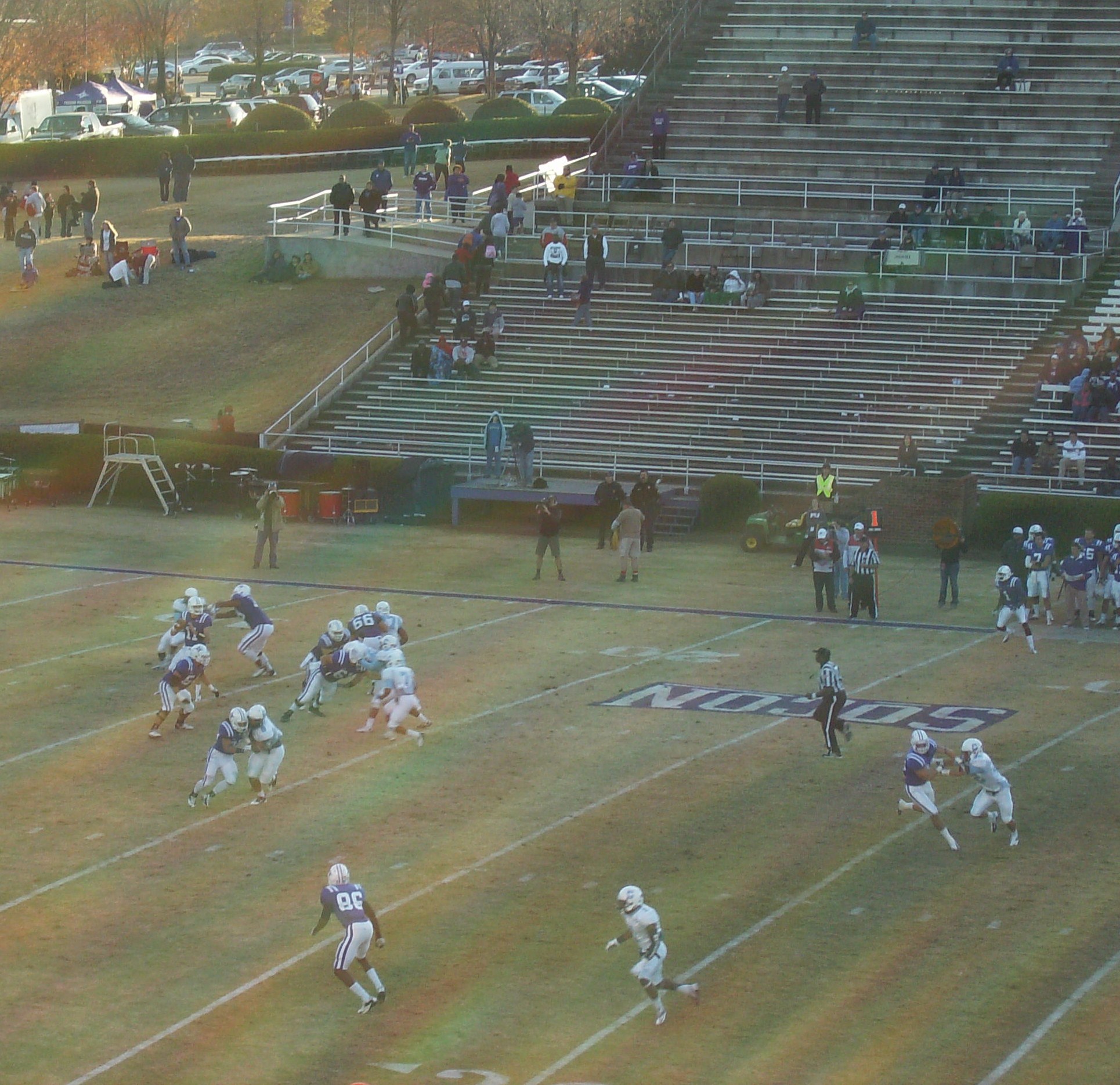
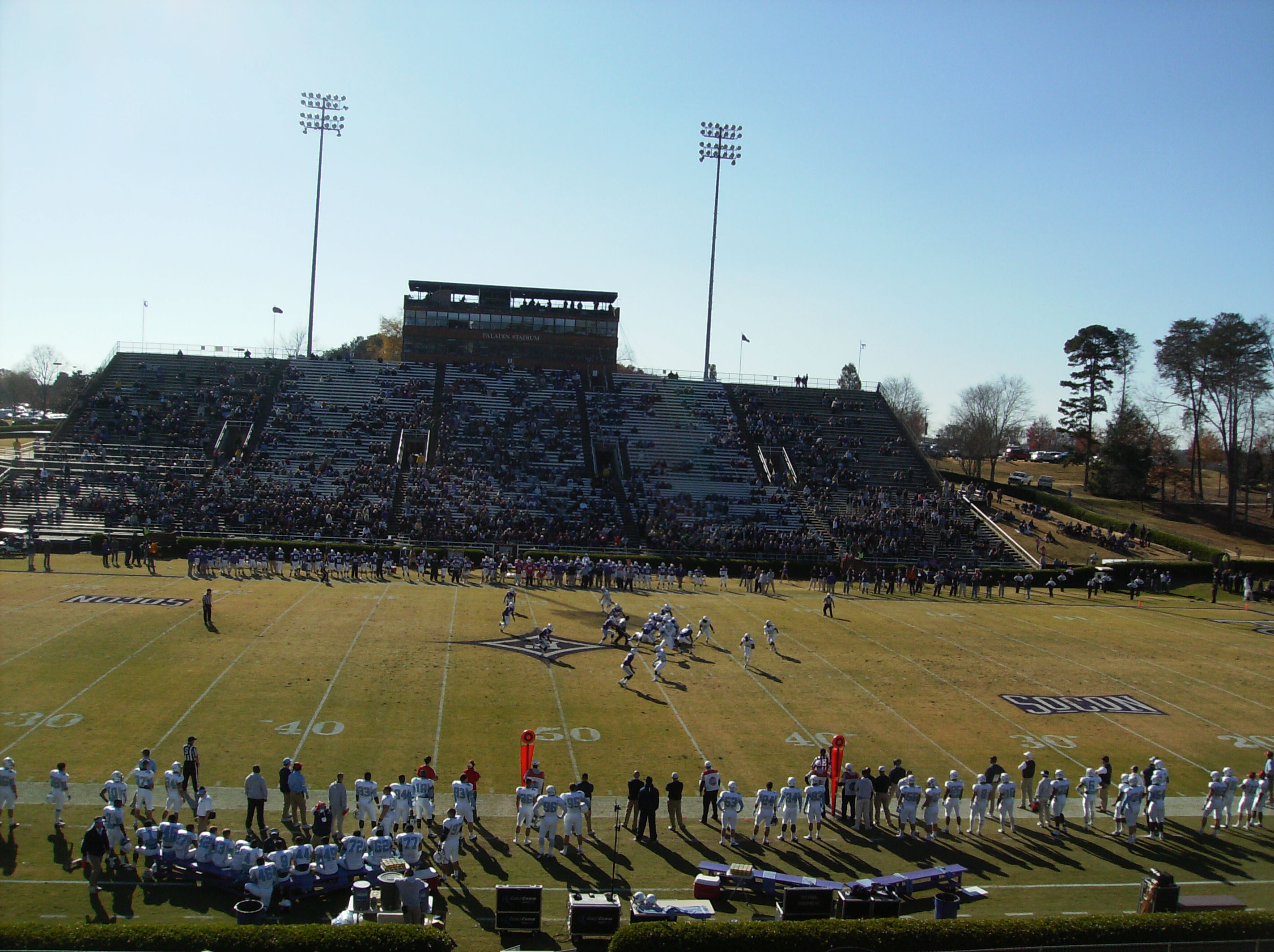
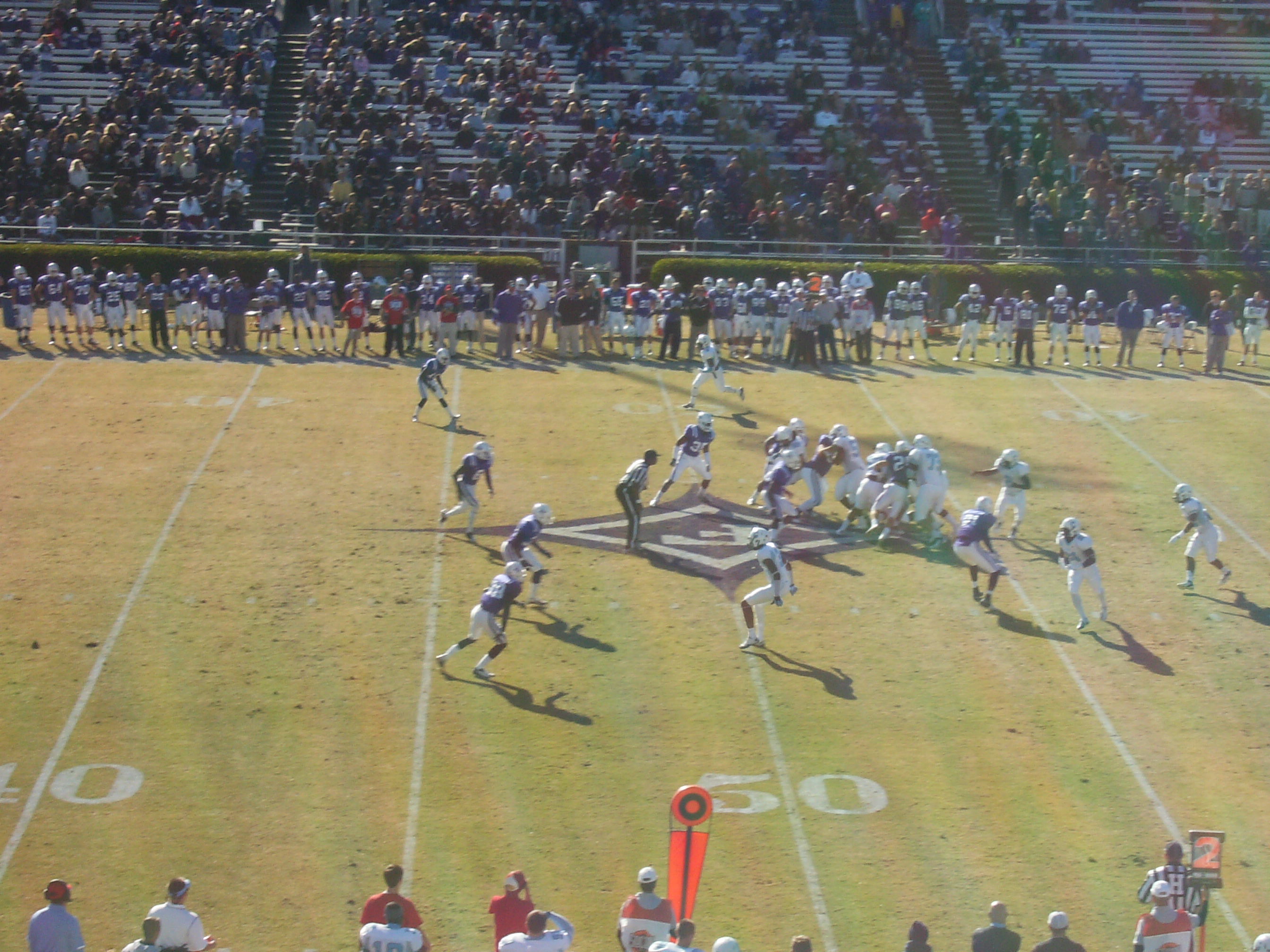
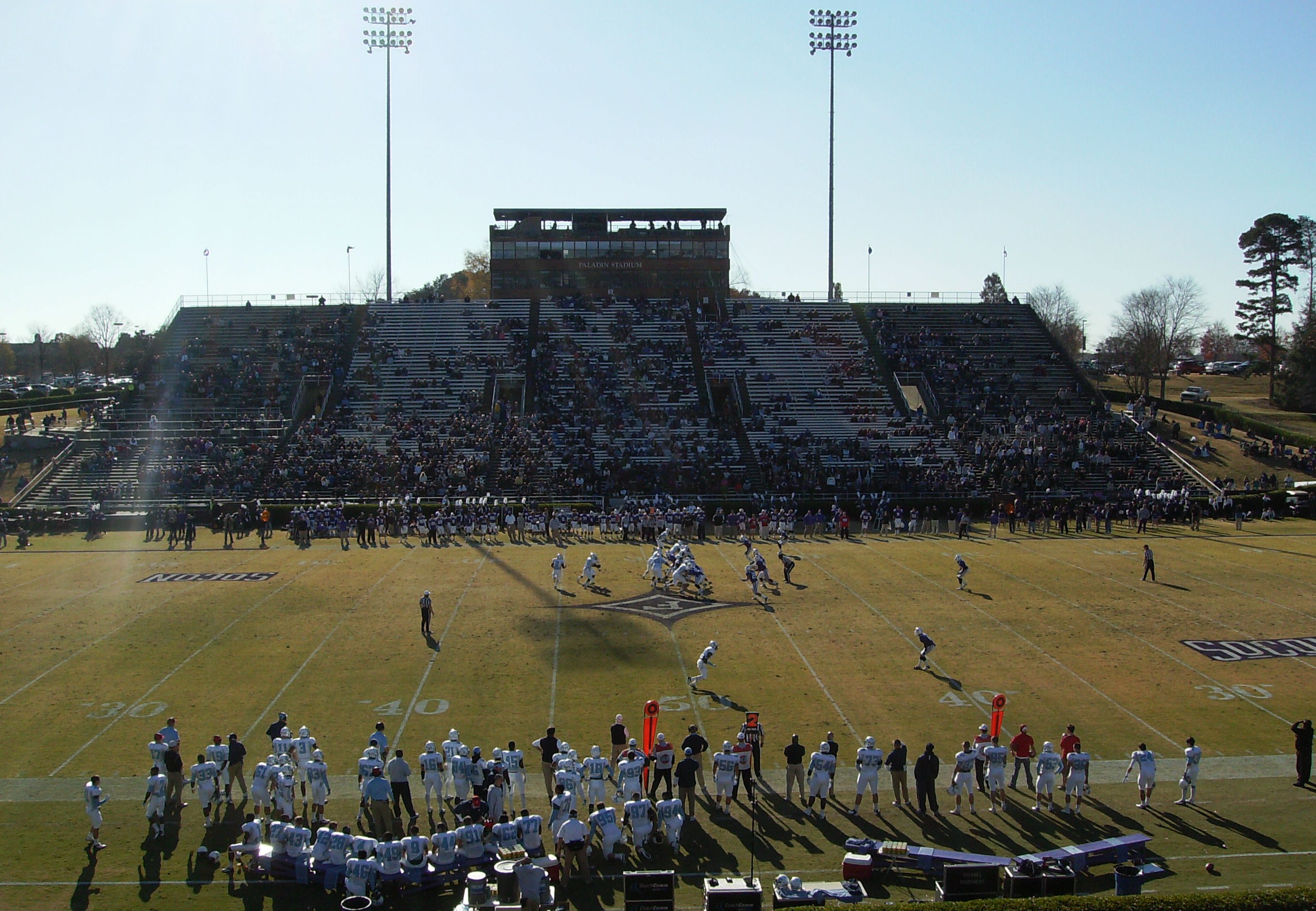
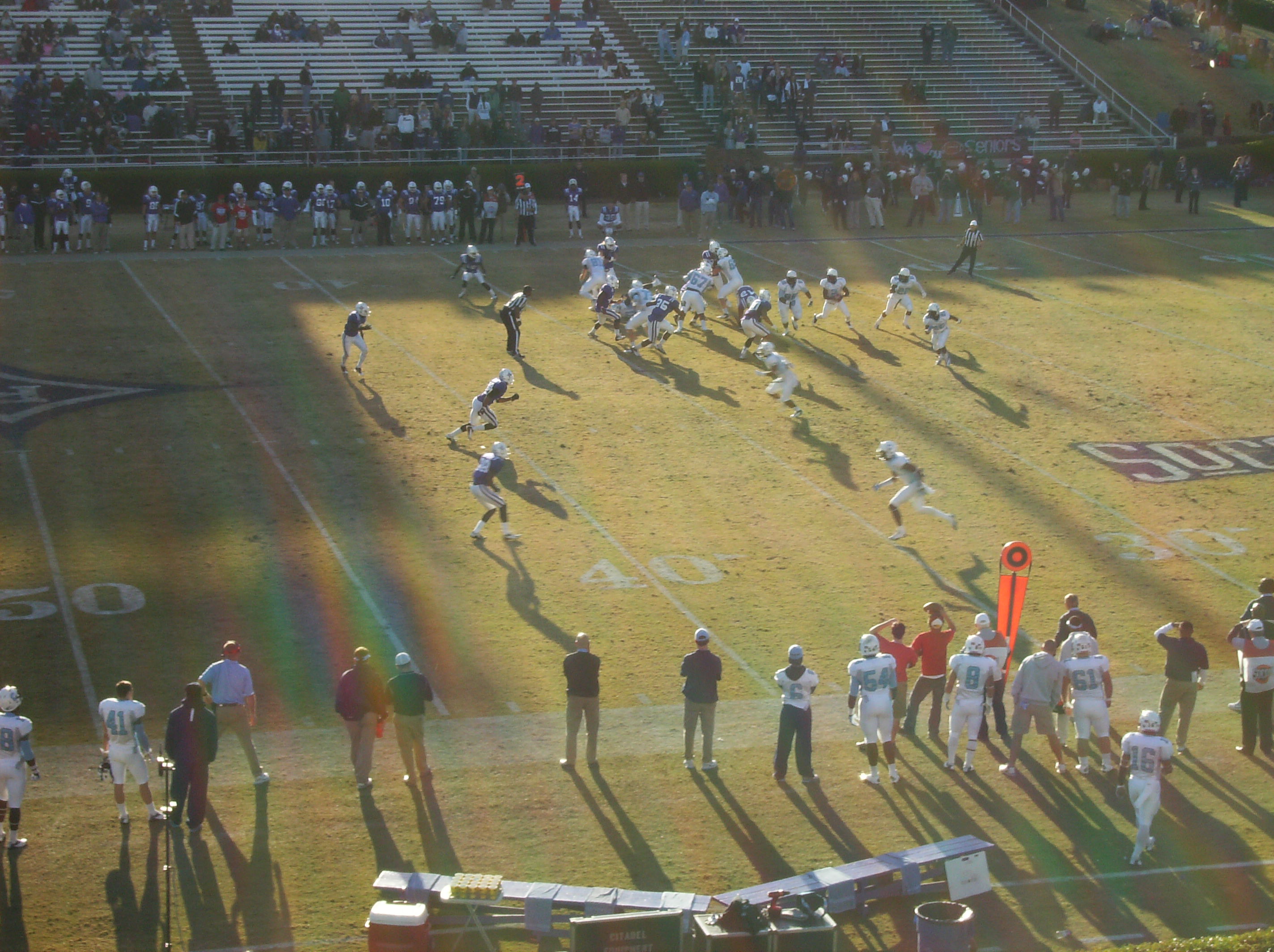
As usual, I’ll close with a few photos. I had a tough afternoon taking pictures, thanks mostly to a rather insistent beam of sunlight that kept coming over the press box and into my line of sight. The quality of these shots is even worse than normal, which is really saying something…

2012 Football, Week 11: The Citadel vs. Furman

The Citadel at Furman, to be played at Paladin Stadium in Greenville, South Carolina, with kickoff at 1:30 pm ET on Saturday, November 17.  The game will be streamed on ESPN3.com, with Darren Goldwater providing play-by-play and Doug Chapman supplying the analysis. It can also be heard on radio via the twelve affiliates of The Citadel Sports Network. Danny Reed (the “Voice of the Bulldogs”) will call the action alongside analyst Josh Baker, with Lee Glaze roaming the sidelines and Walt Nadzak providing pre-game, halftime, and post-game commentary. 

Links of interest:

The Citadel game notes

Furman game notes

SoCon weekly release

The Kevin Higgins Show (following the game against VMI), Part 1 and Part 2

Kevin Higgins’ 11/11 press conference quotes

Bruce Fowler’s SoCon teleconference for 11/12

According to legend, the game between The Citadel and Furman had been each school’s regular-season finale for as long as the sun had heated the earth.

One dismal day, however, an evil wizard arrived. Certain seers from the Upstate claimed he had come from the land of Denison, but no one was sure. The wizard cast a terrible spell that moved the game to a non-November month. This horrible event happened two long decades ago.

Finally, after an incantation from the Magician of Monsey, the spell was broken. The game was shifted to its rightful place on the calendar. Surely, it will stay there forevermore.

— Excerpt from The Golden Book of Tall Football Tales, 2012 edition

The Citadel and Furman will close their respective 2012 campaigns on the gridiron this Saturday. There are people who believe the game should always be the season finale, and more than a few of them think that it always was until the last twenty years.

They are wrong about that, of course. I’ve pointed this out before, but it seems to be a very hard thing for some fans to grasp.

It’s not just fans, though. Furman’s sports information department has a blurb in its game notes that is titled “Back Where It Belongs” and includes this comment:

This year arch-rivals Furman and The Citadel will meet for the first time in the regular season finale since 1992, when The Citadel passed on a SoCon scheduling option for year-end traditional rival games. The option was put in place by the SoCon, which at the time was adjusting future schedules to accommodate the addition of Georgia Southern to the league.

I am less than impressed with this attempt by Furman’s SID to suggest that the series was usually played at season’s end until The Citadel ruined everything. The paragraph in Furman’s release is more than a little obnoxious. At any rate, the facts are simple:

— The Citadel and Furman have played 91 times; the two schools have faced each other every season since 1919 with the exception of three years during World War II.

— The game has been the regular-season finale for both schools 19 times.

That’s it. Those nineteen games were the sixteen games played between 1977 and 1992, and a three-year stretch in the mid-1960s (1965-67).

The matchup has actually been played more often in October (51 times) than in November (37 times). Three times it has been played in September, including the last two seasons.

Do I think playing this game in September is too early? Yes. However, I don’t think it needs to end the season, either. There isn’t a long tradition of it doing so.

Besides, these days it can’t end the season — not every year, anyway.

The Citadel is not going to host any game on the last weekend of the regular season (regardless of the opponent) as long as the current school academic calendar is in effect. The corps of cadets goes on Thanksgiving break on the Friday before the holiday. That wasn’t always the case, but it is now, and I suspect it will be for the foreseeable future.

There won’t be any regular-season home games scheduled without the presence of the corps of cadets. Next year’s pre-Thanksgiving weekend game is at Clemson; the week before, the last weekend the corps will be on campus, The Citadel is hosting VMI.

That doesn’t mean the game can’t be the season-ender when it is played at Furman, and maybe a good way to set up the series would be to have the matchup as the last game of the season in Greenville, and a midseason clash in Charleston.

That would be similar to the Notre Dame-Southern California series, which is traditionally played at midseason in South Bend and late in the year in Los Angeles.

I never liked having the game played at the end of the year because it was generally ignored by the state media in favor of the Clemson-South Carolina contest, which was played on the same day.

However, with the Clemson-South Carolina series moving to the Saturday after Thanksgiving, there is less chance of the game between The Citadel and Furman being lost in the shuffle, so I don’t have an issue with the game ending the season when it is hosted by the Paladins.

There is one other thing I would like to see adjusted, in terms of Furman and scheduling. Right now The Citadel plays Furman and Wofford at home in odd-numbered years and on the road in even-numbered years. I think that ideally the Bulldogs would make just one trip to the Upstate every year, and play one of those two schools at home each season.

Of course, all of those potential moves are subject to the whims of the SoCon office, which is just as likely to schedule Furman-The Citadel on September 14 next year as it is October 19.

Furman is 3-7, 2-5 in the SoCon. The Paladins have not had a lot of luck in close games, leading Kevin Higgins to state in his Monday press conference that “they are the best FCS team in the country with their record.”

There is a snakebit quality to Furman’s losses. The Paladins opened with a 24-21 loss at Samford when the Birmingham Bulldogs converted a last-minute field goal. Furman lost the next week at home to Coastal Carolina in triple overtime, 47-45.

Wofford beat Furman 20-17, with the winning points coming on a long TD pass in the third quarter. Last week, Appalachian State slipped past the Paladins 33-28, with the difference being two second-half Mountaineer field goals.

Furman hasn’t been very lucky. Truthfully, though, it hasn’t been all that good either.

The Paladins are next-to-last in scoring offense in the SoCon, and seventh in the league in scoring defense. That’s not a combination that generally leads to winning seasons.

Furman is balanced on offense , perhaps more so than any SoCon team other than Chattanooga, but it is not a particularly efficient passing team (seventh in the league) and does not pick up a lot of first downs (also seventh). FU is last in the conference in third down conversion rate and red zone offense.

The Paladins are next-to-last in the league in defensive pass efficiency, allowing more passing yards than any team in the conference. How much that really matters against The Citadel is open to question. Furman’s games against the other triple option teams in the league may provide an answer.

Against Wofford, Furman did a good job containing the Terriers’ run game (303 rushing yards, 364 total yards) but allowed that aforementioned touchdown pass (52 yards).

That solid effort came on the road. At home against Georgia Southern, Furman gave up only 275 rushing yards, but got burned through the air on a couple of occasions, including a 75-yard TD strike.

Furman is the league’s best team when it comes to returning kickoffs, but is last in the conference in punt return average. FU is next-to-last in net punting (though well ahead of last-place Elon in that department).

The Paladins are -5 for the year in turnover margin, the worst mark in the SoCon.

Perhaps the statistic that best defines why Furman is 3-7 is fourth quarter scoring. The Paladins have been outscored 91-26 in that period. Furman’s opponents have a slight advantage in the third quarter as well, offsetting the Paladins 110-64 edge in the second quarter.

I haven’t seen any of Furman’s games, but it makes me wonder if the Paladins have issues with line play as the game progresses. It suggests a lack of depth. I could be completely misreading that, of course.

Furman’s best player is running back Jerodis Williams, who was impressive in last year’s game against The Citadel and will be a major problem for the Bulldogs’ D this year as well. Williams is tough, hard to tackle, and has good speed too.

He is the reason Furman leads the SoCon in kickoff return average, as he has taken two kicks back for touchdowns this year (each for 100 yards). One of those TD returns came last week against Appalachian State. Williams’ understudy at running back, Hank McCloud, is also a talented player.

Reese Hannon is a true freshman from Greer who has started most of the season for the Paladins. He has completed 61.6% of his passes this season, with seven touchdowns and seven interceptions. He is not a running threat in the Paladins’ offense.

Kevin Higgins mentioned Furman had “excellent speed” at the wide receiver position, but the Paladins will miss their leading receiver, Will King, who is out for the season due to injury. Furman does have an outstanding tight end, Colin Anderson, and that position has traditionally posed a problem for The Citadel in this series.

Furman’s best offensive lineman is left tackle Dakota Dozier, not to be confused with backup quarterback Dakota Derrick.

The Paladins have some fine players on the defensive side of the ball. Sophomore linebacker Gary Wilkins leads the team in tackles. Other players of note include defensive end Josh Lynn, safety Nathan Wade, linebacker Mitch McGrath, and backup lineman Ricky Lang (who has five sacks).

Backup safety Marcus McMorris has two return TDs this season, including a 95-yard fumble return that was the key play in the Paladins’ victory over Elon.

Placekicker Ray Early is 8 for 14 on field goal attempts this season, with a long of 48 yards. He has also done the majority of the punting for the Paladins this year.

I don’t think The Citadel has much of a chance at a playoff berth even if the Bulldogs are fortunate enough to win in Greenville on Saturday. However, just in case the Mayans were right, I’ve made a checklist of sorts. It features games that would affect the Bulldogs’ (admittedly remote) chances of postseason play.

Obviously The Citadel must finish 7-4. The other “must” game, from the Bulldogs’ perspective, is Samford-Kentucky. The Wildcats have to win that game. I wouldn’t bet on it.

Here are the remaining games to watch. The teams Bulldog fans want to win are listed first:

VMI over Liberty
New Hampshire over Towson
Lafayette over Lehigh
Old Dominion over James Madison
William & Mary over Richmond
Delaware over Villanova
Cal Poly over Northern Arizona
South Dakota over South Dakota State
UC Davis over Sacramento State
Charleston Southern over Coastal Carolina

I’m listing the CSU-CCU game even though it technically won’t affect the number of at-large bids available (don’t ask why, that would take three paragraphs) because a win by the Buccaneers would result in CSU finishing 6-5 (a really good achievement after going 0-11 last year).

That would result in The Citadel having a non-conference victory over a team with a winning record. Those aren’t always easy to come by. For example, of the six CAA teams battling for a playoff bid, only Villanova has beaten a team out of conference with more wins than losses. The Wildcats actually have two such victories (over Fordham and Penn).

It should be a nice day for a game in Greenville on Saturday. The preliminary forecast calls for sunny skies and a high of 60 degrees, perfectly acceptable late-season football weather.

I don’t have any idea how the Bulldogs will play on Saturday, not that I ever really do. The Citadel has accomplished its major goal, a winning season. A playoff bid is a longshot. Finishing with a winning record in the SoCon (something Derek Douglas mentioned in the Monday presser) is something to shoot for, but not exactly a huge prize either.

Playing Furman means something, and I’m not trying to soft-pedal that (despite what the first part of this post may suggest). However, I’m not completely sure how much it means to the players. It may be a big deal to them; I don’t know.

I’m sure the game would be World War III if some of the alums on both sides had anything to say about it, but they aren’t the ones putting on the pads.

My guess is that the game will be spirited and intense on both sides, and close. It’s the last game of the year between two proud teams. There won’t be a lack of effort.

I’m looking forward to one more Saturday of gridiron action. One more round, you might say.

McAlister Musings: Possession is nine-tenths of a win

The previous edition of McAlister Musings

The All-Military Classic has come and gone. Everyone involved is relieved that the original plan to play two of the games on an aircraft carrier did not happen…

The Citadel split its two games, beating VMI 84-76 on Saturday and losing to Air Force 77-70 on Sunday. I was at the latter game, along with luminaries like Len Elmore, Paul Maguire, Harvey Schiller, and the biggest celebrity of them all, General. Bulldog basketball is a hot ticket this season.

Chuck Driesell on the win over VMI (video): Link

Also included in that video are brief interview segments with Mike Groselle and Marshall Harris III. The most interesting comment came from Groselle, after it was pointed out to him that the Bulldogs had played a lot of zone defense. Groselle:

Well, statistically we’ve charted it…and [determined that] it’s our most successful defense.

Indeed. That explains in part why The Citadel never gave up on the zone against Air Force, a decision I would not be inclined to criticize despite the Falcons’ hot second-half outside shooting. Considering its personnel, The Citadel probably won’t fare too well playing man-to-man defense against most opponents. If a team gets hot from outside on a given night, the Bulldogs are just going to have to live with it.

Groselle had his 23rd career double-double against VMI, scoring 21 points and corralling 15 rebounds. He was his usual efficient self, only needing 11 shots to get those 21 points and committing just two turnovers.

Against the Keydets, Groselle got help from Harris (19 points, 9 assists) and freshman Matt Van Scyoc (17 points, 7 rebounds).

The Citadel had a 25% turnover rate against VMI, a statistic that usually would result in a loss. However, the Keydets’ helter-skelter style leads to lots of turnovers and lots of points, usually for both teams, as VMI is not a strong defensive squad. VMI did not shoot well against The Citadel’s 2-3 zone, particularly from inside the three-point line (13-31), and when the Keydets aren’t shooting well, they aren’t winning.

The turnover rate for the Bulldogs against Air Force was 27%, and The Citadel paid for it. Although the Bulldogs actually led the game at halftime (30-28), in my opinion that was the half that cost The Citadel the win. Air Force was within two points at the break despite shooting 9-27 from the field and being outrebounded 20-9.

The Falcons actually led for most of the first half, thanks to eleven Bulldog turnovers. Thirty possessions, and eleven gone to waste. Some of them led to easy baskets for Air Force, too.

The Citadel averaged 1.58 points per possession in the first half when a turnover was not committed. If you just cut the actual number of TOs in half, say from eleven to five, a similar rate of offensive success would have resulted in an additional nine points (9.47, actually, but I’m rounding down).

The Bulldogs could have been up double digits at intermission, and that may have allowed them to withstand Air Force’s three-point barrage in the second half. The Falcons were 10 of 17 from beyond the arc in that stanza, including several from the left corner.

I wanted the uniformed cadet in charge of securing the baseline on that side to hit one of the shooters with her waistbelt, just to see if it would throw them off.

Lawrence Miller had a good game for the Bulldogs, making six of his nine three-point attempts for a career-high 20 points, and CJ. Bray played very well (14 points, 5 rebounds). However, after an impressive debut the day before, Van Scyoc had a nightmarish game against Air Force, one filled with turnovers. Freshmen are going to have games like that, especially early in the season.

I will say that in person, Van Scyoc looks like a player. He is a legit 6’6″ and no beanpole, either. He should be able to mix it up in the SoCon without any problems. Another freshman, Quinton Marshall, had some good moments on Sunday and also looks physically ready to play at the D-1 level.

Odds and ends:

– The Bulldogs entered the court prior to pregame introductions through a veil of smoke. At least, I think that was the idea.

– All-Military Classic t-shirts were given away at the game. After every other timeout, one of the game administrators would throw a bunch of them into the crowd. I didn’t get one, but as it appeared the t-shirts were roughly the same size as my cellphone, it was probably just as well.

– VMI coach Duggar Baucom’s “I’m really angry” walk/stalk to the locker room at halftime of the Army-VMI game was a thing of beauty.

Next up for the Bulldogs are two non-Division I teams, Montreat (on Wednesday night) and Union College of Kentucky (Saturday night). I’m not crazy about playing non-D1 schools, but I understand that the team needs to continue to develop confidence, and winning games is part of that development. It’s also a chance for Chuck Driesell to tinker with his rotation and figure out who is going to be able to help the team once SoCon play rolls around.

As for the games themselves, I’m not too worried about them. I don’t foresee a Francis Marion situation; we no longer live in Dennisian times. Montreat is coming off an 86-54 loss at Appalachian State, and I think the Bulldogs could be better than App State this season. The Cavaliers have also lost to Webber International and Ave Maria.

Union College (also called the Bulldogs) looks like it may be a little better than Montreat, as it is currently on a four-game winning streak. One of its victories came against Cincinnati Christian, a school The Citadel has faced on the hardwood before.

I fully expect The Citadel to be 3-1 when Radford comes to town on November 24. It better be 3-1.

A few pictures from the Air Force game…yes, they’re terrible (though arguably not as bad as Air Force’s uniforms):

Game Review, 2012: VMI

The Citadel 27, VMI 24.

Links of interest:

Game story, The Roanoke Times

Game story, The Post and Courier 

Note: both articles above written by Randy King of The Roanoke Times

The Citadel’s release

VMI’s release

Highlights from the game (video)

VMI postgame press conference with Sparky Woods and two players (video)

Box score

Uh, phew…

For the second week in a row, The Citadel built up a big lead only to see its opponent mount a furious comeback. For the second week in a row, the Bulldogs held on.

I don’t think anyone was truly surprised when Elon finally began scoring points in the second half of last week’s game. However, VMI should have been put away midway through the third quarter. The fact that the Keydets were one drive away from a miraculous victory is worrisome.

After Derek Douglas rumbled into the end zone with a fumble (following a sack by Mark Thomas), it was hard to imagine VMI doing much of anything in response. Not that anyone expected the Keydets to quit, but as it happens the Bulldogs helped VMI make its move.

Special teams were less than special. The Citadel should have had a sizable edge in this department, given the performances of the two teams’ kicking units during the season, but that wasn’t the case. The kickoff coverage for the Bulldogs was unacceptable, and there was also a blocked field goal attempt.

Sparky Woods said after the game that The Citadel “played better in the kicking game” than VMI, but I can’t say that I agree with him.

Then there were the penalties. I was concerned about the tendency of VMI’s opponents to commit more than their typical number of infractions, but the Bulldogs outdid themselves in a negative way, committing nine fouls for 89 yards. Seven of those penalties (and 79 of the 89 total yards) came in the second half and helped enable the Keydet comeback.

I wasn’t all that surprised VMI had some success defensively against The Citadel. I thought going into the game that the Keydet D was a bit underrated, and basically hamstrung by an ineffective offense.

However, the Bulldogs’ defense was disappointing, particularly in the second half. VMI does not have a big-play offense, but The Citadel allowed two huge pass plays (81 and 38 yards) to the Keydets that set up touchdowns.

The fumble return by Douglas was critical, and Sparky Woods has to be very tired of guys named Douglas making plays for The Citadel against his teams. However, don’t overlook Thomas Warren’s second made field goal, which pushed the margin to ten points with less than five minutes to play. The Bulldogs needed those three points.

That field goal came after The Citadel started on its own 49, a short field gifted to the Bulldogs by a “pop-up” kick that went awry. Woods said that it wasn’t really an onside kick attempt, but a placement-type kick that just wasn’t properly executed.

I questioned the play-calling (or simply the act of calling plays) at the end of the Western Carolina game. I’m going to do it again…

Aaron Miller picked up a first down for The Citadel with 2:42 remaining in the game. VMI was by then out of timeouts.

At that point, the Bulldogs could have lined up in “Victory Formation” and kneeled down three times. The clock would have run out, and The Citadel would have the victory.

However, three running plays were called instead, including two handoffs. I suppose the first down play (on which Miller kept for a four-yard loss) could be justified as ensuring the Bulldogs could run out the clock. It would have been close, though I think a run wasn’t necessary.

However, on second and third down it was clear that a kneeldown would do the trick. By that third down play, I was — well, I was upset, to be honest. I could just visualize a Joe Pisarcik-Herm Edwards situation that would be fondly remembered by Keydet fans for decades.

That didn’t happen, but it shouldn’t have been left to chance. It was the second time this season The Citadel had not properly managed the end of the game. If that keeps up, the Bulldogs will eventually get burned.

I’m not trying to be negative. After all, the Bulldogs clinched a winning season, which was the primary goal going into the 2012 campaign. The Citadel remains alive for a playoff berth, but realistically that isn’t going to happen. That’s okay, though. Beating Furman to finish 7-4 would be more than good enough for me.

It was nice to hear VMI’s band play on a regular basis during the game, as opposed to the game at Wofford (which has no band) and the games at Johnson Hagood Stadium (where the band is only occasionally allowed to play). However, someone needs to tell the band when to stop. For one thing, I think a VMI false start penalty in the second quarter could be largely attributed to the band playing as the Keydets were about to snap the ball.

I enjoyed the day in Lexington. The weather was great, and the gameday atmosphere was solid. Plenty of blue-clad supporters were on hand to cheer on the Bulldogs, coming close to filling the (admittedly small) visitors’ section of Foster Stadium.

The home side was mostly full too, a tribute to a very loyal VMI fan base. Some of those same fans traveled to Charleston for last year’s game between the two teams. They were part of arguably the most impressive (on a per capita basis, at least) group of visiting supporters, especially striking given VMI’s way-too-long stretch of gridiron futility.

Those fans deserve a winning season sooner than later, and I hope they get one. Of course, I don’t want it to come at The Citadel’s expense. I prefer that the coveted Silver Shako remain in Charleston, where it belongs.

Pictures…well, every week I write about what a lame-o photographer I am, but I may have set a new standard for ineptitude this week. What follows is the best of a sorry lot.

I took a lot of pictures of the campus and the Saturday parade. VMI is an interesting place. I firmly believe every graduate of The Citadel needs to visit VMI at least once, and vice versa.

Included are a few pictures from the lacrosse match that took place on Saturday, which raised $3,000 for the Special Operations Warrior Foundation. Great job by those guys (not for the first time, either).

I also watched the women’s rugby game for a short time, which more than matched the football game for sheer brutality. There are a few pictures in the set from that contest, as well as the halftime Rugby 7s exhibition.

Besides the “action” shots at the football game, there are pictures of the marchover.